How Inspirations & Talents Work in Graveyard Keeper 2
Learn how Inspirations and talents progress, what actions count, why progress can stop, when Faith is required, and how Mastery and the Tech Tree differ.
Updated:
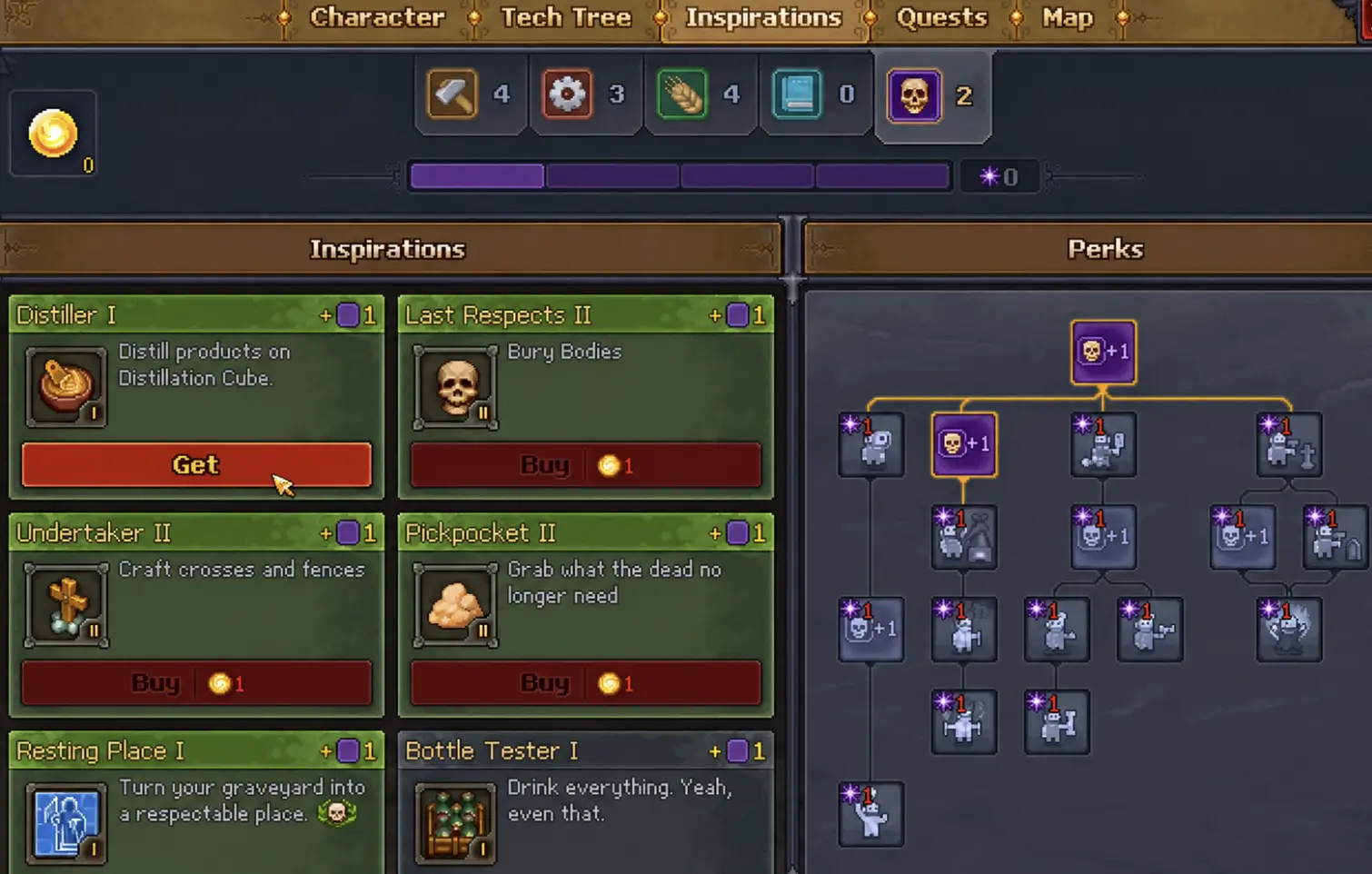
Quick Answer
Open Inspirations and read the current objective before repeating an activity. Finish that objective, claim its progress, then spend the resulting point on a perk or Mastery that helps with the next job.
If the next Inspiration level is complete but still cannot be claimed, check whether it now requires Faith.
Inspirations look like a normal skill tree at first, but they do not progress by feeding every action into one experience bar.
Each Inspiration watches a particular kind of work or accomplishment. Cutting down trees can advance one objective, processing the wood can advance another, crossing bridges belongs somewhere else, and rebuilding part of the town can trigger a different track again.
That distinction matters whenever an Inspiration appears stuck. Doing more activity is only useful when it is the activity that the current objective is actually counting.
Inspirations Progress From Specific Actions
The Inspirations screen is split across five colored tracks, with different objectives tied to the work you perform around the world.
Early examples include objectives connected to:
- cutting down trees;
- processing wood;
- breaking rocks;
- crossing bridges;
- collecting stories;
- burying bodies;
- restoring town buildings;
- and other activities that become available as new systems open.
Completing one of those objectives fills its current Inspiration step. Claiming that step gives you progress that can be spent in the connected talent choices.
This is why repeating an unrelated activity does nothing even when both actions seem to belong to the same broad profession.
Read the Objective Literally When Inspiration Progress Stops
A common trap is assuming that every item produced counts separately.
Carpenter I is a good example. Its progression is tied to qualifying woodworking crafting batches rather than simply adding one point for every plank that comes out of the station.
So producing a large stack in one batch does not necessarily move the objective by the number of finished items.
The same principle applies elsewhere: the Inspiration description tells you what event is being counted.
If a bar is not moving, check three things before making another pile of materials:
- Are you performing the exact activity named by the Inspiration?
- Are you on the correct step of that Inspiration?
- Does the objective count actions or completed batches rather than individual items?
That usually explains an Inspiration that looks frozen despite several minutes of work.
Different Steps Can Ask for Different Versions of the Same Activity
An Inspiration does not necessarily end after the first completion.
Later stages can ask you to repeat or expand the same type of work before another point becomes available. A higher Rock Breaker step, for example, does not unlock simply because an earlier Rock Breaker objective was finished.
The earlier step has to be completed first, followed by whatever the next stage requires.
That means a later talent can remain unavailable even when you have already performed the activity many times in total.
Check the current Inspiration stage rather than relying on how much of that job you remember doing across the whole save.
Inspiration Points Buy Perks or More Mastery
Once an Inspiration gives you a point, the important choice is what that point changes.
Some options are perks that improve work you can already perform. Others add Mastery, which can determine whether a harder action is available at all.
Axeman is an early perk example.
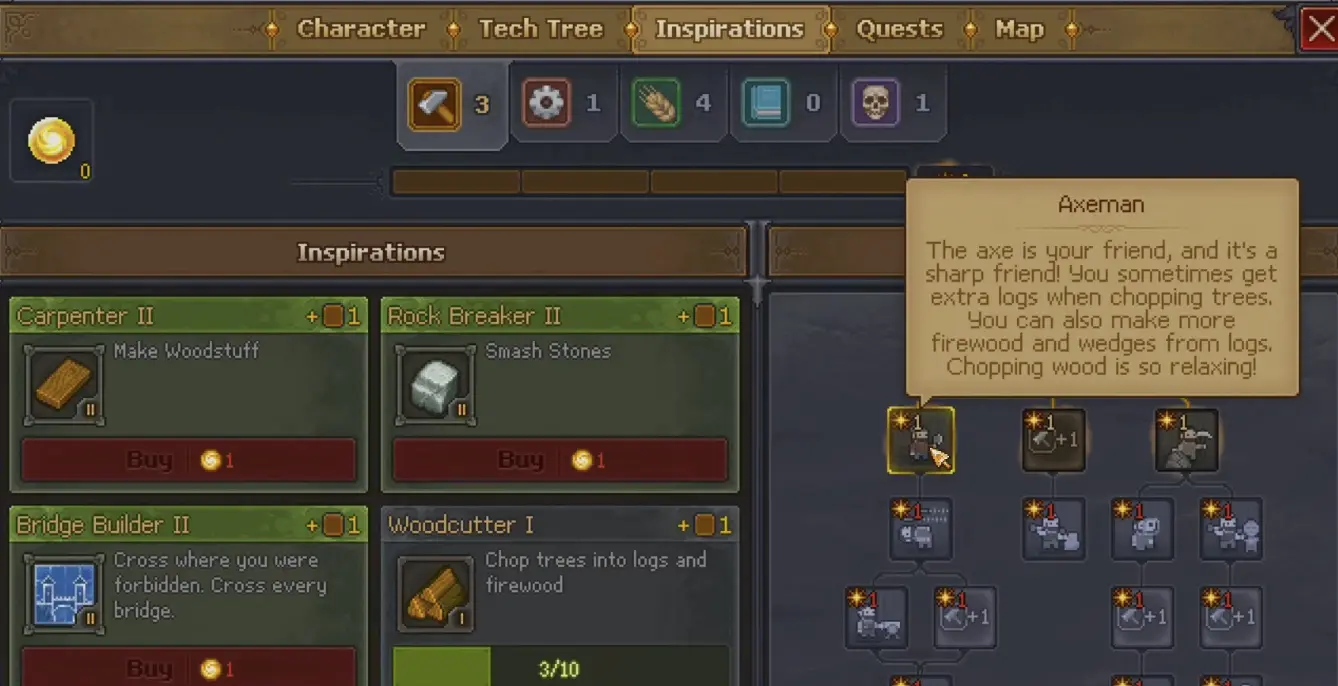
A perk like this makes an existing activity more productive.
That is different from a Mastery increase.
Take Mastery When One Point Removes a Real Restriction
Mastery appears directly on gathering, farming and production actions.
Early resources can already show a clear progression:
- small rocks and trees around Mastery 1;
- larger versions around Mastery 2;
- heavier obstacles reaching Mastery 4.
Farming can create much larger gaps. One early crop can show a Mastery 10 requirement while the Keeper is still around 4.
When the required number is visible, there is no mystery to solve. The action is simply above the Keeper’s current capability.
The Inspirations screen can offer a direct +1 Mastery choice.
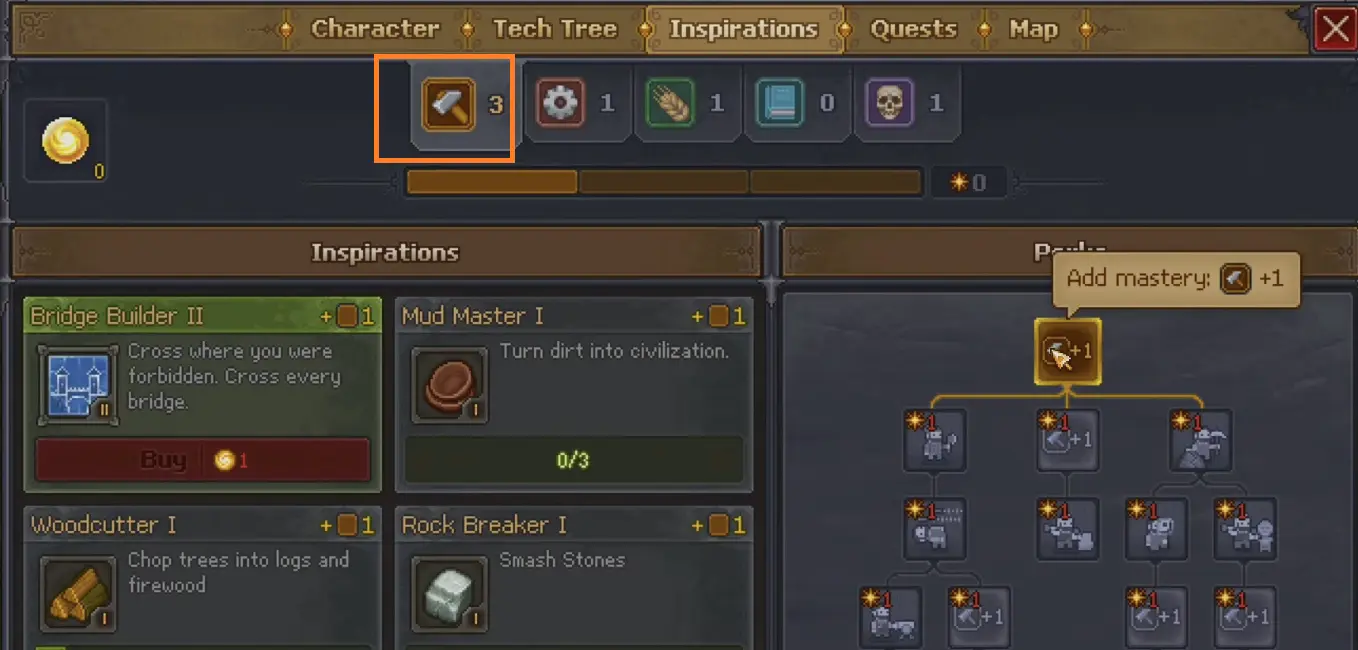
Going from Mastery 3 to 4 when a rock requires 4 immediately changes what you can do. Taking that same point when no nearby action needs it can wait.
That is the practical difference between Mastery and an efficiency perk: Mastery can open the job; a perk improves the job after it is already open.
Iron is one of the clearest places where these progression layers collide. Surface ore can be blocked by capability, while the repeatable supply later depends on opening the Forest mine and getting Zombie Mining working.
When Iron itself is the thing stopping your next tool, building or production step, follow How to Get Iron and Open the Zombie Mine.
Food Can Cover a Small Mastery Gap Temporarily
Food Can Cover a Small Mastery Gap Temporarily
Not every Mastery shortage needs a permanent point.
Some foods temporarily raise a particular Mastery category. Normal progression includes food bonuses for activities such as Writing Mastery and Alchemy Mastery.
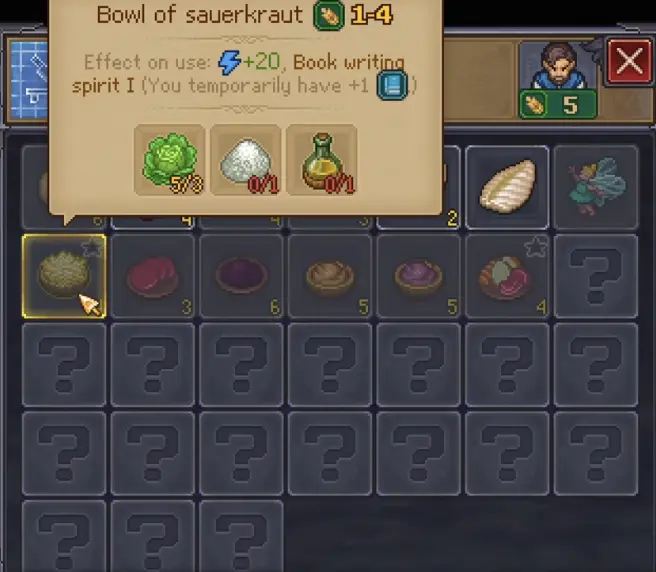
This is useful when a craft sits just above your current value and you do not expect to perform that activity constantly.
A large or recurring gap is different. Repeatedly eating a temporary buff every time you need the same workstation quickly becomes less attractive than raising the relevant capability permanently.
Early Inspiration Steps Can Be Free, but Later Ones Need Faith
The first Inspiration steps can be claimed without spending Faith.
That changes as the branches develop.
Later Inspiration levels begin asking for Faith in addition to the completed objective. One level-three choice encountered during normal progression costs 5 Faith for the next point.
At that stage, continuing to repeat the Inspiration activity does not solve the block. The objective can already be complete; the missing resource is Faith.
Faith is also needed elsewhere, so spending five points simply because a talent is available can delay something more immediately useful.
When Faith itself becomes the restriction, use Faith, Sermons & Prayers for Church Power, Town Gratitude, sermon requirements and Faith income.
Keep the decision here simple: buy the Inspiration point when its perk or Mastery solves a problem you currently have.
Automation Can Change Which Inspiration Progress the Keeper Earns
Zombie automation saves a lot of repeated labor, but it also means the Keeper is no longer personally performing that work.
This becomes noticeable with farming.
A zombie can take over a functioning farm, but once the worker is doing the planting and harvesting, the Keeper may stop generating the same farming progress from those actions.
That creates a real timing decision.
When an important Inspiration still needs farming, woodworking or another repeatable action, finish enough of that objective yourself before handing the entire routine to zombies.
Once the Inspiration you care about is complete, automation becomes much easier to justify.
Zombie Mastery, tools, farming setup, Supplier Stations and worker progression are covered in Zombie Automation & Resurrection.
Inspirations and the Tech Tree Are Separate Systems
Inspirations do not replace technology research.
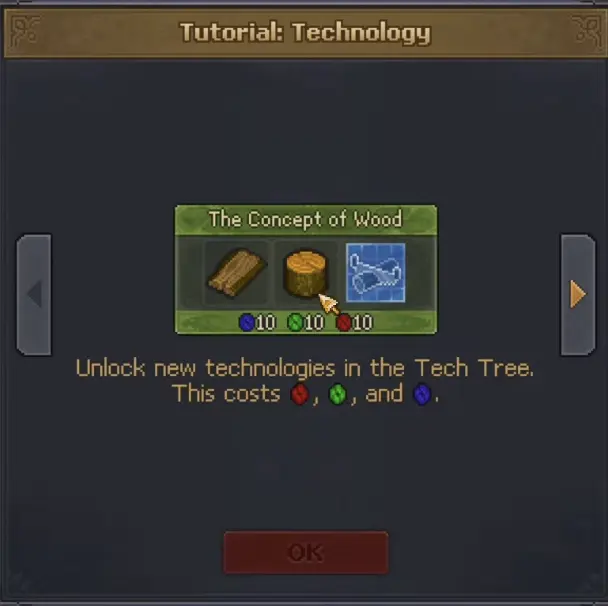
The Tech Tree uses red, green and blue technology points to unlock production knowledge such as recipes, workstations and later manufacturing branches.
An early Concept of Wood unlock demonstrates the difference clearly. It costs:
- 10 red
- 10 green
- 10 blue
So there are two different questions:
Can the Keeper perform this action?
That can be a Mastery or Inspiration issue.
Does the recipe or workstation exist yet?
That is usually a technology issue.
Mixing those two is one of the easiest ways to spend time grinding the wrong resource.
A Missing Recipe Usually Means You Need Technology First
Having the raw material does not make a recipe appear.
If logs are sitting in storage but the woodworking recipe you need is missing, check the relevant technology branch before gathering another load of timber.
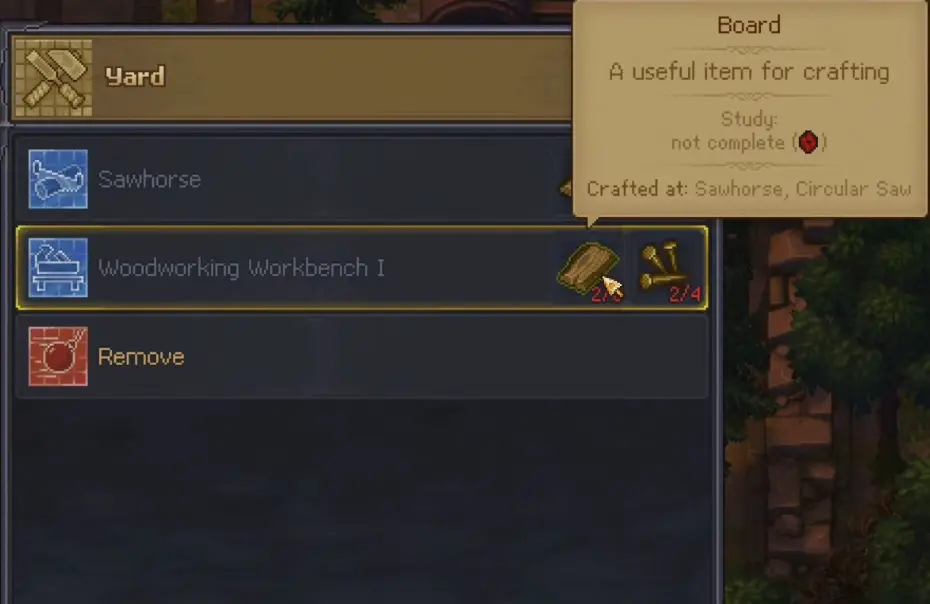
For a missing recipe, the useful order is:
technology → workstation → materials → craft
That sequence works across much more than wood. Stone processing, writing, metalwork, alchemy and later production chains all use the same general logic.
Buying the First Technology in a Branch May Not Reach the Item You Need
A broad technology can open a branch without granting every product inside it.
Stone processing shows this clearly.
Concept of Stone begins the route, but later products sit farther along the same branch. Unlocking the concept does not instantly provide all stone-related recipes.
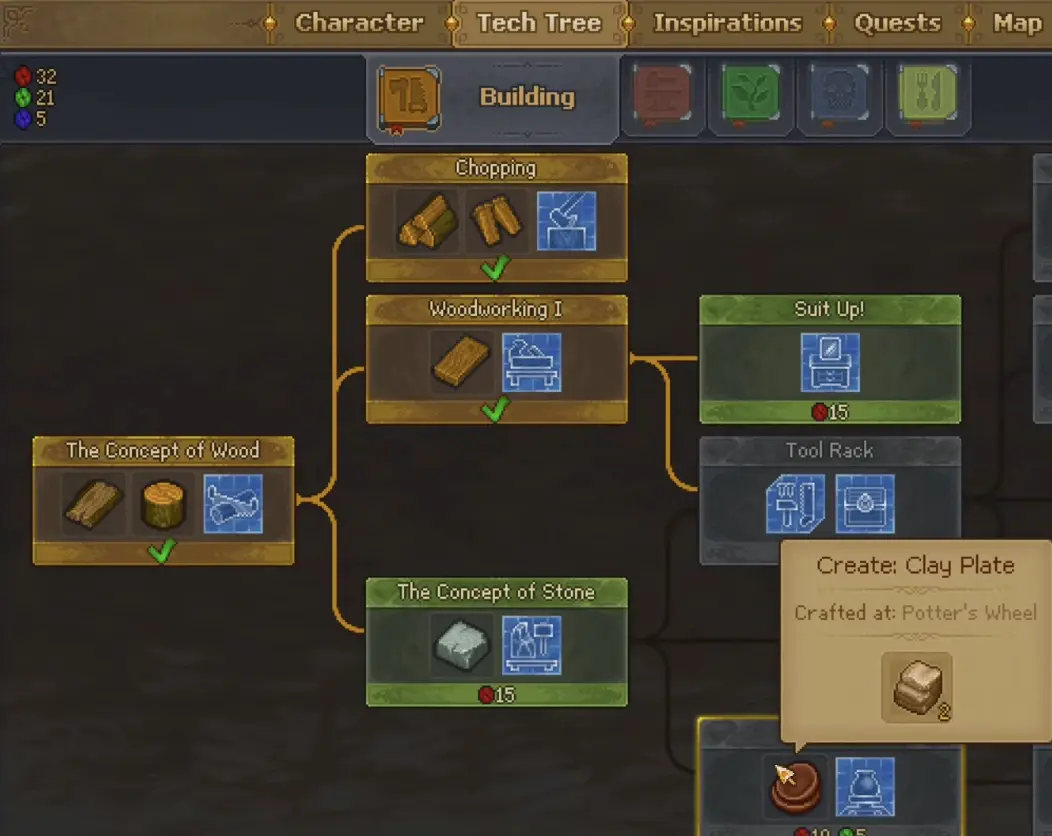
This matters during the Fishing Rod sequence because that progression eventually asks for Pottery.
Once Pottery is the missing item, repeatedly talking to the same NPC does not move the quest forward. Follow the production branch until Pottery is available, then return.
The Fishing Rod, bait, locations and fishing controls are covered in Fishing.
A Technology Can Unlock a Workstation Instead of a Recipe on Your Current Bench
Buying a technology does not guarantee the new item appears on the station already in front of you.
Some technologies unlock another workstation or production building. The recipe then belongs to that new equipment.
When an unlock has been purchased but the recipe still seems missing, read what the technology actually granted.
The complete chain may be:
technology → new workstation → materials → recipe
That extra workstation step becomes increasingly important with writing, metalwork, alchemy and resurrection.
Spend Technology Points on the Next Production Block
The Tech Tree expands much faster than you can use every branch.
Writing, farming, construction, metalwork, zombie production and other systems can all present affordable unlocks at the same time.
Buying all of them immediately is rarely necessary.
Look at the item stopping the next objective.
A missing writing component gives the writing branch immediate value. A metal part needed for construction makes that production chain more important. An unrelated convenience recipe can remain locked until it solves an actual need.
Keeping some red, green and blue points available also makes the next unexpected production request much easier to handle.
Some Technologies Are Hidden Behind Characters
Not every missing technology can be purchased with more points.
The Tech Tree introduction states that some skills remain hidden until you reach the required reputation with particular characters.
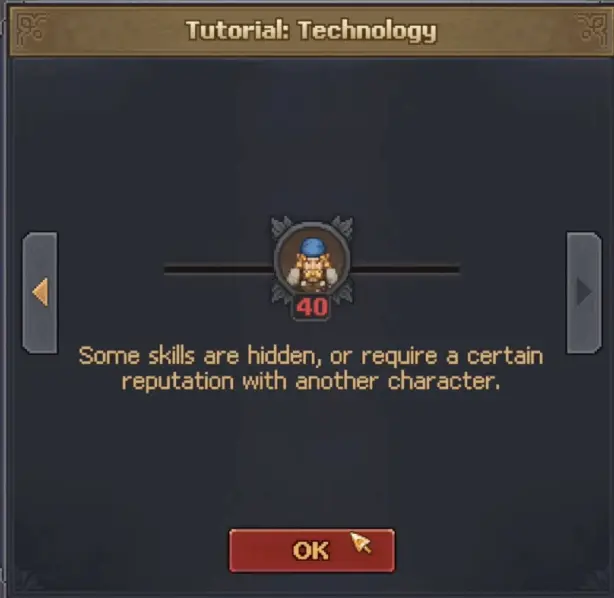
That gives you another useful distinction.
A visible technology with an unpaid cost tells you which points are missing.
A technology that is absent entirely can mean the connected NPC or story sequence has not progressed far enough.
More crafting will not automatically reveal a character-locked branch.
When the next unlock is tied to where the story is sending you, continue the Walkthrough instead of trying to grind every technology color.
Keeper Mastery and Zombie Mastery Are Not Shared
One final source of confusion appears after automation begins.
The Keeper may have enough Mastery to perform a recipe while a zombie assigned to the same workstation cannot start it.
That is not a contradiction.
Zombie workers have their own capability, perks and equipment. Raising Keeper Mastery does not automatically fix an underqualified worker.
So use the screen where the failure occurs:
- Keeper action blocked by a Mastery number → improve the Keeper;
- zombie standing at a valid workstation → inspect that zombie;
- recipe missing entirely → check technology;
- technology missing entirely → check character or story progress;
- completed Inspiration waiting for another point → check its Faith cost.
Once those signals are separated, Inspirations stop feeling like another version of the Tech Tree. They are the system that turns the work you actually perform into perks and Mastery, while technology determines what production knowledge the Keeper has learned.