Orc Incremental Blight Tree Guide: What I Buy and Save For
I spend Blight on upgrades that improve more than one good roll: broad stats, economy, better card access and major unlocks first, then specialize once a Unit has proved it belongs in my runs.
Updated:
Quick Answer
Early on, I spend Blight where a bad Portal draw cannot waste it: all-Unit health and damage, Gold, Blight gain and better card access. I only push deeply into a Shaman, Catapult or other Unit branch after that family has already carried several runs. If Warpath, Epic cards, Trials or another system unlock is close, I save for the breakpoint instead of clearing every cheap node along the way.
I Choose a Destination Before I Start Clicking Nodes
The Blight Tree is large enough that following whichever highlighted node looks affordable quickly becomes expensive.
My first visits were full of upgrades that all sounded useful: Fireball stats, Unit health, Unit damage, Gold, card improvements, Blight scaling and several branches tied to specific Unit families. With a small early balance, I could only buy a fraction of what was visible.
The useful question was not “which node is good?”
Most of them are good.
What matters is what I need the next few runs to do better.
If rebuilding after Dark Rebirth takes too long, I care about economy and card access. If I reach the old wall quickly but the frontline still folds, broad health becomes more attractive. When damage is clearly the limiting factor, I can invest in general damage or the Unit family already carrying the build.
That is also why I check the Tree before committing to a reset. The Dark Rebirth guide handles when I end the current run; once I have the Blight, this page owns the other half of that decision: where the permanent currency goes.
My Safest Early Purchases Affect More Than One Build
A permanent upgrade is easiest to justify when I know it will still matter after the next Portal gives me a completely different set of cards.
Blighted Might is a clean example.
The node shown costs 2 Blight and gives +10% Base Damage for all Units. The preview displayed the change across several different roles:
- Orc Warrior: 20 → 22
- Shaman: 40 → 44
- Witch Doctor: 12 → 13
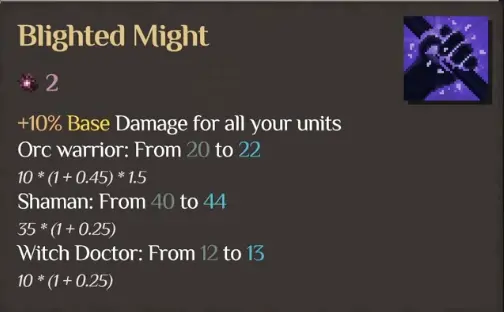
None of those increases is dramatic on its own. The value is coverage.
A Shaman run benefits. A Fighter-heavy run benefits. A Witch Doctor still gets the bonus even though damage is not the main reason I recruited it.
That flexibility is especially useful before I know which Unit families will become regular parts of my stronger formations.
Health works the same way, and in some runs it matters even more.
Ethereal Jade Nebula costs 4 Blight and gives +25% Base Health for all Units. With the permanent bonuses already active when I inspected it, the preview showed:
- Orc Warrior: 394 → 451
- Shaman: 64 → 78
- Witch Doctor: 127 → 156
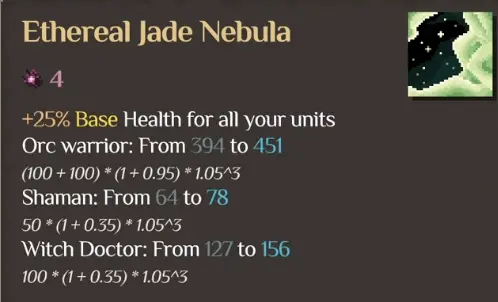
When the army is dying before its damage engine has time to work, this kind of upgrade reaches several failure points with one purchase. A tougher Orc holds contact longer, a Shaman survives more incidental damage, and a Witch Doctor gets another chance to keep the formation alive.
Broad bonuses are not always the strongest eventual choices. They are simply the hardest early choices to regret.
Specialist Nodes Need the Build to Earn Them
The Tree also offers much narrower upgrades, and that is where I become more selective.
Jade Staff, for example, costs 8 Blight in the node shown and gives +10% Base Health for Shaman. The preview moved the Shaman from 64 to 69 Health.
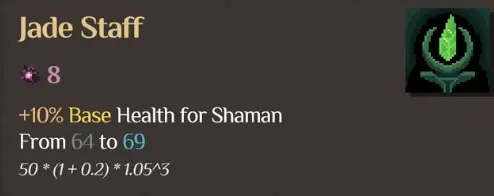
This should not be read as a simple 8 Blight versus 4 Blight comparison with Ethereal Jade Nebula. The Tree has prerequisites, and the total cost of reaching a node matters alongside the price printed on that node.
The more important difference is scope.
A global health upgrade helps almost any formation.
Jade Staff needs Shamans.
That is a perfectly good trade once Shamans are repeatedly carrying my runs, especially if the Portal and Totems keep giving me reasons to stay with that family. Before that point, specialist Blight can easily end up strengthening a Unit I barely field.
The same principle applies to Catapult, Witch Doctor, Orc Warrior, Dragon and the deeper Unit branches.
My build and formation guide decides which pieces are actually performing. The Tree is where I decide whether that performance has been consistent enough to deserve permanent investment.
Fireball Is Worth Permanent Blight While I Am Still Doing the Killing
Fireball upgrades are easy to dismiss once the Warband starts looking impressive, but the player character carries a meaningful share of the opening progression.
During early bosses, I regularly use Fireballs to remove ranged enemies and finish targets before the frontline collapses. Cheap permanent Fireball upgrades therefore have a real window where they improve almost every early run.
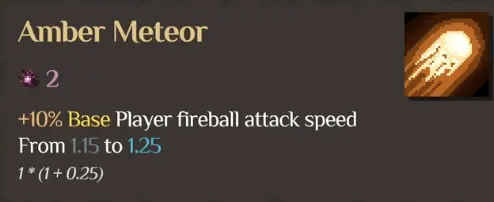
Amber Meteor is one of the inexpensive examples. It costs 2 Blight and gives +10% Base Player Fireball attack speed, with the displayed value moving from 1.15 to 1.25.
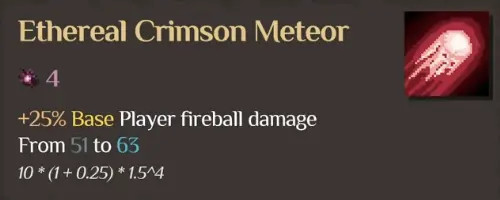
Ethereal Crimson Meteor gives a larger offensive step. The node shown costs 4 Blight and adds +25% Base Player Fireball damage, taking the displayed damage from 51 to 63.
I stop prioritizing this branch when the balance of damage changes.
If I am still manually deleting Archers or landing the shots that finish bosses, Fireball investment is doing real work.
Once Shamans, Catapults, Totem chains or other Unit interactions are clearing most levels while I barely cast, those permanent points begin competing against upgrades that improve a much larger share of the run.
The Tree should follow what is actually killing enemies now, not what carried the first ten levels.
Blighted Lotus Starts Paying Me Back Across Future Rebirths
Combat upgrades help the next fight. Economy upgrades can improve every cycle that follows.
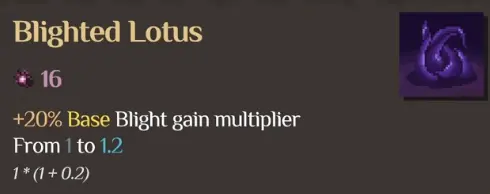
Blighted Lotus is the first Blight-scaling node I pay close attention to. The version shown costs 16 Blight and gives +20% Base Blight gain multiplier, changing the base multiplier from 1 to 1.2.
Sixteen can feel expensive when the account is still struggling to clear the next meaningful wall. In that situation, enough permanent health or damage to unlock several more levels may produce more immediate progress.
The multiplier becomes much easier to justify once the account can already rebuild reliably.
At that point I am no longer buying help for one difficult fight. I am improving the rate at which future runs produce the currency that unlocks the rest of the Tree.
That is an important transition in how I spend Blight.
Early purchases repair progression.
Later economy purchases accelerate progression that is already working.
Warpath Is the First System Unlock That Makes Me Comfortable Saving
Cheap nodes are tempting because buying something feels better than leaving Blight unused.
Warpath was the first target that broke that habit.
I reached a point where the available route put Warpath close enough that saving Blight had a clear payoff.
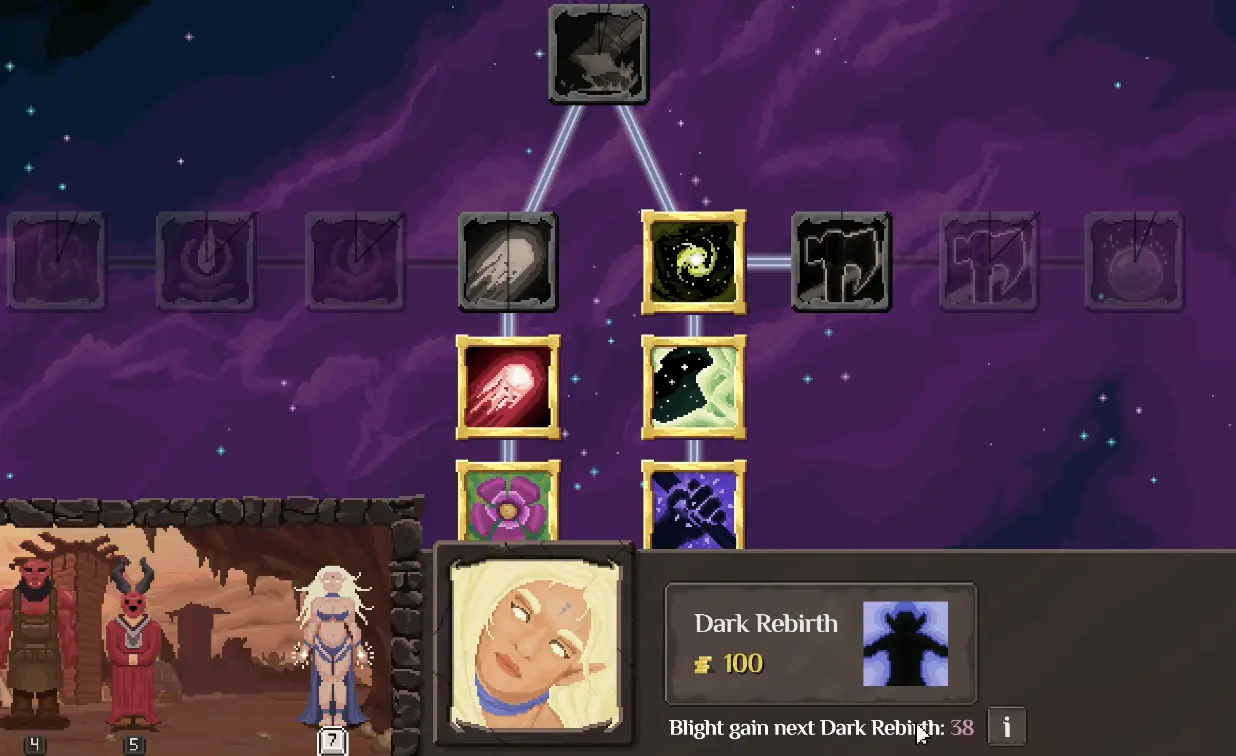
Warpath changes normal progression enough that I value the unlock differently from another small stat increase. Clean victories can chain into additional levels while surviving Units remain on the field, which makes a stable formation progress much faster than one that has to rebuild every battle.
The trigger, Auto-Progress requirement and mini-chest behavior belong in the progression guide. From the Tree side, the important lesson is that system unlocks deserve their own savings plan.
If I am close to opening one, several individually good side nodes may still be the wrong purchase.
Card Economy Matters Because Every Rebirth Asks Me to Rebuild the Army
Permanent damage is visible immediately.
Card economy is less obvious, but it changes the quality and cost of an entire cycle.
After enough Dark Rebirths, I care heavily about anything that improves:
- card draw efficiency;
- the number of cards I can choose from;
- reroll flexibility;
- access to higher rarities.
A weak set of Portal draws can force a run into repeated rerolls before the formation has even reached its old wall. Those rerolls become expensive, and the Gold spent searching for a workable army is Gold that never reached combat upgrades.
Better permanent card access attacks that problem earlier.
A wider or stronger set of choices can assemble a coherent formation with fewer wasted draws, which means I reach the useful part of the run sooner.
This is why card-economy nodes often beat a narrow Unit stat for me unless I already know that Unit is central to the account.
Epic Cards Are a Breakpoint Worth Planning Around
The route toward Epic cards was one of the first times I deliberately stopped buying smaller permanent upgrades for several resets.
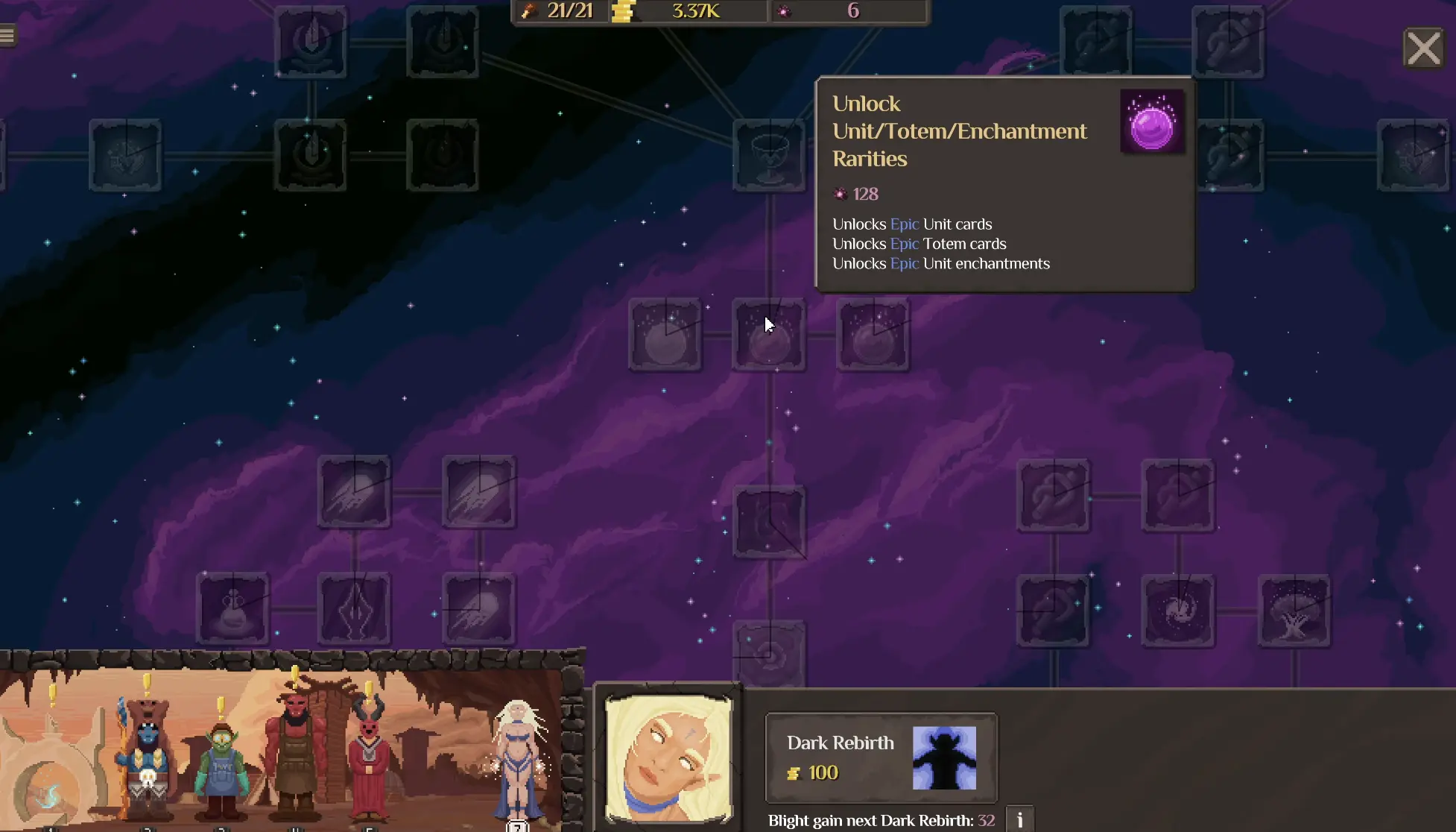
The actual Epic unlock node shown costs 128 Blight and unlocks:
Epic Unit cards, Epic Totem cards and Epic Enchantment cards.
But 128 is not the full cost of reaching it from wherever I happen to be on the Tree.
When I traced the path I wanted, I estimated roughly 200 Blight for a direct route to Epic-card access. Adding the extra card-roll improvement I wanted beyond that pushed the working target to about 232 Blight.
That difference between node cost and route cost is important throughout the Tree.
At 120 or 150 Blight, I could have spent almost everything on attractive side branches and come away stronger.
I would also have delayed a new card rarity by another cycle.
I saved instead.
Epic access changes every future Portal session. That makes it a qualitatively different purchase from another isolated permanent percentage increase.
Once I started thinking in those terms, the Tree felt much less overwhelming: I was not choosing between hundreds of nodes at once. I was choosing the next breakpoint.
Exalted Turquoise Galaxy Is Expensive Because It Improves an Entire Upgrade Layer
Farther up the Tree, Exalted Turquoise Galaxy shows how expensive broad scaling can become.
The node costs 256 Blight.
Its effect enhances both offensive and defensive upgrades from:
1 → 1.5
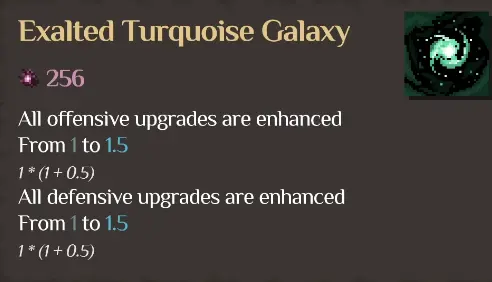
That is a very different investment from adding health to one Unit family.
It affects a category of temporary upgrades that I repeatedly buy across later runs, so the benefit is spread through the entire progression cycle rather than concentrated in one card.
Two hundred fifty-six Blight is far too much for me to buy simply because the node looks powerful.
I want the account to be reaching enough temporary upgrades each cycle that improving their scaling will actually pay back the cost.
Once that is true, this kind of multiplier becomes one of the reasons saving Blight can outperform clearing several cheaper specialist branches.
At 316 Blight, I Am Already Thinking in Routes That Cost Hundreds or Thousands
The scale of the Tree keeps changing.
When one of my later cycles was sitting around 316 Blight, the upper sections were already showing:
- deeper Epic-card progression;
- Cursed Units and cards;
- upgrade-cost reduction;
- Trials;
- stronger global scaling;
- and branches whose future costs climb into the thousands.
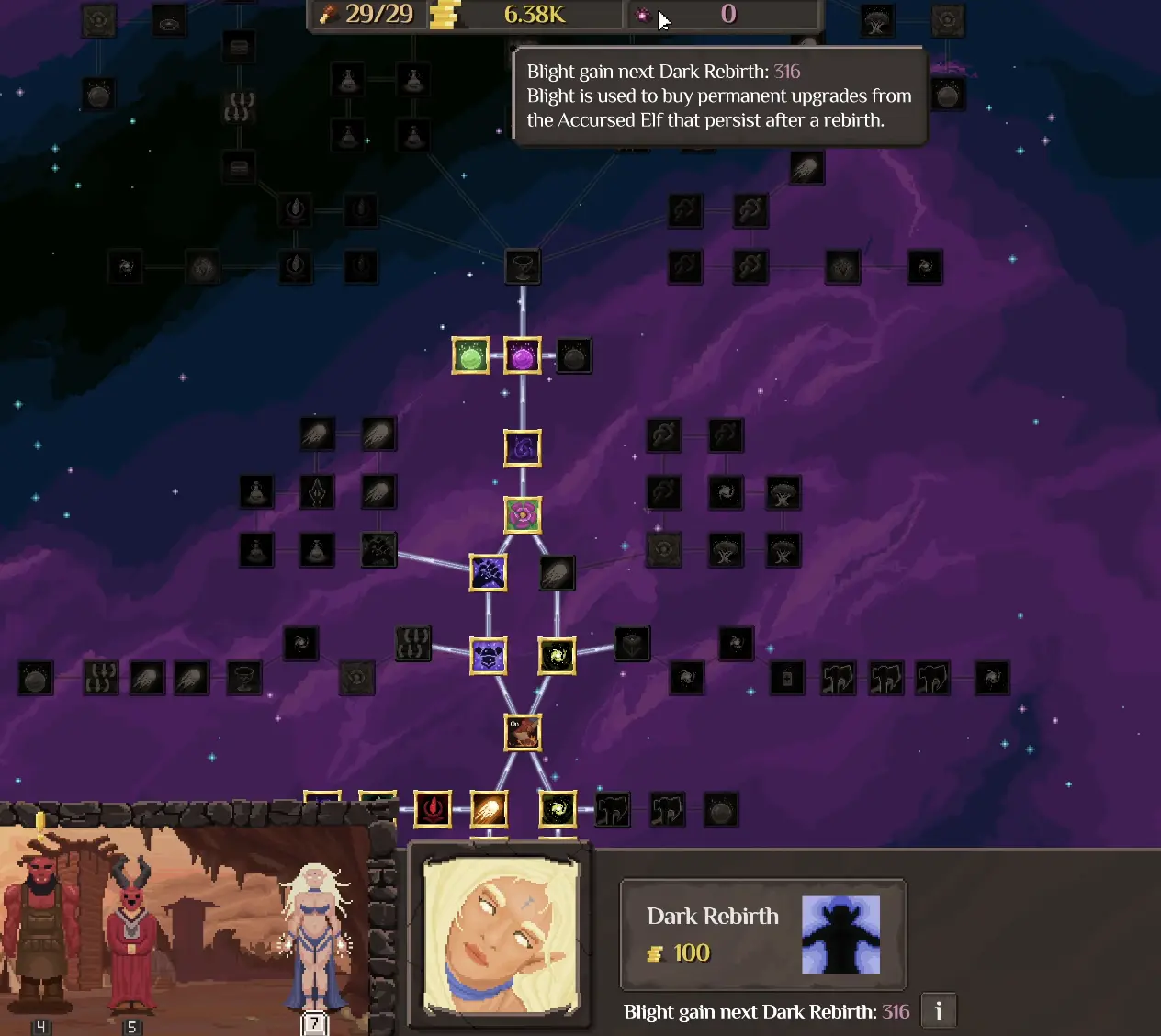
This is where “spend everything before leaving the Tree” becomes a bad rule.
A 32-Blight side node feels inexpensive next to 316.
Several of those purchases can still remove enough currency to postpone a 256-, 300- or 500-plus target that would have changed the next several cycles.
I am comfortable leaving the Tree with Blight unspent when the balance already has a destination.
Unused currency is not wasted currency if the next reset finishes the route.
Trials Compete With Stats Because They Open Another Permanent Progression Track
Trials eventually become another reason to prioritize a system node over raw percentages.
The unlock leads into challenge runs with their own conditions and permanent rewards. That gives the node a different kind of value: instead of making an existing mechanic slightly stronger, it opens another way to improve the account.
When Trials came within reach, the surrounding Tree still had plenty of tempting options — Gold, card improvements, Unit bonuses and deeper scaling paths.
Opening a new permanent progression track won that comparison.
I keep the challenge conditions and actual strategies on the Trials guide. On the Blight Tree, Trials only need one role:
they are a system breakpoint worth planning around instead of treating as another optional side node.
The same principle is what made Warpath and Epic cards easier to save for.
An unlock that changes what future runs can do deserves more weight than its immediate stat value suggests.
I Use the Current Wall to Decide Which Branch Gets the Next Blight
When several routes are reasonable, I stop looking at the Tree and look at the fight.
A wall usually falls into one of three useful categories.
The army survives, but the enemy does not die
That points toward offense.
Global Unit damage is the safest answer when several Unit families are contributing. A specialist damage branch makes more sense when one carry is already doing most of the work. Fireball investment remains relevant if my own casts are still deciding the fight.
The damage is there, but the formation collapses first
I check positioning before spending permanent currency.
If the frontline is correctly placed and still disappears too early, broad health becomes attractive because it improves several roles at once. A specialist health branch earns its cost when one Unit family is consistently the weak link in otherwise good formations.
Rebuilding after every Rebirth is the real problem
Then I stop buying for the current boss.
Gold, Blight scaling and card economy are the permanent upgrades that shorten the distance back to the useful part of the next cycle.
That distinction keeps the Tree connected to real progression instead of turning it into a theoretical “best nodes” list.
I Specialize Only After a Unit Keeps Winning Its Place Back
Unit-specific permanent branches get much better once the same family keeps proving itself through multiple resets.
Catapult is a good example.
If Catapults repeatedly clear waves, I keep drawing War Machine Totems and the formation is already designed to protect artillery, then permanent Catapult damage or attack speed has a clear job.
A Shaman-heavy account creates a different answer. If Shamans are consistently the damage engine and matching Totem effects keep appearing, the Shaman branch becomes much less speculative.
The important part is repetition.
One excellent Rare card is not enough to decide my permanent Tree.
Portal draws change. Enchantments change. Totems change.
I want the Unit family to remain useful even when the exact card roll is different.
Once that happens, specialization is no longer a gamble on the next draw. It becomes investment in a build archetype I already know how to use.
My Blight Priorities Change in Stages
I do not follow one fixed line from the bottom of the Tree to the top.
The order I care about is more stable than the exact path.
During the first resets, broad health, broad damage and useful Fireball improvements are difficult to waste. They make weak early card pools more forgiving.
Once rebuilding becomes consistent, economy starts gaining value. Blight multipliers, Gold and card access shorten the distance between Rebirth and the next meaningful wall.
When a major unlock is within reach, I am willing to leave good side nodes untouched. Warpath, Epic cards and Trials change enough of the game to justify saving.
After the account develops a reliable build identity, specialist Unit branches become much easier to defend.
Farther up the Tree, costs become large enough that route planning matters more than buying everything visible. A 256-Blight multiplier or an upper-tree system can justify carrying unused Blight through another cycle.
That is the progression I use instead of a universal node-by-node order.
The Tree is too large, and the Portal is too variable, for one exact line to remain optimal for every account.
What stays consistent is the way I judge each purchase:
Will this Blight help more future runs than the breakpoint I delay by spending it here?
When the answer is yes, I buy.
When it is not, I leave the node glowing and keep the currency.