Orc Incremental Dark Rebirth Guide: When I Reset a Run
Dark Rebirth works best when I treat it as a breakpoint decision. I keep a healthy run alive while levels and Gold still improve the payout, then reset once the Blight reaches a permanent upgrade I actually want.
Updated:
Quick Answer
Before I use Dark Rebirth, I decide what permanent upgrade I want next and compare its cost with the Blight shown on the reset screen. If a nearby boss, level milestone or short farm can cross that breakpoint, I keep pushing. Once meaningful Gold spending and a formation change stop improving the same wall, and the current payout already reaches something useful, I reset.
Dark Rebirth Is a Trade, Not a Punishment
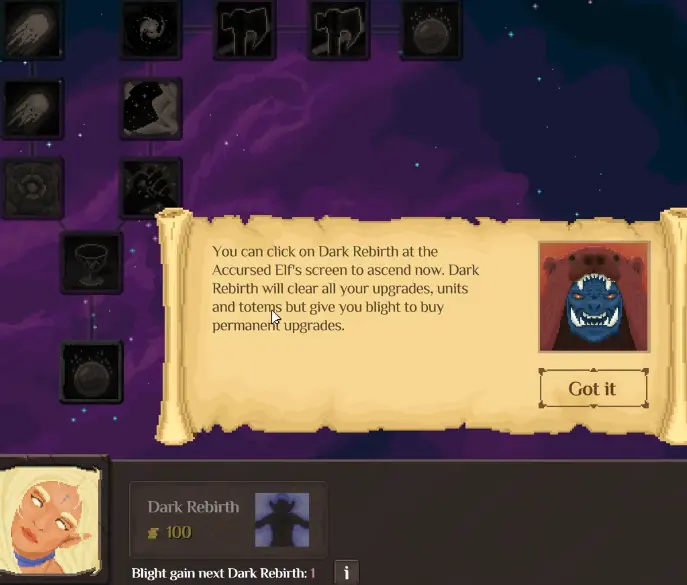
Dark Rebirth becomes available through the Accursed Elf, but the button appears before I normally want to use it.
The confirmation screen spells out the cost: the current run loses its Gold, upgrades, Units and Totems. What I keep is the permanent progress already bought with Blight, and the reset gives me another Blight payout based on the cycle I am ending.
That distinction changed how I looked at the reset almost immediately.
I was not throwing away progress. I was deciding when the temporary version of the army had already produced enough value to be converted into something permanent.
The difficult part is that the game never gives me one universal number that means “reset now.”
My first available payout made that obvious.
It was only 1 Blight.
The current army was still moving, the next few levels were cheap to reach, and one Blight was not going to transform the next run. Breaking the amulet there would have traded a useful cycle for almost nothing.
What Makes the Next Blight Payout Grow
Two parts of the current cycle matter directly to the next Dark Rebirth:
- the maximum level reached;
- the total Gold gained during that cycle.
That makes the last stretch of a run more interesting than simply waiting for a wall.
A healthy army can keep increasing the eventual payout while it pushes. Gold earned on the way matters too, so farming is not automatically wasted time near the end of a cycle.
The important distinction is what that farming is accomplishing.
If the Gold lets me buy enough health to survive the boss, another useful Unit upgrade, or anything else that moves the run farther, then I am improving both the current progression and the eventual reset.
Even when the wall survives, the Gold earned during that attempt still contributes to the cycle.
What does not help is sitting on unspent Gold because I assume the amount in my wallet gives a special bonus at reset. The game cares about Gold gained, so if an upgrade can genuinely extend the run, I still buy it.
That gives me a simple late-cycle question:
Is this next chunk of Gold likely to change the run, or am I only making the same failed fight slightly more expensive?
My First Payout Went From 1 to 17 Without Resetting
The first cycle shows why Dark Rebirth availability is a poor reset trigger.
The initial preview was 1 Blight. I continued.
Later it became 4.
The run was still making useful progress, so I kept the army together and pushed farther. The preview climbed to 10, then eventually to 17.

Seventeen was a much better payout than one, but the formation had not actually run out of useful progression yet.
That matters more than the number.
A player who resets automatically whenever the Blight total looks respectable can easily cut off the part of an early cycle where the payout is still growing quickly.
I let this one continue until the army reached a much harder wall.
By the time I finally chose Break it, the payout had reached 27 Blight.
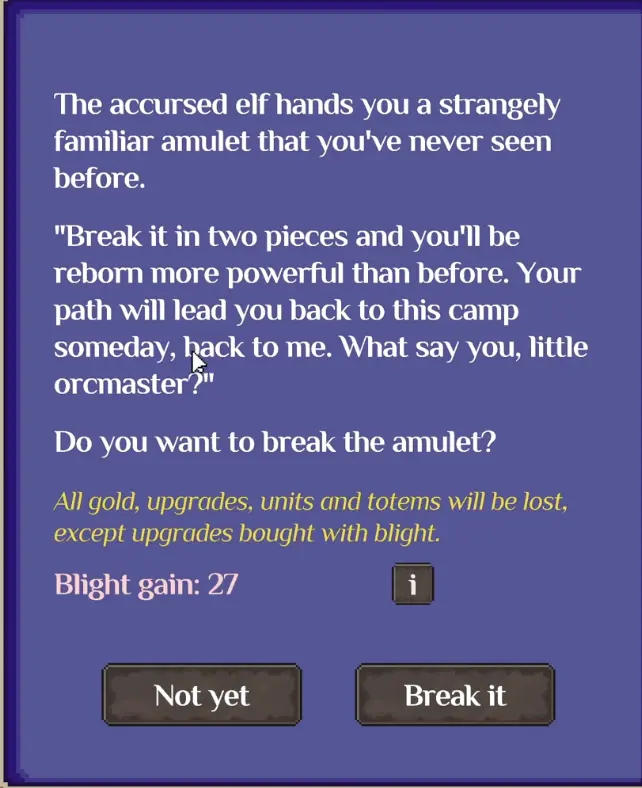
The difference between 17 and 27 was not just ten extra currency.
The later reset came after the run had actually stopped turning temporary upgrades into useful progress. At that point I was no longer sacrificing a strong cycle just to get permanent currency early.
That first Dark Rebirth also introduced another decision before the new Warband was fully rebuilt: which Chieftain to take. I choose that card for the active ability I want in the next run rather than letting the Martyrdom reward decide by itself. The Chieftains and Bloodlines guide covers those ability choices and when I eventually sacrifice the Chieftain.
One Bad Fight Is Not Enough Reason to Break the Amulet
A boss loss can look like the natural end of a run, especially when the health bar barely moves.
I still test the wall before I reset.
The first thing I check is whether the army failed for a structural reason. A ranged Unit may be standing too far forward. An expensive card may be taking several points of capacity while dying before its damage matters. The frontline may simply need enough health to survive one more attack cycle.
If the fight is close, I make one targeted correction and replay it.
That can mean moving Units, replacing one card, buying health for the frontline, strengthening the Unit already doing most of the damage, or farming a lower level long enough to afford one specific upgrade.
Normal battle losses do not destroy the run, so these tests are cheap.
What I care about is whether the next attempt looks different.
A boss dropping much lower, a frontline lasting several more seconds, or a Warpath surviving another wave all tell me the temporary progression still has leverage.
If I make a meaningful formation change, spend Gold on the active army and the same wall still plays out almost identically, the reset case becomes much stronger.
If I am still unsure whether the wall needs more farming, another unlock or a formation change, I check the progression guide before giving up the current cycle.
I Pick the Permanent Purchase Before I Decide Whether to Reset
This is the habit that makes Dark Rebirth much easier to judge.
I open the Blight Tree first and decide which permanent improvement I actually want.
Only then do I look at the next Dark Rebirth payout.
That reverses the temptation to see a big number, reset immediately and figure out what to buy afterward.
One later run was offering 38 Blight. That number mattered because it crossed the permanent route I was targeting at the time, including Warpath.
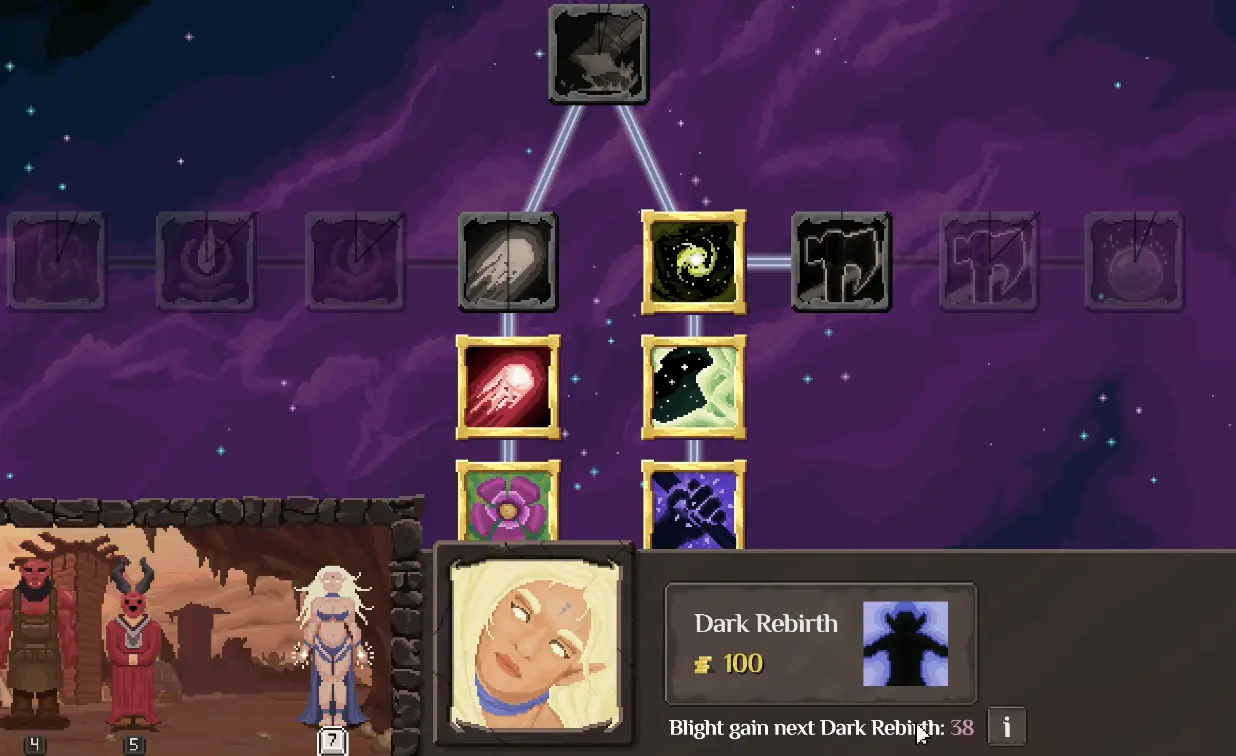
Now the reset had a concrete result attached to it.
If the payout had stopped at 32 while the target needed more, and the army was still progressing efficiently, I would have had a reason to keep the cycle alive.
Once the required cost was covered and the current run was starting to flatten out, the choice became much cleaner.
Before resetting, I check the Blight Tree guide and note the cost of the permanent upgrade I want next. That price is the number I compare against the current Dark Rebirth payout.
A Nearby Milestone Can Make One More Push Worthwhile
Sometimes the Dark Rebirth payout is already attractive, but the next meaningful checkpoint is close enough that leaving immediately still wastes value.
That checkpoint might be a boss, a new Unit unlock, a useful level milestone, or simply enough additional progression to cross the permanent cost I have already chosen.
The distance matters more than the name of the milestone.
If I need one realistic upgrade and several fights the army is already capable of winning, I usually extend the cycle.
If reaching the same checkpoint now requires repeated rerolls, a long Gold farm and several attempts that barely change, I take the permanent gain and approach it from a stronger account next time.
This is where I avoid two equally bad habits.
Resetting at the first slowdown wastes runs that still have momentum.
Dragging every cycle until the army is completely helpless wastes time that a permanent upgrade could have saved.
A milestone earns one more push when it is both valuable and realistically close.
The Same Blight Number Means Less as the Account Gets Stronger
Early payouts are small enough that every jump feels significant.
That changes quickly.
After several cycles, I was already seeing around 84 Blight on the next Dark Rebirth. Not long after that, I was making reset decisions with expected payouts above 200 Blight.
Those numbers are useful because they show why “reset at 20 Blight” or “always wait for 100” cannot remain good advice.
The account is moving through a different permanent economy.
A 27-Blight first reset can open several useful options and noticeably improve the next cycle. Later, 27 may not reach anything I currently care about.
The reset threshold therefore grows with the permanent goals.
That does not mean I always wait for a larger raw number than the previous cycle. A poor roll can still be worth ending early later on. What changes is the cost of the next useful permanent step and how quickly I can rebuild after abandoning the current army.
Better Permanent Progress Makes Bad Runs Cheaper to Abandon
The first few runs feel valuable simply because so much is still being unlocked.
Later, the opening becomes much faster.
Permanent Gold bonuses, broader combat stats, better card access and systems such as Warpath reduce the time required to get a new cycle moving. Once that happens, I become less patient with bad Unit and Totem rolls.
I have had runs where several Portal draws failed to produce a convincing core. Rerolls became increasingly expensive, the formation never developed a clear carry, and Gold was being used to repair an army that still felt weaker than the account should have been capable of producing.
Early in the game I would probably have pushed that run farther because abandoning it meant rebuilding almost everything slowly.
Later, the rebuild cost was small enough that a quick Dark Rebirth gave me another set of draws without losing the permanent foundation underneath them.
That creates a useful contrast between stages.
During the first cycles, new unlocks and fast payout growth reward patience.
Once permanent progression is strong, time becomes more important than squeezing every possible level from a mediocre roll.
I Watch the Result of Each Expensive Upgrade
Late in a cycle, the upgrade menu can still offer plenty of things to buy even after the run has effectively stopped improving.
I use the next fight to decide whether those purchases still deserve more farming time.
Suppose frontline health is the obvious weakness and I buy a significant health upgrade. If the next boss attempt keeps the formation alive much longer and leaves the boss at a fraction of its previous health, the purchase did its job. Another farm can be justified because the wall is visibly moving.
Now suppose several expensive upgrades go in and the dangerous enemy still reaches the same backline Unit at almost the same moment. The numbers increased, but the outcome did not.
That is much closer to an exhausted cycle.
I use this especially when upgrade costs become large enough that one more purchase represents a meaningful amount of farming. At that point, the upgrade needs to earn its time.
A button being available is not evidence that it is still the right investment.
Warpath Is a Good Health Check for the Current Cycle
Once Warpath is unlocked, I get another way to judge whether the formation still has productive life left.
A strong Warpath means the army is winning cleanly enough to carry surviving Units into additional waves. That can generate more progression and Gold without rebuilding the battlefield after every level.
If the current formation is still chaining waves efficiently, I am reluctant to end it just because the Dark Rebirth number already looks good.
The cycle is still converting strength into value.
If Warpath repeatedly starts and collapses almost immediately, the opposite may be true. A formation that can scrape through a single level is not necessarily healthy enough to keep extending the cycle.
The progression guide covers how Warpath starts and how Auto-Progress and mini-chests work. For a Dark Rebirth decision, I mainly watch whether the current Warband can still chain those waves efficiently enough to justify keeping the cycle alive.
Large Payouts Still Need a Breakpoint
Once the Blight total reaches the hundreds, it is easy to assume the decision has become automatic.
It has not.
In one later cycle, I could have reset for roughly 235 Blight. The permanent route I was watching needed at least 352, and I wanted an even larger buffer if the surrounding upgrades became affordable at the same time.
That gap gave the run a clear objective.
The army still had useful progression available, so taking 235 would have ended the cycle without reaching the permanent upgrade that was driving the decision.
I stayed.
This is the same logic as the early 17-Blight example, just at a much larger scale.
At 17, the question was whether another short push could turn an early reset into something more useful.
At 235, the question was whether the remaining run could close a 117-Blight gap to the next target.
The numbers changed. The decision did not.
I Do Not Need the Current Run to Be Completely Dead
Waiting until there is literally nothing left to improve sounds safe, but it can be inefficient later.
A mature run can still have theoretical upgrades available while the time required to buy them has stopped making sense.
By then I am comparing two rates of progress:
How much does another chunk of time improve this temporary cycle?
against:
How much faster will the next cycle become after the permanent upgrade?
If ten more minutes of farming is likely to add only a small temporary stat increase, while resetting immediately buys an upgrade that affects every future run, the reset does not need a total brick wall to be justified.
The same idea works in reverse.
A very strong formation that is still clearing new levels quickly can be worth extending even when the current payout already crosses a reasonable permanent target.
This is why I never treat Dark Rebirth as a fixed schedule.
The quality of the current run matters alongside the Blight number.
My Reset Check Eventually Comes Down to Three Questions
Once the system becomes familiar, I no longer need a complicated ritual before every Dark Rebirth.
I look at three things.
Is the formation still converting upgrades into better fights?
If targeted spending, positioning changes or a useful new draw are still pushing the wall back, the current cycle has room.
Is the run still gaining meaningful progression efficiently?
A nearby unlock, a healthy Warpath or a realistic milestone can justify another stretch. Repeated farming that barely moves the same fight cannot.
Does the current Blight payout reach the permanent breakpoint I chose before opening the reset screen?
This is the final comparison. Once the target is covered and the temporary run is flattening out, I have very little reason to protect the current army.
These three questions scale from the first Dark Rebirth into much later cycles.
The first time, I watched 1 Blight grow through 4, 10 and 17 before finally taking 27 because the run was still producing useful progress.
Later, 38 was enough because it crossed the permanent target I wanted.
After several more cycles, payouts around 84 and then 200+ showed how quickly the scale had changed.
And in another run, even 235 Blight was worth postponing because the next meaningful breakpoint sat at 352.
That is the reset rule I rely on:
Dark Rebirth is ready when the permanent gain I can buy is more valuable than the useful progress still left in the current cycle.