Orc Incremental Chieftains: Which Bloodline Should You Pick?
I choose Orc Incremental Chieftains by the active ability my run needs, then decide whether keeping that ability is worth more than Martyrdom.
Updated:
Quick Answer
After your first Dark Rebirth, choose the Chieftain whose active ability solves the fight you are currently struggling with. I take Ice Javelin when control matters, while Poison Cloud is the more aggressive sustained-damage option. Keep the Chieftain in the Warband while its ability is still winning fights; use Martyrdom later when you are ready to give that Chieftain up.
The Chieftain choice became much easier once I stopped treating it as a permanent verdict on the whole account.
Every Dark Rebirth can put another decision in front of me. What matters is not whether one Bloodline sounds stronger in isolation, but whether its Chieftain can change the next difficult stretch of the run.
I have rerolled past abilities that looked clever, kept one Chieftain for hours because its freeze was carrying bosses, removed another Chieftain for a better Unit, and eventually sacrificed one at the Temple when its active ability was no longer fixing the build.
That range of outcomes is why I judge the active ability first and Martyrdom second.
Your First Chieftain Comes After Dark Rebirth
The first real Chieftain choice appeared after I ended a stalled run with Dark Rebirth.
I happened to reset with 27 Blight on that run. That number was the Blight I had earned, not a Chieftain purchase price. After the reset, the new choice presented Chieftain abilities and Bloodline-related bonuses before I returned to rebuilding the army.
The game also marked the selection as recruiting my first Chieftain.
When the current run has stopped producing useful progress and you have not reached this system yet, the missing step is therefore not another Portal reroll. It is the reset itself. The Dark Rebirth guide covers the separate question of when enough Blight has accumulated to make that reset worthwhile.
Once the Chieftain selection appears, I switch back to the problem that ended the previous run.
Did one dangerous enemy need to be controlled? Were large groups surviving too long? Was the formation dying before the damage engine could start?
Those answers are much more useful than choosing by the Bloodline name alone.
One Chieftain Can Offer Combat Value and Martyrdom Value
The selection screen effectively asks me to compare two different futures for the same Chieftain.
One is immediate: what does the Chieftain do while it is alive and fighting with me?
The other is delayed: what do I gain if I eventually sacrifice that Chieftain through Martyrdom?
Those values can point in opposite directions.
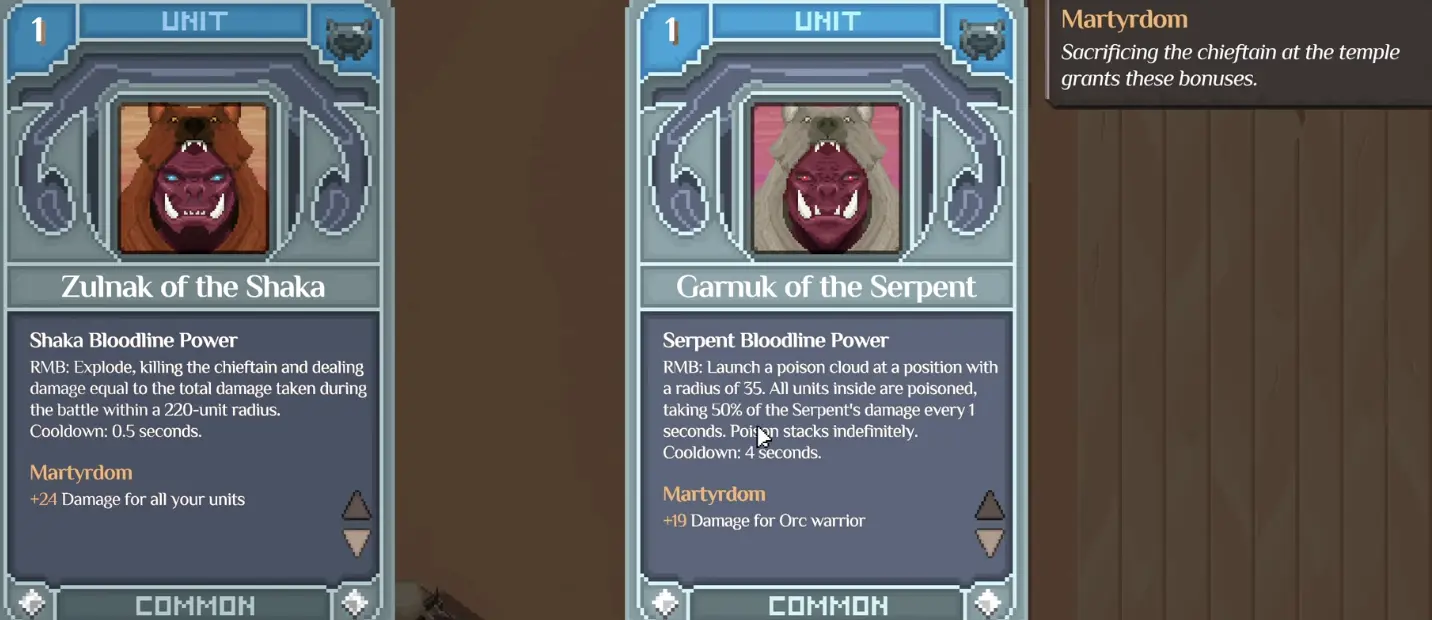
On my first choice, one option could destroy itself through an explosive active ability based around the damage it had taken. Another offered a Poison Cloud. At the same time, the Martyrdom bonuses made the sacrificial side of the decision tempting.
I still chose the combat ability I expected to use.
That became the pattern for later resets. A good Martyrdom reward does not help me clear the next boss while the Chieftain is still alive. A powerful active ability can.
Martyrdom becomes relevant only after the Temple exists and after I am genuinely willing to lose the Chieftain.
Poison Cloud Is a Real Damage Option, but It Needs Time
The Poison Cloud option was one of the clearest early offensive abilities.
The ability launches a cloud with a 35-unit radius. Enemies inside are Poisoned and take 50% of the Chieftain’s damage every second, and the Poison can continue stacking.
That gives it an obvious use against enemies that stay inside the affected area long enough for repeated ticks to matter.
It also explains why I became less enthusiastic about it in some later runs.
Fast fights, moving targets and enemies that need immediate interruption do not give a damage-over-time effect the same opportunity. Several Dark Rebirths later, I was still seeing Poison-based Chieftains, but I repeatedly passed them while searching for the control option that had already proven itself against my harder fights.
Poison was not failing because its numbers were small. It was losing the comparison because I needed the next dangerous target to stop acting now.
Ice Javelin Changed How I Valued Chieftain Abilities
Ice Javelin was the first Chieftain ability I actively started rerolling for.
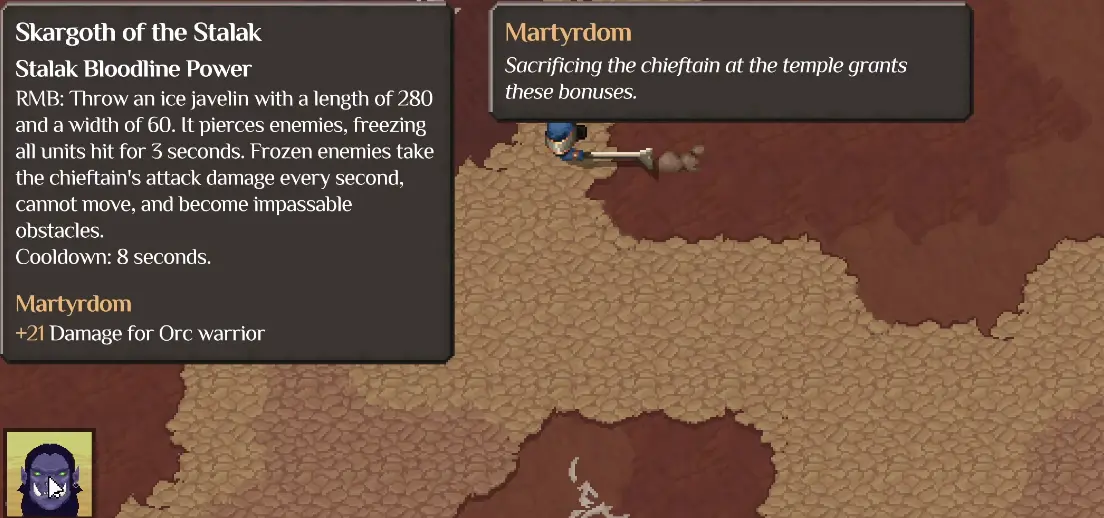
Its right-click attack pierces enemies and freezes them for 3 seconds. While frozen, the enemy takes the Chieftain’s attack damage every second.
The three seconds mattered more than I initially expected.
Against a dangerous enemy, freezing created time for Shamans, Catapults, Fighters and my own attacks to continue working while the target contributed nothing. It was both control and damage from the same click.
The difference became obvious enough that later Dark Rebirths turned into a hunt for the same ability. I passed other acceptable Chieftains, found Ice Javelin again, and immediately kept it.
At one point I was even unwilling to use Martyrdom because the Chieftain was freezing enemies too reliably to throw away.
That is the strongest signal I use when judging a Bloodline choice: would I be annoyed to lose this active ability right now?
With Ice Javelin, the answer was repeatedly yes.
Freeze Does Not Solve Every Boss
Ice Javelin still has a failure state.
One later boss could not be frozen.
The ability that had carried several earlier fights suddenly lost the control half of its value. I could still damage the target, but the run could no longer rely on three-second windows where the boss stopped acting.
That forced me back to the rest of the formation instead of assuming one Chieftain would solve every wall.
This is also why I would not call Ice Javelin a universal “best Bloodline.”
It was the most useful ability in several of my runs because those fights rewarded control. A target immune to that control changes the decision immediately.
When a boss ignores the mechanic I picked the Chieftain for, I stop pouring resources into making that one interaction work and fix the Unit lineup instead.
Healing Chieftains Can Repair a Fragile Formation
Not every useful Chieftain needs to deal damage directly.
Another Dark Rebirth offered a Chieftain whose ability damages itself for its attack damage and heals all allies for the damage dealt.
That creates a very different question.
The value is no longer “how much damage can the Chieftain personally add?” It becomes “does the rest of the Warband need one more way to survive?”
I consider that type of ability when the damage engine is already functioning but several Units are being worn down between important attacks. A formation with expensive ranged Units or a frontline that is barely surviving can get more from a team heal than another small offensive burst.
I was much less interested when healing was not the current bottleneck.
That is where Chieftain selection starts feeling less like a tier list and more like another build slot. The same ability can be the correct answer in one run and completely unnecessary after the next Dark Rebirth.
Invisibility Needs a Specific Unit Worth Protecting
I also saw an ability that could make a Unit invisible until the Chieftain expired.
It sounded useful, but I did not have a target whose survival was important enough to build the whole choice around.
That distinction matters.
An invisibility effect becomes much more attractive when one fragile Unit is responsible for a huge share of the run — for example, a rare damage carry or support Unit that repeatedly dies before delivering its value.
Without that situation, I would rather take an ability I know I will activate during almost every important fight.
A Chieftain active should have an obvious job before I select it.
Chieftain Counts as a Fighter
One interaction that is easy to miss is the Chieftain’s Unit category.
Chieftain is included in the Fighter category, alongside Units such as Orc Warrior, Assassin, Troll, Warg Rider and Juggernaut.
That matters because Fighter-triggered Totems and Rage effects can interact with the Chieftain even when I mentally think of it as the “special leader” instead of another Fighter.
I keep the detailed trigger ranges, stacking behavior and Totem choices in the Totems guide. For Chieftain selection, the practical consequence is simple: a Bloodline does not enter an empty system. Its Unit tag can connect it to passive effects the current Warband already uses.
A Rage-heavy Fighter setup can therefore make one Chieftain more useful than its active tooltip suggests.
A Chieftain Can Still Lose Its Place to a Better Unit
The leader status does not guarantee a permanent slot in my active formation.
In one later run, Catapults had become the real reason I was clearing levels. When another strong Catapult appeared, I removed the Chieftain and used the formation space on the Unit that was actually producing the result I needed.
That decision felt wrong the first time because the Chieftain looks like something the army is supposed to revolve around.
The fight said otherwise.
A mediocre active ability plus weak direct contribution can be less valuable than another carry Unit. When that happens, I rebuild around the stronger piece instead of protecting the Chieftain’s slot for thematic reasons.
The broader Unit combinations are covered in the build and formation guide. I only bring the Chieftain back when its ability or Fighter interactions add something that lineup cannot already do better.
Martyrdom Is Locked Behind the Temple
The Martyrdom icon can appear long before I am able to use it.
Early in the run, I could inspect the mechanic — sacrificing the Chieftain at the Temple for the listed bonuses — but the Temple itself was not available yet.
The route I encountered required the Acolyte to open the Temple.
That means a new player looking at an attractive Martyrdom bonus should not plan around pressing the button immediately after the first Chieftain appears. There is still progression between recruiting the Chieftain and being able to cash that Chieftain out.
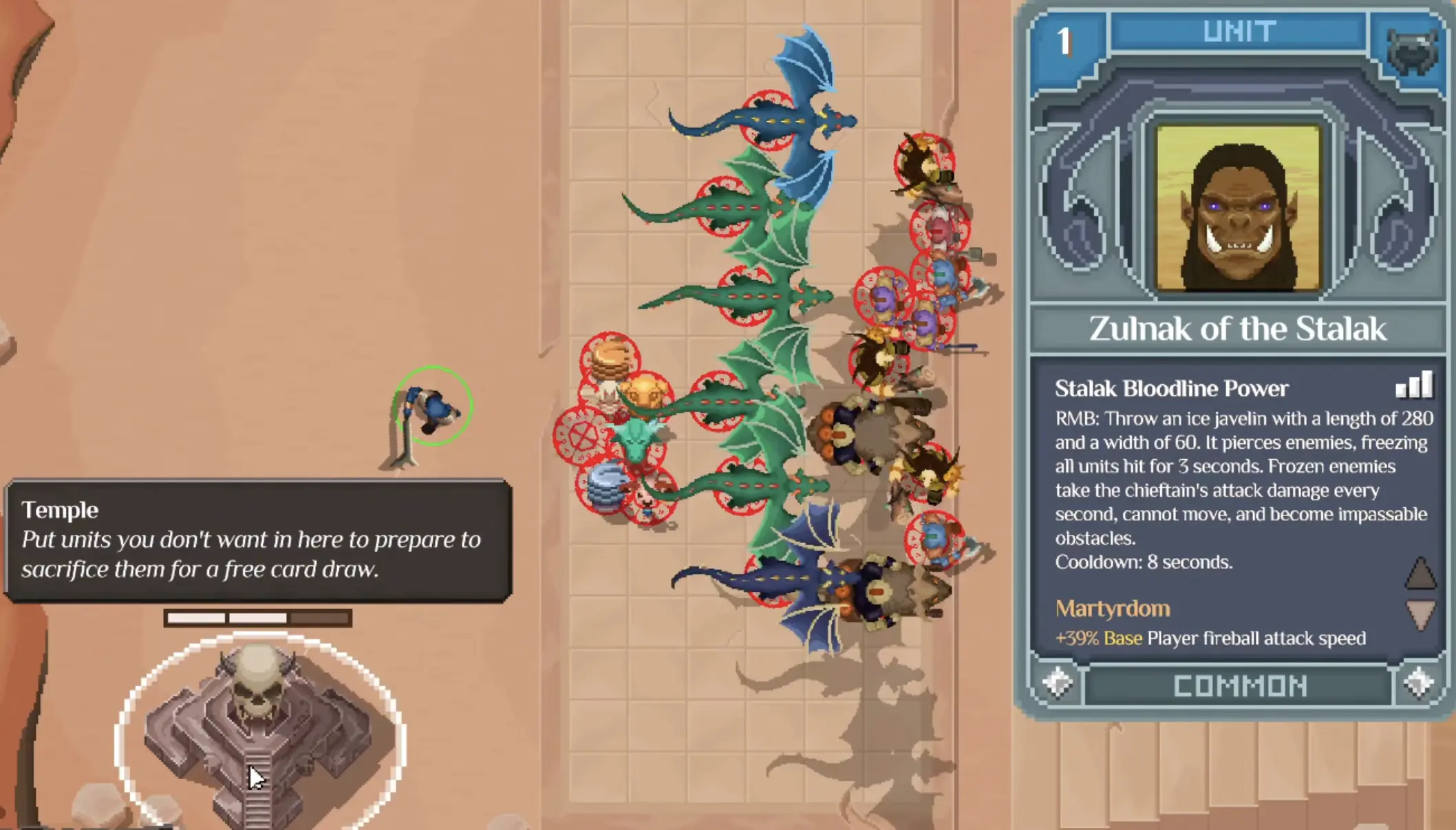
Once the Temple is unlocked, I check the Chieftain’s current Martyrdom reward before deciding anything. One Stalak roll offered +39% Base Player Fireball attack speed, while other Chieftains I saw offered direct Unit damage bonuses instead. The reward changes enough that I read the actual card rather than treating Martyrdom as one fixed bonus.
I Keep a Chieftain While the Active Ability Is Carrying
Ice Javelin gave me the cleanest example.
I had reached the point where Martyrdom was available, but the Chieftain was freezing enemies often enough that sacrificing it would have removed one of the strongest tools in the current build.
So I kept it.
The potential bonus from Martyrdom did not compensate for losing control of the next several fights.
That rule is more reliable than sacrificing at a fixed level:
when the active ability is solving a problem I cannot replace, the Chieftain stays alive.
A healing Chieftain can deserve the same treatment while the army is surviving because of that heal. A damage ability can stay while it continues breaking the current wall.
Martyrdom becomes attractive after the ability stops being central, not simply because the Temple is finally open.
When I Finally Use Martyrdom
Much later, I reached a build whose real issue was Rupture.
I needed Rupture badly, had no reliable way to apply it, and the Chieftain was no longer solving that failure on its own. At that point I went back and sacrificed the Chieftain.
The important part was the order.
I did not martyr the Chieftain because sacrifice had finally become available. I used the ability through the part of the run where it still mattered, recognized that the next wall required a different interaction, and only then converted the Chieftain into the Martyrdom benefit.
That makes Martyrdom feel much less risky.
The decision is not between “good Chieftain” and “good permanent bonus” in a vacuum. It is between what this Chieftain can still accomplish now and what sacrificing it gives the build after that point.
Dark Rebirth Gives Me Another Chance to Change Direction
A disappointing Chieftain does not lock the account into one ability forever.
Across later Dark Rebirths I saw different options: Poison, Ice Javelin, healing, invisibility and other active effects. That let me change direction as the Warband changed.
It also stopped me from burning too many resources trying to rescue a weak choice.
When the current Chieftain is merely average but the rest of the run is progressing well, I keep playing. When the entire run has reached its natural reset point, I take the Blight and see what the next Chieftain offers.
I do not reset a productive run only because one ability is not my favorite.
Conversely, once the run itself is finished, I do not keep pushing only because I am attached to a good Chieftain. Dark Rebirth will clear the current setup anyway, and the next cycle brings another chance to build around a new ability.
The Choice I Make at the Next Bloodline Screen
By the time another Chieftain selection opens, I already know what the previous run lacked.
A boss that kept acting through my damage pushes Ice Javelin to the top of my list.
A formation that survives comfortably but needs more sustained pressure gives Poison Cloud more room to work.
An army with enough damage and poor sustain makes the team-healing option worth another look.
A protection ability only becomes attractive when there is one Unit whose survival is genuinely deciding the run.
Then I look at Martyrdom.
Not before.
The active ability has to carry me from the reset into the next real wall. Martyrdom only matters once I have played far enough to decide whether that Chieftain has finished its job.