How I Unlock Magic Without Stalling the Rest of My Town
My route from Stone Walls to Rubiscar, the Wizard, Witch's Mire, Magic harvesting, and the Magic Academy, including what I check before each gate.
Updated:
Quick Answer
I do not unlock Magic by searching the swamp or buying random Library Research.
My route is:
finish the stronger-wall stage
→ expand the Fishing Harbor
→ construct a Ship
→ save 100,000 Gold for Rubiscar
→ complete the Wizard agreement for 300,000 Food
→ build Witch’s Mire
→ start Magic harvesting
→ follow the next story objective into the Magic Academy
The biggest mistake I avoid is spending heavily between those gates.
Once Rubiscar becomes the active route, I protect the Gold, Food, and Blueprint needed for the next mandatory step instead of buying every late-game upgrade that appears.
Magic looks like something I should be able to unlock from the map.
It is not.
The swamp is visible before I can use it, and Magic-related requirements can appear before the town has any reliable way to produce Magic.
That makes it easy to think I missed a hidden Research card or building.
I did not.
Magic opens through a late-game progression chain.
If I am still before the stronger-wall, Harbor, Ship, and Rubiscar stage, I follow the complete progression route instead of trying to force the swamp early.
The Magic Route Starts With Rubiscar
The first clear Magic objective appears after the stronger defensive progression.
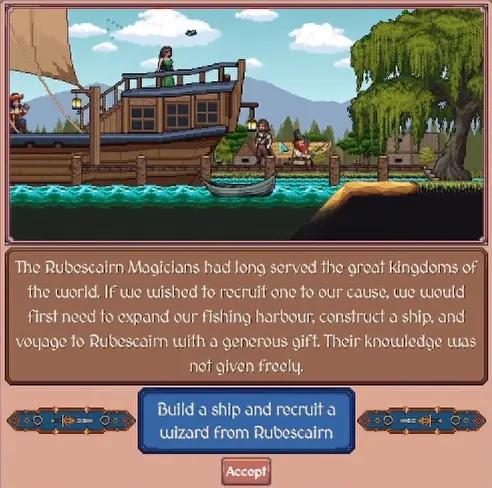
The story points me toward the Rubiscar magicians and tells me to:
expand the Fishing Harbor
→ construct a Ship
→ voyage to Rubiscar with a generous gift
Before this objective appears, I do not spend resources on random late upgrades hoping one of them unlocks Magic.
Once it does appear, I stop treating Gold and the required construction materials as spare resources.
The next gates are large enough that casual spending can add a long delay.
I Save 100,000 Gold for Rubiscar
The first major resource gate in the Magic chain is Gold.
In my run, the Rubiscar expedition required 100,000 Gold.
If Rubiscar is the current objective, I treat that 100,000 as reserved.
I still buy an upgrade if it directly increases the Gold income I need to reach the target faster.
I do not spend 20,000 or 30,000 on something optional simply because I can afford it.
My rule is:
Rubiscar active + Gold below 100,000
→ save.
If Gold itself is the bottleneck, I switch to the Gold guide and fix the Gold economy there.
I do not turn the Magic page into a second Gold guide.
Building the Ship Does Not Finish the Rubiscar Gate
The Ship is only the transport step.
Building it does not immediately give me the Wizard.
I still need to complete the Rubiscar expedition and let that diplomatic step resolve.
That matters because I do not start spending aggressively again the instant the Ship is finished.
I keep enough economic reserve to finish the actual Rubiscar objective.
I also start looking ahead to Food.
The next Magic gate is much larger than the Rubiscar Gold payment in a different resource.
The Wizard Agreement Needs 300,000 Food
After Rubiscar, the magicians offer the Wizard through a Food agreement.
In my run, the requirement was 300,000 Food.

I do not judge this only by whether I can physically hold 300,000 Food.
I check the flow behind the number.
Before I pay, I want:
enough storage to reach the requirement
and
enough Food production to recover afterward.
If I can barely scrape together 300,000 while Food production is weak, the payment can leave the town exposed to population growth, military upkeep, or another disruption.
I would rather wait a little longer and pay from a stable economy.
If Food is already becoming unstable, I fix that through the Food shortage guide before forcing the Wizard step.
Witch’s Mire Is the Real Magic Production Unlock
Recruiting the Wizard does not yet mean Magic is a normal production resource.
The important production step is Witch’s Mire.
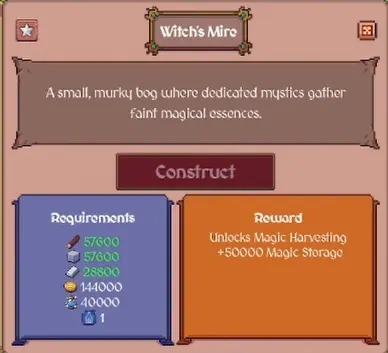
In my run, Witch’s Mire required:
- 57,600 Wood
- 57,600 Stone
- 28,800 Iron
- 40,000 Gold
- 1 blue Blueprint
Its reward included:
Unlocks Magic Harvesting
and
+50,000 Magic Storage
This is the most useful diagnostic point in the whole Magic route.
If Witch’s Mire is blocked, I do not guess.
I check the requirement that is actually missing.
Wood low?
I fix Wood.
Stone low?
I fix Stone.
Iron low?
I protect Iron from side purchases and rebuild it.
Gold low?
I return to the Gold economy.
Blue Blueprint missing?
I stop farming normal resources.
That is a Blueprint gate, so I solve it through the Blueprints guide.
The Blueprint is especially important because 100,000 more Wood will not solve a missing blue design.
I Do Not Empty the Town Before the Blueprint Is Ready
Witch’s Mire is expensive enough that I do not like partial overcommitment.
If I already have the Wood and Stone but still lack the blue Blueprint, I do not immediately drain Gold and Iron just to make every other number ready.
I keep the economy flexible until I solve the actual gate.
The reverse is also true.
If the Blueprint is already in hand but Iron is far behind, I stop buying Iron-heavy side upgrades until Witch’s Mire is funded.
My priority is the building itself because it changes what the town can do.
A small percentage bonus can wait.
A building that unlocks Magic Harvesting cannot.
After Witch’s Mire, I Let Magic Production Stabilize
Once Witch’s Mire is built, Magic finally becomes something I can produce.
I do not immediately max the new resource line.
The town is already supporting Food, Gold, Iron, trade, population, and military costs by this stage.
Pulling too many workers into Magic can solve one new bottleneck while creating an old one somewhere else.
So I start modestly:
assign enough workers to make Magic rise steadily
→ watch the rest of the economy
→ add more only if the town stays healthy
If Food weakens after the worker shift, I undo the last move.
If Iron or Gold is still the next progression gate, I keep those lines productive rather than moving everyone into the newest resource.
Magic becomes important quickly.
That does not mean every worker should become a Magic worker immediately.
I Use Trade Only When It Bridges the Current Magic Gate
Trade can still help after Magic Harvesting opens.
If Magic production is established but too slow for the current objective, I may use trade to bridge the gap.
I do not keep the full Demand and route logic here because that belongs in the Caravan and trade guide.
From the Magic side, I only ask:
Does this trade let me complete the current Magic objective without creating a worse shortage elsewhere?
If yes, I consider it.
If not, I keep producing and wait.
I do not drain Gold or another critical resource just to make the Magic number look larger than the next objective requires.
The Magic Academy Comes Later in the Chain
Once the Wizard is present and Magic progression has advanced, the story eventually points me toward the ruins and the Magic Academy.
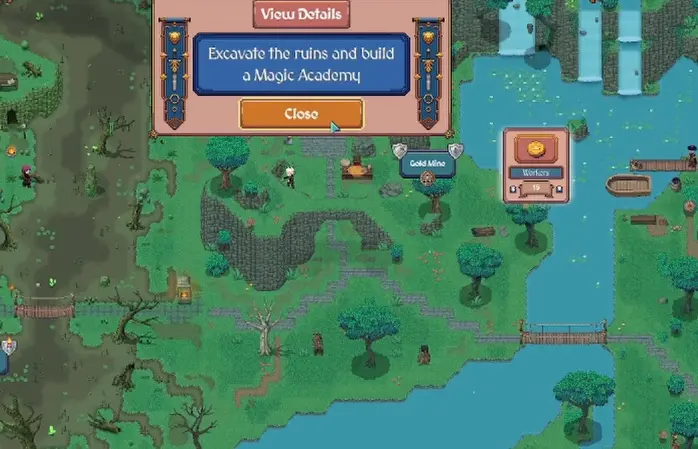
The Academy is not the first Magic unlock.
That distinction matters because I can see Magic-related requirements before the Academy itself becomes available.
My sequence is:
Rubiscar reached
→ Wizard agreement completed
→ Witch’s Mire built
→ Magic Harvesting active
→ story advances
→ ruins and Magic Academy objective appears
If the Academy is not available yet, I do not start spending randomly around the settlement trying to force it.
I check the chain behind me.
I Pause Magic When the Rest of the Town Is Not Ready
Magic is mandatory progression.
That does not mean I force it through a collapsing economy.
I pause the route if:
- Food is negative after the Wizard payment or worker reassignment;
- a dangerous raid is already close;
- Witch’s Mire is waiting on a blue Blueprint;
- Gold is still below the current Magic requirement and income is weak;
- paying the next Magic cost would empty every important reserve at once.
At that point, the Magic objective is not really the problem.
The supporting economy is.
I fix the specific bottleneck, then return.
I push aggressively when the opposite is true:
- Food is rebuilding comfortably;
- Gold income is stable;
- the required Blueprint is already available;
- Wood, Stone, and Iron are ready or near their targets;
- the next Magic structure is the only thing actually blocking progression.
Then delaying Magic no longer protects the economy.
It only delays the next system.
I Use Two Different Magic Checkpoints
I separate unlocking Magic production from establishing the Magic progression chain.
I consider Magic production properly unlocked when:
Witch’s Mire is built
and
Magic is rising on its own.
I consider the broader Magic progression established when:
the Wizard is present
and
the Magic Academy stage is active.
Those are different checkpoints.
That distinction helps when another building suddenly asks for Magic.
If I have only reached Rubiscar, I am still inside the unlock chain.
If Witch’s Mire is complete and Magic is already producing, then Magic is no longer a mystery unlock.
It is another resource bottleneck I can manage like the rest of the town.
From there, I return to the complete progression route and follow the next late-game objective instead of trying to finish every Magic-related upgrade at once.