How I Stop Blueprints From Blocking Every Upgrade
How I unlock Blueprints, decide which building gets them first, and avoid wasting scarce designs on upgrades I can safely leave for later.
Updated:
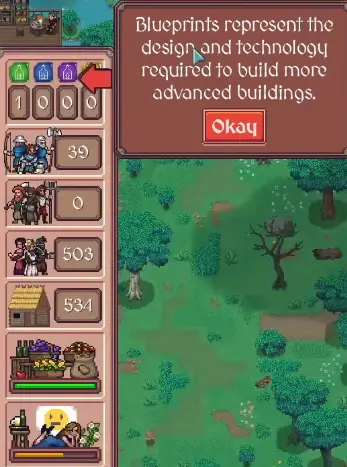
Quick Answer
I do not search the map for Blueprints.
If a building starts showing Blueprint required before I can actually obtain one, I keep pushing the main progression instead of farming more Wood, Stone, Iron, or Gold.
My route is:
open trade and continue the story
→ upgrade the Library when the objective appears
→ research Blueprints
→ commission extra copies from the Shop when I need them
→ reserve enough for the next mandatory building
→ continue Library and story progression when an upgrade asks for a higher Blueprint color
The biggest mistake I avoid is spending the last Blueprint just because an optional upgrade is available.
Blueprints confused me because the game starts showing Blueprint requirements before every part of the Blueprint system is available.
I could already see advanced building upgrades asking for designs, but there was no obvious worker, resource node, or map location that produced them.
The answer was not hidden somewhere around the settlement.
Blueprints are a progression gate.
Once I understood that, I stopped treating every locked upgrade as a resource problem and started checking three things instead:
Has the Library progression reached Blueprints yet?
Do I need another copy of a Blueprint color I already unlocked?
Or is the building asking for a higher Blueprint tier I cannot access yet?
Those are three different problems, and solving the wrong one wastes a lot of Gold.
I Unlock Blueprints Through the Library
The first real Blueprint step comes after the town has already moved into trade and the next stage of economic progression.
Eventually the story gives me a direct objective to upgrade the Library and research Blueprints.
That is the point where the Blueprint icons I had been seeing on buildings finally become actionable.
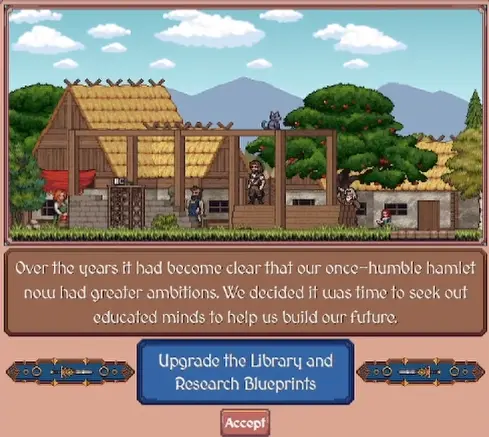
My route around this point is:
Market and trade running
→ continue the story
→ Library objective appears
→ upgrade Library
→ research Blueprints
→ return to advanced building upgrades
If a building says Blueprint required before this objective appears, I leave it alone.
I do not buy unrelated upgrades hoping one of them secretly creates Blueprints.
If I am unsure whether I am simply too early, I return to the complete progression route and check the current story stage.
A Blueprint Is a Resource I Can Spend
Once Blueprints unlock, I treat the colored counters as a real resource.
They are not just permanent technology flags.
If an upgrade needs Blueprint copies, spending them reduces the amount I have available for the next building.
That changes how I read an upgrade cost.
I check the Blueprint requirement before I start saving the normal materials.
If a building needs several designs and I do not have enough, then gathering another 50,000 Wood does nothing to solve the real gate.
I either:
- commission more copies of a Blueprint tier I already own;
- or continue progression until the higher Blueprint color becomes available.
I Commission Extra Blueprints in the Shop
Researching a Blueprint tier does not give me unlimited copies.
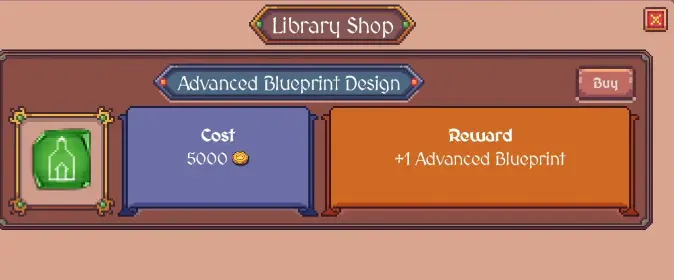
Once the system is active, I can commission more through the Shop.
In one early Blueprint stage, buying another copy increased the Blueprint counter from 1 to 2.
The important distinction is between:
unlocking the design tier
and
buying another copy of that design.
For the Advanced Blueprint stage I used, the Shop charged 5,000 Gold for one additional Advanced Blueprint after the relevant Research had been completed.
That is very different from the Research cost itself.
I do not stockpile extra copies automatically.
Before I commission another Blueprint, I check the next required building and buy only what I expect to use.
Advanced Building Design Is a Bigger Progression Cost
Higher Blueprint tiers become expensive because the Research that unlocks them can require a large bundle of resources.
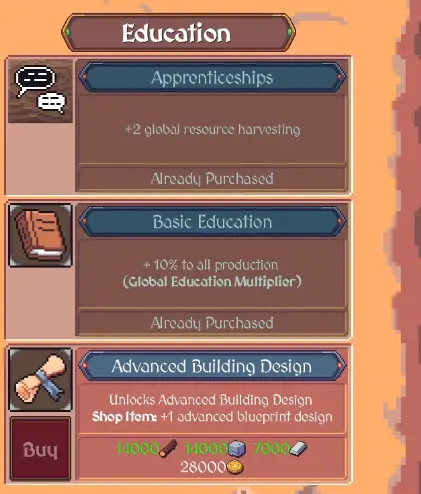
In my run, Advanced Building Design required:
14,000 Wood
14,000 Stone
7,000 Iron
28,000 Gold
This is where Blueprint progression starts competing directly with other expensive objectives.
If the current quest is only a few thousand Gold away from completion, I usually finish the quest first.
If the next required building is already blocked by the Advanced Blueprint tier, then this Research becomes the bottleneck and I save for it.
I do not ask:
Can I afford this Research right now?
I ask:
What does completing it unlock next?
That keeps me from draining the treasury into a new design tier before I actually need it.
If Gold itself is the problem, I fix the economy through the Gold guide rather than turning the Blueprint page into a second Gold strategy.
I Spend Blueprints on the Current Bottleneck
Once several buildings can use Blueprints, I stop trying to upgrade everything evenly.
I look at what is actually slowing progression.
If one resource is holding back several objectives, I consider spending the Blueprint on that production chain.
If the economy is already balanced, I reserve the design for the next mandatory building.
That gives me a simple priority order:
mandatory progression unlock
→ current production bottleneck
→ upgrade that becomes cheap relative to my current economy
→ optional capacity or convenience
For example, an upgraded production building can be worth an early Blueprint when that resource is the only thing delaying several purchases.
A storage increase is much less urgent when I am nowhere near the current cap.
The Research and upgrades guide handles the broader question of which upgrade type is worth buying. Here I only care about whether an upgrade deserves one of my limited Blueprint copies.
I Reserve Three Green Blueprints for Stone Walls
Stone Walls are the first place where casual Blueprint spending can create a very obvious progression stall.
The Stone Wall I upgrade in my run required 3 green Blueprints in addition to its normal resource costs.
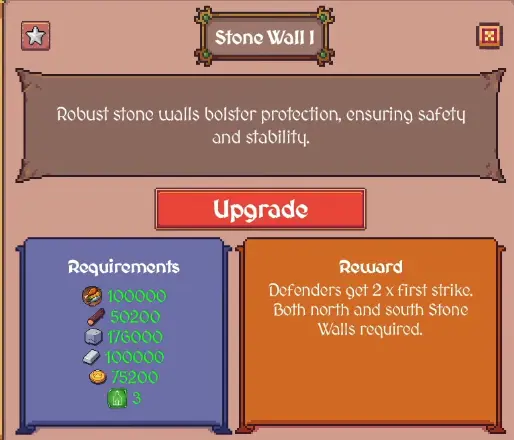
This is where I start thinking one objective ahead.
If I own exactly three green Blueprints and Stone Walls are coming next, I treat those three as already spent.
I only use one elsewhere if I know I can commission a replacement before the wall becomes the blocker.
That matters because normal resources continue accumulating while I wait.
Blueprints do not.
Arriving at Stone Walls with enough Wood, Stone, Iron, and Gold but no designs is exactly the kind of avoidable stall I want to prevent.
A New Blueprint Color Means I Need More Progression
Later upgrades stop asking for the same Blueprint color.
When I reached an upgrade that specifically required a blue Blueprint, buying another green Blueprint would not help at all.
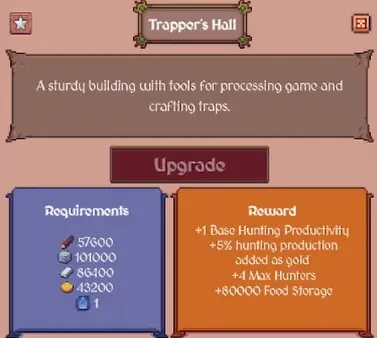
This is the distinction I use:
Same Blueprint color, not enough copies
→ commission more in the Shop.
Different Blueprint color
→ stop buying the old tier and continue progression.
If the color changed, I go back to the Library and check whether a new Research or building level is available.
If nothing is available yet, I push the current story objective.
I do not keep spending Gold on designs that the blocked building cannot use.
I Return to Older Buildings After a New Tier Opens
I do not keep every building fully upgraded while I play.
That costs too much, and Blueprint requirements make it even easier to spend resources on something useful but badly timed.
Whenever I unlock a new Blueprint tier, I make one pass through the town and look for three kinds of upgrade:
a building tied to the next story system
a production building tied to my current bottleneck
an old upgrade that is now cheap relative to my income
Everything else can wait.
That last category becomes surprisingly valuable later.
An upgrade that felt impossible when I first saw it can become trivial after several progression stages.
I would rather return and buy it then than delay a major objective when the town is still poor.
I Do Not Spend the Last Blueprint Without Checking the Next Step
The last copy of a Blueprint color is the one I am most careful with.
Before I spend it, I ask:
Does the current quest or next major building need this Blueprint?
If yes, I keep it.
Is one resource clearly blocking several objectives?
If yes, a production upgrade may justify the spend.
Is this only a capacity upgrade when I am nowhere near the cap?
If yes, I leave it.
Does the building actually want a different Blueprint color?
If yes, I stop buying the current tier completely.
That is enough to keep Blueprints from becoming a permanent progression wall.
I do not need every advanced building the moment it appears.
I need the right building upgraded at the right time, with enough designs left to keep the next stage moving.