Which Moonlighter 2 Weapon I Would Pick First—and Why I Keep Switching
Sword is my safest baseline, Spear rewards clean recall lines, Gauntlets need Berserk uptime, and Great Sword needs patience. The best choice changes with the run.
Updated:

Quick Answer
If I were starting again, I would take Sword first.
It gives me the cleanest way to learn enemy timing without also managing Berserk, Spearhead geometry, or long attack commitments. After that, I switch based on what I want from the run: Spear for positioning and recall damage, Gauntlets when I can stay aggressive, and Great Sword when I am comfortable waiting for heavier openings.
The daily highlighted weapon can change that choice because equipping it gives me higher-Quality relics, but I only take the bonus if I can still run the dimension reliably.
My weapon opinion changed several times before the numbers did.
Gauntlets felt weak until Berserk made sense.
Spear immediately carried one run farther than I expected, then felt awkward the next time I kept putting Spearheads in useless positions.
A slower weapon could hit hard and still cost me more health than a weaker one because I kept committing into attacks I should have waited out.
That is why I stopped trying to rank the four families with one damage number.
If I Were Starting Fresh, I Would Take Sword
On a fresh save, Sword is the easiest family for me to recommend as the first craft.
Its basic rhythm is readable without being passive. Consecutive attacks lead into a stronger finisher, and the special can be worked into that sequence without asking me to track another resource around the screen.
That matters more than it sounds during the first few runs.
I am already learning:
enemy wind-ups,
the dodge timing,
the gun,
backpack hits,
room routes,
relic effects,
and when to stop pushing the dungeon.
I do not need the melee weapon adding another system unless that extra system is the reason I chose it.
Sword gives me a reference point.
Once I know how a room feels with Sword, I can tell whether another family is genuinely helping or simply more exciting.
It is also the family I return to when a newly opened dimension has enough unfamiliar mechanics of its own.
Gauntlets Only Felt Weak While I Was Ignoring Berserk
Gauntlets are much easier to misjudge from normal attacks alone.
The fast punches build the Berserk meter. Activating the special spends that meter on a faster, stronger combat window while the bar drains.
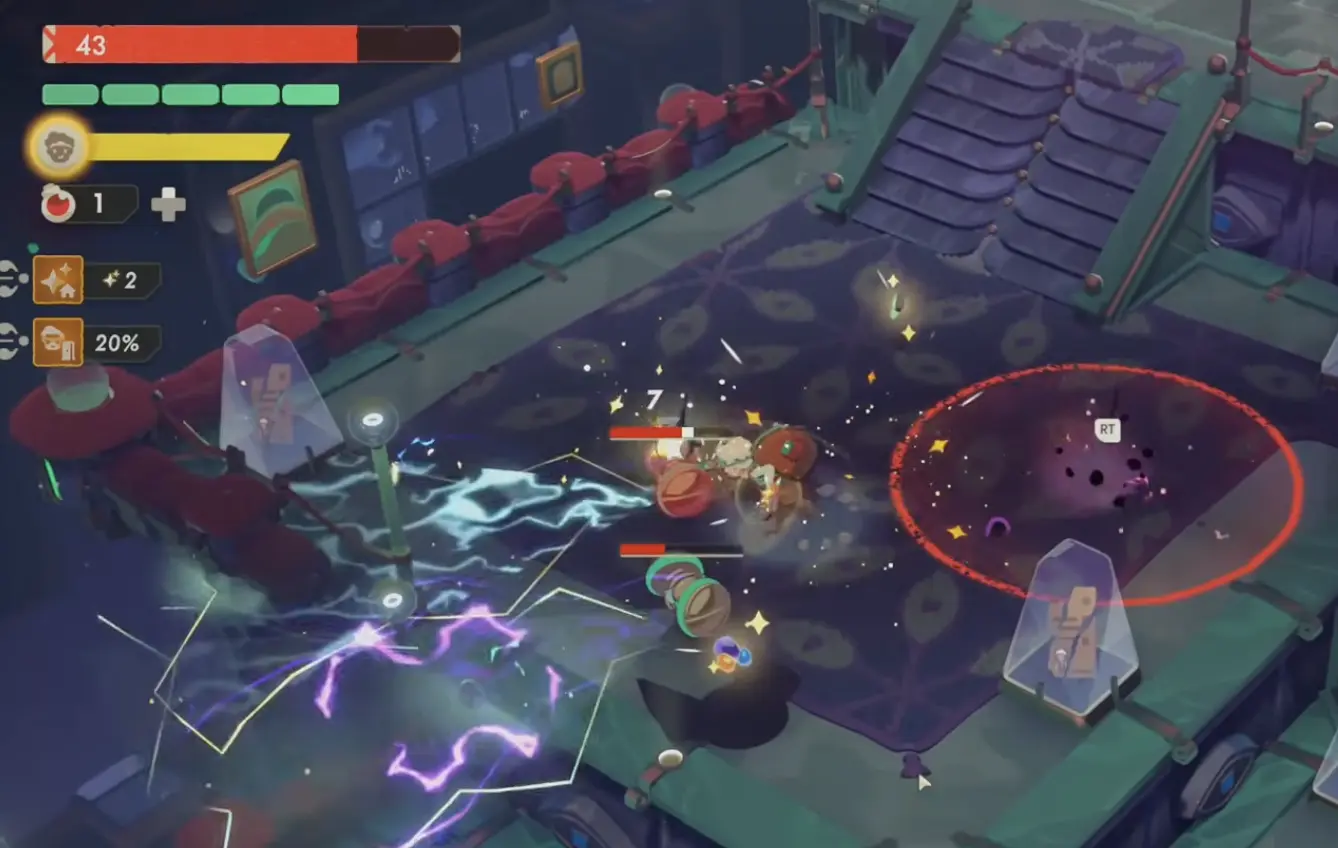
Before I used the meter properly, some enemies felt like they needed an absurd number of punches.
Once I started building Berserk deliberately, the weapon had a different rhythm:
build meter while the room is stable,
activate when I can stay on the target,
then actually use the increased pace before the bar disappears.
The awkward rooms are the ones where enemies keep forcing me away.
If I activate Berserk and immediately spend the whole window dodging or chasing something across the arena, most of the weapon’s advantage has vanished.
That makes Gauntlets much better for me against enemies whose patterns I already understand.
I also found a 5,000-Gold upgrade that increased Berserk duration.
That is useful after I know I enjoy the family. Longer Berserk does very little for a run where my real problem is that I never find a safe time to stay in melee range.
Spear Turned Positioning Into Damage
Spear was the family that surprised me most.
The normal reach already felt comfortable, but the important mechanic is the Spearheads left behind by attacks. Using the special calls those Spearheads back toward Will, and they damage enemies they cross on the return path.
That gave me a different way to read a fight.
With Sword, I am mostly thinking about my opening.
With Spear, I am also thinking about where the attack leaves something behind.
If the Spearheads finish on the far side of an enemy, the return line is useful.
If I scatter them around the room and press Special without looking, the mechanic barely contributes.
One of my early Spear runs went farther than I expected even though I had barely used the family before. That was enough to show me the extra range suited the way I was approaching those rooms.
Later, poor recalls made the exact same weapon feel much worse.
The difference was not its base damage.
It was geometry.
Spear perks can amplify that difference quickly
The stronger Spear perks I saw made accurate recalls even more important.
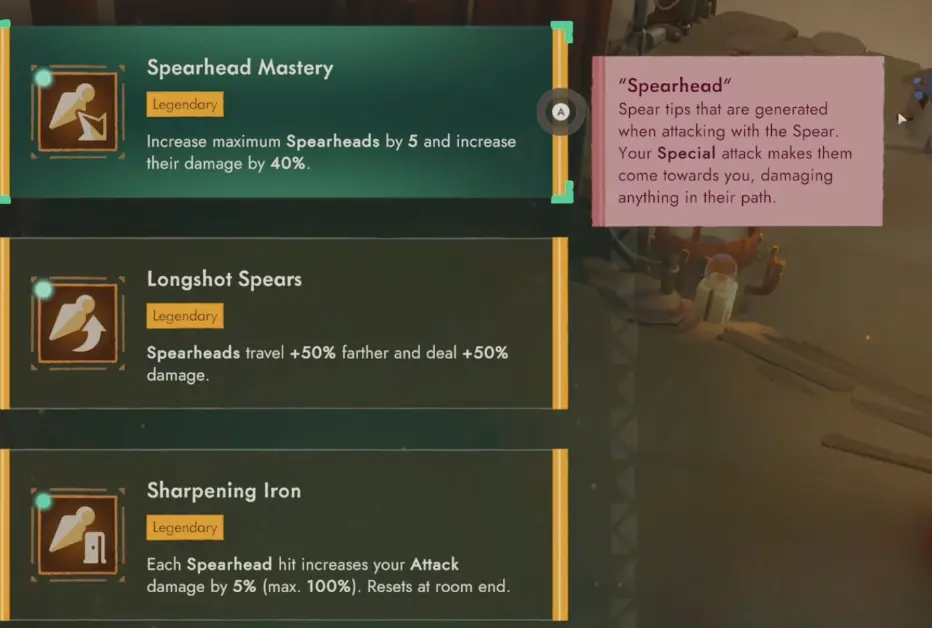
Spearhead Mastery increased the maximum number of Spearheads by 5 and their damage by 40%.
Longshot Spears made Spearheads travel 50% farther and deal 50% more damage.
Sharpening Iron added 5% Attack damage for each Spearhead hit, stacking up to 100%, with the bonus resetting after the room.
Those effects all reward the same skill.
More Spearheads are valuable if I can put them somewhere useful.
More damage per hit is valuable if the return actually crosses an enemy.
A stacking attack bonus is excellent if I am landing the hits that build it.
They make a good Spear run snowball. They do not turn missed recall lines into damage.
Great Sword Gives Me Fewer Chances to Change My Mind
Great Sword changes a different part of combat.
The slower attack commitment means the decision happens earlier.
With a faster family, I can sometimes squeeze in a hit and still react.
With Great Sword, starting the wrong swing is already the mistake.
That makes the weapon feel excellent against enemies with obvious recovery windows. I can wait, let the pattern finish, then commit to the heavier response.
Crowded rooms are where I struggle with it more.
If several attacks are arriving from different directions, the time spent completing one heavy action can become more dangerous than the damage is worth.
I do not solve that by immediately buying more damage.
First I look at why I got hit.
If I chose a safe opening and the enemy repeatedly survived with almost no health, stronger damage could shorten the room.
If I was being interrupted because I attacked during the wrong pattern, another damage upgrade would only make the same mistake more expensive.
Great Sword is the family that makes that distinction easiest for me to see.
The Daily Weapon Highlight Can Override My Usual Preference
Weapon choice is not purely a combat decision.
One weapon is highlighted each day, and equipping it grants higher-Quality relics.
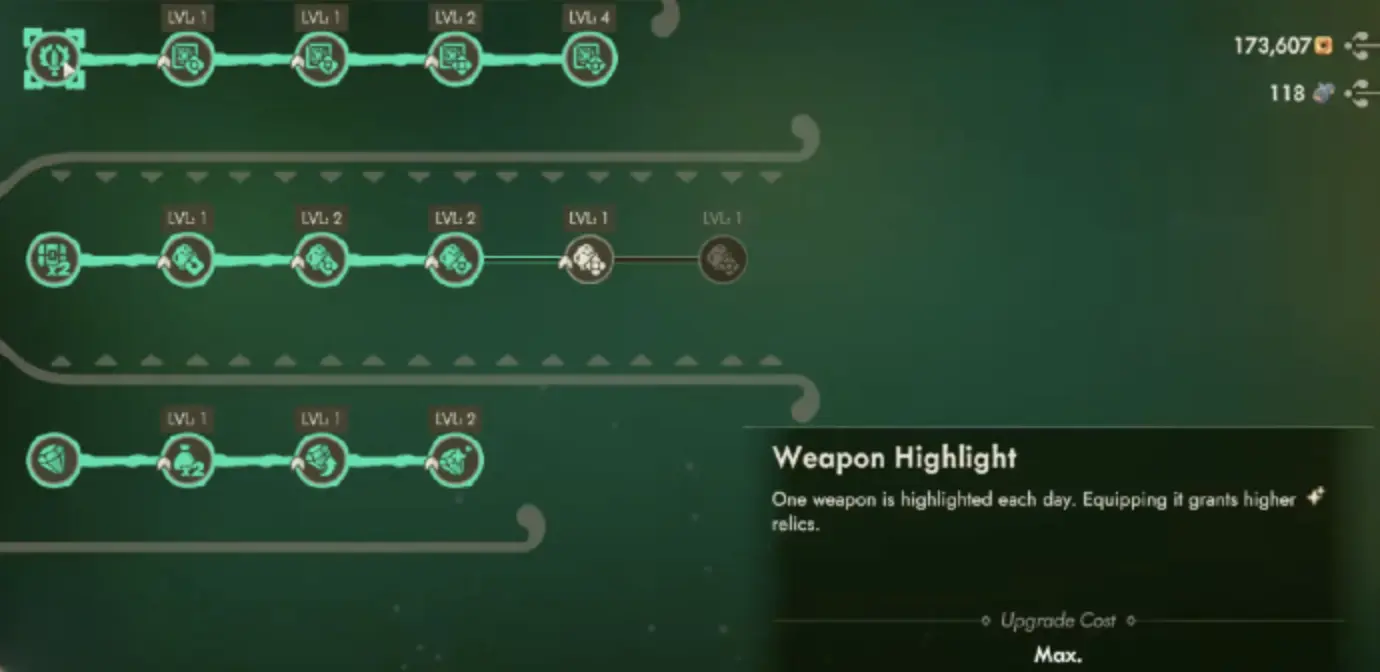
That puts an economic reward on experimenting.
If Spear is highlighted and I am already comfortable with Spear, the choice is easy.
If the highlighted family is one I barely understand, I think about what the run is for.
During a relic-and-Gold run through a familiar dimension, I am much more willing to take the highlighted weapon.
During a difficult boss attempt, I value consistent execution more.
A higher-Quality backpack is not useful if the weapon change makes me lose the run before bringing it home.
The relationship between Quality and final sale value becomes large enough that I account for it separately in the Relic Quality guide.
For weapon choice, the important fact is simply that the daily highlight can make an otherwise second-choice family worth using.
A Weapon Variant Can Change My Opinion Without Changing the Family
I do not treat the first weapon I craft in a family as the final verdict on that family.
Progression adds more recipes.
Those variants can modify attacks, finishers, specials, or the way a family-specific mechanic develops.
That became important after using weapons I did not initially enjoy.
Sometimes I disliked the core mechanic.
Other times I disliked that particular version of the weapon.
Those are different problems.
If I dislike placing and recalling Spearheads altogether, a new Spear recipe probably will not change what bothers me most.
If I like Spearheads but dislike one particular perk package, another Spear is absolutely worth testing.
The same applies to Gauntlets. Enjoying Berserk but disliking one set of bonuses is not a reason to abandon the entire family.
Weapons also do not give me a durability problem to manage, so experimenting is inexpensive compared with permanently committing upgrade Gold to the wrong choice.
I Upgrade Damage Only After a Clean Fight Tells Me I Need It
The easiest time to overspend on a weapon is immediately after a bad room.
I try to remember what actually happened instead.
An enemy surviving several correctly played openings with a small amount of health left is good evidence that more damage will save time.
Missing Spearhead recalls is not.
Triggering Berserk and then spending the whole window out of range is not.
Starting a Great Sword attack into an incoming pattern is not.
Those failures already have solutions inside the moveset.
That is also when changing family can be cheaper than upgrading.
If the same mechanic keeps fighting the way I naturally play, I would rather test another weapon than keep buying numbers for a moveset I am trying to avoid.
The Four Families Solve Different Problems for Me
I do not need one permanent winner.
Sword is the baseline I trust when I want to concentrate on the dungeon rather than the weapon.
Gauntlets are at their best when I can stay close enough to turn Berserk into sustained pressure.
Spear gives me range while rewarding deliberate Spearhead placement and recall lines.
Great Sword works when I can read an opening early enough to commit without getting punished during the swing.
Then the daily highlight can temporarily reshuffle that order when relic Quality matters more than maximum combat comfort.
That is enough for me to choose.
The best weapon is not the one that wins a damage comparison while standing still.
It is the one whose important mechanic I can still execute after the room stops giving me clean, comfortable openings.