My 1.0 Endgame Rule: Read the Vault Before Spending Gold
A returning save can look rich until the Endless Vault asks for six figures. I use the current Vault gap to decide whether Gold belongs in progression, upgrades, or another selling cycle.
Updated:
Quick Answer
On a returning Version 1.0 save, I check the current Endless Vault requirement before spending anything large.
If the next purchase does not fix the bottleneck that is actually slowing my runs, I keep the Gold moving toward the Vault. Before starting another expedition, I also check storage and the shop: sometimes the next chunk of progression is already sitting in relics I have not sold yet.
My returning save opened at 39% completion.
That sounded comfortable until I looked at the numbers attached to the remaining progression.
The important change was not that I suddenly needed better gear everywhere. It was that a single expensive purchase could now delay the next Vault milestone by several profitable runs.
From that point on, I stopped treating the Gold total in the corner as spending money.
I treated it as distance from the next gate.
Vault IV Turned 40,000 Gold Into a Progression Decision
At Endless Vault IV, my progress showed:
132,182 / 200,000 Gold
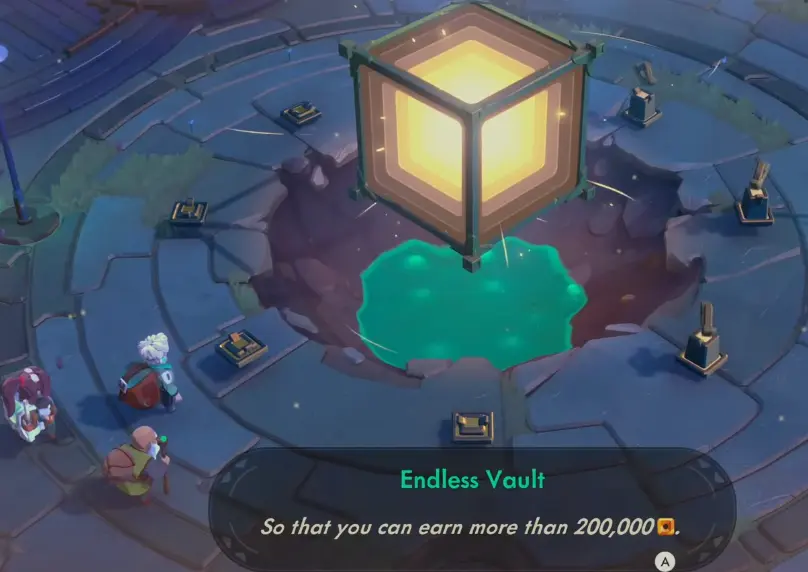
The remaining gap was 67,818 Gold.
That number was more useful than the full 200,000 target because it told me what every purchase was competing with right now.
At the same stage of the save, another backpack slot cost 40,000 Gold.
That is a good upgrade in isolation.
It is also a purchase large enough to delay a 67,818-Gold progression gap substantially.
So the decision became concrete:
- if I was repeatedly abandoning relics I genuinely wanted to sell, capacity could earn that Gold back;
- if the current bag was still doing its job, the Vault was closer to changing the save than one more slot was.
The detailed capacity decision belongs in the Backpack Upgrade guide. For endgame progression, I only need to know whether the purchase fixes a problem expensive enough to justify slowing the gate.
Vault VI Changed the Scale From One Good Day to Repeated Cycles
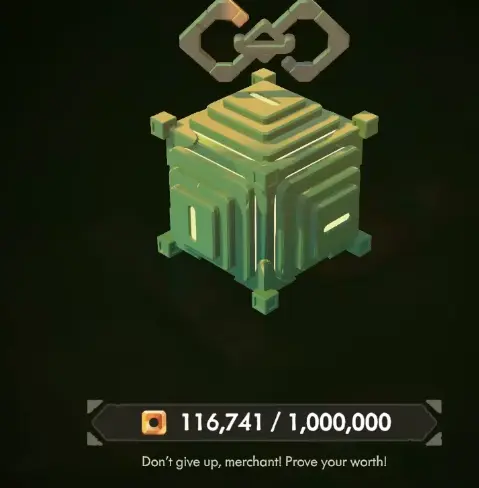
Later, Endless Vault VI showed:
116,741 / 1,000,000 Gold
That left 883,259 Gold.
This was the point where I stopped expecting one unusually strong run or one good shop shift to solve the entire problem.
A six-figure sale is excellent.
Against an 883,259-Gold remaining gap, it is still only one part of the cycle.
That changed how I measured progress.
I no longer asked:
Did I make a lot of Gold today?
I asked:
How many clean dungeon → shop → Vault cycles did this move remove?
The difference matters because million-Gold progression punishes bad side spending more than smaller gates do. A purchase can be useful and still arrive at the wrong time.
Before I Start Another Dungeon, I Check What I Already Own
Large Vault targets make grinding feel like the automatic answer.
Sometimes it is not.
If storage already contains several strong relics, another expedition can add more inventory pressure without moving progression as efficiently as a well-prepared shop day would.
My sequence is:
- Check the current Vault gap.
- Look through the valuable relics already in storage.
- Decide whether the shop can move the gap meaningfully.
- Run another dungeon only when the stored value is no longer enough.
That keeps me from spending twenty minutes collecting more stock while expensive relics are already waiting to become Gold.
The exact order I use inside the shop—cheap sales first, Perkmeter setup, then premium stock—belongs in the Shop Perks guide.
Here, the useful conclusion is simply:
unsold value counts as progression value once I have a plan to convert it.
A Large Upgrade Has to Remove a Repeating Cost
Once the Vault reaches six figures, I use a much stricter test for permanent upgrades.
I want to name the problem before paying for the solution.
A weapon upgrade makes sense when enemies are surviving several clean openings and extending every room.
More healing makes sense when otherwise successful runs repeatedly end because recovery runs out before the important fight.
More backpack space makes sense when profitable relics are regularly being left behind.
Those are repeating costs.
An upgrade that only feels nice does not get the same priority.
This is the main reason my spending becomes more conservative late in the save.
The price alone is not the problem.
The problem is the opportunity cost measured against a visible Vault gap.
When the Vault Is Far Away, Side Progress Becomes More Attractive
There is also a point where hoarding every coin becomes inefficient.
If the next Vault threshold is still hundreds of thousands away, a permanent side reward can improve several cycles before I reach it.
That is when I am more willing to:
- improve a weapon I already know I can use;
- fix a real backpack bottleneck;
- strengthen healing or survivability;
- complete an open Ultimate Challenge that offers permanent progression.
I do not need the details of those systems to make the endgame decision.
I only need to compare two outcomes:
Will this side investment make the remaining Vault grind meaningfully better, or is it just postponing the number on the screen?
For boss-focused side routes and their rewards, I use the Ultimate Challenges guide.
I Do Not Turn a Profitable Run Into a Mandatory Boss Attempt
The other way Vault progress disappears is by treating every dungeon as if it must end with the deepest possible clear.
It does not.
Once the backpack already contains enough value to matter, the run has a second objective:
bring that value back.
If health and healing collapse before the next dangerous room, I reassess the expedition rather than letting the time already invested make the decision for me.
The exact Pendant timing, Normal-mode defeat consequences, and Return-versus-Retry choice belong in the dungeon escape guide.
For the Vault loop, the rule is shorter:
a relic only helps progression after it survives long enough to become Gold.
That matters more as the targets increase. Losing a valuable backpack late in a million-Gold grind does not just waste one fight; it pushes the next meaningful Vault step farther away.
After a Vault Milestone, I Walk Tresna Before Running Again
Filling a Vault threshold is not the moment I immediately start another expedition.
I check the town first.
A milestone can change what is available around Tresna, and that can alter the value of the very next run.
So after a Vault step I make a quick circuit:
- check new conversations or markers;
- look at weapon and upgrade options;
- check healing support;
- look for newly opened progression choices;
- then decide what the next dungeon run is actually for.
This matters even more on a returning save.
Early Access memory is not reliable enough for me to assume the next unlock, cost, or route still works exactly the way I remember it.
If the 1.0 build puts a new objective on screen, that objective wins over my old mental roadmap.
I Do Not Guess the Next Vault From an Older Guide
My screenshots give me reliable numbers for the Vault stages I actually reached:
Vault IV — 200,000 Gold
Vault VI — 1,000,000 Gold
I use those numbers because I can read them directly from the save.
What I do not do is extrapolate the missing stages from Early Access information or assume that the next 1.0 threshold follows the same pattern.
Once I move beyond the progression I have already verified, I read the new requirement in-game first.
That is especially important now that Version 1.0 extends the progression past the point many Early Access guides covered.
The safest returning-player habit is not memorizing an old reward table.
It is checking what the current save is asking for before committing the next large pile of Gold.
The Loop That Keeps My Endgame Moving
By the time the Vault reaches this scale, my progression loop is no longer:
run → sell → run → sell
It becomes:
read the current Vault gap → convert stored relics first → buy only a bottleneck fix → run for the next meaningful chunk → protect the haul → fill the gate → recheck Tresna
That sequence keeps each system in its place.
The shop creates Gold.
Upgrades make future runs more efficient.
The Vault tells me whether those upgrades are worth delaying progression for.
Once I started treating the current gap as the budget, the large numbers became easier to manage.
A million Gold is still a lot.
It is much less confusing when every purchase has to explain exactly why it deserves to stand between me and the next unlock.