Which ReStory Choices Matter? Consequences I Confirmed
The ReStory choices I actually track, what changed later in my run, which decisions I repeat, and where I still refuse to guess at hidden consequences.
Updated:
Quick Answer
I do not treat every ReStory dialogue option as an ending choice. I only change my route when I have seen a later consequence. The clearest choices in my runs are helping Yui for free, sending her to wait at the nearby cafe, warning the Courier when someone is being followed, and deciding whether to reveal money found inside a customer’s Brick Game. For a completion run, I choose the free Yui route. For later story decisions, I prefer the option that keeps vulnerable characters connected to someone I already know can help.
ReStory gives me a lot of dialogue choices.
The difficult part is not choosing an answer.
It is knowing whether that answer actually matters.
Some decisions change the next line.
Some are remembered much later.
Some affect an achievement.
And some look important enough that I do not want to pretend I know the consequence until I see it happen.
That is the rule I use for this guide:
I only call a consequence confirmed when I can connect the choice to something the game shows me later.
I do not label every friendly answer as a “good choice.”
I do not label every rude answer as a “bad ending choice.”
And I keep final ending conditions out of this page until I can verify the actual ending route separately.
The Choice Rule I Use on a First Run
When ReStory gives me two story answers and I do not yet know the result, I use three checks.
First:
Does one option clearly help or protect a recurring character?
Second:
Does one option reveal, hide, or pass information to another character?
Third:
Does the choice involve money, trust, police, the Hashimoto family, Yui, the cafe, or the Courier?
Those are the decisions I pay attention to.
If the choice is only a different tone for accepting the same repair, I do not stop the entire run trying to optimize it.
If it changes where someone goes, who receives information, or whether I help someone, I treat it much more carefully.
Help Yui for Free if I Am Going for Completion
One of the early Yui decisions I pay attention to is whether I take money for helping her.
On my completion-focused run, I choose to help her without charging.
I make that choice because the achievement list includes Origami, whose requirement is:
Help a child out for free.
I therefore treat this as a completion decision rather than an ordinary pricing choice.
I do not generalize that into giving every customer free service.
This is a specific Yui story decision with a specific completion requirement.
The full achievement checklist stays in the Achievements Guide.
Here, the only choice rule I need is:
If I care about completion, help Yui for free.
I Do Not Assume Every Free Repair Works the Same Way
The Yui choice does not make me start giving every customer free service.
That would be taking one confirmed story choice and turning it into a fake general mechanic.
There are plenty of repairs where money matters far more than dialogue tone.
So I separate:
a named story choice with a confirmed consequence
from:
ordinary pricing dialogue
If I have not seen a later branch change, I do not sacrifice thousands of yen just because the kinder sentence sounds safer.
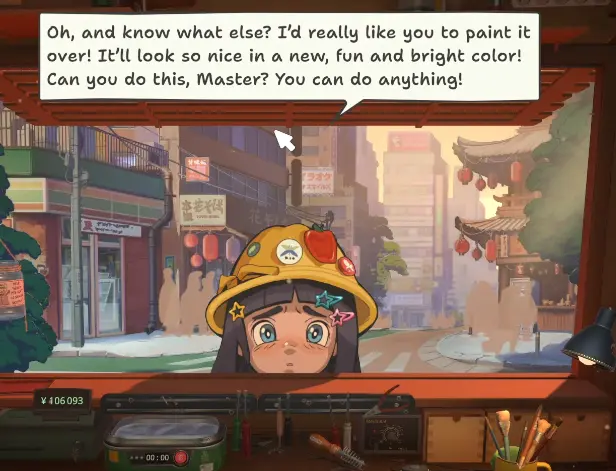
When Yui Needs Somewhere to Wait, I Send Her to the Nearby Cafe
A later Yui decision is more important than it first looks.
She appears during the competition period with another problem.
At that point I can direct her toward the nearby cafe while I handle the repair.
I choose the cafe.
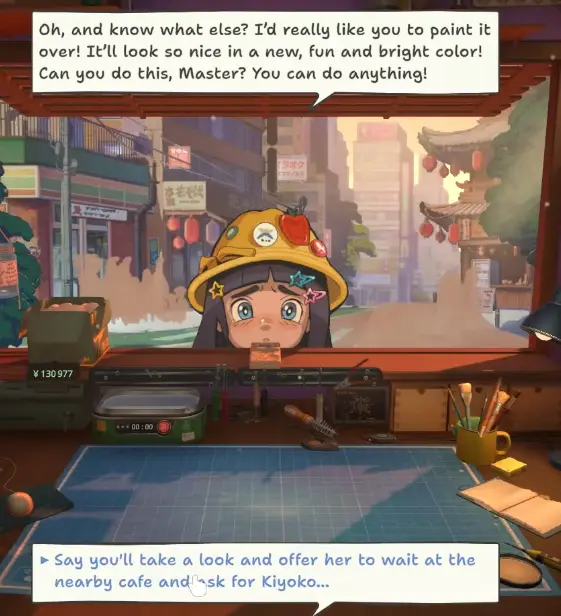
At the time, I cannot prove that this will matter.
So I continue playing.
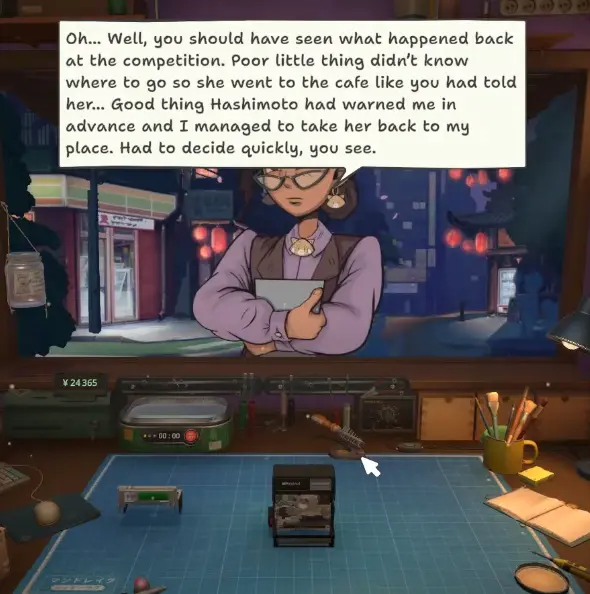
Much later, another character explains what happened after the competition situation became dangerous.
The important detail is that Yui:
went to the cafe like I told her
That is the point where I stop treating the earlier answer as flavor text.
The game remembered where I sent her.
The Cafe Choice Gets a Real Later Payoff
The later sequence explains that Yui could not safely return home.
Because she had gone to the cafe, someone there was able to take her somewhere safer while the situation around her family was being dealt with.
That gives me a much stronger rule than:
choose the nicest dialogue.
My actual rule is:
When ReStory asks me where a vulnerable recurring character should go, I prefer a location connected to people I already know rather than treating the choice as disposable dialogue.
The cafe route is one of the clearest examples I have seen of an early answer being referenced much later.
I Do Not Turn the Yui Route Into an Ending Claim Yet
The cafe choice clearly changes later story context.
That does not automatically prove:
Cafe = best ending
or:
Any other answer = bad ending
Those are different claims.
I can confirm:
I told Yui to wait at the cafe.
Then later:
the game explicitly said she went there.
Then:
she ended up protected while the danger around her escalated.
That is enough for a Choices Guide.
It is not enough for me to invent a final ending formula.
When Someone Is Being Followed, I Warn the Courier
Another late choice appears when the situation around the cafe and competition gets much more dangerous.
A character tells me she thinks someone is following her.
At that moment, the game gives me a choice involving the Courier.
I choose the option that gets him involved.
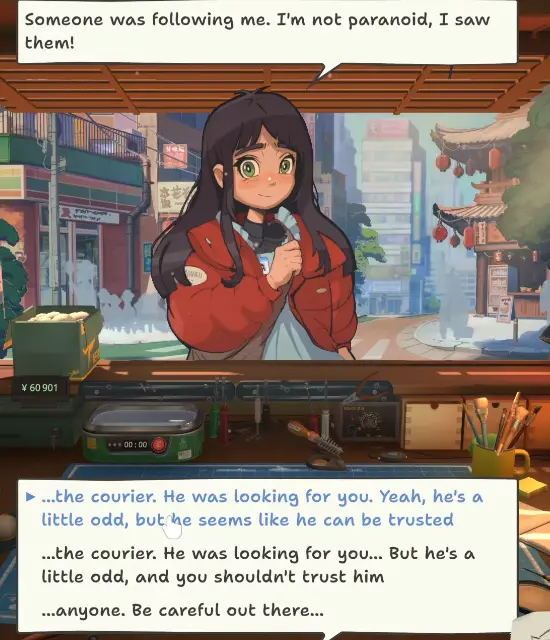
The reason I like this choice is not that I assume the Courier is secretly tied to the best ending.
It is because I have already seen enough of his storyline to know he is a recurring person who can physically show up and help.
That makes this a concrete decision rather than a vague morality choice.
The Courier Choice Pays Off Almost Immediately
After I send the warning, I do not have to wait several in-game weeks to see whether anything happened.
The following story sequence confirms that the person I was worried about is:
safe
and staying at the Courier’s place.
That is exactly the kind of consequence I am willing to put in this guide.
Choice:
contact the Courier
Observed result:
the endangered character reaches a safe place connected to him
I still do not convert that into an unverified statement about the final ending.
But if I reach this decision again, I make the same choice.
The Brick Game Cash Choice Has an Immediate Consequence, Not a Confirmed Long-Term One
One of the stranger early choices happens during a Brick Game repair.
While the device is open, I notice money inside it.
When I return the device, I get a dialogue option to tell the customer that I found the cash.
On my run, I decide not to tell him.
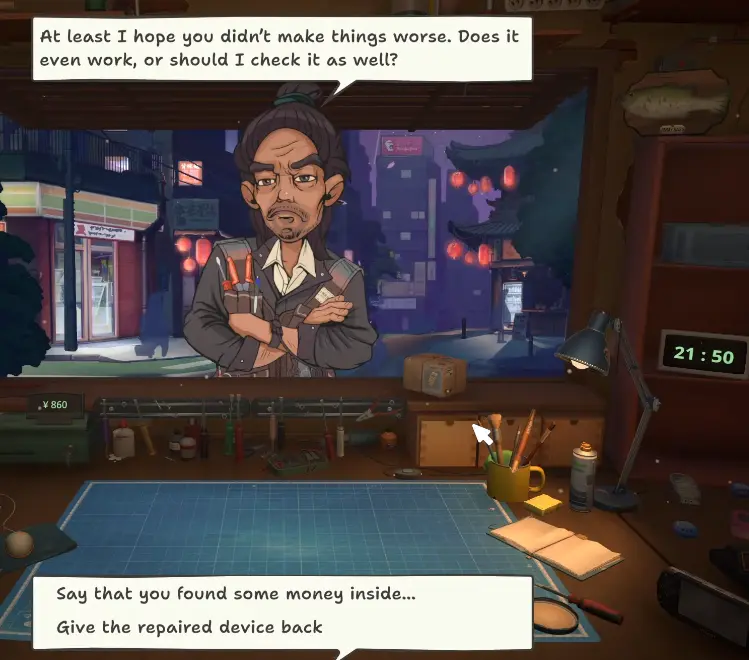
The immediate outcome is clear.
I keep the money.
The customer reacts suspiciously before leaving.
What I have not confirmed is a clean later branch such as:
keeping the cash locks an ending
or:
telling him always gives a later reward
So I do not publish either claim.
This choice belongs on the page because players can reasonably stop and wonder:
Should I tell him about the money?
My current answer is:
Keeping it gives an immediate financial benefit, but I have not verified a long-term consequence.
If I were protecting a blind first story run rather than maximizing immediate cash, I would save this as a decision worth testing on another route instead of calling one answer objectively best.
I Separate Immediate Rewards From Story Consequences
The hidden cash is a good example of why I do not use one big “best choices” list.
There are at least three different kinds of outcomes.
Immediate economic result
I gain or lose money now.
Later character result
Someone remembers what I told them or ends up somewhere because of it.
Completion or story-route result
The decision affects an achievement or potentially contributes to a larger branch.
Those are not the same level of evidence.
Yui’s free repair has a clear completion consequence.
The cafe choice has a clear later character consequence.
The Courier warning has a clear later safety consequence.
The hidden cash has a clear immediate result but no long-term route I am ready to claim.
That distinction keeps me from turning every visible response into fake certainty.
I Am Careful With Police and Hashimoto-Family Choices
The Hashimoto-family story is exactly where I slow down.
Later conversations can refer back to incidents involving the police, trust, family business, and who was told what.
I have even reached later dialogue where I am treated as though earlier actions have changed how the family sees me.
That proves to me that this part of the story can remember previous events.
What I do not yet have is a clean enough A/B comparison to say:
pick this exact line here and this exact Hashimoto outcome always happens.
So I do not build a fake flowchart.
When a choice involves:
- giving information to police;
- keeping something private;
- revealing Hashimoto-family information;
- helping someone connected to the family;
I treat it as a high-value decision and avoid clicking through casually.
But until I reproduce the branch cleanly, I describe the result I saw rather than assigning an invented universal condition.
I Treat “Who Should I Tell?” as More Important Than Tone
One pattern keeps repeating.
The choices I care about most are not:
friendly answer vs sarcastic answer
They are:
tell this person vs keep it secret
send someone here vs somewhere else
ask for help vs handle it alone
take the money vs disclose it
That is where ReStory starts behaving less like a simple repair sim and more like a branching story.
So when I reach a new choice, I ask:
Is this changing information, location, trust, or money?
If yes, I pay attention.
If it is only a different way to say “I’ll repair it,” I usually keep moving.
I Do Not Reload Every Dialogue Choice
I also do not turn the first playthrough into a constant reload test.
That makes the story harder to follow.
Instead, I keep a mental hierarchy.
I continue immediately when the choice is mostly tone.
I slow down when it affects:
Yui
the Courier
the cafe
Hashimoto-family information
police
hidden property or money
someone’s safety
Those are the points I want to compare between runs.
Everything else can wait until there is a reason to investigate it.
The Choices I Would Make Again
If I started another completion-focused run now, I would repeat these decisions.
Help Yui for free.
I have a confirmed completion reason to do it.
Send Yui to the nearby cafe when that option appears.
I have seen the later story explicitly remember the location choice and put her in contact with people who help keep her safe.
Contact the Courier when the later warning choice appears.
I have seen the next story sequence confirm a safe outcome after involving him.
For the Brick Game cash, I treat it differently.
Keeping the cash gives me the immediate benefit I observed.
But because I have not verified a later route difference, I do not present it as a mandatory “best” answer.
And for choices involving police or the Hashimoto family, I still treat the decision as important while refusing to guess at the exact final consequence.
What This Page Does Not Own
This page answers:
What choice did I make, and what did I actually see happen afterward?
It does not own:
how to unlock every achievement
That stays in the Achievements Guide.
It also does not own:
which exact sequence creates every ending
I keep those conditions separate because an observed character consequence is not automatically an ending requirement.
That boundary matters in ReStory.
The story remembers enough of my decisions that careless assumptions can easily turn into confident-sounding but wrong routes.
So until I see the final result, I keep the rule simple:
confirmed consequence first, ending theory later.