What I Do Next When Floor 1 Still Has Work to Do
I judge early progress by whether each dungeon run makes the next one cheaper, safer and more productive—not by how quickly the next floor unlocks.
Updated:
Quick Answer
Once the first settlement works, I keep using Floor 1 → settlement → upgrade → Floor 1 until an ordinary run stops creating new emergencies.
The milestones I care about are a useful four-person party, working research and leveling, reliable recovery, equipment that can handle normal Floor 1 fights, and a settlement that can turn one haul into the next expedition.
I keep farming Floor 1 while it still solves a real bottleneck. When Depletion rises, the useful materials are no longer worth another repeat run, and the party is already stable, I start thinking seriously about going deeper.
My quest log is not the progress meter I trust most in Dungeon Settlers.
It can tell me to make a Level 2 character while the base is still awkward.
The research tree can expose three new branches while I barely have the materials for one.
The party can start asking to go deeper while somebody is still limping home from Floor 1.
What tells me more is the cost of the last expedition.
If I come home, repair the damage, solve one bottleneck and leave in better shape than before, the run moved the settlement forward.
If I keep returning with the same shortages, the same exhausted characters and the same weak equipment, another floor is unlikely to fix the problem.
I Know a Run Paid Off When the Next One Gets Cheaper
The first few trips underground are expensive.
Health disappears quickly.
Energy becomes a reason to stop exploring.
Arrows need replacing.
Wood vanishes into rooms and workstations almost as soon as I bring it home.
A research unlock can reveal another recipe that wants a material I do not have.
I expect that at the start.
What I watch for is whether the recovery bill keeps shrinking.
A useful Floor 1 run might come home with enough wood to finish a room that was blocking research.
The next trip then begins with research working.
Another run might bring Mana Stones that let a capped character level.
That character makes the following fights cheaper.
A bag, a better weapon or a proper bed can have the same effect.
The individual upgrade matters less than the direction:
one expedition should improve the economics of the next one.
That is how I tell the difference between farming and spinning my wheels.
Four Members Gives Me Room for a Bad Fight
Getting the active expedition to four useful members is one of the earliest progression jumps I actually feel.
Dungeon Settlers allows up to four members in an expedition.
With only two people, one character going down can turn a manageable room into a disaster immediately.
At four, mistakes have somewhere to go.
A frontliner can absorb attention.
A ranged unit can keep dealing damage without joining the pile.
Another melee or damage role can finish dangerous targets.
The fourth slot can grow toward magic or whatever capability the group is missing.
I am not looking for a perfect endgame composition at this stage. I want four characters who do not all collapse when the same thing goes wrong.
That also lets me spread recovery items instead of putting every emergency tool on one person.
Once the group reaches that point, recruitment stops feeling like basic survival and starts becoming a build decision. I make those choices in the Builds & Party Guide.
A Full EXP Bar Changes the Next Destination
Maximum EXP looks like an invitation to fight more.
It usually sends me back to the surface.
Once the bar is capped, ordinary combat is no longer the missing step. The unit needs the settlement-side level-up process.
That is an important progression signal because it changes what a Floor 1 run is worth.
If two core members are sitting at maximum EXP, another combat-heavy sweep may have less value than going home and converting that progress into actual levels.
I also do not like leaving capped characters sitting there indefinitely while Growth Fatigue becomes another Mood problem.
The Goddess Statue, Mana Stones and prayer choices are handled in the Level Up Guide.
For my route planning, the only thing I need to remember is:
max EXP means there is useful work waiting at home.
Recovery Tells Me Whether the Settlement Is Actually Working
A base can contain plenty of buildings and still be bad at supporting expeditions.
Recovery is where I notice the difference.
A Poor Private Room gave +3 Mood after sleep.
A Sleeping Bag restored +8 Energy, and better beds recover Energy faster.
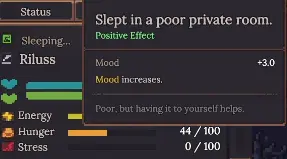
Those are small numbers compared with a weapon tooltip, but they affect every expedition.
If several characters come home exhausted and are still not ready the next time I want to leave, the settlement has not finished solving recovery.
That can make another bed or a better room more valuable than a side crafting project.
Once everybody can return, sleep and be ready for another trip without the entire base schedule collapsing around them, I start spending more freely on specialization.
Recovery has stopped being the bottleneck.
Dungeon Stay Changed the Way I Think About “Clearing” a Floor
Combat is not the only thing making a dungeon run expensive.
Time underground carries its own cost through Dungeon Stay.
The longer the party remains in the dungeon, the worse the effect becomes.
At Dungeon Stay D3, I have seen the penalty reach Mood -16.
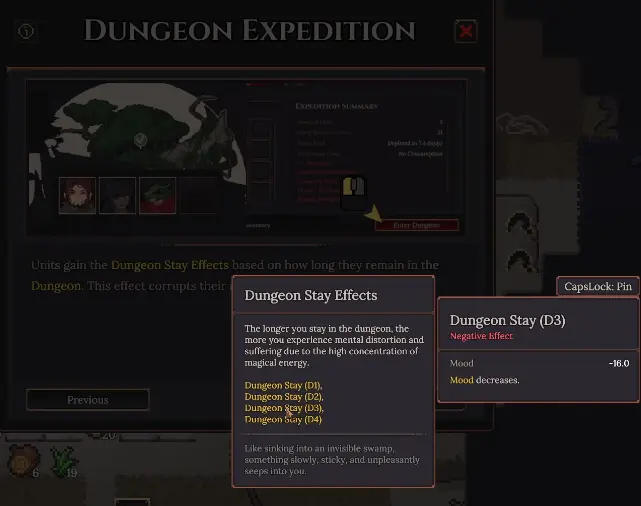
That number is large enough that an extra side room needs a reason.
A chest I can reach safely may be worth it.
A resource patch that fixes the settlement’s current bottleneck may be worth it.
Walking through more rooms because the map is not completely uncovered is harder to justify.
Monsters can also respawn or patrol as time passes, so a previously quiet route does not stay free forever.
This changes my definition of a good run.
I would rather return with the material I needed and a party that can recover quickly than squeeze the floor dry and spend the next settlement cycle repairing Mood, Energy and injuries.
Floor 1 Is Still Useful Long After the First Clear
I do not stop visiting Floor 1 because I have already seen it once.
The layout changes, and the resources it provides remain useful across several early systems.
I can still come back for:
- Mana Stones;
- Research Books;
- wood and grass;
- food;
- equipment and chest loot;
- materials that finish a production chain.
Because the dungeon is procedural, I am not repeating a memorized farming route.
I am repeating a purpose.
If the settlement needs timber, I enter looking for timber.
If research has stalled, valuable chests become more important.
If several characters are waiting on Mana Stones, enemy drops gain more value.
That keeps Floor 1 productive even after the quest flow starts pointing elsewhere.
The mistake is not repeating Floor 1.
The mistake is repeating it without knowing what another run is supposed to accomplish.
Depletion Tells Me When Repetition Is Losing Value
Dungeon floors are not an unlimited resource faucet.
They have Depletion.
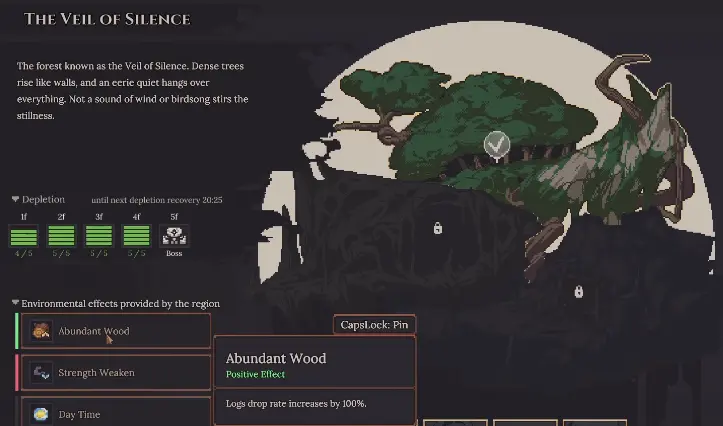
Repeated expeditions consume the floor’s available charges, and item drops become worse as the floor depletes. The charges recover over time.
On one early cycle, Floor 1 had already moved to 4/5 charges after a previous run.
One missing charge does not make me abandon the floor.
The charges regenerate, and a partially depleted Floor 1 can still be exactly where I need to go.
Depletion becomes useful as a decision signal when two conditions meet:
the floor is paying less,
and the settlement no longer has a strong reason to keep farming it.
If Floor 1 is depleted but I urgently need a resource I can still get there, I may use it anyway.
If the active party is stable and the next meaningful materials are deeper, repeating the same floor starts losing its advantage.
That is the point where progression and depletion begin pointing in the same direction.
A Good Modifier Can Make One More Run the Right Answer
Depletion is only half of what I check on the expedition screen.
The current environmental effects can change the value of a run dramatically.
I have seen Abundant Wood increase the log drop rate by 100%.
If the settlement is short on timber, that modifier can make one more Floor 1 trip more valuable than whatever the quest log is suggesting next.
The same principle works the other way.
A negative effect that directly hurts the party’s current strengths makes me less ambitious.
I do not need every modifier to change my destination.
Sometimes it changes what I do inside the destination.
With Abundant Wood active, timber becomes the priority.
With an irrelevant magic bonus on a physical party, the modifier barely matters.
The expedition screen is not just telling me where I can go. It is giving me information about what the current run is unusually good—or bad—at doing.
Sometimes Buying the Bottleneck Is Better Than Farming It
A dungeon merchant can turn gold into progression much faster than another complete resource run.
I found one while the settlement needed several raw materials at once.
I had an item I was unlikely to use, so I sold it.
Then I bought:
wood, bone and stone.
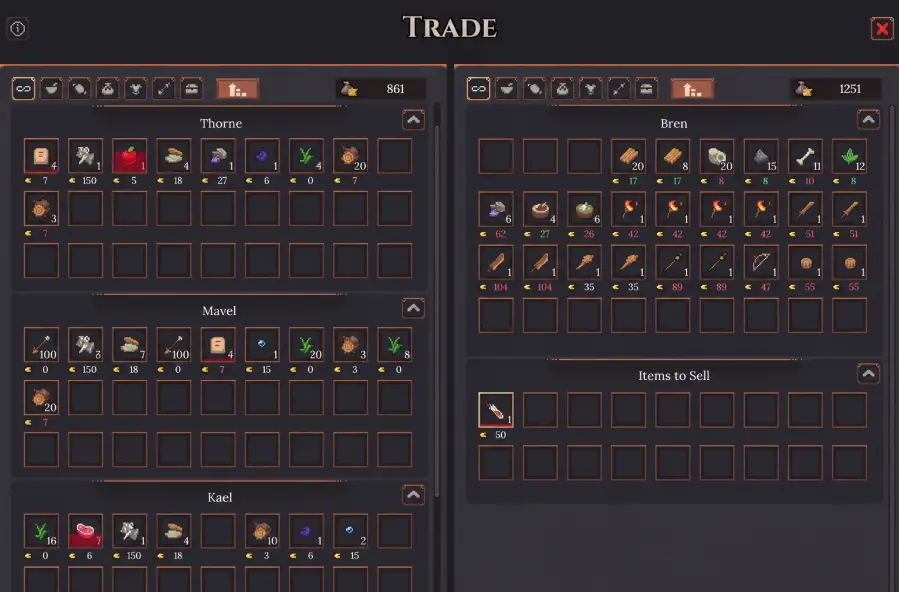
Wood Planks were also available.
I left them there.
They were more expensive, and I did not have a project urgently waiting for planks at that moment.
Raw wood had several immediate uses, so buying it saved a productive dungeon trip.
The processed material would mostly have saved future convenience.
That is the distinction I use when deciding whether to buy.
If a purchase completes a room, workstation, weapon or material chain that I can use right now, spending gold can move progression forward.
If the merchant is merely offering something I can already produce and do not need yet, cash is more flexible than the item.
Side Projects Wait When the Active Four Are Still Lagging
Once the base begins working, it becomes very easy to expand in every direction.
A better dining room sounds useful.
Alchemy opens more possibilities.
A magic workstation is interesting.
Housing can improve.
Storage can grow.
Meanwhile, somebody in the active party may still be wearing equipment that already feels weak on Floor 1.
That is the situation where I stop widening the settlement.
The main four are the engine bringing resources home.
An upgrade that makes those four safer or more efficient can pay back on every later trip.
A side workstation that I cannot use yet does not.
This does not mean I only build combat infrastructure.
A bedroom that gets a core character back into the dungeon faster is part of expedition progression.
A storage upgrade that lets me carry more useful loot home can be too.
I only want the project to answer a current problem rather than create another unfinished branch.
The specific weapon, role and skill decisions stay in the Builds & Party Guide.
The Game Can Tell Me to Go Deeper Before I Agree
One of the more interesting progression moments happens when the party itself gets impatient.
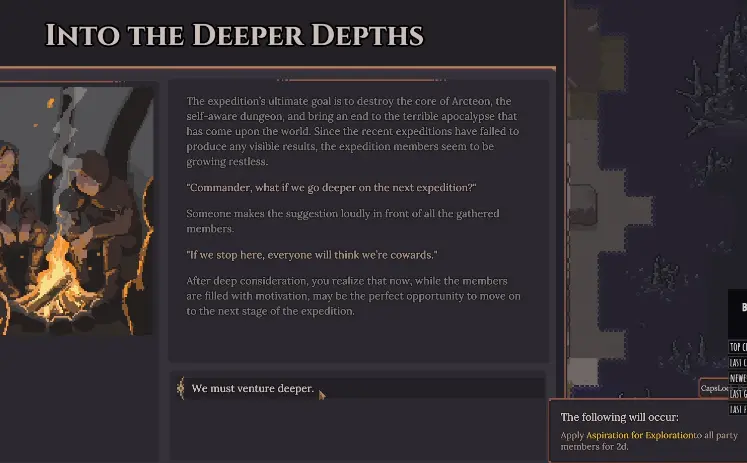
After repeated expeditions without visible deeper progress, I triggered Into the Deeper Depths.
The group wanted the next expedition to push farther.
Choosing to move on applied Aspiration for Exploration to the party for 2 days, with positive Mood and extra Energy.
That buff is valuable.
It is not a readiness test.
After receiving it, I still had useful settlement work to finish.
Bedrooms needed attention.
The alchemy setup mattered.
There were upgrades that would make a deeper trip less dependent on everything going right.
That event clarified something I now use throughout progression:
the game can tell me what direction the story wants to move without guaranteeing that today’s party should move there immediately.
I take the motivation.
Then I finish the preparation that has already shown me it matters.
Floor 2 Starts Where This Progression Loop Stops
I consider the early Floor 1 loop nearly finished when another repeat run has noticeably less to offer.
The active expedition has four useful members.
Capped characters can actually level.
The settlement can recover the party without turning every return into a crisis.
Ordinary Floor 1 combat feels manageable.
Research, equipment and production are no longer constantly blocked by the same basic shortages.
Depletion makes another identical run less attractive.
The resources I actually want are beginning to point deeper.
At that point, I stop asking whether Floor 2 is unlocked.
I start asking whether the next trip has enough margin for an unfamiliar floor.
That preparation—Level 2 expectations, the Return Scroll, stronger ammunition and the exit plan—is in the Floor 2 Guide.
When I Lose Track of What to Do Next
I use a few checks to find the real bottleneck.
The expedition is still below four useful members
Recruitment still has immediate progression value.
A core member is sitting at maximum EXP
I have unfinished work at the settlement.
One normal Floor 1 run nearly wipes the group
Going deeper is not the next problem. Survival on the current floor is.
The party comes home and cannot recover cleanly
Beds, rooms, supplies or settlement labor need attention.
A building or item is blocked by one resource
The next run gets a specific collection target, or I buy the material if the merchant makes that cheaper.
Floor 1 is becoming depleted but still solves an urgent shortage
I can keep using it; depletion alone is not a reason to leave.
Floor 1 is depleted and another run has no clear purpose
That is when repeating it starts looking like avoidance rather than progression.
These questions work better for me than a fixed Day 1 / Day 2 / Day 3 route because the dungeon layout, modifiers and material shortages do not repeat cleanly between runs.
Early Progression Ends When Returning Home Feels Routine
The most important milestone is surprisingly quiet.
Floor 1 no longer creates an emergency every time I enter.
Characters come home tired instead of barely alive.
The settlement can recover them.
A research decision turns into something I can actually build.
Materials coming out of the dungeon have known jobs.
The active four have roles rather than random starting equipment.
Another expedition feels like a planned cycle instead of another attempt to repair the damage from the previous one.
That is the point where going deeper finally stops competing with obvious unfinished work above it.
The opening loop has done what I needed it to do.
Now the dungeon can start asking harder questions.