The Food Loop I Use Before Hunger Starts Choosing My Route
I forage early, then switch to cooking and food policies once shortages start changing where the party goes and what the settlement can afford to do.
Updated:
Quick Answer
For the opening runs, I gather Blueberries, apples and other edible dungeon loot and keep the trip short.
Once the expedition screen starts warning about Party Food, I move toward a repeatable loop: unlock cooking, build the Cooking Workstation indoors, place Food Storage close to it, then use Consumption Policy so ingredients reach the kitchen instead of disappearing raw.
For a deeper or less predictable expedition, I clear the food warning before leaving.
The first food shortage I cared about was not somebody collapsing from hunger.
It was the expedition screen refusing to let food stay in the background.
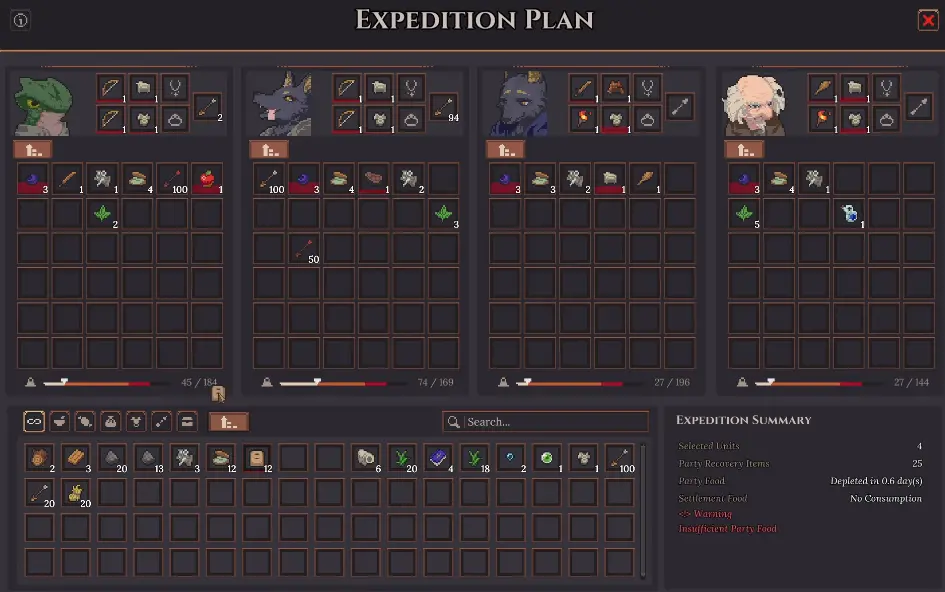
I had four characters equipped.
Food had been handed around.
The party looked ready.
The summary still showed only 0.4 day(s) before Party Food was depleted and flagged the supply as insufficient.
That was the moment I stopped judging food by the number of edible items I could see.
Dungeon Settlers was already calculating the trip I was about to ask those four people to make.
Blueberries Carry the Opening Better Than I Expected
Blueberries are one of the early foods I rarely walk past.
The tooltip gives them two useful effects:
Hunger Restoration 10
and
Mood +3 for 300 seconds.
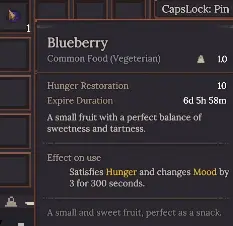
That Mood effect changes who I want eating them.
A character who is already unhappy from a dungeon aftereffect gets more from the berry than somebody sitting comfortably at high Mood.
I also like Blueberries because Floor 1 can provide them while I am already there for something else. A timber run can pick up food without becoming a dedicated food expedition.
The limitation is reliability.
Dungeon rooms change between runs, so I cannot build the settlement’s long-term food economy around returning to one remembered berry patch.
Blueberries are excellent opening supplies.
They are not food infrastructure.
Party Food Is a Clock, Not an Item Count
Manually splitting food between four inventories initially gave me a false sense of security.
Everyone had something to eat.
That did not mean the expedition had enough duration.
The planner is more useful because it translates the current supply into time.
That is the number I read before leaving.
A short Floor 1 collection trip can work with a thin margin because I already understand the likely risk, I can turn around early, and food may appear along the way.
An unfamiliar deeper trip has none of those advantages.
The same pile of food therefore has different value depending on the route.
This keeps me from carrying a huge pantry into every five-minute resource run, while also preventing the opposite mistake of treating “some food” as enough for an expedition whose exit I have not found yet.
The Warning Changes My Run Before It Changes My Research
When food is low, the dungeon starts pulling my attention away from whatever I entered for.
A run for wood becomes:
there are Blueberries over there.
A material route becomes:
maybe the next room has apples.
That is manageable for a while.
If useful food is beside the route, I take it.
If a nearby edible resource solves the current shortage without exposing the party to much extra risk, that is efficient.
The warning becomes a real problem when I start taking fights because I am hoping the room behind them contains food.
At that point hunger is setting the route.
That is usually when I want the settlement to take over more of the job.
I Move Into Cuisine When Scavenging Stops Being Convenient
I do not need a kitchen on the first dungeon trip.
I need one when repeated scavenging starts interfering with everything else.
The research choice becomes much easier once food has already caused:
- a delayed departure;
- an insufficient Party Food warning;
- a resource run to turn into a forage run;
- repeated dependence on whatever edible room happens to generate.
That is when Cuisine deserves Research Books.
The complete technology priority stays in the Research Guide. From the food side, my threshold is narrower:
if I am scheduling expeditions around food, food production is already part of progression.
Grass Porridge and farming-related research become more attractive at the same stage because they give me additional ways to turn settlement resources into calories.
Grass is especially interesting because I am already collecting large amounts of it for textiles and other construction.
Porridge gives that stock another emergency use.
The downside is that settlers are not particularly happy about eating it, so I treat it as a fallback rather than the meal I want to build the entire economy around.
My First Kitchen Only Needs to Complete the Loop
Once Basic Cuisine is available, I care much more about logistics than room quality.
The working chain is:
enclosed room → Cooking Workstation → nearby Food Storage → ingredients available to workers → cooked food.
The indoor requirement matters.
Like several production buildings in Dungeon Settlers, a Cooking Workstation can exist on the map and still fail to function because the room does not count as properly enclosed.
Once the room registers, I put Food Storage close to the workstation.
Then raw ingredients such as meat and turnips have a short path into production.
My early goal is not a polished dining complex.
It is getting food from:
loot
to
storage
to
cooking
to
the party
without manually rescuing the system every time somebody gets hungry.
Consumption Policy Is What Made the Kitchen Reliable
The Cooking Workstation exposed a problem that more recipes would not have fixed.
Settlers were already allowed to eat ingredients.
If somebody consumes the Tough Raw Meat I planned to grill, the kitchen never receives it.
That is where Consumption Policy becomes part of food production.
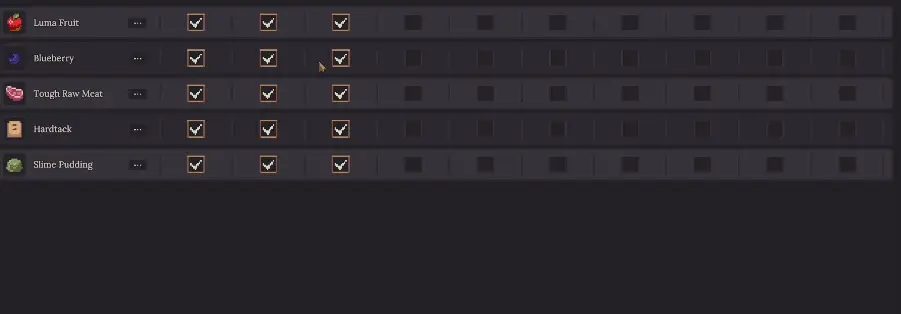
In one mixed party, I blocked human settlers from eating Tough Raw Meat while allowing the Lizardman to keep access to it.
That alone was not always enough.
A character could still be physically carrying meat that I wanted the settlement to process.
I had to make the character drop the meat so it could return to the settlement inventory and enter the cooking workflow.
That is an important troubleshooting step.
If the Cooking Workstation is ready but the ingredient seems to be missing, I check individual inventories before assuming production is broken.
Food Preference Makes “Edible” a Bad Enough Standard
The party does not react to every food in the same way.
My Lizardman made that obvious.
Vegetarian foods such as Blueberries and Luma Fruit can clash with Lizardman preferences through Plant Rage.
Elves can have the opposite problem through Meat Rage.
So availability is only the first question.
The next one is:
who should actually eat this?
In a mixed group, I use policy to keep several things from happening:
vegetarian food going to somebody who dislikes it;
meat disappearing into a character who would rather eat plants;
raw cooking ingredients being eaten before production;
valuable Mood food being consumed by whoever happened to get hungry first.
That gives Consumption Policy more value than I expected from a simple permissions screen.
It is not just controlling diet.
It is deciding where scarce food produces the most useful result.
Tough Raw Meat Changes Value After the Kitchen Exists
Before cooking, Tough Raw Meat is mainly an edible resource with species preference attached to it.
After cooking is available, it becomes production material.
That changes what I consider waste.
If I let every character eat the raw meat as soon as hunger appears, I may never get the cooked output from the workstation I just built.
My sequence after a dungeon haul is therefore straightforward:
get the ingredients out of character inventories,
protect the ingredients with Consumption Policy,
let workers move them into Food Storage,
then cook.
If the workstation is idle while settlers are walking around with meat in their pockets, adding another food technology is not the answer.
The food already exists.
It is simply in the wrong place.
Food Storage Matters Because the Kitchen Competes With the Whole Settlement
Hauling looks trivial when the base is tiny.
It becomes less trivial once workers are moving:
wood,
stone,
grass,
equipment,
ammunition,
research materials,
and food
through the same settlement.
Putting Food Storage beside the kitchen reduces how much of that traffic cooking has to fight through.
This is why I value the kitchen as a workflow rather than a room.
A workstation on one end of the settlement and ingredients scattered through random inventories can technically satisfy the building requirements while still producing food badly.
Short paths make the system much more dependable.
That matters most when the expedition is already waiting to leave.
A Dining Room Is a Later Improvement, Not the Food Fix
Once cooking works, a dining space can start adding more value through room quality and Mood.
That is useful.
It is also downstream of the real shortage.
A settlement with attractive tables and no steady meals still has a food problem.
I first want:
ingredients arriving,
cooking completing,
finished food available,
and consumption behaving sensibly.
Better floors, furniture and room quality make the dining setup more rewarding afterward.
That keeps me from spending construction material on the part of the food system that looks finished while the actual production chain is still unreliable.
Short Floor 1 Runs Can Use a Thinner Food Margin
I do not react to every low-food state by cancelling the expedition.
Context matters.
If the plan is:
enter Floor 1,
take a small amount of wood,
check a few nearby rooms,
use a route I already understand,
return,
then a modest supply can be workable.
I have ignored a low-stock concern on exactly that kind of run because I had no intention of staying underground long.
Finding Blueberries along the way can extend the margin further.
That judgment changes when the expedition is supposed to descend.
The unknown floor may take longer.
The next portal may not be obvious.
Combat can consume more Energy and recovery items.
A food shortage that was acceptable for a controlled Floor 1 loop becomes an unnecessary extra failure condition.
That is where I want the warning cleared before entering.
Food Shortages Make Unrelated Rewards Look Different
One of the clearest signs that food had become a real strategic problem came from a settlement event rather than the kitchen.
A Thousand-Colored Bird created a choice between outcomes that included money and food.
When the settlement is comfortable, that can be evaluated as an ordinary reward decision.
When the food supply is collapsing, the edible option suddenly has much more leverage.
That is the point I watch for.
Food scarcity has escaped the food system and started distorting:
research choices,
event choices,
dungeon routes,
carried supplies,
and return timing.
One event does not make me rebuild the settlement around food.
Repeated decisions like that do.
I Stop Foraging Once the Food Run Has Already Succeeded
Food scarcity creates a very specific form of greed.
I enter needing supplies.
I find enough to solve the immediate problem.
Then the next room might also contain food.
And the next one.
Meanwhile:
Energy falls,
the party accumulates damage,
and the known exit gets farther behind me.
Once I am carrying enough food to relieve the shortage, another dangerous room needs a better reason than maybe there are more apples inside.
I bring the haul home and let the settlement multiply its value through storage, policy and cooking.
Food in a dead expedition does nothing for the settlement.
I Know the Food Loop Is Working When I Stop Thinking About It
The strongest food setup is not the one with the largest pile of meals.
It is the one that stops interrupting everything else.
I can form the four-person expedition without immediately seeing an insufficient-food warning.
Raw ingredients actually reach the kitchen.
Tough Raw Meat is not disappearing before workers can cook it.
Different settlers are not casually eating food that clashes with their preferences.
Blueberries can be saved when their Mood effect is more useful elsewhere.
A short timber run stays a timber run.
That is when the system feels stable.
The dungeon is still supplying food and ingredients, but the expedition is no longer spending every trip trying to rescue the settlement from hunger.