Why 30/30 EXP Still Didn't Give Me a Level
A full EXP bar only makes a settler eligible to level. I use the Goddess Statue, Mana Stones and prayer choices to turn that progress into real stats.
Updated:
Quick Answer
If a settler is sitting at maximum EXP, I stop farming XP and take them back to the settlement.
I research Wood Processing, make the required Wood Planks, build the Wooden Goddess Statue from the Special menu, then use the statue with that settler and pay for a prayer with Mana Stones.
My first Level 2 Normal prayer cost 4 Mana Stones. I use the cheaper option when several core members need levels and save heavier prayers for characters whose long-term role is already clear.
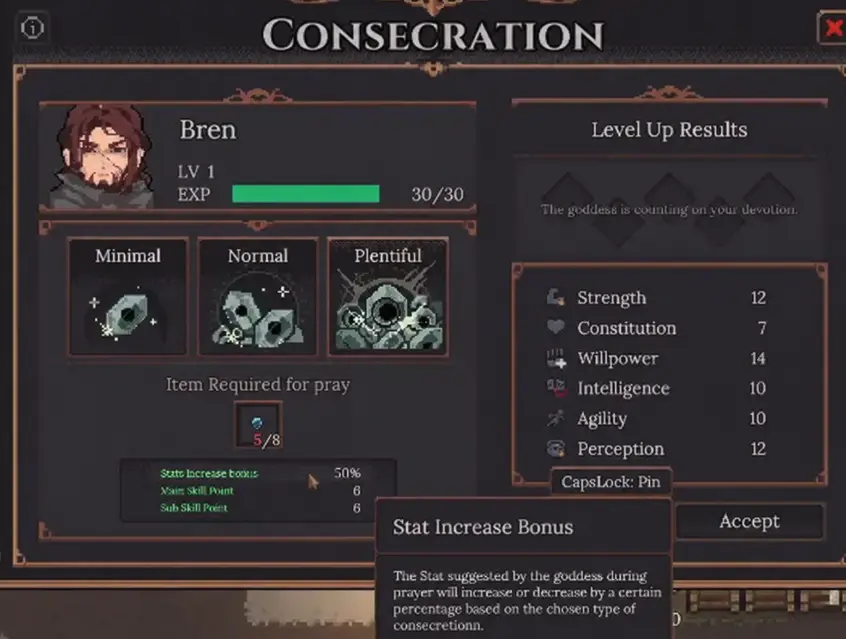
One of my Level 1 settlers reached:
EXP 30/30
and stayed Level 1.
That was the moment I understood that Dungeon Settlers separates earning a level from performing the level-up.
Combat fills the EXP bar.
The actual level happens back at the settlement.
Until that second part is working, another room full of enemies is solving the wrong problem.
30/30 EXP Means I Am Done Farming XP for That Settler
The clearest warning is Growth Fatigue.
I originally read it as another generic Mood problem.
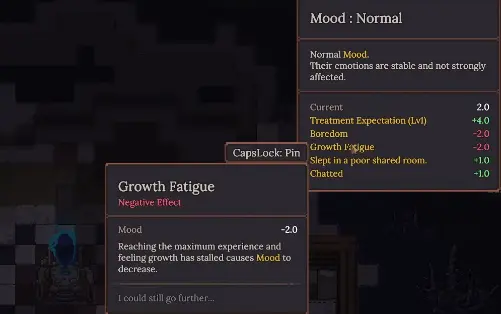
The tooltip made the cause much more useful: the character had already reached maximum EXP and was waiting for growth.
In the state I checked, Growth Fatigue was applying:
Mood -2
That changes my dungeon decision immediately.
A character at 30/30 does not need a better XP route.
They need access to the Goddess Statue.
If several members of the active four are capped, the settlement becomes more valuable than another combat-heavy Floor 1 sweep.
Leveling Is Really a Small Settlement Production Chain
The part that confused me was how many apparently unrelated systems sit between “EXP full” and “Level 2.”
The path that worked was:
- return the eligible settler to the settlement;
- complete Wood Processing;
- turn Logs into Wood Planks;
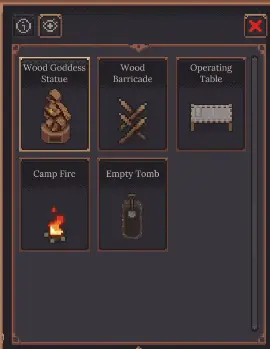
- open the Special construction category;
- build the Wooden Goddess Statue;
- interact with the statue using the settler who is ready;
- choose a prayer and supply its required items;
- accept one of the resulting level-up rewards.
The easy mistake is stopping after Wood Processing.
Researching the technology unlocks the path, but raw Logs are still not the finished building material.
I need Planks.
That is why I now treat Wood Processing as part of leveling rather than just another woodworking upgrade.
If the broader question is what to research after this first gate, I choose the next branch from the Research Guide.
The Statue Solved One Problem and Exposed the Next One: Mana Stones
Building the statue does not make leveling free.
Prayer consumes resources.
The early material I watch most closely is Mana Stones.
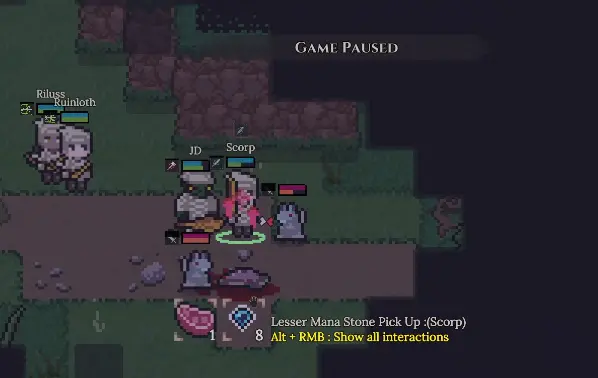
I collect Lesser Mana Stones whenever I see them drop in the dungeon because they sit at the intersection of several systems: character growth, magical production and later crafting can all want them.
Before anyone is capped, another stone is future value.
After two or three core characters hit maximum EXP, the same drop has an immediate job waiting at home.
That is when I am happy to make another Floor 1 run specifically for stones instead of forcing a deeper floor with an underleveled party.
Four Mana Stones Was Cheap Enough That I Leveled Immediately
My first Level 2 upgrade used a Normal prayer.
The cost was:
4 Mana Stones
For a member of the active expedition, that was an easy trade.
The character had already finished earning the EXP.
Growth Fatigue was providing a downside.
The level would improve someone I expected to take underground again immediately.
At four stones, leaving that progress unused made less sense than paying.
What I stopped doing was assuming that every future level would stay that cheap.
Later, another leveling check showed a requirement of:
24 Mana Stones
That is a completely different budget decision.
The first four-stone prayer encouraged me to get the core party online.
The 24-stone requirement told me that leveling would eventually compete much harder with the other things Mana Stones can fund.
So I no longer think of the resource as an automatic XP tax.
It is a progression currency.
Plentiful Prayer Showed a 50% Stat Increase Bonus
The Goddess Statue also lets me decide how heavily to invest in a level.
On one Consecration screen, the character was still visibly sitting at Level 1, EXP 30/30, while the prayer options included Minimal, Normal and Plentiful.
Selecting Plentiful showed:
Stat Increase Bonus 50%
That 50% is tempting.
It is not automatically my default.
If one character is clearly the permanent frontline or main physical damage dealer, putting more resources into that level can make sense.
If three members of my active four are all waiting at the statue, spreading cheaper prayers across the group may improve the next expedition more.
The question I ask is not:
Which prayer makes the biggest number?
It is:
Where does the next Mana Stone improve the party most?
That becomes increasingly important once prayer costs stop looking like four-stone purchases.
Talent Decides How Much Major Stat Growth a Level Can Produce
Prayer investment is only one part of the stat result.
Talent changes a character’s growth potential in each Major Stat.
The grades I have seen are:
- Poor
- Moderate
- Outstanding
- Exceptional
- Genius
Higher Talent allows more growth in that Major Stat during Level Up.
That means two Level 1 settlers reaching the statue with the same EXP are not necessarily equally attractive places to make a large investment.
A character with strong growth in the stats their role actually needs can make better use of a richer prayer over time.
This is why recruitment information matters long after I have paid the hiring cost.
Starting level is temporary.
Talent keeps influencing what future levels can become.
I still do not use Talent alone to pick a build. Equipment, skill access and the party’s missing role matter too. Those choices are easier to compare in the Builds & Party Guide.
For the statue decision, Talent tells me how much I should care about maximizing a particular character’s growth.
The Result Screen Can Change More Than the Base Stats
The level-up does not end with a generic “stats increased” message.
I get a result to evaluate.
One of my actual Level Up Results included:
Low-grade Max Weight Inscription — +20% Max Weight
alongside Major Stat gains including:
Agility +4
and
Perception +2
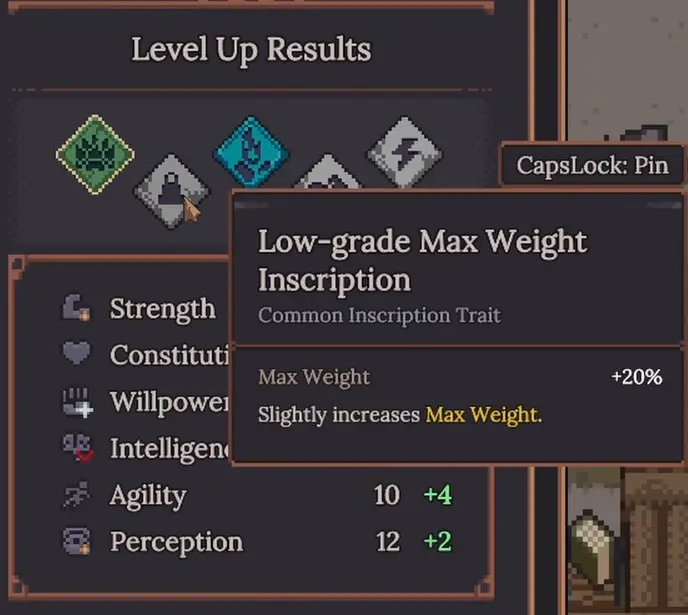
That is a much more interesting decision than simply gaining one level.
The inscription can change what the character is good at carrying, surviving or dealing.
The Major Stat gains move the underlying character forward.
And different result choices can push the same settler in different directions.
I have seen options involving:
physical attack,
critical chance,
life steal,
hit chance,
Energy,
movement,
and weight-related effects.
That is why I slow down on this screen.
A stronger-looking percentage is only useful if the character can exploit it.
I Learned That “More Attack Speed” Can Still Be the Wrong Level-Up Choice
One archer result made this very obvious.
Attack Speed was attractive.
More attacks should mean more damage.
But more attacks also meant burning through arrows faster.
Hit Chance was available too.
For that character, I preferred the accuracy because ammunition was already part of the expedition budget.
That is the kind of choice I make after leveling:
not “which stat is universally strongest,”
but “which result improves this character without creating a bigger problem somewhere else.”
A physical melee character can evaluate a +20% Physical Attack option very differently.
A future caster may not care about the same reward at all.
The statue creates the options.
The job I expect the character to perform gives those options context.
Levels Also Change What the Skill Tree Can Do
After a level, I check skills before sending the party straight back underground.
The gain is not only a larger stat sheet.
Higher levels also move characters toward more Main Skill and Sub Skill options.
That is where an early Level 2 character starts separating from the Level 1 version in actual combat.
A frontline can continue into defensive tools.
An archer can start leaning harder into ranged specialization.
A melee damage dealer can access stronger attacks or supporting passives.
Some nodes remain locked behind later levels even when I already have skill points.
I have seen a defensive path where Level 4 was still required before the next skill became available.
So I distinguish between:
having skill points
and
having enough character level to reach the skill I want.
That gives leveling another value that is easy to miss when staring only at the stat increases.
Four Stones and Twenty-Four Stones Lead to Different Priorities
The stone budget is where my leveling decisions eventually stop being automatic.
At the cheap end, I usually level immediately when:
- the settler is part of my active four;
- EXP is already capped;
- Growth Fatigue is active;
- the next expedition is getting harder;
- the character’s role is reasonably clear.
The first Normal prayer at four stones fit that situation perfectly.
Once I start seeing much larger requirements, I become selective.
I may wait when:
- several core settlers are eligible at once;
- magic production is also consuming Mana Stones;
- one character’s eventual role is still unclear;
- a richer prayer would leave the rest of the active party underleveled;
- the current Floor 1 runs are already easy enough that the level is not urgent.
That is the point where the roster matters more than the individual character.
I would rather improve the expedition than create one over-invested settler surrounded by three unfinished ones.
I Do Not Need Floor 2 to Fix a Level 1 Party
The first levels can already be supported by Floor 1.
That matters because it prevents a bad progression loop:
the party is underleveled,
so I go to a harder floor,
hoping the harder floor will provide what I need to stop being underleveled.
Mana Stones can already drop upstairs.
EXP is already available there.
If the Goddess Statue is working, Floor 1 can keep feeding the first leveling cycle while the party grows strong enough for the next stage.
When the question changes from “how do I level?” to “is this party ready to descend?”, I make that call using the Floor 2 Guide.
Level 2 helps.
It is not the entire readiness test.
The Leveling Problem Becomes Easy to Read Once the Statue Works
After building the Goddess Statue once, I stop thinking of a stalled level as a mystery.
The character state tells me which part is missing.
The EXP bar is not full
The settler still needs experience.
The bar is full but the Goddess Statue is unavailable
The settlement-side Wood Processing and construction chain is unfinished.
The statue is ready but the prayer cannot be funded
I need the required Mana Stones or other offering items.
Several core characters are capped at once
The problem is now resource allocation, not experience gain.
The prayer is affordable but I am unsure which reward to take
I look at the character’s Talent, equipment and intended role before committing.
That is the whole loop I was missing when I first saw a Level 1 settler sitting at 30/30 EXP.
The EXP bar had already done its job.
The rest of the level was waiting at home.