The Early Party I Trust When Floor 1 Starts Hitting Back
My early party is built around four jobs: hold enemies, punish them in melee, attack safely at range, and add a fourth role only when its gear actually works.
Updated:
Quick Answer
My most reliable early party has one durable frontline, one heavy melee attacker, one archer and one flexible fourth slot.
I recruit for the missing job rather than the highest starting level. For the roles themselves, I use shield skills to keep enemies together, put the greatsword on someone who can tolerate its accuracy penalty, keep the archer at range for Sniping Shot, and only turn the fourth member into a mage once the staff and elemental crafting chain are actually ready.
A Level 2 recruit once lost the job to a Level 1 candidate in my settlement.
That sounds backwards until I look at the party instead of the recruitment list.
I already had a guard.
I already had an archer.
I already had a two-handed melee fighter.
What I needed was a fourth character who could grow into a different role without bringing traits or Major Stat weaknesses that would fight the plan.
That decision sums up how I approach early builds in Dungeon Settlers.
I am not assembling four individually impressive character sheets.
I am trying to make four settlers useful at the same time.
Four Jobs Cover More Problems Than Four Similar Damage Dealers
The party shape I keep returning to is:
Frontline — stays next to multiple enemies and gives the rest of the group room to work.
Heavy melee — turns a controlled target or cluster into actual kills.
Archer — removes dangerous enemies while spending as little time as possible inside the melee pile.
Flexible fourth slot — adds something the first three cannot already do, with magic becoming especially useful once its equipment chain is complete.
I have used a shield-oriented guard, a greatsword Lizardman and an archer as the physical core.
The fourth slot has changed.
In one party I was building toward Nature Magic.
In another, Fire Magic eventually came online.
The exact characters matter less than avoiding four copies of the same weakness.
A Burn-immune enemy should not switch off the whole team’s damage.
A melee cluster should not force every attacker into the same dangerous tile.
One settler going down should not leave the expedition without any way to finish the fight.
That is what the four jobs are trying to prevent.
The Recruitment Screen Is Where the Build Really Starts
Starting level is useful information.
It is not the first filter I use.
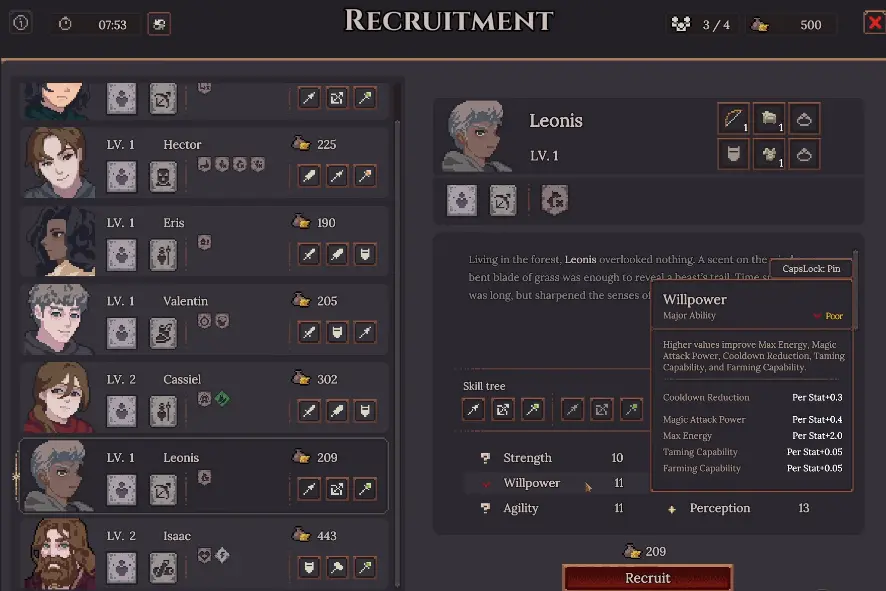
In one recruitment round, Isaac was Level 2 while the other serious candidates were Level 1.
I still chose Deina.
Isaac had the immediate level advantage and useful logging capability, but his profile did not fit the future role as cleanly.
Leonus had Poor Willpower and a trait that made him hostile toward Lizardmen. That was especially awkward because a Lizardman was already part of the active expedition.
Deina had Slow Learner, but the rest of the sheet was more interesting for what I needed. Her visible growth included:
- Exceptional Strength
- Outstanding Perception
She gave me more room to decide where the fourth slot would go.
A starting level can be replaced by experience.
A bad role overlap or permanently awkward trait is harder to erase.
The recruitment list also refreshes over time, so I am comfortable passing on a batch where every candidate creates a problem I do not need.
Talent and Major Stat growth become more important as those characters start leveling. The actual prayer and growth mechanics are in the Level Up Guide.
The Frontline Becomes Useful When Standing Next to Enemies Is an Advantage
My tank is there to make positioning easier for the other three characters.
That sounds obvious, but a settler carrying a sword does not automatically perform that job.
The shield and Guardian skills are where the role begins to reinforce itself.
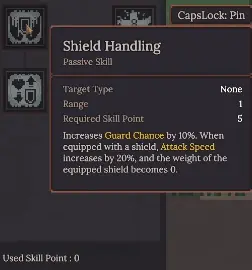
Shield Handling gave the setup I used:
- Guard Chance +10% while equipped with a shield
- Attack Speed +20%
- the shield’s weight becomes zero for the effect
Guard is more interesting once I combine it with active defense.
One Fortification-based counter setup lasted 12 seconds and retaliated for 200% of Physical Attack Power when blocking.
Now blocking is doing two jobs.
It reduces the chance that the front collapses, and it can punish enemies for attacking the character who was supposed to be absorbing that pressure anyway.
Bastion fits the same idea from another direction:
+4% Guard Chance for each adjacent enemy.
A three-enemy pile is exactly where I want the dedicated frontliner to become harder to break.
That is much more useful to me than turning the same character into another generic attacker.
Some of the deeper defensive tree still waits on levels. I saw Withstand require Level 4, so I do not plan the opening build around a node the character cannot reach yet.
The early version only needs to do one thing consistently:
hold the ugly part of the room together.
The Wooden Great Sword Is Not a Free Damage Upgrade
My heavy melee slot gets a very different set of tradeoffs.
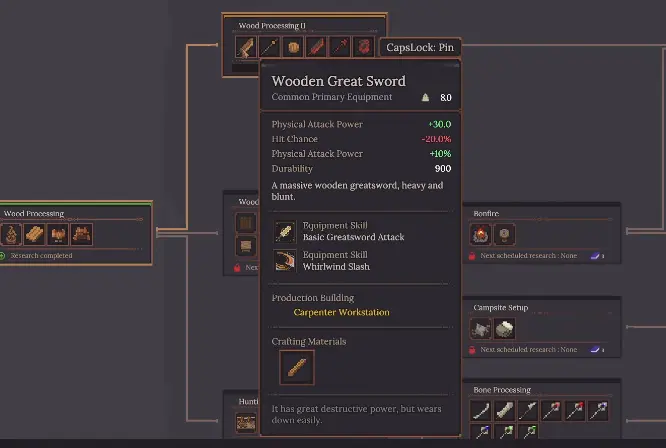
The Wooden Great Sword I checked had:
- Physical Attack Power +30.0
- Physical Attack Power +10%
- Hit Chance -20.0%
- Durability 900
- Weight 8.0
The number that keeps me from treating it as a universal upgrade is:
Hit Chance -20%.
A big attack value does very little while the character is missing the target.
I want the weapon on someone whose aptitude, skill direction and existing stats can support it.
My Lizardman melee character was a much more natural home for it than a settler I was trying to turn into a caster.
The Great Sword reinforces what that character already does well.
It does not need to rescue a mismatched build.
Destructive Split Makes the Tile Behind the Enemy Matter
The strongest melee hit can also create a positioning problem.
Destructive Split landed for 320 damage in an early fight.
It could stun and continue through enemies behind the initial target.
That makes a straight enemy line attractive.
It also means I care about what is standing on the far side.
The attack can hit allies.
A perfect-looking line through two enemies becomes much less appealing when the tank is completing that same line.
So the sequence I use is positional:
the frontline catches the enemies,
the greatsword user moves off-axis,
then Destructive Split travels through the hostile tiles without continuing into my own party.
That is part of the build just as much as the weapon tooltip.
A greatsword character who cannot find a clean angle will not get the same value from the skill as one who has room to set it up.
Sniping Shot Gives Me a Reason to Back Up Before Firing
The archer has almost the opposite spatial problem.
Distance itself becomes damage.
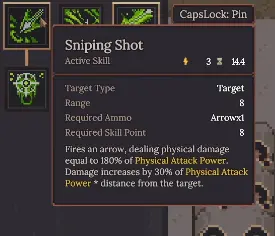
The Sniping Shot tooltip I checked starts at:
180% of Physical Attack Power
and adds:
30% of Physical Attack Power for every 1 tile of distance from the target.
That makes the archer’s pre-cast movement worth doing.
If the target is already dangerous enough to deserve Sniping Shot, I would rather spend a moment increasing the distance than fire from beside the frontline.
Against a tadpole, backing away let the ranged character contribute the high-value attack without adding another body to the dangerous part of the room.
This is one reason the tank and archer work well together.
The frontline creates the distance.
The archer converts it into damage.
Faster Attacks Have an Arrow Cost
Attack Speed looks especially attractive on an archer because every basic attack is damage from a safe position.
It also spends ammunition faster.
That changed one of my level-up choices.
I had the option to take more Attack Speed and instead chose Hit Chance.
The archer was already dealing useful damage.
The weak point was making the existing attacks count without turning every Floor 1 expedition into a larger arrow bill.
That distinction matters because ammunition is part of the build’s operating cost.
A stat sheet can show more theoretical damage while the expedition becomes less efficient.
For routine fights, I care about how much damage I get per arrow carried, not only how many arrows I can fire in a minute.
The more expensive ammunition becomes a separate preparation choice once I start going deeper, so I keep the actual premium-arrow decision in the Floor 2 Guide.
A Future Mage Can Spend Several Runs Being a Future Mage
My fourth slot caused the most wasted build thoughts because the character sheet could look ready long before the equipment was.
A recruit can have useful Intelligence or Willpower.
Magic skills can be visible.
Staff Crafting can be researched.
None of that produces a functioning caster without a staff.
I planned one character toward Nature Magic and left some skill points unspent while the production chain was incomplete.
The staff still needed an elemental component from alchemy plus an appropriate weapon material.
Until those resources existed, spending everything on a temporary direction would only make the later pivot messier.
So the character remained partly unfinished for a while.
That was fine.
A build does not have to use every available skill point the moment it appears.
Sometimes the correct build decision is waiting for the item that makes those points meaningful.
The production prerequisites behind Staff Crafting and alchemy are covered in the Research Guide.
Fire Magic Only Looked Weak Before the Combo Existed
Fire Magic gave me a much better example of why I wait for the complete setup before judging a role.
Josephine was not doing much compared with the physical characters while the magic production chain was incomplete.
Then I had:
Fire Essence,
a Lesser Fire Elemental Stone,
a Fire Bloodwood Staff,
and the actual Fire skills needed for the combo.
At that point the role changed.
The interaction I care about is:
apply Burning first, then use Incinerate.
Incinerate itself showed:
300% of Magic Attack Power
as its base damage.
It then adds:
Burning Stacks × 30% of Magic Attack Power
and consumes the Burning stacks.
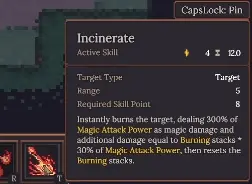
That gives the Fire Mage an actual damage cycle.
A fresh target gets Burning.
The stacks become stored damage.
Incinerate cashes them out.
Using Incinerate too early throws away part of what makes the skill interesting.
Once I started treating it as the finisher instead of another spell to press immediately, the caster stopped feeling like a weak fourth member and started bringing a damage pattern the physical characters did not have.
Redstone Golems Are Why I Keep Physical Damage in the Party
The Fire setup still has a clear answer it does not solve.
Redstone Golems are immune to Burn.
The ones I fought also had Art of Fury, increasing Attack Speed by 15% whenever they took damage.
That combination changes the fight.
The mage loses the Burning interaction.
Meanwhile, casually chipping at the golem keeps making its offense more dangerous.
I focus the target and get it out of the room quickly.
This is also why the early party stays mixed.
A shield frontline can contain it.
The greatsword character can commit physical damage.
The archer can focus from range.
The Fire Mage still has a party around them when Burn immunity removes the preferred combo.
One immunity weakens one tool.
It does not collapse the expedition.
Auto Skill Can Empty a Good Build Before the Important Fight
I can build all four roles correctly and still make the expedition worse by letting them spend Energy carelessly.
Auto Skill usage is convenient.
It is also aggressive.
Characters can fire abilities on enemies that never required those abilities in the first place.
That pushes the party toward low Energy sooner, which eventually means sleeping underground and losing expedition time.
I save active skills for the fights that justify them.
The frontliner uses defensive tools when enemy pressure is real.
The greatsword user waits for a good Destructive Split line.
The archer spends Sniping Shot on a target worth the Energy and arrow.
The Fire Mage gets enough time to establish the Burning sequence properly.
Easy enemies can die to ordinary attacks.
The build is not just supposed to win the current room.
It needs to reach the later rooms with something left.
Skill Points Become Easier to Spend After the Weapon Exists
I am much more confident spending skill points once the character is already performing the role.
A shield is equipped?
Guardian investment has an immediate context.
The greatsword is in the character’s hands?
Now the weapon tree is real rather than hypothetical.
The archer has a stable ammunition supply?
Ranged specialization becomes easier to budget.
The staff still needs several missing materials?
Those points can wait.
Some future passives are safe enough to plan around, but I no longer feel pressure to fill a tree because the number beside Skill Points is positive.
I have already had a future mage waiting on a staff.
I have also had a tank reach the end of what was useful early because the next defensive node still required Level 4.
Available points tell me what I can buy.
Current equipment tells me what will actually work.
I Judge the Party by What Happens When the Room Goes Wrong
The four roles become useful when a normal plan breaks.
Several enemies rush the party.
The shield user absorbs the cluster instead of forcing everybody to scatter.
The greatsword attacker finds a safe angle and punishes the group.
The archer stays out of the pile and deletes the target that makes the encounter dangerous.
The fourth member contributes something different—magic, control or another capability the first three lack.
That is the standard I use before calling the early build functional.
The gear does not need to be perfect.
Every skill tree does not need to be filled.
One character can still be waiting for a later upgrade.
What I do want is an answer for why each portrait is taking one of the four expedition slots.
When those answers are clear, Floor 1 combat becomes much less expensive.
Then the next question stops being “what should this character become?” and starts becoming whether the whole group is prepared for a more dangerous floor.