My Beginner Route From the First Dungeon Run to a Working Settlement
I use the tutorial to stock the settlement, get one workshop and one research room working, build toward a four-person expedition, then repeat Floor 1 without rushing deeper.
I use the tutorial to stock the settlement, get one workshop and one research room working, build toward a four-person expedition, then repeat Floor 1 without rushing deeper.
I choose research by what the settlement can use next. Wood Processing opens leveling; after that, materials, party weakness and the next expedition set the order.
My early party is built around four jobs: hold enemies, punish them in melee, attack safely at range, and add a fourth role only when its gear actually works.
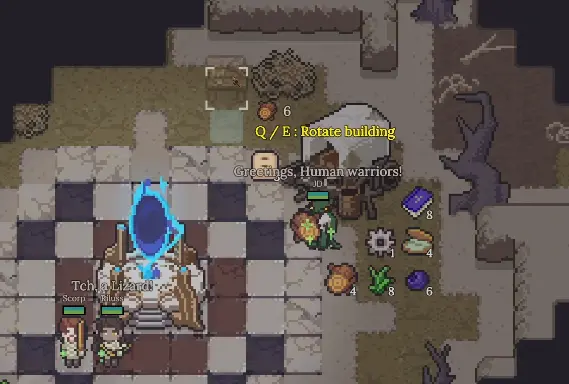
On a new run, I treat the tutorial as my first real supply expedition. I gather Logs, Long Grass and useful loot, bring every surviving member back through the portal, then turn that haul into a Basic Workshop and one properly enclosed research room.
After that, I recruit toward a four-person expedition, let the party recover, replace the supplies I actually used, and return to Floor 1 with a specific material goal.
I leave once the haul has solved that goal or the party starts deteriorating. I do not need to prove anything by going deeper during the opening.
The opening got much easier once I stopped trying to complete every objective as quickly as it appeared.
A new objective often tells me what system exists next.
It does not necessarily tell me what deserves the next piece of wood.
My first few hours work better when I keep one simple loop intact:
bring useful material home, turn it into something the expedition needs, then go back underground in better shape.
That starts before the settlement is even properly built.
I Loot the Tutorial Like I Already Own a Settlement
The tutorial is not disposable.
The Logs and Long Grass I collect there become part of the first settlement economy.
Wood disappears especially fast once walls, workstations, equipment and later production all begin competing for it.
Long Grass also starts looking much more important once textiles enter the picture.
So when the tutorial gives me access to gatherable resources, I take the ones that are already on or near the route instead of walking past everything because the objective marker is somewhere else.
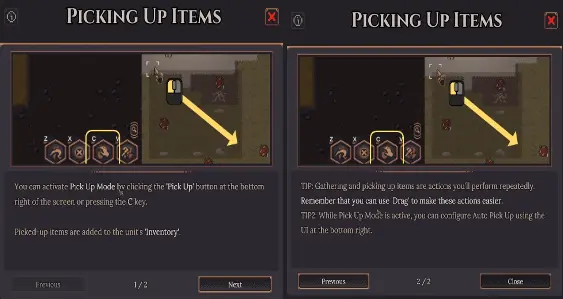
Pickup Mode makes this much less tedious.
Pickup Mode is one of the first controls I start using regularly. The settlement lives on what comes back from the dungeon, so marking scattered resources quickly saves a lot of clicking.
I am still selective.
A weak spare weapon that nobody is likely to equip has less value than the material that finishes a workstation.
That becomes my first inventory rule:
I carry things that already have a job waiting at home.
The Portal Is Not Safe Until the Whole Party Is Standing There
The first return taught me to check something that is easy to overlook.
Finding the portal is only half of leaving.
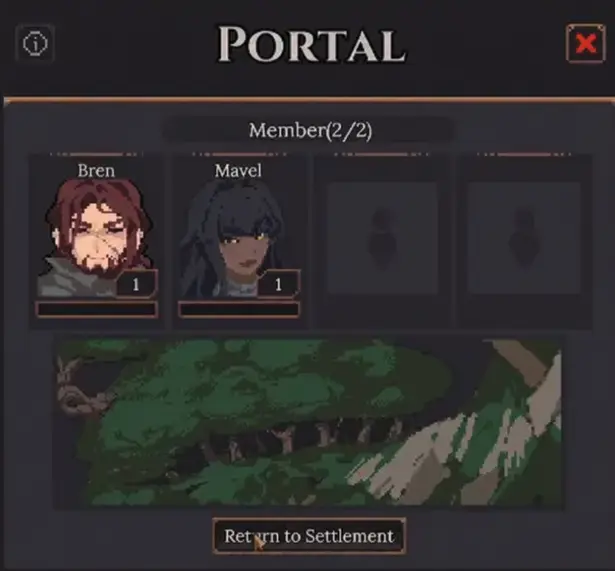
Before confirming Return to Settlement, I bring the expedition members into the return area and check who is actually included.
Before confirming the portal, I check that every member I intend to bring home is actually included in the return group.
I do this every time now.
The cost of one extra glance is tiny.
The cost of accidentally leaving a useful settler behind is not.
Finding the portal early also changes the rest of a dungeon run. Once I know where the exit is, I know what “one more room” actually costs if the next fight goes badly.
That makes retreat a planned option instead of something I start thinking about only after somebody is already on the ground.
The Basic Workshop Is Where the First Haul Starts Paying Me Back
Back at the surface, I want production before expansion.
The settlement can look rough.
It can be cramped.
It does not need multiple half-finished rooms.
What I need first is a way to turn dungeon materials into things the next expedition can use.
That is where the Basic Workshop earns its place.
The first workshop is more important to me than a large first base. It starts converting the tutorial haul into textiles, ammunition and basic equipment.
The workshop immediately creates competition for early resources.
Textiles may be needed for bedding.
Equipment may need replacing.
A bow user may need more arrows.
Construction is still asking for materials at the same time.
I rarely queue a huge amount of one item just because the recipe is available.
I make enough to remove the next obvious problem, then look again at the settlement.
That keeps one enthusiastic crafting order from consuming material needed for something more important five minutes later.
If Research Does Nothing, I Check the Room Before the Researcher
The Research Station was my first real base-building trap.
I could place the workstation.
I could have someone available.
Research could still refuse to work.
The problem was the room.
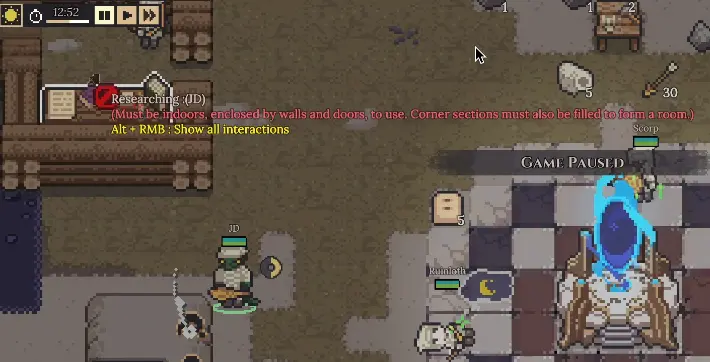
A Research Station can exist and still be unusable. When research will not start, I check whether the room actually counts as indoors.
The enclosure has to be valid.
A missing section around the edge or corner can leave what looks like a room failing the indoor requirement.
My solution is to finish one small functional room first.
One completed research room is more valuable than several outlines for future bedrooms and workshops.
Once research is running, the opening can move forward normally.
Wood Processing becomes important very early because it connects to character progression, but I do not try to solve the whole technology tree during the beginner route. Once several branches are competing for Research Books, I make the choice through the Research Guide.
I Recruit Until the Expedition Has Four Useful People
Dungeon expeditions can take up to four members.
Getting close to that full party changes the opening more than adding another decorative room.
With only a couple of settlers, every bad hit affects a huge percentage of the group’s combat power.
At four, I finally have room for different jobs.
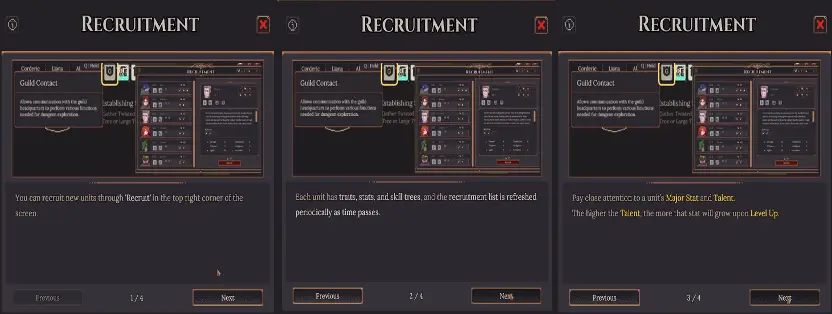
I look beyond starting level when recruiting. Traits, Major Stats, Talent and skill direction all help tell me whether a candidate adds something the current expedition is missing.
I do not try to perfect the party here.
The opening question is simpler:
does this recruit make the expedition less fragile?
Another durable character can help.
Reliable ranged damage can help.
A future specialist can help if the current group has enough basic combat coverage.
What I avoid is spending gold on another version of a role I already have while a bigger weakness is still obvious.
Once I am comparing actual tank, greatsword, archer and magic setups, I use the Builds & Party Guide instead.
The First Level-Up Objective Is a Signal to Improve the Settlement
Eventually somebody fills their EXP bar and the game starts asking for a Level 2 unit.
That does not mean I should send the character back underground for more experience.
Leveling happens through a settlement system.
So if someone is capped, I treat that as another reason to return home and make sure the Wood Processing and Goddess Statue path is available.
I keep the full sequence—Growth Fatigue, Goddess Statue, Mana Stones, prayers and rewards—in the Level Up Guide.
For the beginner route, the useful lesson is only this:
a full EXP bar can mean the next upgrade is above ground.
Before Floor 1, I Look at the Party Rather Than the Destination
My second expedition is where I stop relying on the tutorial to protect me from poor preparation.
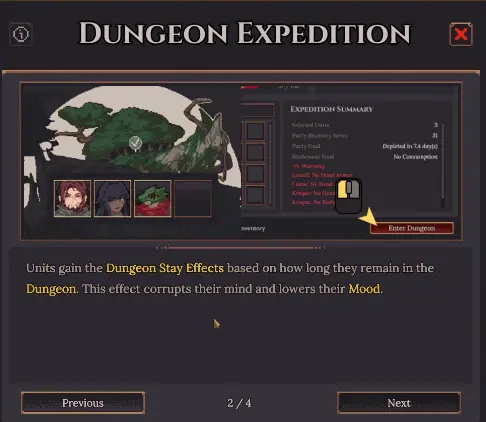
The expedition screen is the last place I check whether the run makes sense.
Before entering Floor 1, I use the expedition screen to catch problems that are cheaper to fix at the settlement than inside the dungeon.
The things that stop me from clicking Enter Dungeon are usually mundane.
Someone is exhausted.
The party is obviously short on food.
The ranged characters do not have enough ordinary ammunition.
A member who may need to revive somebody is carrying no recovery item.
One of those problems is enough to turn an otherwise routine Floor 1 run into a much shorter trip.
I fix them while the settlement is safe.
For food specifically, I use the planner’s Party Food warning rather than guessing from the number of items in inventories. Once hunger starts repeatedly delaying departures, the Food Guide covers the cooking and Consumption Policy loop.
I Spread Recovery Items Instead of Creating One Rescue Character
Near-death changes how I distribute supplies.
If the only Aid Kit is sitting on the character who goes down, the item is not doing much for me.
When the supply allows it, I spread revival capability around the active party rather than concentrating everything on one person.
I do the same kind of thinking with other consumables.
The person most likely to need an item is not always the best person to carry the only copy.
That matters much more once a fight stops going according to plan.
Floor 1 Runs Work Better When I Name the Shortage First
I no longer enter Floor 1 with the objective:
clear Floor 1.
I decide what I want to bring home.
Maybe the research room needs wood.
Maybe textiles are consuming Long Grass faster than I expected.
Maybe a capped settler needs Mana Stones.
Maybe the technology I want is blocked by Research Books.
That gives the random dungeon a purpose even though the rooms themselves change.
The route can be different every time.
The decision process stays useful:
find the portal when possible,
clear fights the current party can handle,
collect the resource that solves the current shortage,
then decide whether another room is worth the risk.
This is enough structure for the opening without pretending Floor 1 has one fixed walkthrough.
One Useful Haul Is Better Than a Greedy Wipe
My early runs became much more successful when I got better at leaving.
A character reaches near-death.
Several members are low on Energy.
Food is suddenly becoming the main reason I am opening new rooms.
The inventory already contains enough material to finish the project I came for.
Those are all reasons to look toward the portal.
I do not need every one of them at the same time.
If I entered for wood and I already have enough wood to finish the room blocking research, the expedition has achieved something important.
Another chest may be useful.
The wood I am already carrying is definitely useful.
That difference matters when the party is getting weaker.
A Near-Death Character Makes the Next Normal Fight Much More Expensive
Near-death is not something I treat as a normal healing inconvenience.
I have had an early slime fight put a character down while the rest of the party was still trying to stabilize the room.
That required healing, control and a First Aid Kit to get the character back up.
A second bad sequence can be much worse.
So once one core member has already needed that kind of rescue, I lower the risk I am willing to take on the rest of the run.
The expedition does not become a failure because I return early.
A survivor carrying useful resources home can improve.
A dead specialist cannot.
Low Energy Across the Group Is Different From One Tired Settler
One character getting tired can sometimes be managed.
When the whole group is running low, the expedition is losing options.
Active skills become harder to sustain.
Another difficult fight costs more.
Even moving back through previously explored rooms becomes less comfortable if enemies patrol or reappear.
That is why I prefer starting a real resource run rested.
Going into the dungeon already tired means spending the early part of the expedition consuming the resource I am supposed to use for exploration and combat.
If I know the party needs sleep, I solve that in the settlement.
Food Becomes a Beginner Problem Only When It Blocks Departure
I do not build a full food economy before the second Floor 1 run.
Scavenged food can carry the opening.
The point where I pay more attention is when the expedition planner itself starts warning that the party supply is inadequate.
That warning is more useful than trying to count berries manually across several inventories.
For a quick known Floor 1 trip, I can accept a thinner margin.
If the plan is becoming longer or less predictable, I want more food before leaving.
The beginner decision stops there.
Once the settlement needs a Cooking Workstation, Food Storage and Consumption Policy to remain stable, food has become its own system.
I Do Not Use Floor 2 as the Test of Whether My Opening Worked
Floor 2 can become visible while the first settlement still has obvious problems.
That is not a contradiction.
The game is showing me where progression eventually continues.
My opening is finished on a different signal.
I want Floor 1 to stop feeling like an emergency.
The party returns with useful material.
They rest.
The workshop replaces what was consumed.
Research is functional.
The next objective does not immediately expose another basic room problem.
Preparing another Floor 1 expedition feels routine.
At that point the settlement has become a support system instead of a campsite built between disasters.
That is when I start caring much more about the broader Progression Guide and whether repeated Floor 1 runs are still producing enough value to justify staying there.
The Stable Opening I Am Looking For
I do not measure the first settlement by its size.
I measure it by what happens after a normal dungeon return.
If I can come home and, without creating another crisis:
rest the active party,
turn gathered resources into useful production,
replace ordinary supplies,
keep research moving,
and prepare four useful members for another Floor 1 run,
then the opening loop is working.
That is enough.
Better housing can come later.
More specialized crafting can come later.
Deeper floors can come later.
The first job of the settlement is to make the next expedition easier than the one that built it.