Russian Guard Guide: How I Play the Specialization
Russian Guard works best for me as a flexible support layer around a stable frontline, not as a roster I try to use all at once.
Updated:
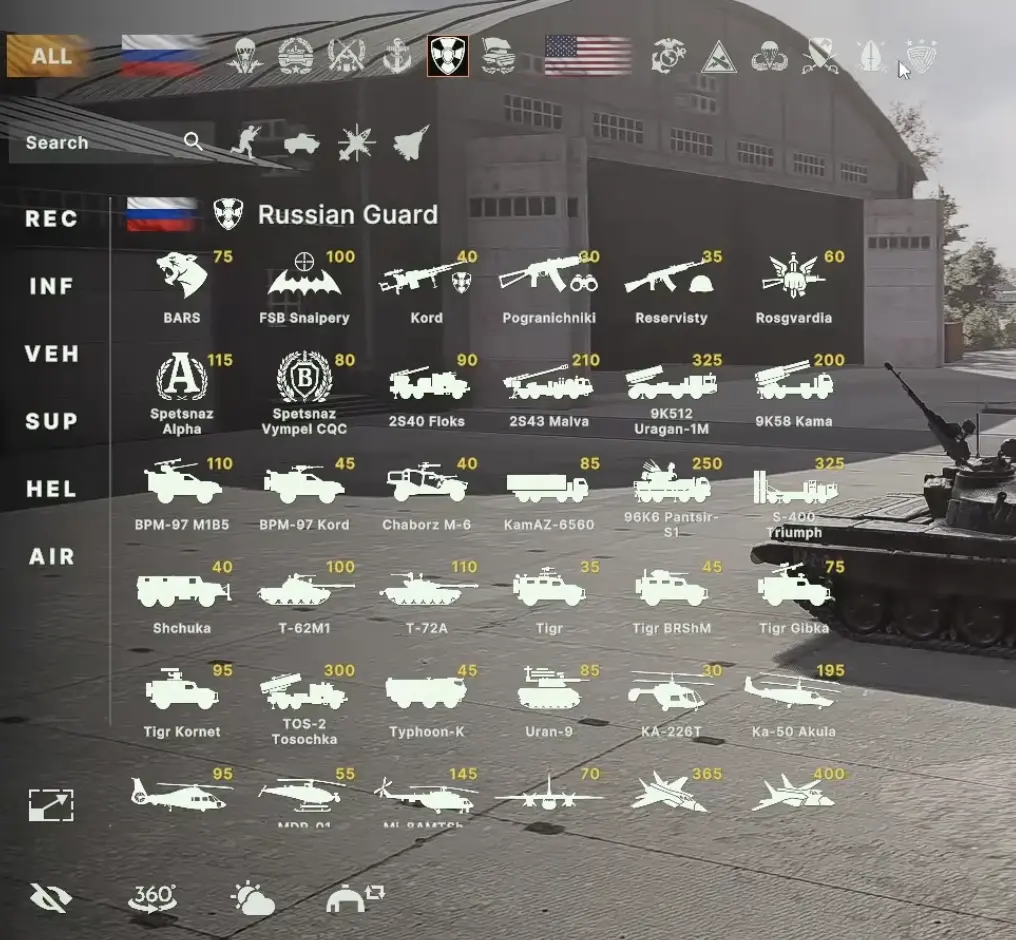
Quick answer: I start Russian Guard with recon, ordinary infantry and a frontline that can survive direct contact. Once I know what is blocking the lane, I add one Guard tool that solves that problem—AA, specialist infantry, artillery, a helicopter or aircraft. If the support layer cannot move safely with the push, I stop and rebuild the position before spending on another premium unit.
Russian Guard is one of the easiest Broken Arrow specializations to overbuild.
The roster offers elite infantry, reserves, stealthy reconnaissance, unmanned vehicles, heavy fire support, layered air defense, helicopters and unusual aircraft. In the Arsenal, that breadth looks like freedom. In a match, it can turn into 1,000 points of answers with nobody left to hold the objective.
I get better results by splitting the battlegroup into two jobs:
the frontline creates a stable fight; Russian Guard changes the terms of that fight.
What the Russian Guard DLC Adds
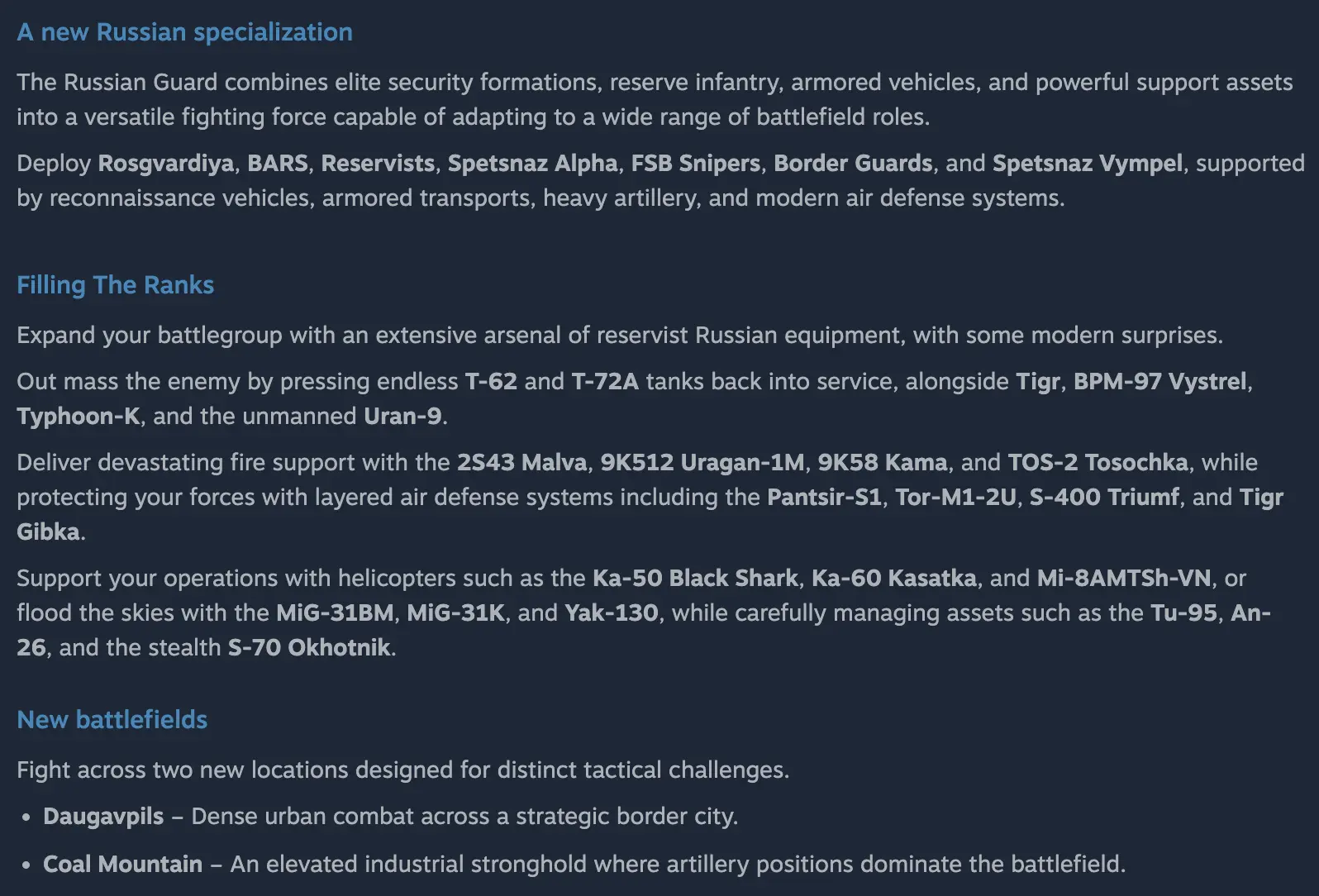
Russian Guard is a paid Broken Arrow specialization rather than a standalone campaign. The current store package is $9.99 and lists:
- 8 infantry squads with 20 weapon loadouts
- 31 new ground and air units
- the Daugavpils and Coal Mountain battlefields
- a Russian Guard AI army for Skirmish
- a Russian Guard hangar theme
The roster spans Rosgvardiya, BARS, Reservists, Spetsnaz Alpha, FSB snipers, Border Guards and Vympel, then extends into older armor, unmanned systems, artillery, modern AA, helicopters and aircraft.
There is one content-list discrepancy worth knowing. The store copy refers to two dedicated scenarios, while the 1.2.0 launch content names Assault on Daugavpils, Daugavpils Defense and Coal Mountain Defense. I use the current patch and in-game list when checking what is actually available.
For me, the main reason to buy the DLC is still the specialization itself. The scenarios and maps add places to use it; they do not turn the pack into a second full campaign.
How I Think About the Specialization
Russian Guard does not need to be the unit source for every job. Its value comes from covering a large number of specialist jobs after the battlegroup already has a workable shape.
The Russian Guard deck guide owns the pairing and card-level choices. My general rule is narrower: if the battlegroup cannot occupy ground without constant air or artillery rescue, the base structure is not finished yet.
My First Match: Build the Lane in Four Layers
Recon decides whether the push is worth paying for
I want vision on the route before I commit the expensive answer.
Three checks are enough:
- Is the enemy already in the tree line or building I need?
- Is the approach covered by armor, ATGM or AA?
- Is there another route that solves the same objective for fewer points?
If I cannot answer those, I keep the commitment small.
Russian Guard has plenty of attractive recon tools, but the important habit is not which one I choose. Recon needs to arrive early enough that the next purchase is based on a real contact instead of a guess.
The Russian Guard units guide covers the individual unit and loadout decisions. At the specialization level, I only need the sequence right: find first, then spend.
Ordinary infantry gives the specialists somewhere to leave
Alpha and Vympel are useful because they can swing a difficult close-range fight. They become wasteful when they are permanently sitting on a quiet objective.
I use cheaper squads for:
- holding a captured zone
- checking low-value buildings
- screening vehicles through forests
- forcing the opponent to reveal what is covering a road
A familiar failure pattern is an elite squad taking the first building, getting found by artillery or air, and being replaced by another elite squad while the rest of the lane still has no depth.
When that starts, I stop replacing the specialist. The missing purchase is usually a cheaper screen, not another premium infantry card.
The frontline fixes the enemy in place
Once contact is established, I need something that can survive long enough for the Guard tools to matter.
On an open lane, that may be armor from the second specialization. In denser terrain, infantry, smoke and direct-fire support can form the same base.
The useful sequence is:
vision identifies the threat → the frontline holds it → Russian Guard adds the asymmetric answer.
Only then do artillery, helicopters, stealthy recon, elite infantry or aircraft have a clear job.
A 300-point support asset bought before the frontline is ready often spends its first minute waiting for a target while cheaper units die in front of it.
AA and supply move before the next capture attempt
The first successful push is not the end of the move.
If the tanks and infantry advance two tree lines while AA and supply stay behind, the formation has already created its next weakness. Aircraft now get a window, and damaged vehicles may have to cross exposed ground just to repair.
After a capture, I check the support route before I queue another attack:
Where can the AA cover the new line? Where can the supply sit without becoming the easiest bombing target on the map?
If both answers are bad, I consolidate.
When I Push Again—and When I Turn Sideways
Russian Guard is most valuable after a lane stops needing constant attention.
A stable objective does not automatically need another tank, another helicopter or another elite squad. The specialization has enough mobility and range to influence a neighboring fight sooner than many heavier formations can.
I push deeper when:
- recon can already see the next defensive layer
- AA and supply can move with the force
- the next objective is weak enough that the defender cannot simply trade space and punish the crossing
- the breakthrough threatens something more valuable than another empty capture zone
I turn sideways when my own lane is secure but the next push would cross exposed ground into a prepared defense. Recon, artillery, AA or air pressure can often create more value by helping the adjacent player.
That choice is one of the main reasons I like the specialization. Russian Guard does not need to win by making every lane heavier; it can win by making the important lane unfair for thirty seconds.
How the New Maps Change My Priorities
The same battlegroup can feel completely different on the two DLC maps.
Coal Mountain exposes units for long stretches. I care about early cover, usable AA and the route between positions before I add expensive fire support. If the next crossing has no cover and the air-defense layer cannot follow, I stop. The Coal Mountain map guide covers the actual Alpha opener, central linkups, hill use and retreat points.
Daugavpils rewards control of the terrain around the objective. Buildings, high ground, the river and isolated pockets can make a short movement change several firing angles at once. I am more willing to delay the capture if the better high-rise, bridge angle or flank building is still available. The Daugavpils map guide owns those PvP positions and player assignments.
The map changes the purchase order because it changes the cost of exposing a unit. That matters more to me than forcing the same “best opener” into both matches.
Where I Start With the PvE Content
I start with Assault on Daugavpils.
It moves through several different Russian Guard problems in one run: preparation, battlegroup choice, city fighting, consolidation, a defensive phase and a renewed offensive. That makes it a better introduction than treating the specialization as a pile of unit cards.
The Assault on Daugavpils walkthrough owns the sabotage decisions, objective route, resupply windows, observer priority and final push.
Daugavpils Defense and Coal Mountain Defense remain useful search intents, but I would rather keep them unsplit than publish thin walkthroughs without enough route-specific decisions and failure points. They deserve separate Owner Pages once the material can answer where players actually get stuck, not just confirm that the scenarios exist.
Is the Russian Guard DLC Worth Buying?
At $9.99, I would buy it mainly if I already enjoy the Russian side and spend time building battlegroups.
The roster changes enough of the decision-making to feel distinct: reserve equipment and elite infantry coexist with unmanned systems, heavy support and modern air defense, so I am choosing between very different ways to solve the same battlefield problem.
I would wait if:
- I only play the US side. The maps and matchup still matter, but I am not using the main paid roster.
- I mainly want a large single-player campaign. The DLC adds scenarios, but the product is still centered on a specialization.
- I dislike revisiting decks after balance changes. A roster with several unusual, expensive or high-impact tools is likely to care about point costs, availability and loadout changes.
For a Russian multiplayer or skirmish player, the value is easier to justify.
The specialization works best once I stop trying to prove that every new unit belongs in the same match. A normal combined-arms core handles the routine work; Russian Guard earns its points by solving the fight that routine units are struggling to solve cleanly.