Russian Guard Decks & Pairings I Would Build First
Russian Guard pairs with almost anything, but the best partner is the one that fixes the frontline job my deck still cannot do cheaply.
Updated:
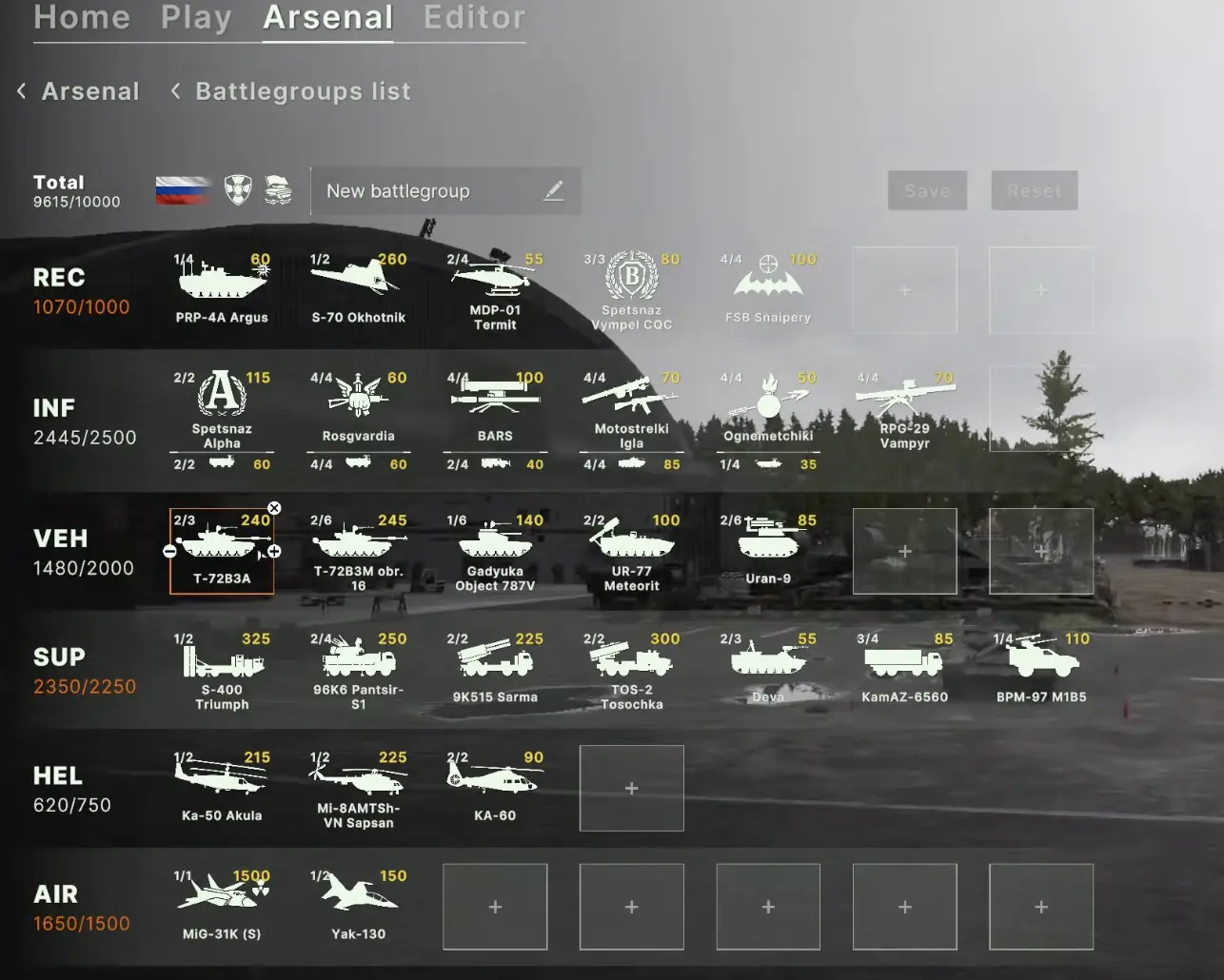
Quick answer: I would learn Russian Guard with Mechanized first. Mech gives me the armored line Guard lacks, while Guard adds faster infantry, recon, mobile AA, helicopters and aircraft around it. I switch to Armor when the match is likely to be decided by heavy ground trades, and to VDV when I am comfortable replacing some tank safety with mobility, air pressure and more demanding point management.
The hardest part of a Russian Guard deck is not finding good cards.
It is deciding which good cards never make the list.
Guard already has recon, specialist infantry, fast transports, artillery, air defense, helicopters and a deep aircraft tab. A second specialization that duplicates all of those strengths can make the deck look impressive without fixing the one job that keeps losing the lane.
I build from the missing role instead.
The Tab Limits Tell Me What the Partner Should Fix
Russian Guard currently has:
- Reconnaissance: 750
- Infantry: 750
- Vehicles: 750
- Support: 1,000
- Helicopters: 750
- Aircraft: 1,000
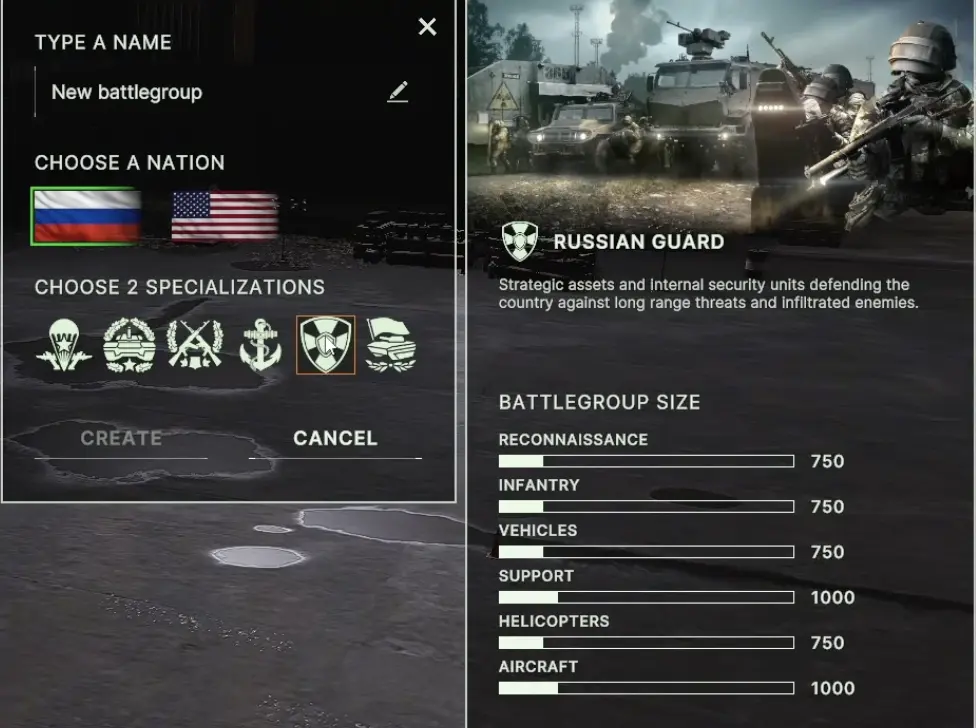
Those caps push me toward one question before I choose a partner:
What is going to stand in front of all this support?
If I cannot answer that cheaply and reliably, another artillery launcher or aircraft option is not the solution.
Which Russian Guard Pairing Fits the Job?
I treat those as different deck shapes, not a permanent balance ranking.
Mechanized asks Guard to make a slow formation faster.
Armor asks Guard to support a heavy formation.
VDV asks me to win through mobility and timing.
Coastal and Motorized only become attractive once I know why their overlap is useful.
Guard + Mechanized: My Default Deck
Mechanized solves the problem I feel most often with Russian Guard: I want something dependable in the direct-fire fight so the Guard half does not have to pretend every support vehicle is a tank.
A post-release Mech/Guard build used a 240-point T-72B3A with APS as part of that armored foundation.
That is enough tank investment to make the division of labor clear.
Mech takes the exposed ground fight.
Guard handles the pieces around it.
The shell I lock before adding luxury cards
I build this pairing from the ground up.
A real armored line comes first.
I want enough proper armor that losing one tank does not force light Guard vehicles into the same exposed fight.
Infantry needs two price bands.
One expensive squad can handle difficult close terrain. The rest of the infantry tab still needs units cheap enough to hold normal buildings, screen forests and sit on captured zones.
Fast movement has to survive the deck builder.
Guard is helping Mech because it brings speed. If I cut the fast transports, smoke or mobile support to squeeze in another premium aircraft, I have removed part of the reason for pairing them.
Mobile AA gets a slot before redundant fire support.
The tank line is too expensive to leave uncovered while I wait for a long-range system to solve every air threat.
Aircraft come after the ground package can function alone.
Guard’s aircraft tab can consume the remaining activation budget very quickly. I choose the air mission only after the deck can take and hold ground without requiring a plane every time contact begins.
What I Buy First With Mech/Guard Depends on the Lane
The full deck is one thing. The first 600-1,000 points on the field are another.
On an open vehicle lane, I bring the proper armored piece earlier. Recon and AA support it before I start experimenting with Guard’s more unusual tools.
In urban or forest terrain, the tank can wait. Infantry, recon, smoke and close support create more value while a heavy vehicle is still trying to find a useful line of sight.
Against an opponent showing early aircraft, mobile AA moves ahead of the second tank purchase.
On a quiet flank, I spend less. A cheap holding force is enough if the rest of the deck can influence the center faster.
The pairing is strong because I can change the spending order without changing the deck’s basic structure.
Guard + Armor: Pick It When the Tank Fight Is the Match
Armor is the easier choice when I can already see the ground battle becoming a vehicle contest.
The frontline question disappears.
I have heavy armor for the direct engagement, and Russian Guard can spend more of its own budget on finding targets, protecting the formation and punishing whatever the tanks force into view.
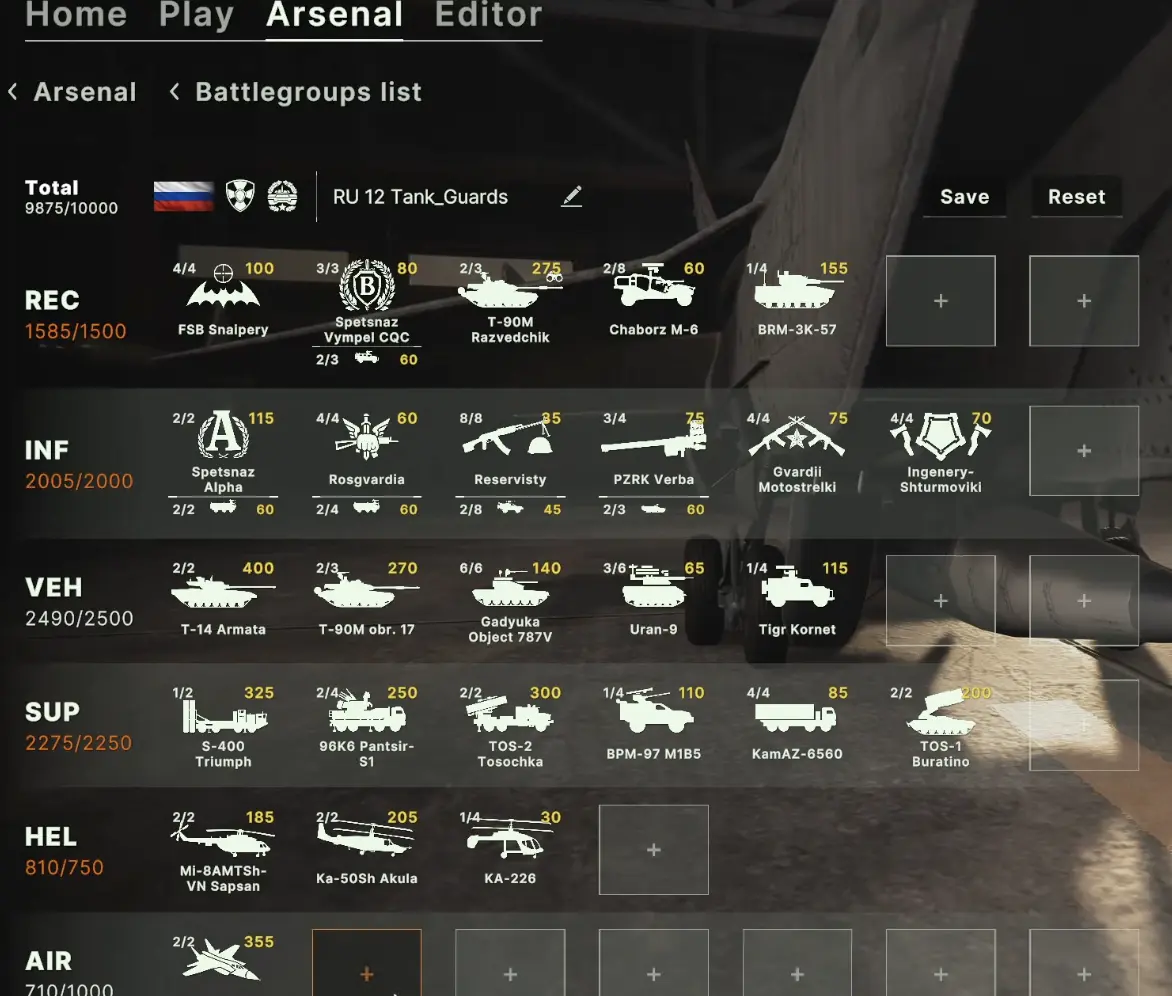
The weakness is the price curve.
Heavy tanks are expensive.
Guard’s support and aircraft can also be expensive.
Putting both appetites into the same deck creates a list where nearly every card looks strong and the actual match starts with too few bodies.
My budget test for Guard + Armor
Before another premium card gets a slot, I want:
- enough armor to survive one meaningful loss;
- infantry for cover the tanks cannot occupy;
- a recon plan that does not depend on a single premium scout;
- mobile AA;
- smoke;
- supply that can stay near the formation without sitting directly on the objective.
Once those are covered, I can justify the unusual Guard pieces.
If cutting one of those basics is the only way to fit another bomber, helicopter or long-range support system, the premium card loses.
The deck is already expensive enough.
Guard + VDV: More Ceiling, Less Safety
VDV produces the most interesting disagreement among the pairings.
One post-release ranking placed Guard + Mech first, Guard + Armor second and Guard + VDV third, largely because VDV does not give Guard the same comfortable tank answer.
High-level match analysis still came away favoring VDV + Guard.
I can understand both results because they measure different things.
Mech is easier to stabilize.
VDV gives me more ways to change where the fight happens.
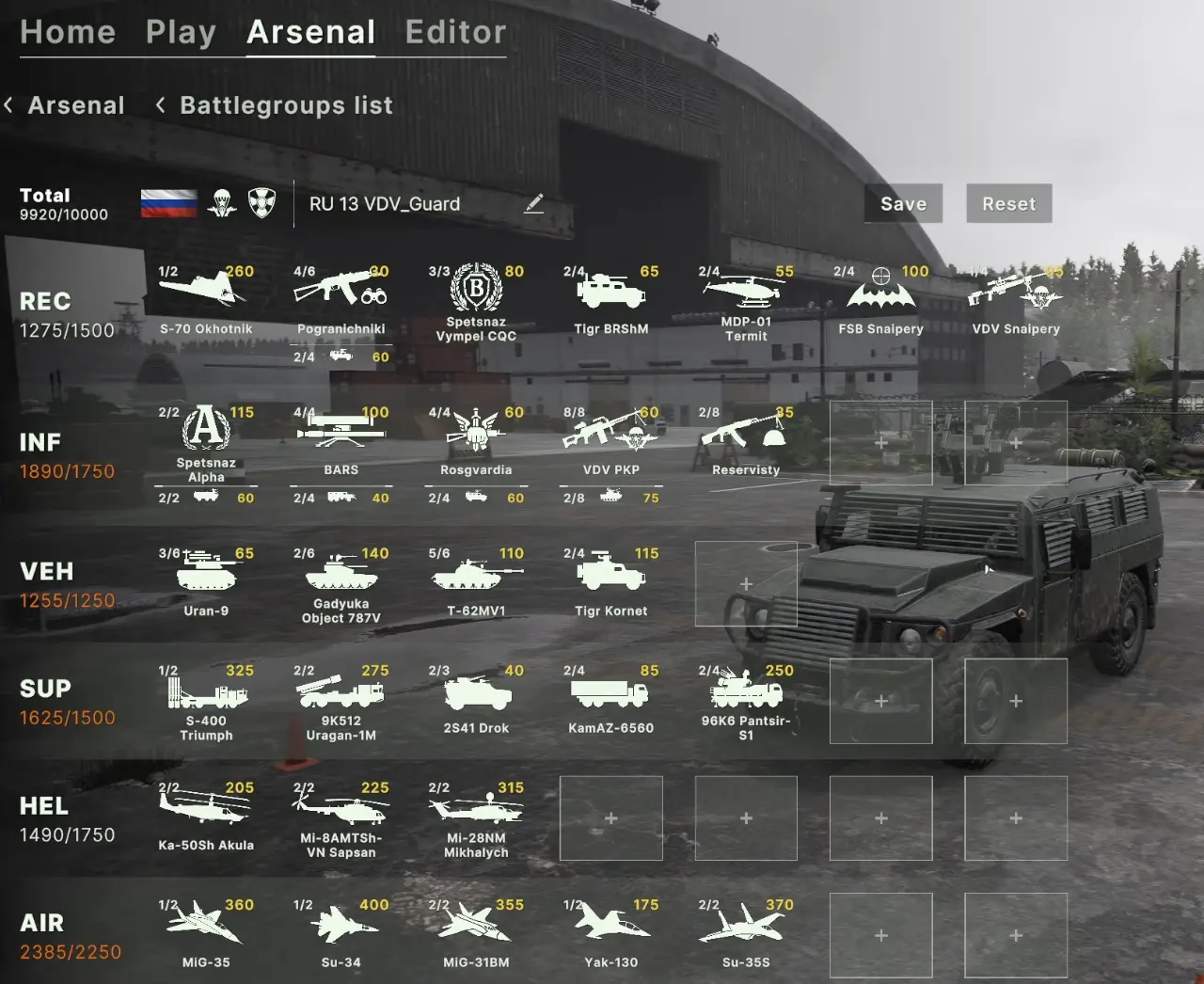
A practical VDV/Guard build gives me a useful picture of how I want the deck to work:
- Su-35s handle the visible air-superiority role;
- S-70 can work behind the first fighter rather than open the air engagement;
- double Pantsir creates a meaningful mobile AA layer;
- smoke remains a real slot rather than being cut for another weapon;
- conventional infantry still has to exist beside the elite squads.
The S-70/Su-35 combination is a good example of why VDV/Guard has a higher ceiling.
I am not buying two aircraft that perform the same action.
One aircraft takes the obvious engagement; the other joins from behind after the fight has already formed.
That gives me more angles, but it also means more expensive units whose timing has to be correct.
When VDV becomes better for me than Mech
I move toward VDV when:
- I am comfortable holding a lane without a heavy tank sitting at its center;
- aircraft are part of a planned engagement rather than emergency purchases;
- the map rewards fast redistribution between lanes;
- I can preserve expensive assets instead of trading them as soon as they appear.
A narrow vehicle corridor changes the answer.
If I know most of the match will be a frontal armor exchange, Mech or Armor gives me a cleaner tool for the job.
Guard + Coastal: A Role Deck, Not a Default Upgrade
Coastal can produce a strong Russian Guard deck, but I need a specific reason to add it.
One completed Guard/Coastal build ended up Guard-heavy with selected Coastal cards, which is close to how I prefer the pairing.
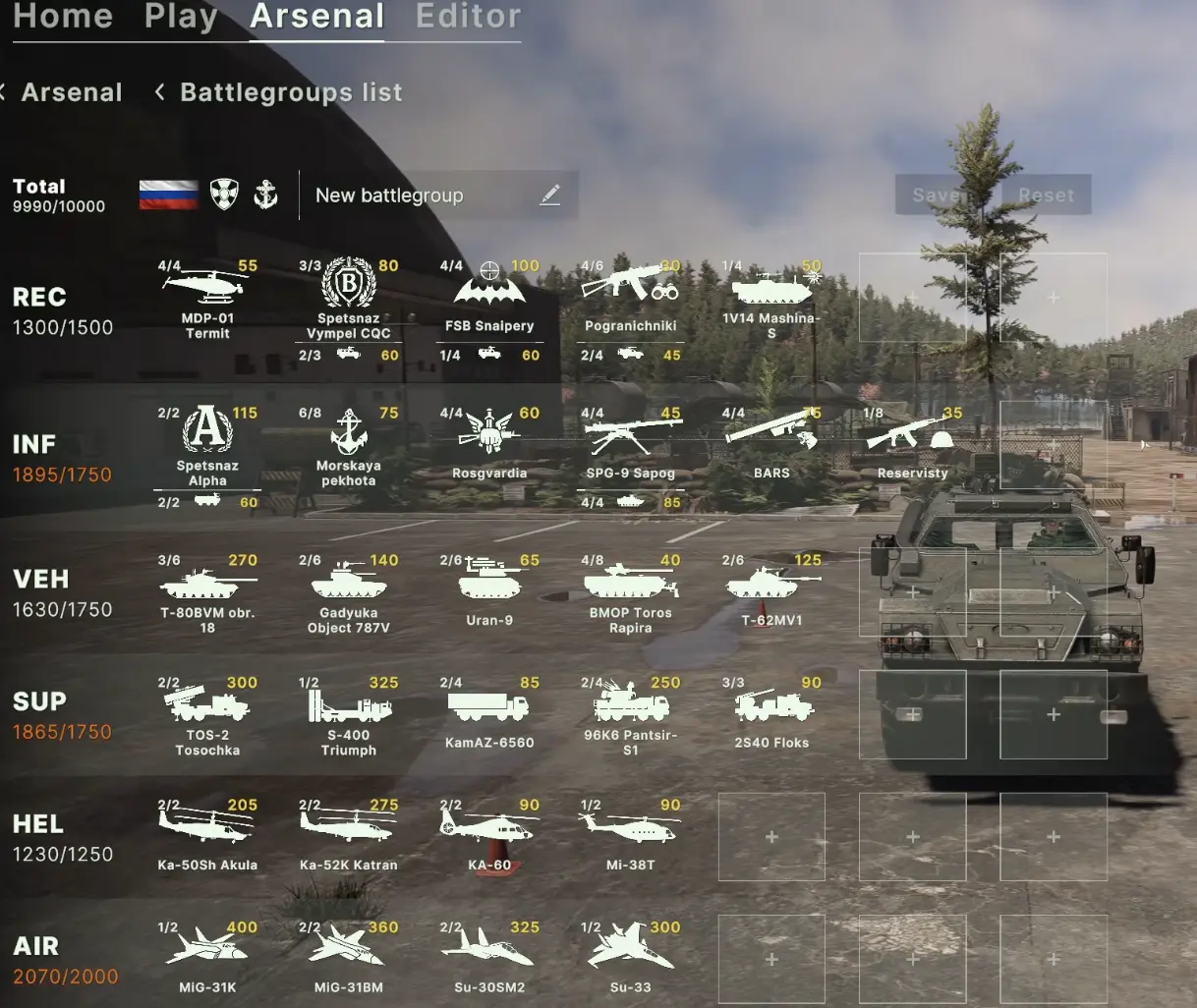
The overlap is the main concern.
Russian Guard already has 1,000 Support and 1,000 Aircraft capacity. Choosing Coastal because it adds more interesting support and aircraft can leave the deck with impressive depth in roles it did not need help with.
I use Coastal when its cards support a concrete plan:
- the team wants another fire-support role;
- the map rewards the specific Coastal infantry or support package;
- my partner choices already cover the frontline elsewhere;
- the extra aircraft options perform a job the Guard half is not already filling.
Without one of those reasons, Mechanized solves more common problems.
Guard + Motorized: Best When Someone Else Owns the Heavy Fight
Motorized pushes the specialization toward speed and support density.
That can be excellent in a coordinated team.
It is less convincing when I queue into a lineup that already lacks durable armor.
Russian Guard itself already brings fast transports, recon, artillery and mobile support, so Motorized does not repair as many weaknesses as Mechanized or Armor.
The pairing starts to make sense when another player is already carrying the expensive frontal role.
Then I can focus on:
- rapid reinforcement between lanes;
- MLRS or artillery pressure;
- mobile AA;
- flank infantry;
- support that can leave a solved lane quickly.
I would rather have this deck helping two teammates than trying to make it win a heavy tank lane by itself.
Six Capabilities I Lock Before the Expensive Cards
The exact units change with the pairing, but six capabilities survive almost every Guard deck I keep.
Expendable vision
Termit can provide high-value reconnaissance, but some scouting jobs should be cheap.
I want at least one way to check a road, tree line or secondary flank without risking a premium asset every time.
Infantry that can stay behind
Elite squads are poor economy if every captured zone requires one.
The deck needs ordinary infantry that can occupy quiet terrain while the specialists leave for the next difficult fight.
Something that survives direct contact
For Mech and Armor, this is easy to identify.
For VDV, Coastal or Motorized, I have to be more deliberate about how the formation holds ground after the first attack.
If the answer is always “call aircraft,” the ground package is too thin.
Smoke
Expensive formations need smoke more than cheap ones.
The more points I have concentrated behind one crossing, the worse it feels to lose them because I used the support slot on another damage card.
Mobile AA
A frontline that moves beyond its AA is temporarily unprotected no matter how good the air-defense card looked in the Arsenal.
I want at least one layer that can relocate with the formation.
Supply with somewhere safe to live
I check the map position before I call the logistics plan complete.
A large supply truck parked beside an exposed capture zone can become the easiest bombing target in the entire formation.
If the safe resupply point is farther back, I accept the extra drive.
The Deck Is Over Budget: What Leaves First?
Russian Guard’s last few activation points are where most of my bad deck-building decisions happen.
I cut by role duplication.
Duplicate premium recon goes first.
Good reconnaissance is essential. Paying several high activation costs for units that all solve the same spotting job is not.
The second luxury air mission is next.
If the partner already provides strong fighters, Guard aircraft can handle strike work. If Guard already owns air superiority, I do not need another specialization duplicating it.
Redundant artillery follows.
Two systems with different jobs can be useful.
Three systems all waiting for the same target usually mean one of those slots should become infantry, armor or AA.
Upgrades that do not change the unit’s battlefield job are easy cuts.
A weapon or armor package has to change what I am willing to send the unit against. If the upgraded version still performs exactly the same role, that is where I recover points.
I protect four things until the end:
basic infantry, smoke, mobile AA and supply.
Those slots rarely produce the most exciting card screen.
They are the reason the exciting cards survive long enough to matter.
Which Pairing I Would Queue With First
For a new Russian Guard deck, I still choose Mechanized.
The match has a readable progression:
recon finds the lane → infantry establishes cover → Mech armor takes the exposed ground → Guard support follows → AA and smoke stabilize the position → helicopters or aircraft punish whatever the ground fight reveals.
Nothing in that sequence requires me to make a premium unit solve three jobs at once.
I choose Armor when I expect the map to reward heavy direct-fire trades.
I choose VDV when I want mobility and air pressure badly enough to accept a more demanding ground game.
Coastal needs a specific combined-arms reason.
Motorized makes the most sense when the team’s heavy frontline is already covered and I can play across multiple lanes.
Russian Guard has enough strong cards to make almost every pairing look possible.
The partner I keep is the one that lets me remove the most unnecessary jobs from the Guard half of the deck.