Russian Guard Units: What I Buy, Skip & Build Around
A practical Russian Guard unit guide built around roles, loadouts, purchase windows and exit signals rather than card stats alone.
Updated:
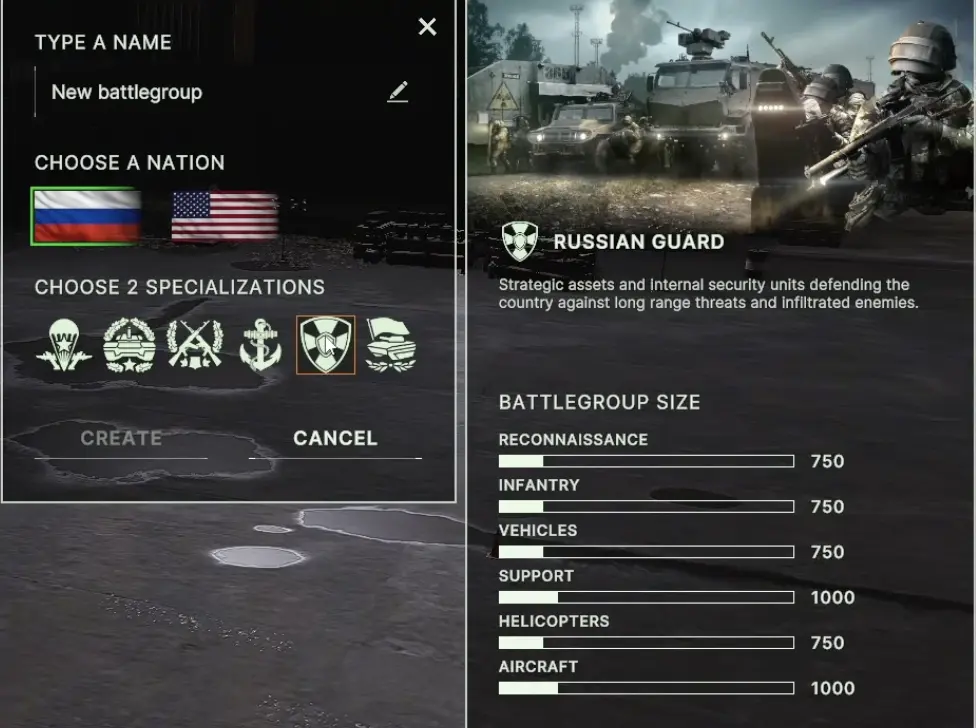
Quick answer: Termit and Vympel CQC are the two Russian Guard units I am happiest building a plan around early. Uran-9 becomes excellent when the fight moves into infantry-heavy woods, while S-70 earns its cost after the enemy establishes a predictable air lane. S-400 is a premium purchase for a stable front, not an emergency button. Kinzhal stays in the luxury category until I can point to a target valuable enough to justify the entire strike cycle.
A unit can have excellent card stats and still be the wrong purchase.
Russian Guard makes that distinction especially important. The roster contains cheap reconnaissance, elite infantry, unmanned vehicles, several layers of air defense, long-range artillery and aircraft expensive enough to delay the rest of a battlegroup.
I rank the units by the decisions they create during a match:
How often can I find a real job for it? How quickly can it repay the points? What changes on the battlefield should make me stop buying more?
Russian Guard Tier List: Priority Matters More Than the Letter
| Unit | Priority | Loadout / role I favor | Buy when | Stop buying when |
|---|---|---|---|---|
| MDP-01 Termit | Core | S-8L guided rockets | I have a flank, hard cover or exposed armor to punish | MANPADS and SHORAD are already layered around the route |
| Spetsnaz Vympel | Core | CQC / 6P62 | I can name the building, forest edge or short lane they will own | The fight has moved into open ground or constant indirect fire |
| Uran-9 | Strong | Thermobaric forest-clearing setup | Soft infantry is holding woods and I already have something spotting ahead | Vehicles and serious AT start escorting the infantry |
| S-70 Okhotnik | Strong | R-77 or R-37 air-support setup | Expensive aircraft keep using the same air lane | I have no safe fighter/AA layer to recover behind |
| Spetsnaz Alpha | Strong | SEC / close-terrain use | I need another elite squad for a specific urban position | Vympel already covers the same job or the price climbs too far |
| S-400 Triumph | Situational Premium | Long-range terminal-guidance AA | My ground line is stable and valuable aircraft repeatedly cross one sector | The frontline needs cheaper units, supply or mobile AA more urgently |
| MiG-31K / Kinzhal | Luxury | Ballistic strike against a known high-value target | The target is worth saving hundreds of points and interception is manageable | I am saving for the missile while my active lane is losing |
The priority column is not meant to turn every patch into another alphabet reshuffle. A Core unit is one I can give a useful job in many matches. A Luxury unit can still win a game; it simply needs a much narrower window before the investment makes sense.
Termit: 55 Points Can Distort an Entire Flank
The MDP-01 Termit is the first Russian Guard card I learn because the cheap configuration combines several jobs without asking for aircraft-level spending.
The S-8L setup costs 55 points and gives me:
- 6 HP
- 10 armor
- 2,000 ground optics
- 2,500 low-altitude optics
- 2.5 stealth
- three S-8L guided rockets
- 1,400 m rocket range
- 400 explosive penetration
- 8 damage per rocket
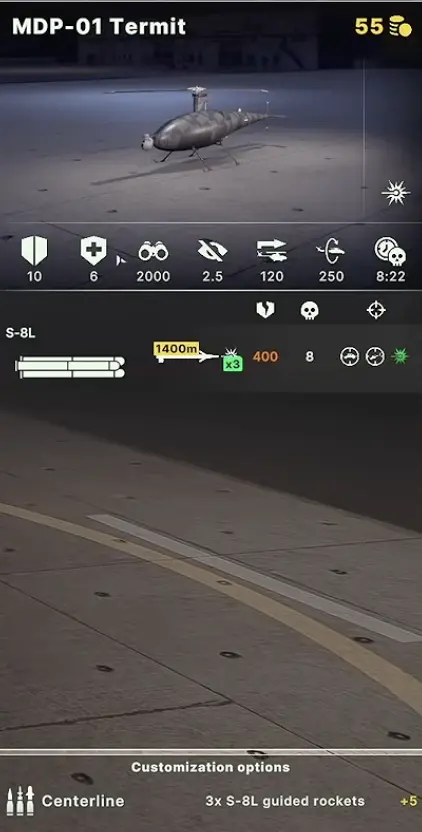
Those numbers create a very specific route.
I send it toward a flank, building edge or hard-cover pocket, where it can reveal the target before several AA systems reveal the drone.
Once a useful target appears:
- acquire vision from the edge of cover;
- lase the target;
- fire the S-8Ls;
- break line of sight immediately;
- change angle or resupply before the opponent places a dedicated counter on the route.
The 6 HP is the reason I leave after getting value.
A Termit that just killed something has already told the opponent where to look. Remaining in the same pocket turns the second attack into a much worse trade than the first.
The Kornet configuration can provide longer-range anti-vehicle pressure, but the cheap guided rockets preserve what I like about the platform: a low-cost scout can become a serious threat without turning into a unit I am afraid to lose.
Vympel CQC: Buy the Position Before the Squad
Spetsnaz Vympel CQC is strongest when I already know where the fight will happen.
The squad costs 80 points, with 35 HP, 1,750 optics and 2.5 stealth. Its defining weapon is the 6P62:
- 500 m range
- 27.5 kinetic penetration at the base profile
- penetration can rise to roughly 40 with favorable armor geometry
- listed damage rate of 1.85
- the weapon only fires while the squad is stationary
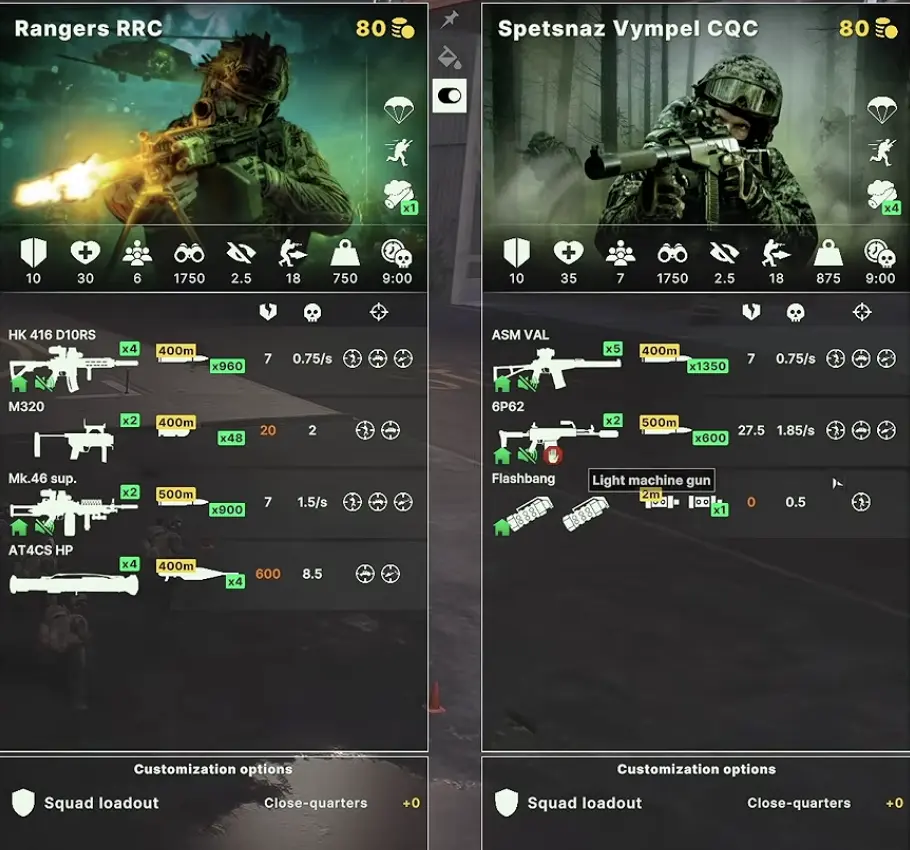
That stationary requirement changes the way I deploy them.
I unload Vympel one piece of hard cover before the contact point. The squad settles first; the enemy then has to enter the weapon rather than making Vympel chase across a street.
High-rises make the 6P62 more dangerous because side and top armor angles appear naturally. The same squad becomes far less efficient on an open approach where every engagement starts with a sprint.
My buy condition is therefore positional:
If I can name the building, forest edge or short approach I want them to own, the 80 points have a job.
If the answer is only “I need strong infantry,” another squad usually gets the points first.
The expensive standoff packages are harder for me to justify because Russian Guard already has artillery, aircraft and other ways to reach distant targets. Vympel’s unique value is making close terrain uncomfortable.
Uran-9: The 65-Point Forest Tool
The thermobaric Uran-9 solves a narrower problem, but the price is low enough that the answer is attractive whenever that problem appears.
The setup shown here costs 65 points and has:
- 14 HP
- 30 front armor
- 15 top, side and rear armor
- a 30 mm cannon reaching roughly 1,000 m
- an RPO-M thermobaric weapon reaching roughly 800 m
The more general Ataka / Igla-S configuration sits around 85 points, but the thermobaric build is the one I reach for when infantry is turning a forest into a slow grind.
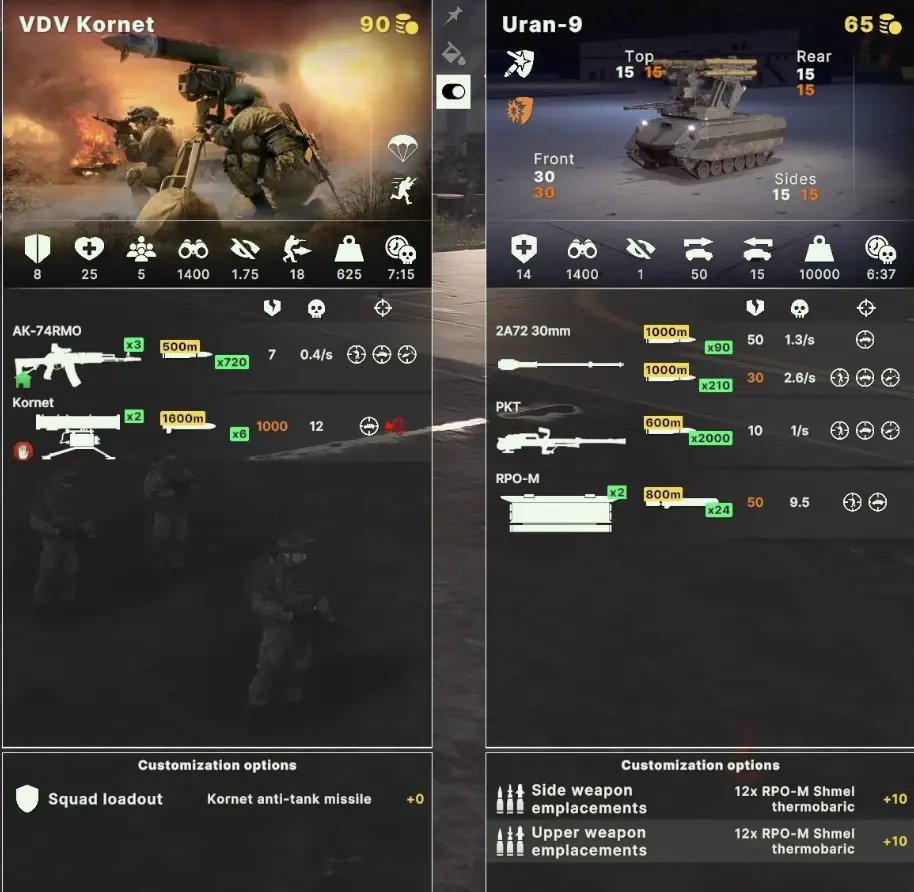
Its position is one layer behind the first contact.
Cheap infantry or recon enters the wood line first. Once the enemy squad exposes itself, Uran-9 closes the distance and stacks the thermobaric weapon, autocannon and machine gun into the same target.
Against soft infantry, the suppression arrives very quickly.
The purchase stops making sense when the opponent adds a vehicle with a real autocannon or infantry carrying enough dedicated anti-vehicle fire. The drone still hurts infantry, but it no longer owns the exchange.
At that point, another Uran-9 only repeats a solution the enemy has already answered.
S-70 Okhotnik: Add It Behind an Air Fight, Not in Front of One
The S-70 Okhotnik is expensive enough that I want to know the enemy’s air habits before buying it.
The configurations I use as reference points are:
- about 250 points with four R-77s
- about 260 points with two R-37s
- roughly 340 points for a heavier cruise-missile package
The platform carries 1.75 stealth, but that advantage disappears once it fires. It also lacks ECM and flares, so surviving the return missile is much harder than surviving initial detection.
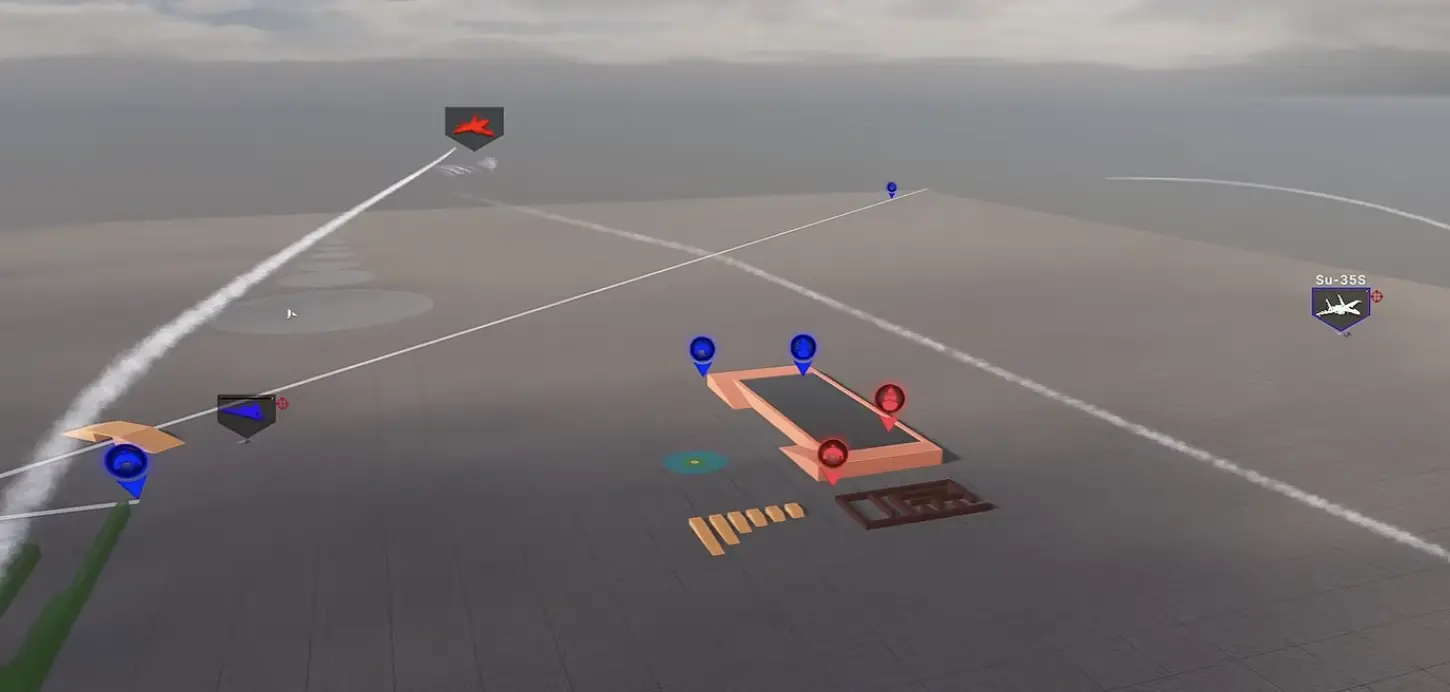
I usually pair it with an air-superiority fighter rather than asking the drone to start the engagement.
The fighter takes the visible position. The S-70 stays deeper, contributes reconnaissance and launches once the enemy is already committed.
After the shot, I recover it.
A 250-260 point platform surviving for another sortie is worth more than squeezing out an extra missile while the drone is revealed and has no defensive countermeasures left to save it.
This is also why S-70 is Strong rather than Core for me. Termit can justify itself almost immediately. S-70 wants the air picture to exist first.
Spetsnaz Alpha: Strong Infantry Without an Automatic Win Button
Spetsnaz Alpha belongs in the strong category, but I watch the loadout price carefully.
A standoff-oriented setup can reach roughly 140 points. At that level, the squad is competing with several other Russian Guard tools for a large chunk of the same budget.
The cheaper SEC / close-terrain role is easier for me to justify.
Alpha does not automatically beat every elite infantry squad simply because it is new. In controlled building fights, it did not simply walk over Delta Force, which is enough reason for me to avoid treating the card as a universal infantry answer.
If Vympel already owns my close-range lane, Alpha needs another job before I add it.
Good reasons include:
- another urban sector needs elite infantry;
- I want a different weapon package from Vympel;
- the deck needs an elite squad without paying for the full standoff setup.
Weak reason:
- “Alpha is strong, so I should bring another one.”
The 140-point version becomes especially painful when artillery, aircraft or vehicles are already deciding infantry fights more efficiently than another premium squad can.
S-400: 325 Points Need a Stable Air War
The S-400 Triumph is one of the easiest Russian Guard units to judge from the wrong match.
The long-range configuration costs 325 points and carries four 40N6 missiles with:
- 600-2,600 m engagement range
- 20 damage
- terminal guidance
- two-target engagement capability
- 250 kg supply weight per missile
- around 20 seconds listed resupply time per missile
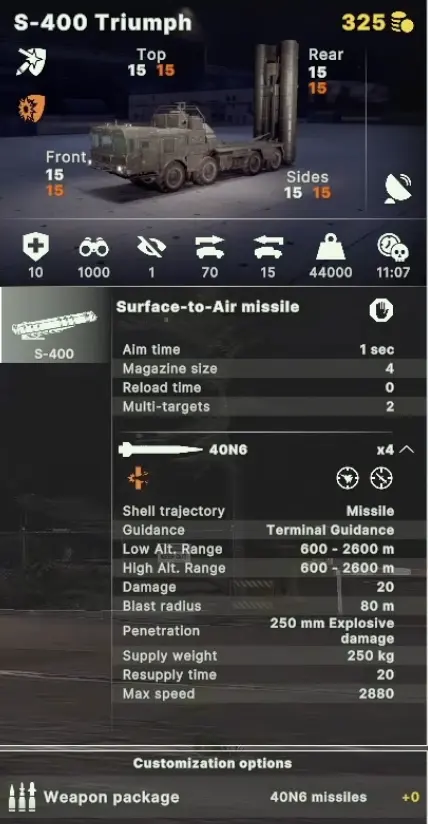
A clean connection can decide an air exchange.
The problem is consistency.
I have seen the system produce a huge kill total when aircraft repeatedly entered the defended sector. I have also seen enough tracking and miss problems that I do not budget around a guaranteed result.
Before buying one, I want four conditions:
- the ground line is already stable;
- supply can sit close enough to keep the launcher useful;
- the launcher has somewhere to relocate after revealing itself;
- enemy aircraft are valuable and frequent enough to repay the 325 points.
If the lane is collapsing and I could instead buy several infantry, vehicles or mobile AA units, S-400 waits.
I also value a layered air-defense network more than a lonely long-range launcher. Pantsir, Tor or short-range coverage reduces the number of ways an opponent can solve the S-400 with one coordinated pass.
Kinzhal: 400 Points Need a Target Before the Aircraft
The MiG-31K / Kinzhal is the card most likely to make me save points simply because the weapon looks decisive.
The configuration shown here costs 400 points, while the Kh-47 Kinzhal has a listed 10,000 m range.
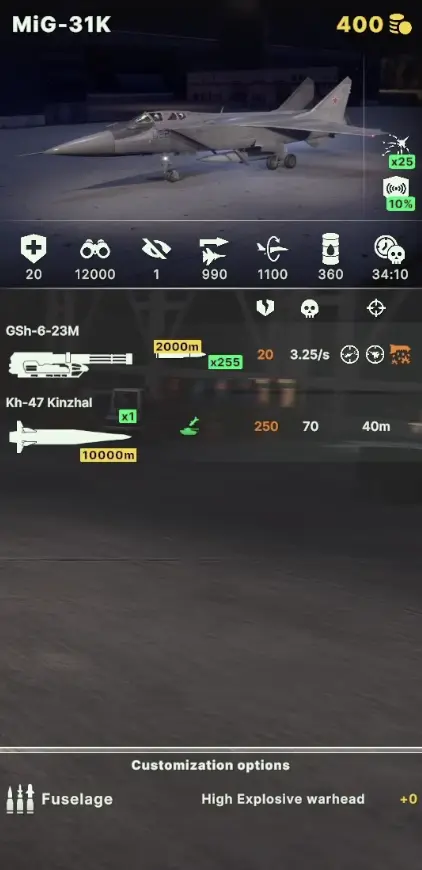
The purchase starts with the target, not the aircraft.
Before saving for it, I want three answers:
What am I hitting?
A dense armor group, important artillery/support concentration or valuable AA cluster can justify the attempt.
Why is that target worth hundreds of points right now?
Deleting an isolated 100-point unit with a strategic strike is still a losing decision.
What happens to my lane while I save?
A missile cannot repair a frontline that collapsed while the points were unavailable.
The ballistic path can also be intercepted by capable missile-defense systems. The exact US interception distances and defensive positioning belong in the Russian Guard counter guide; on the Russian side, I only need to remember that the launch is not guaranteed damage.
Kinzhal becomes dangerous when the opponent gives me a valuable concentration. I do not spend the match trying to create a reason to buy it.
The Other Russian Guard Units I Actually Consider
The seven units above deserve full sections because they change how I play a lane. The rest of the roster still matters for deck construction, but most of these cards can be understood through a much shorter decision.
Recon: Pogranichniki, Snaipery FSB and Chaborz M-6
Pogranichniki are the kind of recon infantry I use when the job is to occupy forward cover and keep vision alive, not to turn every reconnaissance purchase into a premium platform. Their RPG-18 gives the squad some teeth against light targets, but information remains the reason I bring them.
Snaipery FSB are far more specialized. A tested configuration sits around 100 points for a four-man team, with access to long-range rifles, smoke and laser designation. I like them when a protected building or ridge can produce vision and designation for several other units. Paying that price for a sniper squad that spends the match moving through short-range terrain wastes the card.
Chaborz M-6 gives me a fast reconnaissance vehicle with a very different ceiling depending on the loadout. The Kornet-M option is attractive when I want recon to contribute serious anti-vehicle pressure. On a lane where stealth and survivability matter more than another missile, I keep the platform cheaper.
Infantry: Rosgvardiya, BARS and Reservists
Rosgvardiya fills the gap between “cheap body” and “elite specialist.” I use it when the objective needs competent infantry but does not need Alpha or Vympel pricing.
BARS is one of the squads I look at when I want infantry to cover more than one job. Different weapon packages let the unit contribute AT, fire support or utility without automatically jumping to elite-infantry cost. The value is flexibility inside the deck rather than winning a single matchup.
Reservists are the opposite end of the roster. A cheap configuration can sit around 35 points, which makes them useful for screening forests, occupying quiet zones and forcing enemy units to reveal themselves. A 35-point squad dying after spotting the weapon that killed it can still be a good trade; an elite squad used for the same job usually is not.
Old Armor: T-62 and T-72A
The older T-62 and T-72A variants are not the tanks I want taking a fair duel against the best modern armor.
Their purpose is price and mass.
I use them when:
- the enemy is spending premium points elsewhere;
- I need several hulls rather than one centerpiece tank;
- infantry and support already control the dangerous AT angles;
- the vehicle only needs to hold or pressure a secondary lane.
They become poor buys when the opponent has already established modern tanks, strong ATGMs or air power over an open approach.
Russian Guard can field older armor effectively; it cannot make old armor stop being old armor.
Tigr, BPM-97 Vystrel and Typhoon-K
The transport pool is one of the reasons Russian Guard feels fast despite having several heavy support options.
Tigr variants are mainly about getting the right infantry or reconnaissance element to useful terrain quickly. Recon-specific versions can add sensors or weapons, but I still judge them by whether the platform needs to survive after unloading.
BPM-97 Vystrel gives me a heavier transport choice when I expect the vehicle itself to remain relevant after delivery. A weapon package that can contribute against infantry or aircraft is useful in an opener, provided I am not paying so much that losing the transport becomes more expensive than losing the squad.
Typhoon-K fits the same broader question: do I need transport speed, protection, firepower, or simply the cheapest safe ride to the objective? I choose the configuration around what happens after the infantry gets out.
Support: Malva, Uragan-1M, Kama and TOS-2
Russian Guard’s support tab is deep enough that filling it with every interesting artillery system is easy.
I get better results by picking different firing jobs.
2S43 Malva is the conventional long-range howitzer option I trust when I need repeated fire missions rather than one spectacular salvo. Its 152 mm gun can deliver roughly 12 damage on the HE profile, with smoke available as part of the same broader artillery role. Mobility matters here: fire, move, then prepare the next mission instead of letting counter-battery fire solve the gun.
Uragan-1M offers a much larger rocket volume. The long reload is the price. A full launcher can spend many minutes getting its ammunition back, so I treat the salvo as a deliberate commitment. After emptying it, selling or rotating the launcher can make more sense than parking a large investment near supply for an entire phase of the match.
9K58 Kama gives me another MLRS route with harder-hitting and cluster-oriented options. I prefer it when I need a smaller number of meaningful fire missions against a known concentration rather than constant background artillery.
TOS-2 Tosochka is the support card I am most careful with. Around the 300-point level, the weapon can produce terrifying area damage, but the price and reload cycle mean the target density has to justify it. One infantry squad in a forest is not enough. A packed defensive position, repeated reinforcement route or stubborn concentration is.
If the artillery has no identified target, the points belong on the frontline.
Air Defense: Pantsir-S1, Tor-M1-2U and Tigr Gibka
I do not pick one of these and declare the air problem solved. They cover different parts of the same network.
Pantsir-S1 is the mobile AA unit I am happiest moving with an opener or valuable ground group. It gives the formation a way to advance without leaving serious air defense several sectors behind.
Tor-M1-2U is attractive when I need a cheaper missile layer and do not want every air-defense purchase to become a premium investment.
Tigr Gibka fills the closer mobile end of the network. It is the type of system I want near infantry, supply routes or another AA launcher that needs protection after aircraft have already committed.
S-400 becomes much harder to attack when these systems are doing their jobs around it. The reverse is also true: short-range AA becomes far more useful when enemy aircraft cannot simply orbit outside it without entering another layer.
Helicopters: Ka-50, Ka-60 and Mi-8AMTSh-VN
Ka-50 Black Shark is the helicopter I consider when I want a proper attack platform rather than another transport with weapons attached. I bring it after the enemy’s short-range AA picture is understood. Flying it forward to discover the AA itself is an expensive scouting method.
Ka-60 Kasatka fits mobility and utility better. I value it when fast movement or a supporting helicopter role matters more than maximum weapons on one platform.
Mi-8AMTSh-VN has several aggressive weapon options, including heavy rocket packages. An S-13-style build can hit extremely hard, while other configurations trade raw rocket volume for different standoff tools. It becomes attractive when the target is already spotted and the helicopter has a route in and out that does not cross prepared AA.
Helicopters pay for information. If recon has not found the safe approach, I wait.
Aircraft: MiG-31BM and Yak-130
MiG-31BM gives Russian Guard a fast aircraft that can be shaped around interception or strike pressure depending on the rest of the battlegroup.
I prefer the interceptor role when the second specialization lacks good air superiority. If VDV or another partner already gives me strong fighters, the same aircraft slot can be configured around a different job rather than duplicating what the deck already does well.
Yak-130 is the cheaper attack-aircraft option with a wide payload menu: rockets, bombs and other ground-attack configurations are available, but I do not treat versatility as proof that every loadout is efficient.
I buy it when a cheaper aircraft can solve a target without tying up the kind of points demanded by the premium air tab.
If the mission requires maximum survivability, range or strike weight, another platform gets the slot.
How My Purchases Change During a Match
I do not follow a fixed six-unit build order. The enemy composition decides when I move down the roster.
Before the first real contact, I care about vision and low-risk pressure. Termit, Pogranichniki, FSB snipers or another recon option can make the next purchase much more informed.
Once terrain defines the fight, the unit becomes obvious. Vympel belongs in a short urban engagement. Uran-9 becomes interesting when soft infantry is packed into woods. Cheap line squads take the objectives that do not justify elite infantry.
When the opponent answers the first tool, repeating the same purchase is usually the wrong response. MANPADS reduce the value of another Termit. Vehicle-supported forests reduce the value of another Uran-9. Persistent artillery lowers the return on expensive infantry sitting in predictable buildings.
Air pressure changes the budget later. S-70 becomes useful after repeated aircraft establish a pattern. Pantsir, Tor and other mobile AA move with the valuable ground group. S-400 enters only when the front can afford a 325-point air-denial investment.
Strategic strike comes last. Kinzhal needs the target before it needs the points.
This is the part of Russian Guard I enjoy most: the roster is broad enough that the answer can change without rebuilding the entire battlegroup.
The expensive unit is rarely the reward for saving long enough.
The better purchase is the card that solves the fight already happening.