Alchemy Factory 1.0 Shop Recognition: Reputation, Fees and Sales
Shop reputation works differently in Alchemy Factory 1.0. Recognition now comes from specific customer sales, then has to be claimed for a fee. I use those milestones when production can support them, without letting the shop consume stock needed for the next Main Quest.
Updated:
Quick Answer
In Alchemy Factory 1.0, Shop Reputation comes from Recognition milestones rather than constantly rising and falling with shelf availability. Check the current requirement, sell that item to normal shop customers, finish the counter, then return and pay the claim fee. If a Recognition counter is not moving, make sure the item is going through the shop—Dispatch sales do not count.
Shop Reputation Is a Milestone System in 1.0
The biggest change is easy to miss if I approach the shop with the old reputation logic in mind.
An empty shelf is no longer a reputation emergency. Customer purchase feedback does not keep dragging the score downward because one product ran out. Instead, 1.0 turns reputation growth into a sequence of Shop Recognition milestones: sell a specified quantity of a specified item, complete the requirement, pay its fee, and add the permanent bonus to the shop.
That makes the storefront much easier to manage around factory progression. If I need Bandages for a Sample Request, Flax for the next potion batch or a whole production area offline during a rebuild, I can let a low-priority product disappear from the shelf for a while. I lose whatever sales that shelf would have made, but I am not destroying a reputation score simply because everything is not stocked simultaneously.
The practical consequence is that I now think about the shop in bursts. When a useful Recognition lines up with production I can spare, I push that product through customer sales. When the Association needs the same material more urgently, I leave Recognition alone until the supply pressure has passed.
The Early Sundries Milestones Show Exactly How Recognition Works
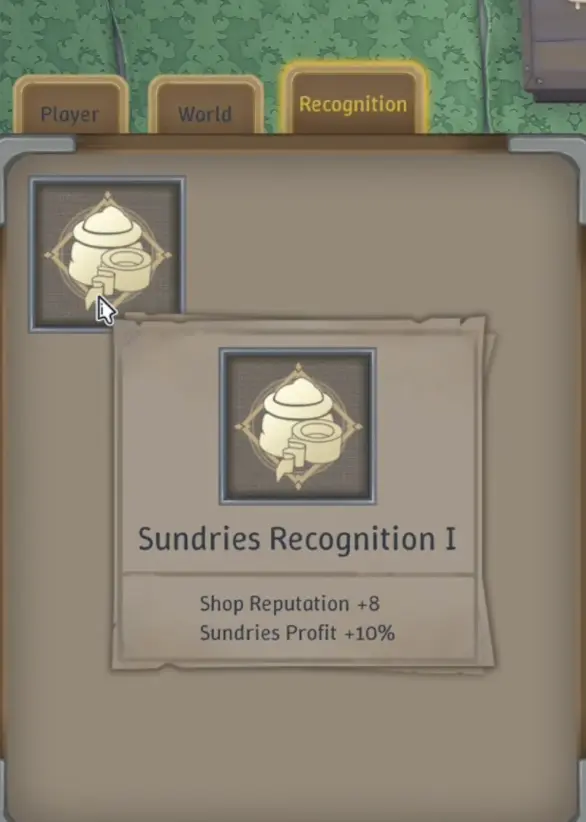
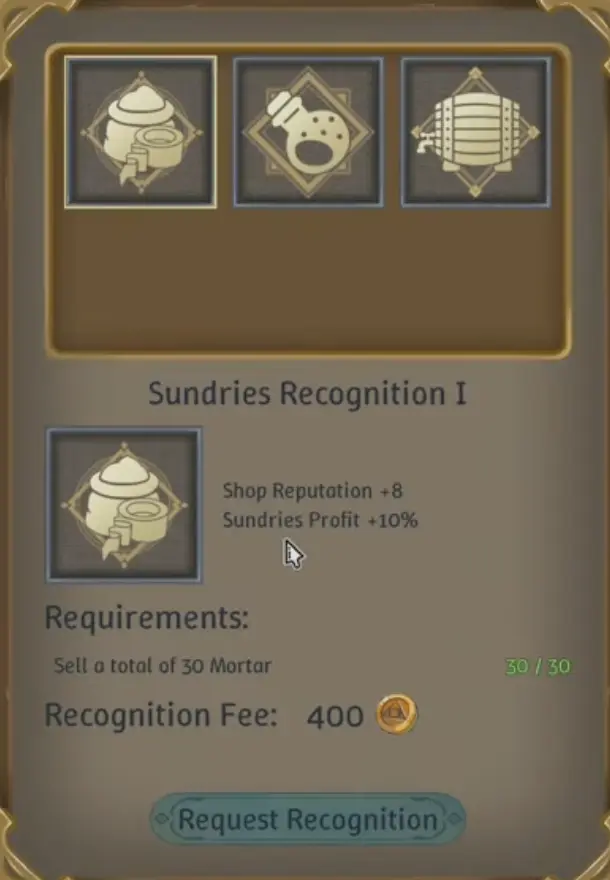
The first few Recognition requirements are useful because they expose the full loop: a sales target, a permanent reputation increase, a profit bonus and a fee to activate the reward.
| Recognition | Requirement | Permanent bonus | Claim fee |
|---|---|---|---|
| Sundries I | Sell 30 Mortars | +8 Shop Reputation, +10% Sundries Profit | 400 |
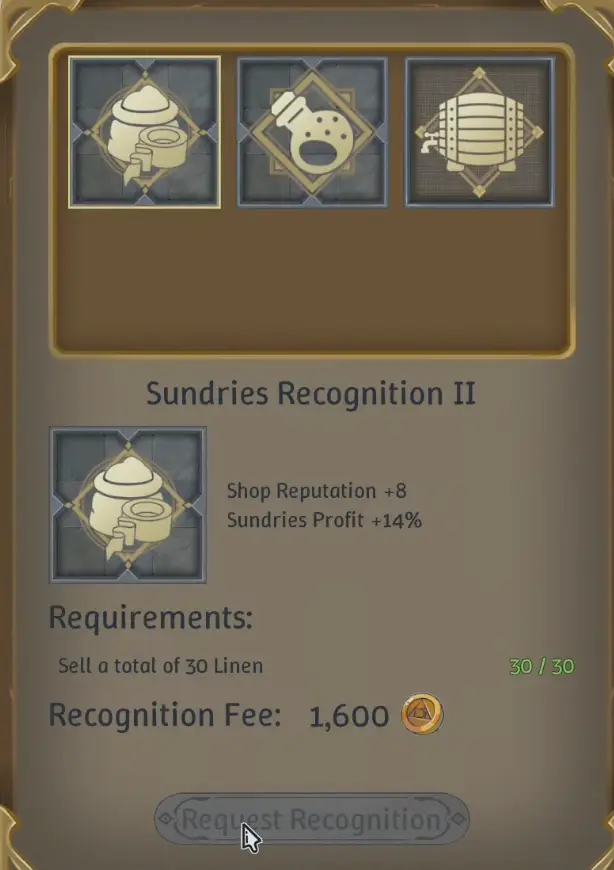
| Sundries II | Sell 30 Linen | +8 Shop Reputation, +14% Sundries Profit | 1,600 |
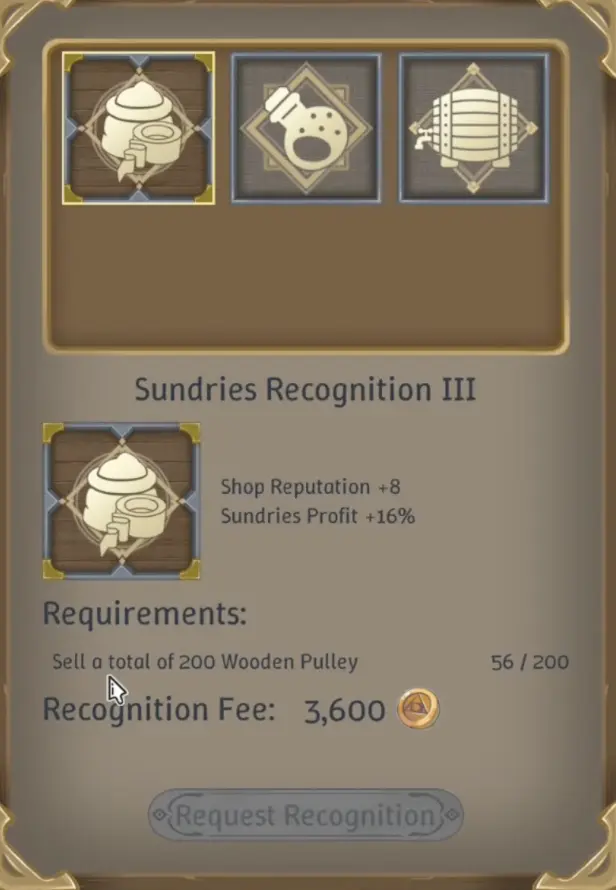
| Sundries III | Sell 200 Wooden Pulleys | +8 Shop Reputation, +16% Sundries Profit | 3,600 |
The quantities and fees climb fast enough that Recognition eventually stops being something I complete by accident. Thirty Mortars or thirty Linen can fit into normal early sales without much disruption. Two hundred Wooden Pulleys require a shop route that can actually keep moving product while the rest of the factory continues working.
The reward also becomes more meaningful as volume increases. I am temporarily committing production to a specific retail target in exchange for reputation and profit bonuses that remain after that particular product is no longer important.
Recognition Wants Customer Sales, Not Items Sitting in Storage
A milestone that says Sell 30 Linen is very literal.
Thirty Linen in a storage box does nothing. Producing thirty Linen does nothing by itself. The product has to move through the shop in the way the Recognition counter expects.
That sometimes means retailing an intermediate product I would normally keep away from customers. I do not permanently redesign the factory around that decision. I give the item a temporary route to the shop, supply enough shelf capacity for the milestone and let the counter finish.
Afterward, the same production can go back to construction, crafting or whatever downstream chain needs it.
This becomes more important with later requirements because quantities such as 200 Wooden Pulleys, 100 Vitality Potions and 20 Whispering Fields are large enough to compete with other systems if I treat them like ordinary spare stock.
Dispatch Does Not Advance Recognition
This is the easiest way to waste hundreds of items.
A Dispatch order is still a sale in the economic sense, but Recognition is looking for normal customer sales through the shop. Sending the required product through the Dispatch Portal does not advance that Recognition counter.
The difference becomes painfully obvious at the 200 Wooden Pulley milestone. Pulleys are useful enough that I may already have several destinations for them, and Dispatch provides another tempting outlet. If those units leave through wholesale contracts, the Recognition number stays where it was.
While a Recognition target is active, I therefore separate retail stock from true surplus. The quantity needed for Recognition stays on the customer side until the requirement is complete. Whatever the factory can produce beyond that can still feed contracts.
That same distinction matters in reverse on the Contracts page: Dispatch is strongest when I already have more output than the shop can absorb, not when it is stealing units from a retail milestone I am actively trying to finish.
Completing 30/30 Does Not Activate the Bonus
The next trap happens after the selling is already done.
Recognition has to be claimed, and claiming can cost money. A completed counter does not automatically add the reputation or profit reward.
The early Sundries sequence makes the increasing cost clear:
400 → 1,600 → 3,600
for the first three visible milestones.
That means a Recognition can be technically complete while the shop still shows the old bonuses because I have not paid the fee yet.
I keep that cash requirement in mind near the end of a milestone. If I have just enough money for the next Main Quest machine and a Recognition is sitting at 28/30, I do not necessarily spend the entire balance pushing and claiming Recognition first. The sales can finish naturally while I protect the Gold needed to keep progression moving.
When cash is comfortable, I claim the completed Recognition quickly because there is little benefit to leaving a permanent profit bonus inactive.
The Bonuses Stay After the Milestone Is Over
Recognition would be much less interesting if it only rewarded the product I just sold. The important part is that its effects remain attached to the shop.
The early Sundries milestones add Shop Reputation and increasingly strong Sundries Profit bonuses. Once claimed, those gains are not dependent on keeping that original Recognition item permanently stocked.
That changes the economics of awkward requirements. Selling 200 Wooden Pulleys is not necessarily attractive because Wooden Pulleys are my ideal permanent retail product. I do it because the requirement converts a temporary production commitment into a permanent economic improvement.
Once the counter is finished and claimed, the Pulley output can be redirected without giving the bonus back.
The 200 Wooden Pulley Stage Exposes Weak Restocking
Thirty sales are easy to brute-force manually. Two hundred are not.
By the time Sundries III asks for 200 Wooden Pulleys, walking every batch from production to a shelf becomes a poor use of time. I want a buffer near the shop and some form of reliable restocking so the counter can continue moving while I am somewhere else.
The factory side also matters. If Wooden Pulley production is consuming material needed by a current Association objective, forcing 200 retail units at maximum speed can create a much more expensive delay than the Recognition bonus is worth.
I prefer to wait until the Pulley chain is repeatable, give the shop a controlled share of output, and allow the quantity to accumulate over normal customer traffic. A Recognition counter does not need to be completed the moment it becomes visible.
Vitality Potions Are Where Recognition Starts Competing With Progression
A requirement such as 100 Vitality Potions is different from selling an early intermediate good.
Vitality Potions are tied closely to actual Alchemy progression, and their production sits on a more demanding chain. Redirecting a large batch into the shop before the Association requirement is secure can leave the entire run waiting on an economic side objective.
My priority there is straightforward: the current Main Quest receives the quantity it needs first. Once the potion line is stable and production can replace stock faster than the Association consumes it, I start allowing Recognition sales to build.
This is particularly important around the middle levels, when fertilizer, metals and longer potion chains are all competing for established upstream resources. The Levels 5–7 route is where I stabilize those systems before expecting the shop to absorb large Recognition quantities comfortably.
Whispering Fields Reinforce the Same Rule
Later visible Recognition requirements also include 20 Whispering Fields.
At that stage, the absolute quantity may look smaller than 200 Pulleys or 100 Potions, but quantity alone does not determine how expensive a milestone is. A high-tier product can consume far more factory effort per unit.
So I judge Recognition by replacement cost, not just the number written beside it.
Thirty cheap items can be trivial. Twenty advanced products can be disruptive. I ask how quickly the upstream factory can recover after those items reach customers and whether another important chain uses the same materials.
Recognition is worth advancing when the shop can take the stock without creating a shortage somewhere more important.
An Empty Shelf Is Now an Economic Problem, Not a Reputation Crisis
This is one of the best consequences of the 1.0 system.
If I am rebuilding, finishing a potion assessment or repairing an upstream shortage, I can decide that a shelf simply does not deserve attention right now. The missing sale has an obvious cost—less shop income—but it no longer creates the same pressure to maintain every product at all times for fear of reputation damage.
That allows the storefront to behave more like another output of the factory.
Products with healthy supply stay stocked. Recognition products get temporary priority when I am actively pursuing their milestone. Low-value items can run dry while production capacity goes somewhere better.
Once I stopped treating every empty display as an emergency, the shop became much easier to scale alongside the factory.
Shop Profit and Sales Ability Are Separate Systems
Another 1.0 change explains why some familiar economic upgrades no longer appear where I initially expected them.
Shop Profit progression now lives inside Recognition bonuses.
Sales Ability remains separate and affects how customers purchase rather than replacing Recognition.
Those two upgrades solve different problems. Recognition improves the economics of completed categories through permanent reputation and profit progression. Sales Ability changes customer purchasing behavior.
This distinction matters most once production is already strong. A profit percentage cannot generate money from an empty shelf, and stronger purchasing behavior is not helpful if my factory cannot replace the stock customers are consuming.
I strengthen the production loop first, then let those economic bonuses amplify something that can already stay supplied.
Why Recognition Progress Gets Stuck
When a milestone appears frozen, the Recognition screen usually tells me more than adding another machine.
| What I see | What it usually means | What I do |
|---|---|---|
| Product is being produced but the counter stays at 0 | Production itself does not count | Put the item on a customer shelf |
| Large quantities went through Dispatch but Recognition did not move | Wholesale sales do not count | Route the required stock through the shop |
| Counter shows 30/30 but reputation did not increase | Recognition has not been claimed | Return to Recognition and check the fee |
| An empty shelf does not reduce reputation | This is normal in the 1.0 system | Decide whether lost income is worth fixing |
| Recognition item keeps starving the Main Quest | Both systems share production | Reserve quest stock first and slow retail |
| 200-item target feels unbearably slow | Retail logistics are too manual or upstream output is too weak | Improve buffering/restocking before forcing more volume |
| Shop Profit upgrade seems missing elsewhere | Profit progression moved into Recognition | Check claimed Recognition bonuses |
The important part is identifying which stage of the loop has stopped: production, shop delivery, customer sales or claiming. More production only helps the first of those.
I Push Recognition When the Factory Has Crossed a Capacity Threshold
I do not keep the Recognition menu open while I play. I return to it when the factory has visibly changed.
A production line that used to stay empty begins filling storage. A Main Quest batch is finished and no longer needs the full output. Shop restocking becomes automatic enough that another product can be added without creating manual work. A previously expensive intermediate becomes routine.
Those are the moments when a Recognition that looked unreasonable earlier can suddenly be cheap.
The reverse is also useful. If reaching a milestone requires dismantling current progression, buying several machines for a product I barely use or exhausting a scarce input, I leave it alone. The permanent bonuses are valuable precisely because they remain useful later; I do not need to pay an excessive opportunity cost to obtain them early.
That is the rhythm I use throughout 1.0: sell when the factory has spare capacity, claim when the fee is comfortable, and let Recognition turn that temporary surplus into permanent shop growth.