Alchemy Factory Contracts Guide: Sample Requests, Dispatch and Bulk Selling
Contracts become useful when production starts outrunning the shop. I unlock Dispatch through the 50-Bandage Sample Request, keep the 2,000-Bandage Gloom Spore requirement moving with surplus stock, and only accept the lower wholesale margin when it solves a real factory problem.
Updated:
Quick Answer
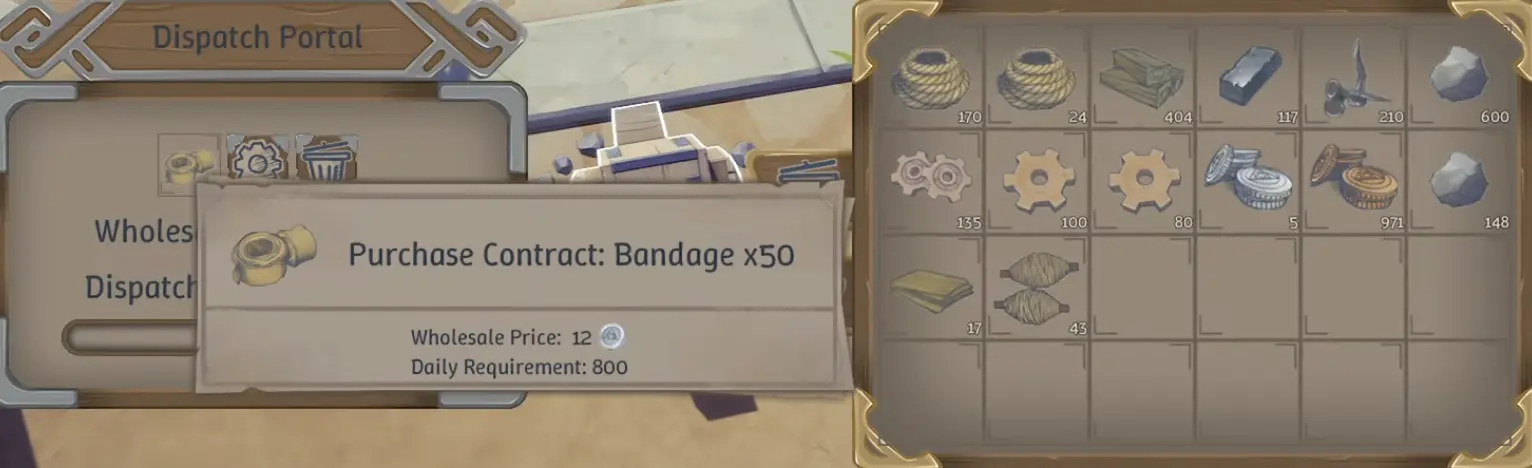
Start with the Sample Request, not by searching for another portal research node. The early request asks for 50 Bandages; once it is complete, Bandages become available through Dispatch. A shipment of 50 Bandages pays 12 Silver, less than the roughly 17.5 Silver direct shop value I was seeing, so I use Dispatch for surplus and unlock progress rather than maximum margin. Keep that surplus moving toward the 2,000 Bandages needed to open Gloom Spores.
The First Contract Is Hidden Behind a Sample Request
The confusing part of Contracts is that the Dispatch Portal is not the beginning of the process. When I first went looking for wholesale orders, I expected to research a portal, place it and immediately find a list of products. The actual entry point was sitting in the quest list: a Sample Request.
The early request I encountered wanted 50 Bandages. Completing it is what made the Bandage contract available through Dispatch, so I treat those first 50 very differently from ordinary shop inventory.
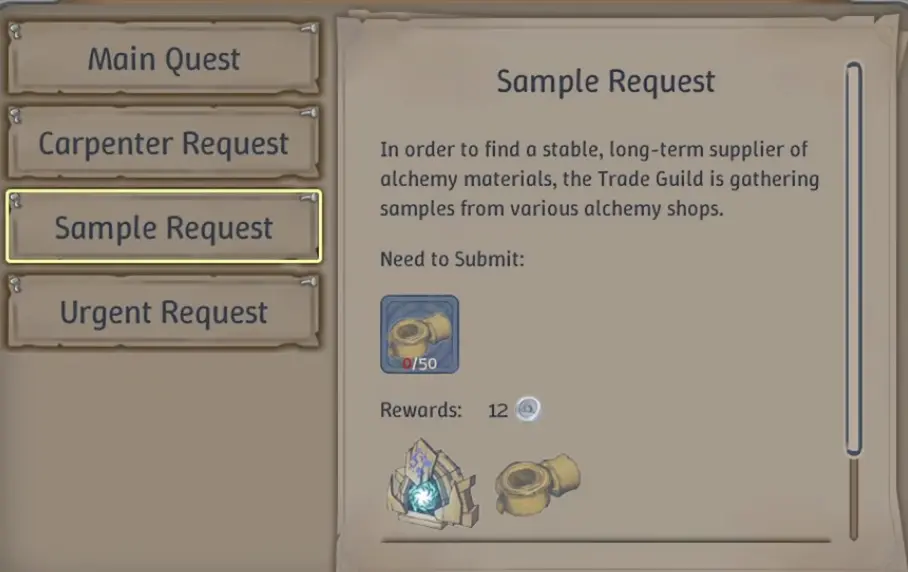
This creates a small but very real inventory trap. Bandages are already sellable, which means the shop can eat the exact stock I am trying to save for the sample. When the counter is in the forties, leaving the shelf fully supplied only turns the last few items into repeated re-crafting.
I pull Bandages out of normal sales long enough to finish the request, then restore the shop after Dispatch is actually available.
Completing the Sample Changes the Item Into a Dispatch Option
Once the Sample Request is done, the contract stops being an abstract quest and becomes something I can select through the Dispatch Portal.
That distinction matters because researching more portal technology does not substitute for the sample. If Bandages are not showing as a Dispatch option, the first thing I check is whether the corresponding Sample Request is actually complete.
The portal itself is simply the outlet. The Sample Request is what establishes the product relationship.
This also means I do not place Dispatch and immediately reroute the whole Bandage factory into it. Unlocking a new sales channel tells me where I can sell; it does not tell me that wholesale is now the most profitable destination.
The First Bandage Contract Trades Margin for Throughput
The first Bandage offer makes that tradeoff unusually clear.
The Dispatch Portal asks for:
50 Bandages
and pays:
12 Silver
The same 50 Bandages were worth roughly 17.5 Silver through direct shop sales in the setup I was using.
The difference is large enough that I would not replace customer sales with Dispatch while shelves are still clearing everything I can produce. The portal becomes attractive when production has moved into the opposite situation: boxes stay full, machines begin backing up and ordinary customer demand cannot absorb output quickly enough.
A lower price is easier to accept when the alternative is not “sell for more later,” but “the line has stopped because storage is full.”
I Divide Stock by Urgency, Not by a Fixed Percentage
Trying to send half of every product to the shop and half to Dispatch sounds tidy, but it ignores what the factory is actually doing at that moment. I change the split depending on the current constraint.
| Current situation | Where I send the stock first | Why |
|---|---|---|
| A Sample Request is still incomplete | Sample Request | The contract is still locked until the sample is finished |
| The Main Quest needs the same resource chain | Main Quest | Raising Alchemy Level is usually more valuable than accelerating a wholesale counter |
| Shop shelves are empty and customers can absorb the output | Shop | Direct sales give better value on the early Bandage comparison |
| Storage remains full even with normal sales | Dispatch | Bulk selling clears production that would otherwise stop |
| The next Dispatch unlock is close | Dispatch can temporarily take priority | Finishing the gate may be worth a short-term margin sacrifice |
| Dispatch is emptying the entire production line | Reduce shipments | A background system should not turn every other consumer into a shortage |
For the early Bandage stage, this usually becomes a simple order of operations: finish the sample, restore enough shop stock to keep normal sales healthy, and let true surplus feed the contract counter.
That works better than assigning Dispatch a permanent share of production regardless of inventory.
The 2,000-Bandage Requirement Changes the Value of Every Shipment
A 12-Silver shipment would be much less interesting if the portal were only another place to sell. The long unlock counter gives those lower-margin orders a second purpose.
The Bandage chain requires 2,000 Bandages delivered through Dispatch before Gloom Spores become available.
At 50 Bandages in the early order, this is clearly not a “make one large batch and move on” objective. The better approach is to begin while Bandages are still part of normal production and allow the total to rise alongside the rest of progression.
Waiting until Gloom Spores become urgent leaves a very different problem: suddenly I am trying to manufacture a four-digit quantity of an older product while the mid-game factory already wants space and materials for more valuable chains.
A 2,000-Item Counter Does Not Mean I Need a Giant Bandage Factory
This is where the number itself can push me into the wrong build.
Two thousand sounds large enough to justify dedicating land, machines and storage to Bandages alone. In practice, I only increase production if the existing line remains full while both the shop and Dispatch are consuming from it. That tells me there is demand for more output.
If Dispatch empties the Bandage stock as soon as an order leaves, the line is already doing enough work. Making it larger just to shorten a long background counter can pull materials and floor space away from the current Association objective.
The distinction becomes increasingly important as the factory moves into longer potion, farming and metal chains. Old production still has value, but I do not let a wholesale unlock determine the entire mid-game layout.
Players still working through the first Alchemy Levels will usually get more value from stabilizing the Levels 1–4 route before pushing contract volume hard.
Shop and Dispatch Solve Opposite Inventory Problems
I use the shop when I want strong value from stock the customer base can realistically consume. Dispatch becomes more interesting after output starts exceeding that demand.
The difference is easiest to see in storage behavior.
If a Bandage box spends most of the day nearly empty, Dispatch is competing with a product that already has somewhere useful to go. If the box spends most of the day full and the upstream machines keep stopping, the wholesale discount is buying something valuable: continued throughput.
That makes Dispatch particularly useful for mature lines. Once a product has been automated well enough that I no longer need to watch it, the portal can quietly prevent output from clogging while the main factory works on something else.
I care much less about getting the highest possible price from every single item once the greater loss would be idle machinery.
Dispatch Progression Continues Beyond Bandages
The 2,000-Bandage gate also makes the structure of the system clearer: products unlock through cumulative Dispatch activity rather than every contract being immediately available.
After Bandages, the chain moves into Gloom Spores, and later Dispatch products continue further up the production economy.
That changes how I look at an old contract. The item may no longer matter much to my current Main Quest, but continuing to move excess output can still be advancing access to something I will use later.
I therefore keep old Dispatch-capable production alive when it is cheap to maintain. I do not necessarily scale it, but I also avoid dismantling a functioning line simply because the Association has moved on.
Dispatch Portal and Purchasing Portal Do Opposite Jobs
The two portal systems are easy to confuse, especially once both appear in a larger factory.
The distinction is straightforward:
- Dispatch Portal: sends finished or produced goods out through contracts.
- Purchasing Portal: brings purchased raw materials into the factory.
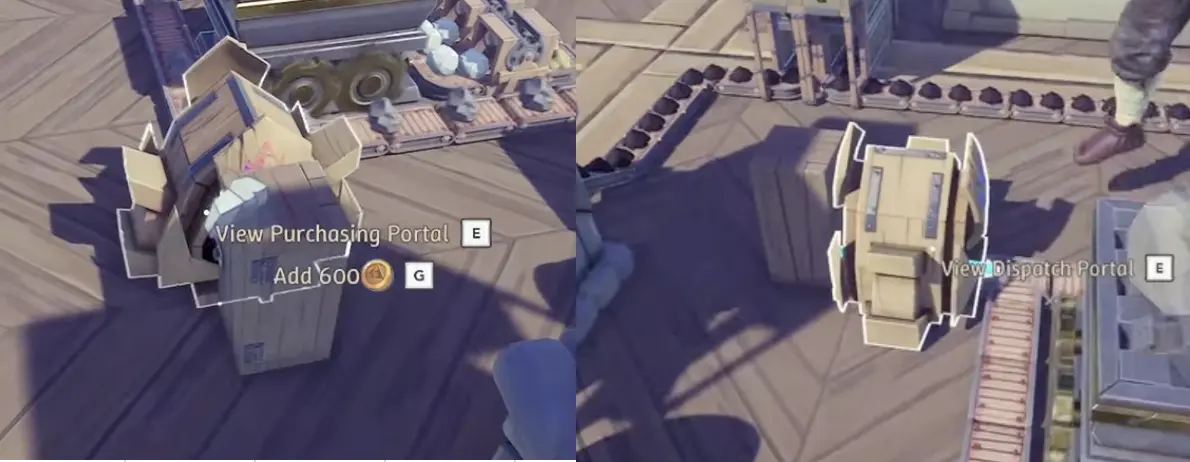
I once approached the wrong portal while trying to automate supply because their names and broader role both sound like logistics. The correction is easy once I think in terms of direction.
Need Logs, Stone or another purchased input delivered automatically? That is Purchasing.
Need Bandages or another finished item leaving the factory toward a wholesale requirement? That is Dispatch.
If a contract is missing, changing the Purchasing Portal will not help. I go back to the Sample Request and the Dispatch unlock state.
Sample Requests Need a Temporary Inventory Lock
The 50-Bandage example taught me a habit that carries forward into later Samples.
When the requested quantity is nearly complete, I stop treating that item as ordinary sale stock. If the quest counter is at 46/50, every item sold from the shelf is effectively pushing the unlock backward relative to production.
I do not necessarily rebuild belts or dismantle the shelf. Pulling the product from sale, shutting off the relevant feed or manually reserving the final batch is enough.
After submission, the restriction disappears. The shop can resume selling, and Dispatch gets whatever portion of the line is genuinely available after higher-priority needs are covered.
That short interruption is far less disruptive than allowing several outputs to compete until the sample takes twice as long to finish.
How I Decide Whether Another Dispatch Order Is Worth Sending
By the time the portal is part of normal factory logistics, the decision can be reduced to four checks.
First is storage pressure. A full box and stopped upstream machines are strong reasons to ship.
Second is unlock value. Deliveries that move me substantially closer to Gloom Spores or another useful contract product have value beyond their Silver payout.
Third is resource competition. I avoid sending a batch when the same production chain is already starving the Main Quest, Recognition stock or a new machine build.
Fourth is replacement speed. If another 50 Bandages can be regenerated before the shop meaningfully notices the loss, the lower margin matters much less.
| What I see | Dispatch decision |
|---|---|
| Storage full, machines backing up | Send — the shipment restores production flow |
| Sample Request incomplete | Hold stock — finish the unlock first |
| Main Quest using the same upstream inputs | Wait or reduce Dispatch |
| Shop selling through the stock faster than I replace it | Keep more in the shop |
| 2,000-Bandage gate still far away but surplus is steady | Keep sending gradually |
| Gloom Spore unlock is almost complete | A temporary Dispatch push can make sense |
| Bandage line was built only for the old contract and now consumes scarce resources | Do not expand it just for the counter |
This makes the portal much easier to use than judging every order by the payout alone.
The Best Contract Factory Has Surplus Before Dispatch Touches It
Contracts work best for me once they become the final destination for production that already has a healthy upstream chain.
The first 50 Bandages are different because they unlock the system; I protect them aggressively. After that, I want the line to serve the shop and any important progression needs without running dry. Whatever remains can leave through Dispatch and slowly work through the larger quantity gates.
Used this way, the lower wholesale price has a clear purpose. I am giving up some margin in exchange for bulk movement, unclogged storage and access to later contract products.
That is much more useful than turning Dispatch into a second shop and forcing the factory to feed both at full capacity from the moment the portal appears.