Alchemy Factory Levels 1–4: From Linen Rope to Automatic Cashier
The opening levels reuse the same materials more than they first appear to. I build enough Stone and Flax to clear 50 Linen Rope, preserve that Flax for 100 Healing Potions, then use the Level 4 payout on the Automatic Cashier instead of another premature expansion.
Updated:

Quick Answer
At Level 2, get the Stone supply running and build the Flax chain needed for 50 Linen Rope. Once that quest is nearly finished, stop expanding Rope production and preserve new Flax for Level 3. Submit 100 Healing Potions to reach Level 4, then put the 3,000 Gold assessment payout toward the Automatic Cashier before spending heavily on land or another side project.
The Early Game Is Really One Supply Chain Being Reused
Levels 1–4 look like a sequence of unrelated tutorial recipes when I first unlock them. They make more sense once I notice that each assessment reuses materials from the previous one in a slightly different way. Flax teaches that lesson first: the same crop that gets me through Linen Rope becomes one of the inputs holding back Healing Potions only a short time later.
That changes how I build. I still automate enough to clear the current assessment comfortably, but I avoid turning every early quest item into a huge permanent line. Storage and spare upstream capacity matter more than a warehouse full of something the Association has already stopped asking for.
If the problem is still earlier than that—where to put the opening machines, whether to buy land, or what deserves automation first—the beginner guide covers those opening decisions. This route starts once progression itself becomes the main concern.
Level 2: Get Stone Moving Before Construction Starts Competing for It
The first research choice I care about at Level 2 is the Stone Crusher. Its research screen shows a cost of 230 Gold and a 9.5-second research time, and once the machine is running it can supply 20 Stone per minute.
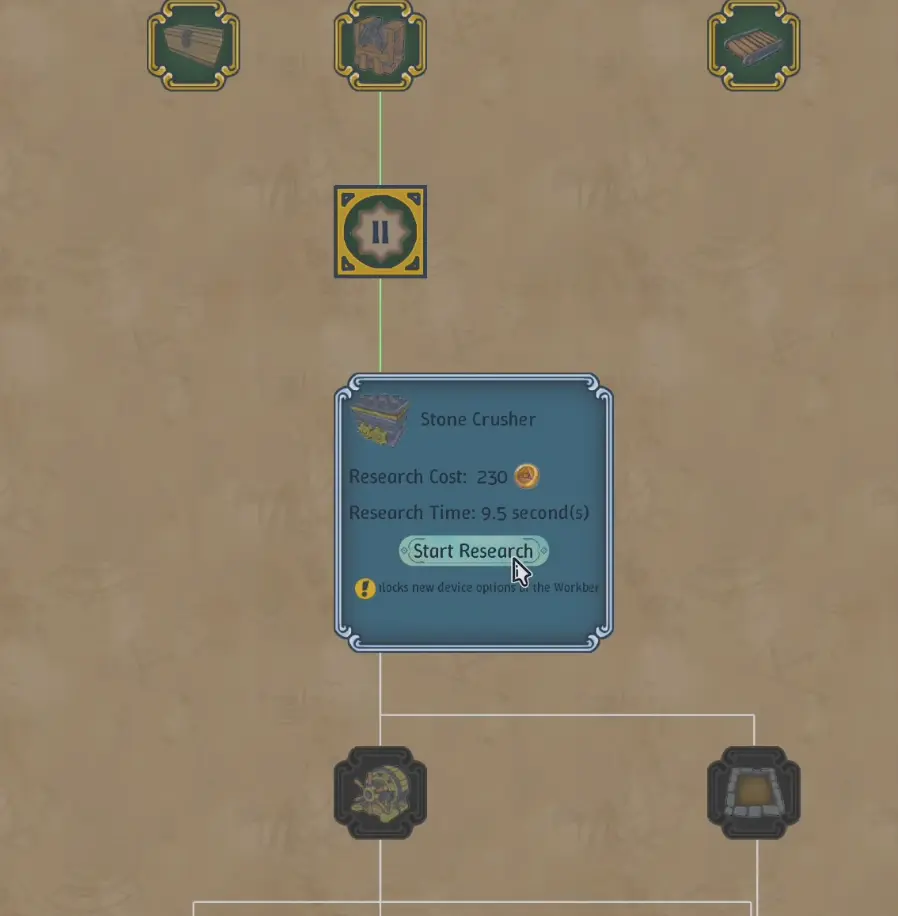
Twenty Stone per minute is not a number I use to min-max the entire starter factory. It is useful because Stone demand arrives from several directions at once. Machines, crop expansion and later processing can all pull from the same stock, so a Crusher that has been quietly filling storage saves me from discovering the shortage halfway through the next build.
When Stone storage is empty, I let that line recover before adding more consumers. Extra machines downstream cannot compensate for an upstream box that never stays full.
50 Linen Rope Is the First Time Throughput Matters
The first larger Main Quest asks for 50 Linen Rope. That objective is where the factory stops feeling like isolated crafting stations and starts behaving like a chain.
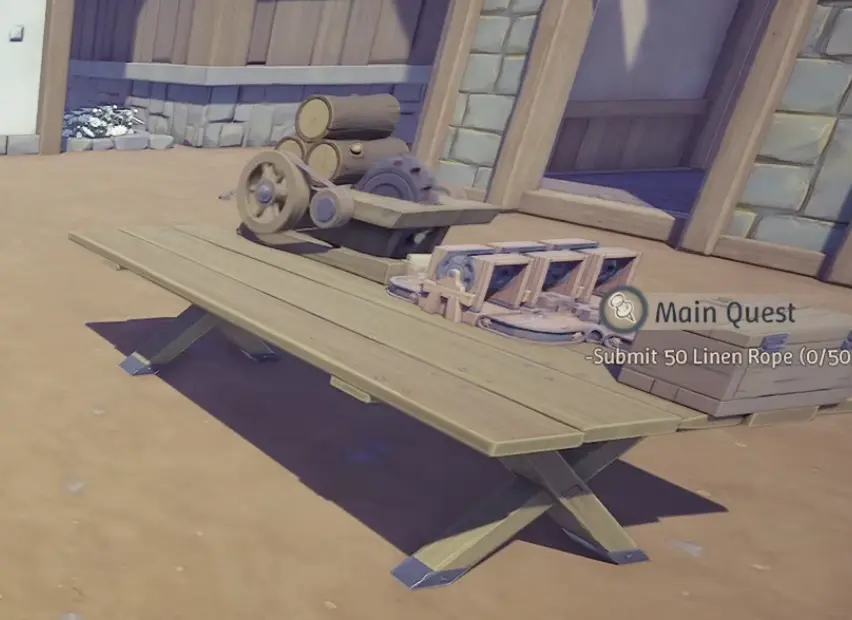
The route is:
Flax → Flax Fiber → Linen Thread → Linen Rope
The usual slowdown is not the final machine. It is Flax.
If processors are waiting while the plots are still growing, adding another processor only creates another idle machine. I add crop capacity first, then let buffers between the processing stages absorb short interruptions. That gives me a line that can keep advancing toward 50 without requiring me to stand beside it and move every intermediate item manually.
Storage is already useful here for another reason: it separates the pace of farming from the pace of processing. A small Flax or intermediate buffer lets the machines keep working when I temporarily divert attention to Stone, research or the shop.
Stop Expanding Rope Before the Counter Reaches 50
A production line that is finally working creates a strong temptation to duplicate it. With Linen Rope, that is exactly when I start thinking about the next objective instead.
Once the quest is safely approaching 50 Rope, additional Flax is more valuable uncommitted than converted into another large Rope stockpile. Level 3 introduces Sage and moves progression toward Healing Potions, where the Flax branch is needed again as Flax Fiber.
I keep a modest Rope reserve because it remains useful elsewhere, but I stop adding permanent Rope capacity. Any new Flax harvest can then be redirected without dismantling an oversized line that has already served its main progression purpose.
That one decision prevents a surprisingly common Level 3 problem: the Healing Potion machines are waiting for Flax while an older Rope line continues consuming it automatically.
Level 3 Changes the Question From “Can I Make It?” to “Can I Feed It?”
The next assessment requires 100 Healing Potions.
Healing Potions bring together two processed crop streams:
- Flax Fiber
- Sage Powder
The final Assembler can consume both quickly enough that the real problem is keeping those two inputs arriving at the same time. A machine that is full of Flax Fiber but waiting on Sage Powder is no more productive than one with neither.
The useful numbers are:
- one Grinder processes 20 input per minute into 20 output per minute;
- the Healing Potion recipe can consume 60 Flax Fiber per minute;
- it can also consume 60 Sage Powder per minute;
- one Assembler outputs 10 Healing Potions per minute.
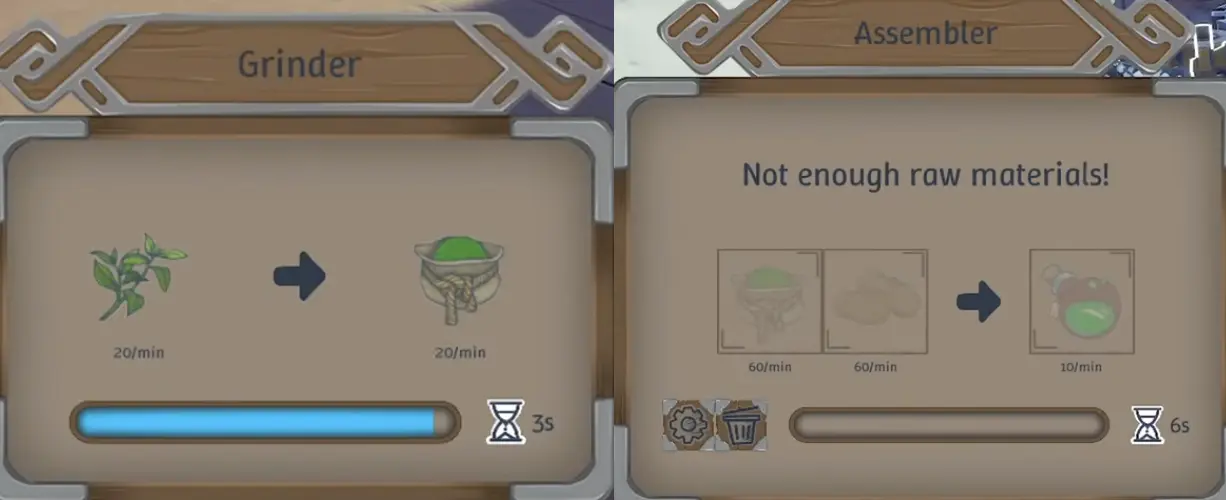
From those numbers, a fully supplied Assembler can use approximately:
3 Flax Grinders + 3 Sage Grinders → 1 Healing Potion Assembler
I treat that as a ceiling for a continuously fed line, not a requirement for producing the first potion. Starting with fewer Grinders is perfectly workable while crops are still the limiting factor. The ratio becomes valuable when the Assembler begins pausing, because it tells me where additional capacity could actually help.
An Idle Assembler Usually Means I Need More Crop Processing, Not Another Assembler
This is one of the first early-game mistakes that costs both money and space.
When the potion counter feels slow, another Assembler looks like the fastest solution. If the first machine is already displaying a raw-material shortage, however, the second one simply divides the same inadequate supply across two idle machines.
I check the line backward. Is Sage Powder arriving at the same pace as Flax Fiber? Are the Grinders themselves waiting on crops? Is the old Rope branch still taking most of the Flax?
That diagnosis matters more than the exact machine count. Three Grinders per ingredient only help if there is enough Flax and Sage to keep them busy.
Flax is usually the resource I have to rebalance because it already has history in the factory. The Rope line exists, storage may still be requesting Rope-related intermediates, and construction can continue consuming the same supply. Once the 50-Rope assessment is finished, progression gets the next harvest.
I Spend on Inputs Before I Spend on Empty Ground
Level 3 is also where the factory starts feeling cramped enough to make land expansion look urgent. On this route, lack of floor space was rarely the reason the 100-potion assessment stalled.
The blockers were usually much more concrete: Flax plots could not keep up, Sage supply was thin, Stone was being consumed faster than the early buffer could recover, or the Grinders could not supply the Assembler continuously. None of those problems gets better because I own another empty plot.
I buy agricultural space when crop supply itself has become the constraint. I do not buy a larger footprint simply because a later production tier is visible on the Research Tree. Until the potion line is moving steadily, raw-material capacity gives me more progression per Gold than unused land.
The 100-Potion Reward Has an Immediate Use
Submitting the 100 Healing Potions gives a particularly useful Level 4 transition because the assessment shows:
- 15 Silver
- 3,000 Gold
The Automatic Cashier becomes available at Level 4 and costs 3,000 Gold.
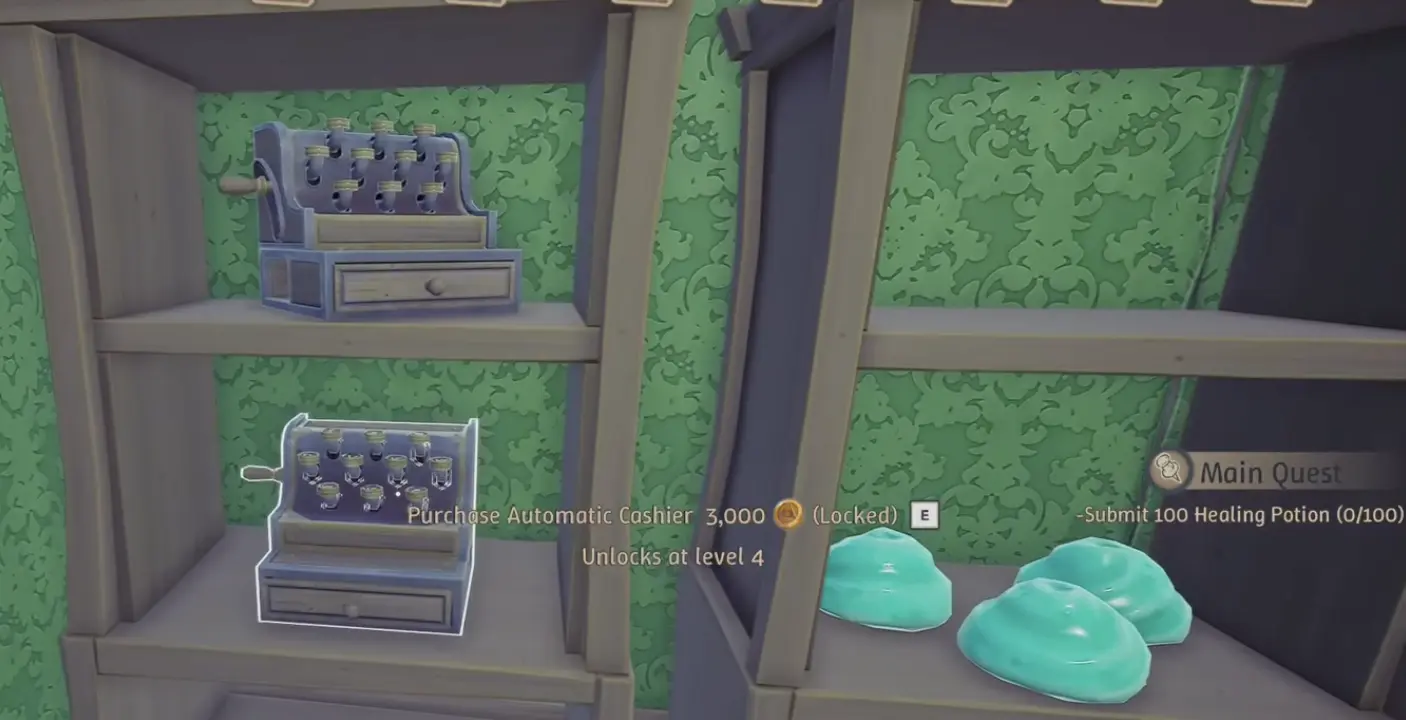
That makes the first purchase after the assessment easy for me. Unless something is genuinely broken upstream, I keep that payout away from speculative land purchases and side production and use it to remove manual checkout from my routine.
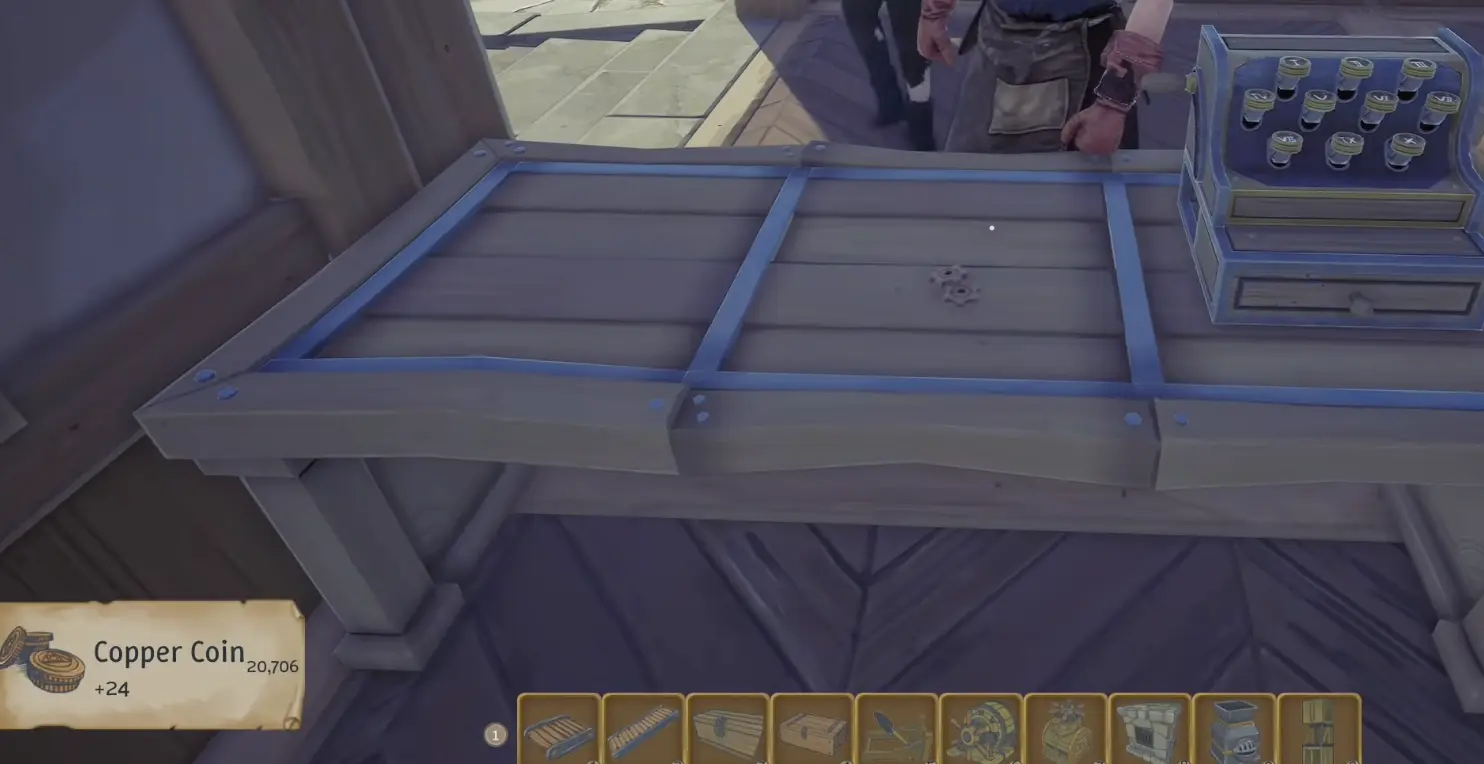
The benefit is bigger than saving a few clicks. Level 4 is about to introduce longer chains and more demanding material routing, so uninterrupted factory time becomes increasingly valuable. Shop income can continue while I am tracing an upstream shortage, researching or rebuilding a line elsewhere.
Before Starting Vitality Potions, I Stabilize the Factory I Already Have
Level 4 leads toward Vitality Potions, but reaching the new level does not make every temporary weakness disappear. I use the transition to clean up three things before adding another long recipe.
First, the Automatic Cashier needs to be working so the shop is no longer competing directly for my attention. Second, the Healing Potion line should be understandable even if I no longer need maximum output from it; I want to know which crop or processor to adjust when it slows. Third, basic Stone and wood supply should recover without repeated manual intervention, because the next stage will ask more from both infrastructure and processing.
I do not need a beautiful permanent factory yet. I need an early factory whose bottlenecks are visible and whose useful resources are not being consumed by an outdated quest line.
Once that is true, I move into the Levels 5–7 route, where Vitality Potions, Advanced Fertilizer, Steel and larger production chains make those early supply decisions much more important.
If Progression Stops, Check the Bottleneck Before Building More
| What I see | Most likely problem | What I check first | What I avoid doing |
|---|---|---|---|
| Linen Rope machines keep waiting | Flax production is too small | Crop plots and Flax buffer | Adding more processors that will also sit idle |
| 50 Rope is finished but Healing Potions have no Flax Fiber | Old Rope production is still consuming new Flax | Rope storage and input routing | Expanding the finished quest line |
| Healing Potion Assembler keeps stopping | Flax Fiber or Sage Powder is below demand | Both Grinder streams and crop supply | Buying a second Assembler before the first is fed |
| Construction repeatedly stops for Stone | The early Stone buffer never recovered | Stone Crusher and storage | Starting another Stone-consuming expansion |
| Automatic Cashier is still locked | The run has not reached Level 4 | 100 Healing Potion assessment | Searching unrelated research branches |
| Level 4 is reached but I cannot afford the Cashier | The assessment payout was spent elsewhere | Current Gold and optional purchases | Buying more land before restoring the 3,000 Gold reserve |
The opening stage becomes much faster once I stop answering every slowdown with another machine. Levels 1–4 mostly reward preserving the same upstream resources long enough to reuse them for the next assessment.
Flax is the clearest example: first it becomes Rope, then the same supply has to pivot toward Healing Potions. Stone follows a similar pattern, starting as a construction material before becoming part of increasingly important processing chains. By the time the Automatic Cashier is running, those lessons matter more than the size of the starter factory itself.