Teamfight Manager 2 Scouting and Transfer Guide
A practical Teamfight Manager 2 scouting and transfer guide covering staff, scout quality, player database filters, solo ranking, analyst reports, final approve/reject decisions, salary, free agents, and role fit.
Updated:
Quick Answer
In Teamfight Manager 2, good scouting starts before you open the market. Identify the role problem, use Scout staff and database filters to find the right profile, check Solo Ranking as a signal, use Analyst reports to spot roster weaknesses, negotiate without breaking salary flexibility, and only approve the deal if it solves a real team problem.
The TM2 Scouting Loop
Do not treat scouting as “find the highest-rated player.” In Teamfight Manager 2, scouting should connect four systems:
- Roster review — which role is actually losing matches?
- Staff and reports — how reliable is your scouting information?
- Player database filters — can you search for the right profile?
- Final approval — does the deal still make sense after negotiation?
Quick Decision Flow
Use this before opening the Player Database. The goal is to decide what kind of search you are about to run, not which specific player to sign.
| Before scouting, ask… | If yes | Search direction |
|---|---|---|
| Is one role losing matches right now? | Yes | Search for an immediate starter or veteran in that role |
| Is the role stable today but weak long-term? | Yes | Search for a Rising Star or future replacement |
| Is the next opponent exposing a clear weakness? | Yes | Use the Analyst report to prioritize that role or counter-profile |
| Are your reports too vague to trust? | Yes | Improve Scout staff or narrow the search before spending |
| Is this only a depth problem? | Yes | Search Local Talent, backup options, or cheaper rotation players |
This table is for pre-scouting direction. Use the later Scouting Decision Table for specific situations.
Staff Changes Scouting Quality
TM2 is not only about the player database. Staff quality changes how confidently you can trust the information you are using.
Treat Scout staff as the system that improves your ability to discover, evaluate, and compare players. Treat Head Coach delegation as a way to reduce manual management load, but not as a replacement for strategic decisions.
| Staff system | What it affects | When to invest |
|---|---|---|
| Scout staff | Scouting report reliability, discovery quality, search confidence, player comparison | Your searches keep missing the right role profile |
| Analyst | Opponent prep, role weakness detection, match planning signals | You need to connect upcoming opponents to roster decisions |
| Head Coach | Delegated management and routine team handling | You want automation, but still need to approve key roster moves |
| Training staff | Player development and prospect value | You plan to grow Rising Stars instead of buying starters |
| Support / recovery staff | Condition, stress, or stability support if available in your build | Your roster loses form due to fatigue, stress, or mental instability |
Use Analyst Reports to Guide Scouting
Analyst reports are not only for the next match. They can tell you what kind of player you should scout next.
For example:
- If the next opponent has strong jungle pressure, check whether your jungler is good enough or whether you need a backup plan.
- If the opponent repeatedly attacks bot, review your Bot and Support roles before scouting a random mid upgrade.
- If the report shows strong objective control, prioritize players who improve jungle, engage, peel, or lane priority.
- If your team loses to the same opponent pattern, turn that pattern into a scouting target.
| Analyst signal | Scouting implication |
|---|---|
| Enemy jungle dominates objectives | Review Jungle role, objective awareness, and engage options |
| Enemy backline carries fights | Scout dive, pick, or anti-carry tools |
| Enemy wins long fights | Scout sustain, scaling, or stronger carry protection |
| Enemy punishes your carry | Scout Support, peel, frontline, or safer carry profile |
| Enemy controls waves before objectives | Scout lane priority, wave control, or mid/jungle support |
| Enemy drafts around one role | Check if your counter role is too weak |
Define the Player Type Before Searching
The market makes more sense when you know whether you need a starter, prospect, backup, or short-term fix.
| Player type | Best for | Main risk |
|---|---|---|
| Immediate starter | Fixing a role that loses matches now | Fee and salary can be high |
| Rising Star / prospect | Building a future starter | May need multiple seasons and training |
| Backup / rotation player | Covering stress, form, or schedule problems | May not improve your ceiling |
| Veteran | Stabilizing a role quickly | Lower growth and possible high salary |
| Free agent | Avoiding transfer fee | Salary demand or contract terms may be worse |
| Specialist | Countering one role or draft pattern | Can be narrow if the meta changes |
Player Database Filters That Matter
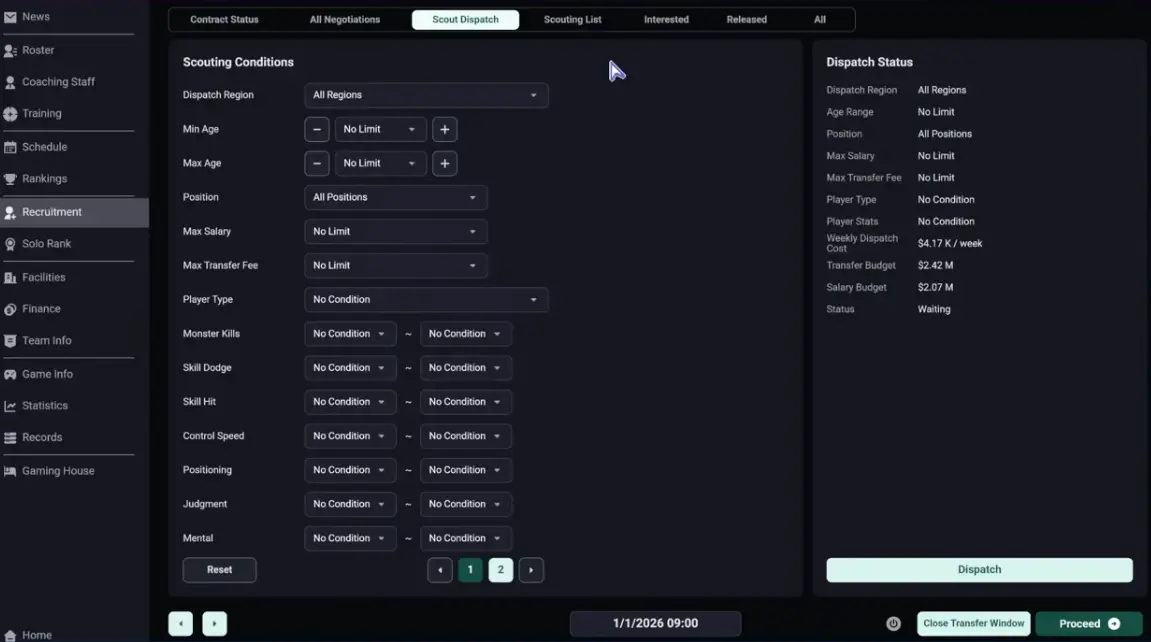
Use the Player Database as a targeted search tool. A broad search for “best player available” usually creates bad transfers.
| Filter area | How to use it | Mistake to avoid |
|---|---|---|
| Role / position | Start with the role that is losing matches | Searching every role because one star looks attractive |
| Age | Younger for prospects, wider range for immediate starters | Signing only young players when you need stability now |
| Transfer fee | Keep the fee inside real buying power | Spending the whole budget before checking salary |
| Salary | Check season-long cost, not just transfer fee | Ignoring wage pressure after a cheap fee |
| Contract status | Use expiring deals and free agents as leverage | Assuming free means cheap |
| Region / league | Use when chemistry, scouting range, or market access matters | Over-filtering until the pool is too small |
| Solo Ranking | Use as talent signal or discovery source | Treating ranking as proof of team fit |
| Key stats | Match stats to the role profile | Filtering for generic high numbers with no role plan |
Use filters together. One filter rarely gives you the right player by itself.
TM2 Stat Names and Role Priorities
Use visible in-game stat names when you take notes. If your build or language uses slightly different wording, map the idea to the closest visible field.
| Role | Important stat signals | Why they matter |
|---|---|---|
| Top | Mechanics, mental, focus, stability, aggression control | Needs to survive pressure and avoid bad side-lane deaths |
| Jungle | Decision-making, aggression, focus, roaming, objective awareness | Controls early tempo, Serpen setup, and map pressure |
| Mid | Mechanics, focus, roaming, decision-making | Connects lanes and affects both side pressure and objective fights |
| Bot | Mechanics, positioning, focus, consistency, mental | Often becomes the main damage source and must survive pressure |
| Support | Teamwork, shot calling, mental, focus, protection / engage fit | Protects carry, starts fights, or stabilizes team behavior |
| Prospect | Growth potential, age, trainable weaknesses, mental | Needs time and training before becoming a starter |
| Veteran | Mental, consistency, leadership, role reliability | Should stabilize the team immediately |
These priorities are scouting filters, not universal truth. Adjust for your roster, tactic settings, and patch.
Solo Ranking Is a Signal, Not a Signing Decision
Solo Ranking can help you find talent, but it does not answer whether the player fits your team.
| Solo Ranking situation | What it may mean | What to check next |
|---|---|---|
| High solo rank + good role fit | Strong candidate | Salary, age, personality, team role |
| High solo rank + poor team fit | Individually strong but risky | Mental, teamwork, role behavior |
| Low solo rank + strong role stats | Possible undervalued specialist | Match history and specific stat fit |
| Rising solo rank | Improving player or hidden value | Scout again and compare trend |
| High solo rank but high salary | Expensive target | Check if the role problem is urgent enough |
| High solo rank in wrong role | Not automatically useful | Do not force role conversion without evidence |
A high Solo Ranking player can still be a bad transfer if they duplicate a role you already have, demand too much salary, or do not fit your tactic setup.
When to Choose Each Player Type
Use this after you understand the player categories above. This section is about trigger conditions, not definitions.
| Trigger condition | Choose this player type | Why |
|---|---|---|
| Your current starter is losing matches now | Immediate starter or Veteran | You need reliability faster than training can provide |
| Your starter is stable but aging or expensive | Rising Star / prospect | You can develop the replacement before the crisis |
| Your main roster is good but stress or rotation is hurting performance | Backup / rotation player | Depth protects form and condition without changing the whole team |
| One opponent pattern keeps beating you | Specialist | A narrow signing can be worth it if it solves a repeated matchup problem |
| The market is expensive but the role still needs cover | Free agent or cheaper market option | You need cost control, but salary still matters |
| You do not know the real role problem yet | Pass / keep scouting | A signing without a clear role problem is usually an impulse move |
Free Agents: What Is Actually Different
Free agents are not simply “cheap transfers.” The difference is the negotiation structure.
You avoid the transfer fee, but the player may ask for more salary, a longer deal, stronger bonuses, or a role promise that makes the total cost worse than expected.
| Free agent issue | Why it is specific to free agents | What to do |
|---|---|---|
| No transfer fee | Upfront cost looks low | Compare total salary across contract length |
| Higher salary demand | Player may compensate for no fee with wages | Check season-long and multi-season budget |
| Longer contract pressure | Player may want security | Avoid locking in a declining or narrow player |
| Role promise risk | Free agent may expect starter treatment | Do not promise a role you cannot give |
| Crowded market temptation | Many options can look like value | Still filter by role problem first |
| Fast signing pressure | Easy deal can bypass discipline | Use final approve/reject before confirming |
Negotiation: Fee, Salary, Bonus, Installments
Negotiation is one financial check with several levers. Because Early Access rules can change, verify the exact limits and payment structure in the negotiation UI before approving the deal.
| Negotiation lever | Use it when | What to verify in TM2 UI | Risk |
|---|---|---|---|
| Transfer fee | You need the player now and can afford the upfront cost | Total fee, remaining budget, whether the fee blocks another role fix | Can drain the budget before salary is considered |
| Salary | The player is a true starter or critical role fix | Weekly/monthly salary display, contract length, total season cost | Long-term wage pressure can hurt later transfers |
| Win bonus | You want performance-linked cost instead of higher base salary | Bonus trigger, bonus amount, and whether it stacks across wins | Can become expensive if the team improves quickly |
| Installments | You need cash-flow flexibility | Number of installments, payment timing, and future budget impact | Hides future debt and can reduce next-window flexibility |
| Contract length | The player is core or has resale/development value | Contract years, renewal flexibility, and decline risk | Long bad contracts are hard to escape |
| Role promise | The player truly fits that role in your lineup | Promised role, starter expectation, and roster conflict | Can create morale or rotation problems |
| Final approve/reject | The deal changed during negotiation | Full final cost, role need, salary pressure, and opportunity cost | Skipping it turns negotiation into autopilot |
Final Approve / Reject Checklist
Use this right before confirming the transfer.
Role fit
Does this player solve the original role problem?
Reject if the deal drifted away from the reason you started scouting.
Is the player better now or only better later?
Do not pay starter money for a prospect unless you can wait.
Does the player fit your tactic settings?
A good player can still fail if they do not fit your draft and objective plan.
Financial fit
Can you afford the salary across the contract?
Transfer fee is only part of the cost.
Does the deal block another important move?
Keep flexibility if more than one role needs help.
Are bonuses or installments hiding the real cost?
Check future budget pressure before approving.
Roster fit
Does the signing create a bench or morale problem?
A new starter may push another player into a bad role.
Is the age and timeline correct?
Prospects, starters, and veterans should solve different problems.
Would you still sign this player if they were not available right now?
This catches impulse transfers and free-agent traps.
Scouting Decision Table
Use this when you know the situation but not the next move.
| Situation | Next move |
|---|---|
| Young player has upside but is not ready | Train and protect them |
| Starter is old, expensive, and declining | Scout replacement |
| Same role loses every match | Search for immediate starter |
| Player has high solo ranking but poor role fit | Keep scouting; do not force it |
| Scout reports are vague | Improve Scout staff or narrow filters |
| Analyst report exposes a role weakness | Prioritize scouting that role |
| Market is too expensive | Wait, use free agents, or adjust filters |
| Free agent asks for high salary | Compare total contract cost, not just fee |
| Salary budget is tight | Avoid long contracts and heavy bonuses |
| Transfer fixes one role but blocks two others | Reject or renegotiate |
| Prospect needs time but starter is failing now | Sign short-term veteran or stable backup |
| Deal looks good until final terms | Use final reject |
This table is for situations. The approve/reject checklist is for a specific player.
Common Scouting and Transfer Mistakes
Trusting raw rating over role fit
A high-rated player can still fail if they do not fit Top, Jungle, Mid, Bot, or Support needs.
Ignoring Scout staff quality
Bad or incomplete scouting information can make the market look worse than it is. If reports are vague, improve staff or narrow filters before blaming the player pool.
Copying Solo Ranking into your transfer list
Solo Ranking is useful, but it does not measure team fit, salary fit, tactic fit, or role behavior by itself.
Using training and transfers for the same problem
If the player needs time, train. If the role is losing now, sign. Do not pretend a long-term prospect is an immediate fix.
Solving tomorrow’s problem while losing today
A Rising Star is valuable only if the current starter can survive long enough for development to matter.
Signing specialists without a recurring matchup reason
Specialists are useful when they solve a repeated enemy pattern. If the problem only happened once, keep scouting instead of rushing a narrow signing.
FAQ
What should I check before scouting in Teamfight Manager 2? +
Start with the role problem, player condition, staff quality, budget, and timeline. Do not open the market until you know whether you need an immediate starter, a backup, a prospect, or a long-term replacement.
How does Scout staff affect scouting? +
Scout staff should be treated as a scouting quality multiplier. Better staff can make your reports, search quality, and discovery process more reliable, so upgrade or hire scouting staff when your player search keeps missing the right profile.
How should I use Solo Ranking? +
Use Solo Ranking as a signal, not a final answer. A strong solo ranking can reveal talent, but you still need to check role fit, player stats, personality, salary, and whether the player fits your team structure.
When should I use the Player Database filters? +
Use filters after defining the role, budget, age range, salary limit, and key stats. The database is strongest when you search for a specific profile instead of browsing random high-rated players.
What is the final approve or reject step? +
After negotiation, do one final check before confirming the deal: role need, salary, contract length, player fit, condition risk, and whether the signing blocks future transfers or facility upgrades.
Are free agents always good in Teamfight Manager 2? +
No. Free agents avoid transfer fees, but they can demand higher salary, longer contracts, or become expensive if you sign them only because they look cheap upfront.