How to Use the Personal Tier List in Teamfight Manager 2
A practical Teamfight Manager 2 personal tier list guide explaining real champion examples, Meta Report signals, opponent draft expectations, player stat fit, must-bans, safe picks, trap picks, and post-match updates.
Updated:
Quick Answer
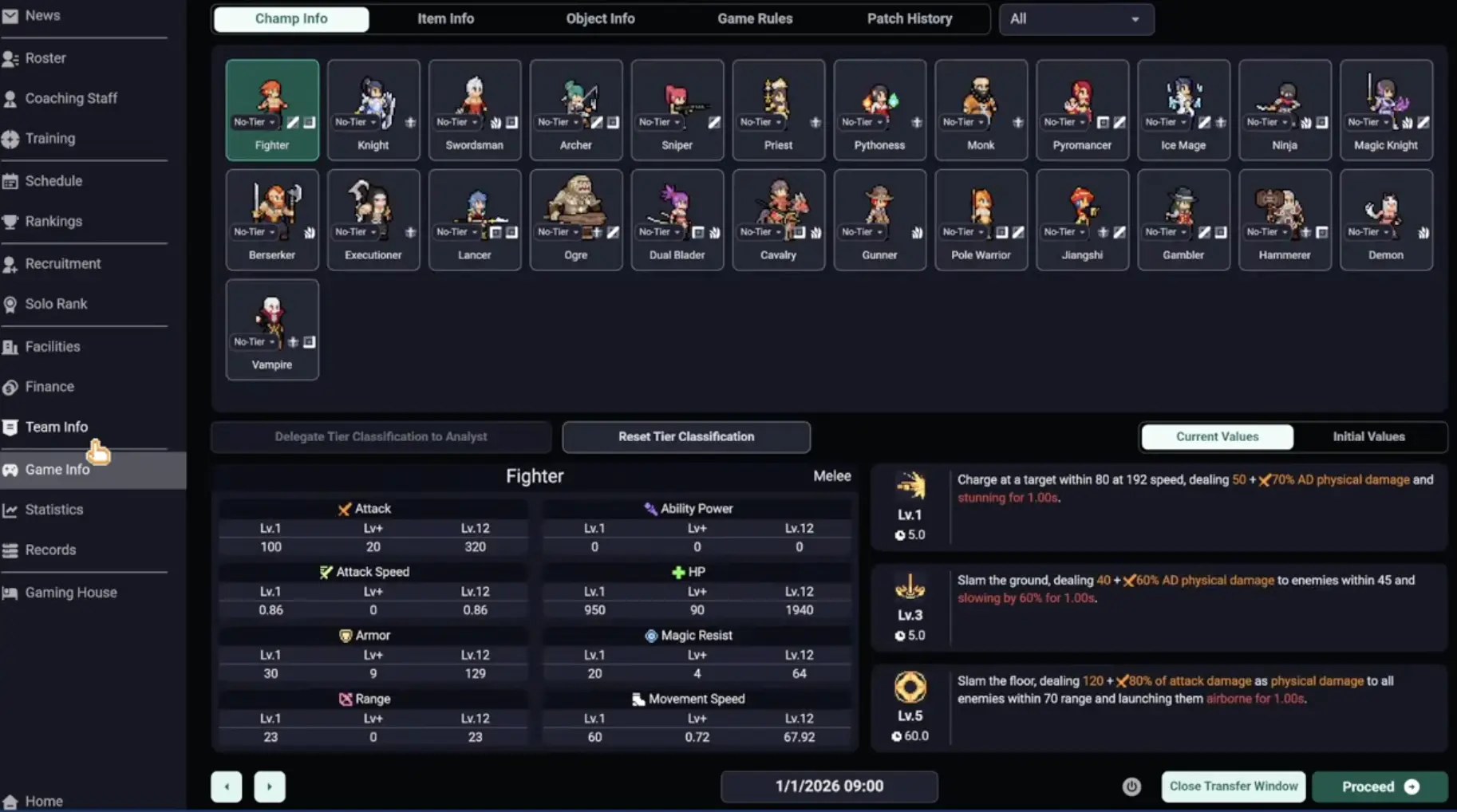
Use the Teamfight Manager 2 Personal Tier List as a draft notebook, not a permanent global ranking. Rate champions like Lancer, Sniper, Ninja, Priest, Berserker, Swordsman, and Pyromancer by draft job, player fit, Meta Report signals, and match review. A champion should have a tier, a label, a draft action, and a reason.
What the Personal Tier List Should Do
The Personal Tier List is useful because Teamfight Manager 2 drafts are not solved by champion strength alone. A champion can be strong globally but wrong for your roster, your player stats, your tactic settings, or your current draft.
Your personal list should answer five questions:
- Should I ban this champion?
- Can I safely pick this champion early?
- Does this champion need protection or a specific comp?
- Does this champion counter something common?
- Does my player actually fit this champion?
Early Access Rating Note
This guide uses early tactical reads for Teamfight Manager 2. Champion balance, AI behavior, and role fit can change during Early Access, so treat the example ratings below as a starting framework.
The goal is not to publish a final global tier list. The goal is to show how to rate champions in a way that helps you draft.
Example Champion Ratings
These are example champion notes to show how a real personal tier list can look. They are not a universal tier list. Use them as starting notes, then adjust by roster, player fit, patch, and match review.
| Champion | Starting tier | Draft label | Draft action | Why it matters | Player fit note |
|---|---|---|---|---|---|
| Lancer | A | Objective / tempo pick | Pick when your lanes can support early Serpen or objective pressure | Gives engage, tempo, and objective setup | Needs a player who can handle aggression and objective timing |
| Sniper | A | Scaling carry / needs peel | Pick with frontline, peel, and objective patience | Strong late-game damage, risky if exposed early | Needs stable positioning, focus, and protection |
| Ninja | B+ / A- | Counter-pick / backline threat | Pick into fragile carries or weak-peel comps | Punishes Sniper or Archer-style backlines | Works best with aggressive players and follow-up damage |
| Priest | A- | Sustain / protection support | Pick when your carry needs time or fights go long | Stabilizes scaling comps and extends fights | Best with players who support team structure instead of forcing plays |
| Berserker | B+ | Skirmish pick | Pick when fights are messy or enemy control is low | Can pressure isolated targets and early brawls | Needs aggression, but also enough mental and focus to avoid feeding |
| Swordsman | A- | Lane priority / wave control | Pick when your comp needs early lane control and objective access | Helps lanes move and supports Serpen setup | Good for reliable players who stabilize lanes |
| Pyromancer | B+ / A- | Wave clear / poke pressure | Pick for side pressure, wave clear, or poke setup | Creates pressure before objectives | Fits players who can pressure without overextending |
| Guardian Spirit | B+ | Defensive protection | Pick into burst or fragile carry drafts | Helps protect scaling carries and extend fights | Best with a disciplined support-style player |
| Demon | B+ | Dive / displacement threat | Pick into immobile or low-peel backlines | Breaks carry positioning and creates chaos | Needs aggressive player fit and strong follow-up |
| Bomber | B+ | Zone control / poke | Pick for objective choke points and pick-before-objective plans | Controls space around Serpen or Morgard | Needs players who fit patient objective control |
These are example personal ratings, not final global rankings. Change them based on your roster, patch, and match review.
How to Read Meta Report Data
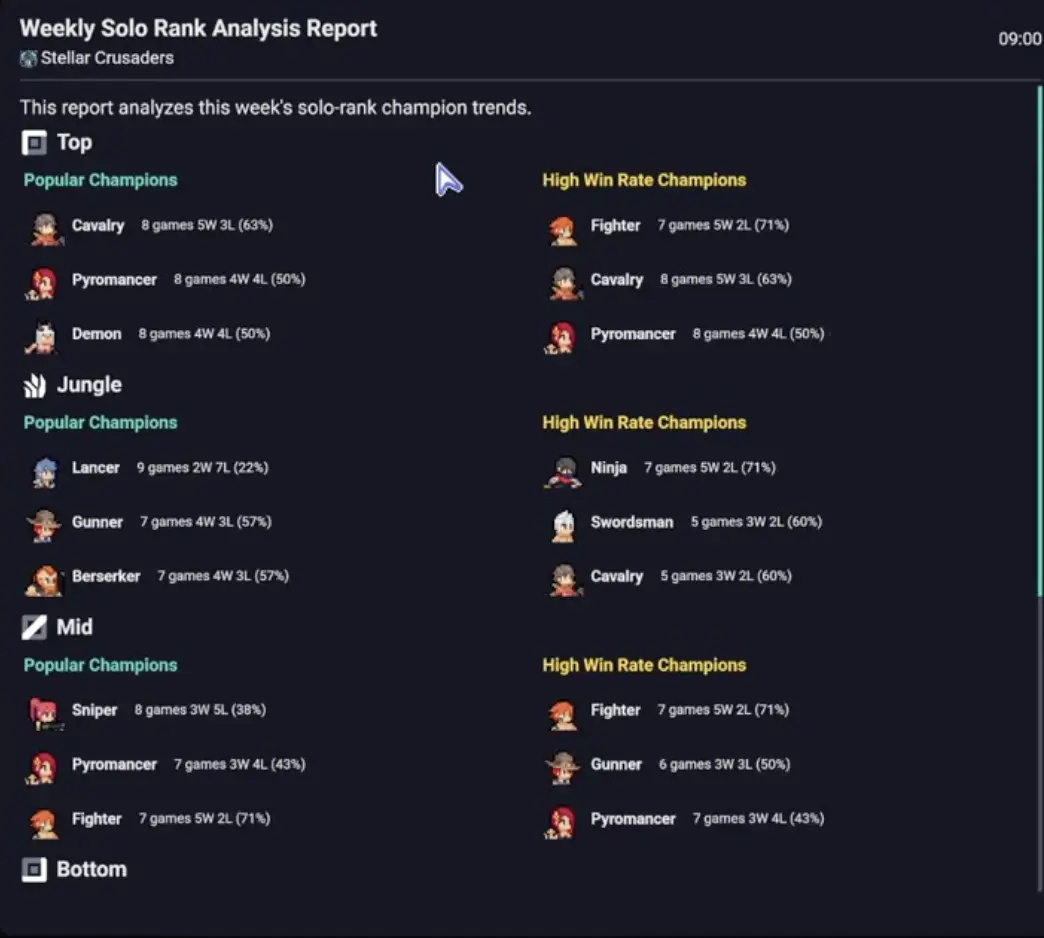
The Meta Report should not replace your personal tier list. It should tell you which champions deserve testing.
| Meta Report signal | What it may mean | What to do |
|---|---|---|
| High win rate + high pick rate | Champion is probably strong or easy to fit | Test as A or S candidate |
| High win rate + low pick rate | Champion may be niche, underused, or only good in specific comps | Test as counter-pick or comp-dependent pick |
| Low win rate + high pick rate | Champion may be overrated, hard to use, or often drafted incorrectly | Mark as risky until your own review proves value |
| High ban rate | Players or AI may treat it as draft-warping | Add must-ban or must-answer note |
| Low pick + low ban | Champion may be weak, unexplored, or meta-dependent | Do not prioritize unless your comp has a clear reason |
| Rising trend after patch | Champion may be affected by balance changes or new discoveries | Put on watchlist and test before rating high |
Use Meta Report numbers as signals, not final answers.
Meta Report Reading Examples
Use the Meta Report to create test questions, not final rankings.
- If Lancer has high pick rate and strong objective results, test it as an objective / tempo A-tier pick.
- If Sniper has high win rate but needs protection in your matches, do not call it safe blind. Label it scaling carry / needs peel.
- If Ninja beats your Sniper comps repeatedly, raise it as a counter-pick or must-ban into fragile carry drafts.
- If Pyromancer shows good results but dies in your side-lane reviews, keep it as wave pressure / comp-dependent, not automatic A tier.
- If Priest has stable results but your team still lacks damage, keep it as protection support, not a carry solution.
Your Tier List vs Opponent Expectations
Your tier list has two jobs:
- It tells you what to pick, ban, or avoid.
- It helps you predict what the opponent might value.
If you rate a champion highly, ask how the opponent might respond.
| Your rating | What it means for you | What to expect from opponent | Draft response |
|---|---|---|---|
| S / Must-ban | You cannot reliably answer it | Opponent may first-pick it if open | Ban it or prepare a tested counter |
| S / Must-pick | You want it whenever available | Opponent may ban it after seeing your pattern | Prepare replacement picks |
| A / Safe blind | You can pick it early | Opponent may draft soft counters | Keep draft flexible |
| A / Objective pick | It supports Serpen or Morgard plan | Opponent may contest jungle or objective setup | Draft lane priority or backup plan |
| B / Counter-pick | You want it only into specific enemy comps | Opponent may avoid showing the target too early | Save it for later if draft format allows |
| C / Trap risk | It looks strong but fails without setup | Opponent may bait you into picking it | Avoid unless the comp is perfect |
| Must-answer enemy pick | It is not always ban-worthy, but must be planned for | Opponent may use it as a comfort pick | Draft counter, peel, or alternative win condition |
Example: Reading Ninja Both Ways
If you mark Ninja as high priority because it keeps killing your Sniper, that affects both sides of draft:
- You may ban Ninja when drafting Sniper.
- You may pick Ninja when the opponent drafts a fragile carry.
- You should expect the opponent to pick peel if Ninja is open.
- You should prepare a second answer such as Ice Mage, Priest, Guardian Spirit, Shieldbearer, or another anti-dive tool.
Player Stats and Champion Fit
In Teamfight Manager 2, a champion is not separate from the player using it. Player stats and personality can affect how reliably a champion executes its job.
A champion can move up or down your personal tier list depending on who plays it.
| Champion type | Example champions | Useful player signals | Risk if player fit is wrong |
|---|---|---|---|
| Tempo / engage jungler | Lancer, Fighter | Aggression, decision-making, focus, objective awareness | Starts fights with no follow-up or arrives at bad timings |
| Scaling carry | Sniper | Focus, positioning, consistency, low tilt risk | Dies before dealing damage or collapses under pressure |
| Backline threat | Ninja, Demon, Executioner | Aggression, mechanics, confidence, timing | Dives too early, feeds into peel, or misses the carry window |
| Sustain / protection support | Priest, Guardian Spirit, Shieldbearer | Teamwork, mental, shot calling, discipline | Protects too late or fails to stabilize the main carry |
| Wave / lane priority pick | Swordsman, Pyromancer | Stability, focus, lane discipline | Overextends or fails to convert lane pressure into objective setup |
| Poke / zone control | Bomber, Gambler, Pyromancer | Patience, positioning, objective discipline | Walks into hard engage before poke creates value |
| Skirmish bruiser | Berserker, Cavalry, Monk | Aggression plus mental stability | Overfights, chases, or ignores objective timing |
Use this table to connect champion labels with the type of player who should pilot them.
If your best Sniper player has poor positioning or low focus, Sniper should not automatically be A tier for your team. If your aggressive player performs well on Lancer or Ninja, those champions may move higher for your roster than they would on a global list.
How to Write Each Tier List Note
Do not keep separate notes for tier, label, and action. Write one compact note that includes all three.
Use this format:
Champion — Tier — Label — Draft action — Reason
Example:
Sniper — A — Scaling carry / needs peel — Pick with frontline and protection — Strong late, risky if exposed early
A good note should answer four questions:
Tier list note checklist
What is the tier?
Use S, A, B, C, or D only after you know what the rating means in draft.
What is the label?
Use labels like safe blind, scaling carry, objective pick, counter-pick, trap risk, or must-ban.
What is the draft action?
Write whether you should ban it, pick it early, save it, counter it, or avoid it.
What is the reason?
Add one short reason such as needs peel, wins Serpen setup, punishes fragile carries, or fails into hard CC.
This note format is faster to use during draft than a long paragraph. The point is not to describe everything. The point is to make the next ban or pick easier.
How to Update Ratings After a Match
Do not move five champions after one match. Update one clear note when the match proves something.
Move up when
The champion creates repeatable value
It wins lane, controls objective setup, protects the carry, or creates picks across multiple drafts.
The player fit is clearly strong
A specific player repeatedly executes the champion’s job well.
The champion changes enemy draft behavior
The opponent bans it, first-picks it, or drafts around it.
Move down when
The champion needs too many conditions
It only works with perfect peel, perfect lane state, or one specific comp.
The champion fails its actual job
A scaling carry dies early, an engage pick starts bad fights, or a support fails to protect.
Your roster cannot use it
The champion may be strong globally but wrong for your players.
Trap Pick Test
A trap pick is not always weak. It is a champion that asks too much from the rest of the draft.
Use this test before rating a champion too high:
Needs three other picks
If one champion needs multiple support picks to function, it is comp-dependent, not safe.
Loses first objective too often
If the champion keeps delaying Serpen or Morgard setup, lower the rating or change the label.
Only works when already ahead
A champion that cannot stabilize bad games should not be treated as safe blind.
Fails into common counters
If one common peel, dive, freeze, or poke answer ruins the champion, mark it as matchup-dependent.
Examples:
- Sniper is not a trap by default, but it becomes a trap if you draft it without peel.
- Ninja is not a trap by default, but it becomes a trap if enemy has layered anti-dive tools.
- Berserker can look strong in skirmishes but become risky if enemy control stops every engage.
- Pyromancer can look good for wave pressure but become risky if it keeps dying isolated before objectives.
Personal Tier Update Workflow
After you have checked the Meta Report signals, turn them into your own personal ratings through roster fit and match review.
| Step | Action | Output |
|---|---|---|
| 1. Compare to your roster | Ask which player can actually use the champion | Player fit note |
| 2. Test in draft | Use the champion in the role and comp where it should work | Match evidence |
| 3. Review the match | Check whether it performed its job | Keep, move, or relabel |
| 4. Update Personal Tier List | Change one tier, label, or note | Better draft memory |
| 5. Predict opponent response | Ask whether enemy will ban, pick, or counter it | Draft preparation |
Common Personal Tier List Mistakes
Rating champions without a draft job
A rating is weak if it does not tell you whether to ban, pick, save, counter, or avoid the champion.
Copying Meta Report numbers directly
Win rate and pick rate are testing signals. They do not know your roster, player stats, or draft habits.
Calling scaling carries safe picks
A champion like Sniper can be strong without being safe. If it needs peel and time, label it correctly.
Forgetting the opponent’s draft
If a champion is high priority for you, assume the opponent may also ban it, pick it, or prepare a counter.
Ignoring player fit
A champion that works for one player may fail for another. Player stats and behavior should change the rating.
Refusing to move favorites down
If a favorite champion keeps creating the same problem, mark it honestly as risky, comp-dependent, or trap risk.
What to Read Next
If your ratings do not translate into better drafts, read the ban/pick guide. If your objective picks keep failing around Serpen or Morgard, read the jungle guide. If you keep overrating late-game carries, read the safe picks vs scaling picks guide. If your champion ratings reveal a weak role, read the scouting and transfer guide.
FAQ
What is the personal tier list in Teamfight Manager 2? +
The personal tier list is your own champion rating system. Use it to mark safe picks, scaling carries, objective picks, counter-picks, trap picks, and must-bans based on your own roster and match results.
Should I copy the Meta Report? +
No. Use the Meta Report as a testing list. High win rate, high pick rate, and high ban pressure are signals, but your player stats, role fit, and draft style decide whether a champion belongs in your personal S or A tier.
Which champions should I rate first? +
Start with champions that affect your drafts often: Lancer, Sniper, Ninja, Priest, Berserker, Swordsman, Pyromancer, Guardian Spirit, and any champion that keeps beating you.
Is Sniper a safe pick or a scaling pick? +
Sniper should usually be labeled as a scaling carry, not a simple safe blind pick. It can be very strong when protected, but it needs frontline, peel, and objective patience.
How do I use my tier list against the opponent? +
Your tier list is not only for your own picks. If you mark Ninja, Lancer, or Sniper as high priority, you should also expect the opponent to ban, pick, or counter those champions when they fit their draft.
How often should I update my personal tier list? +
Update it after meaningful matches or patches. Do not rewrite the whole list after one game; change one rating, label, or note when the match clearly proves something.