Minecraft Dungeons II Endgame: What to Do After the Story
Learn what to do after beating Minecraft Dungeons II, including Soul Storms, three-modifier gear, Rifts, Dungeons, rare Enchantment Books, shards, and postgame priorities.
Updated:
Quick Answer
After finishing The Final Souldown, start with Soul Storms if stronger gear is the priority. A Soul Storm gives you 20 minutes to destroy three storm towers, and successful runs can produce endgame weapons with an additional modifier.
Between storms, run Rifts and Dungeons for rare Enchantment Books and fight Soul Corrupted mobs for shards used to improve gear. Leave level 100, missing stations, books, side quests, and other completion work for the gaps between farming runs.
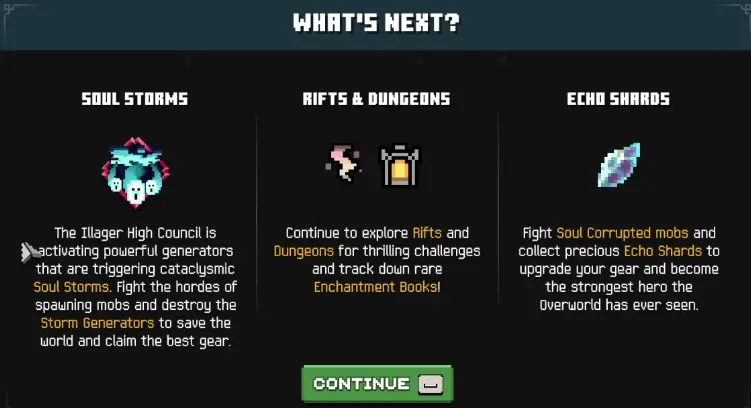
Finishing the main story does not leave Minecraft Dungeons II with only collectible cleanup. Once the final portal is resolved, the game points directly toward a repeatable endgame loop: Soul Storms for stronger gear, Rifts and Dungeons for challenges and rare Enchantment Books, and Soul Corrupted enemies for upgrade shards.
That changes how time and resources should be spent. During the story, replacing a weapon every few regions is normal. After the ending, it becomes more useful to improve a small number of pieces that already fit the way you fight, then use the postgame activities to look for better rolls rather than buying every higher-numbered item that appears.
What Unlocks After the Main Story?
After the final encounter and the portal resolution, the game introduces two immediate directions:
- Soul Storms — fight spawned hordes and destroy storm generators for high-end gear.
- Rifts and Dungeons — continue exploring for harder encounters, rare Enchantment Books, Soul Corrupted mobs, and shards.
If the ending has not happened yet, there is no reason to divert into postgame preparation early. Finish the main route through The Final Souldown first, then decide whether the next goal is stronger gear or completion.
Soul Storms Are the Main Endgame Gear Activity
Soul Storms are triggered by powerful generators left by the Illager High Council.
The activity has a clear objective:
fight the spawning mobs → destroy the storm generators → claim the gear.
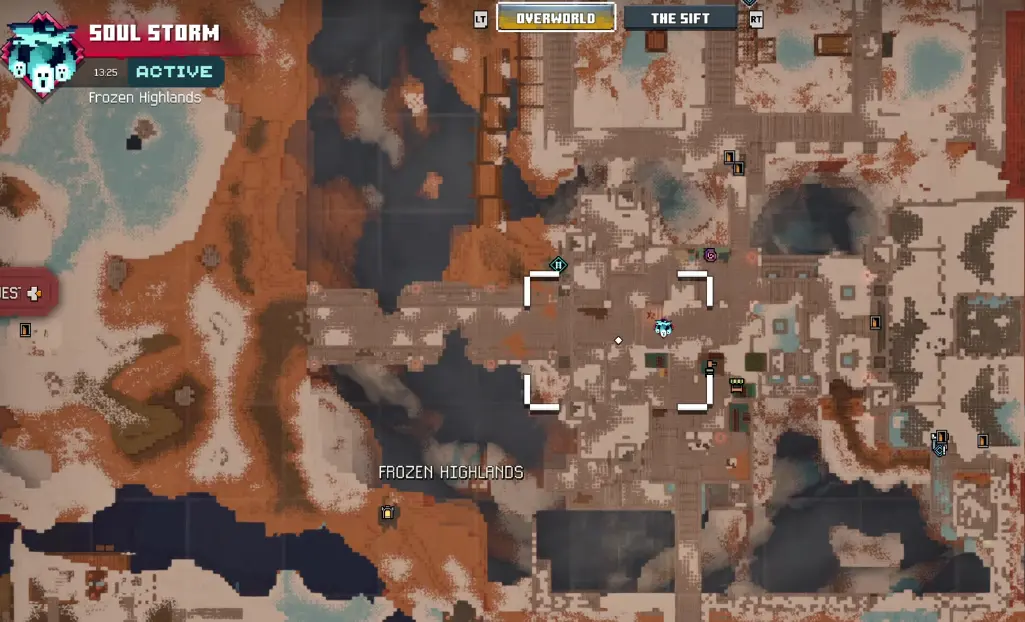
A Soul Storm cycle appears roughly every 30 minutes, and once the event is active you have 20 minutes to destroy three Soul Storm towers.
Those three numbers matter more than trying to clear every enemy on the map:
| Soul Storm rule | Value | What it means in a run |
|---|---|---|
| Approximate interval | 30 minutes | There is downtime between storm opportunities |
| Event timer | 20 minutes | Do not spend the whole event farming side enemies |
| Towers to destroy | 3 | Progress comes from finishing the three objectives |
| Endgame modifier ceiling | 3 modifiers | Soul Storm gear can exceed the normal modifier count |
The timer makes route discipline important. Hordes keep the pressure high, but killing enemies is not the final objective. If time is being lost in a corner that does not move you toward the next tower, leave the fight and continue toward the generator.
Why Soul Storm Gear Is Different
Normal gear rarity already changes how many modifiers a piece carries:
- Rare gear: one modifier.
- Special gear: two modifiers.
- Unique gear: two modifiers, with one being its special effect.
Endgame gear from Soul Storms can gain an additional modifier, raising the maximum to three modifiers.
That is a meaningful upgrade even when the weapon type itself is familiar. A weapon whose attack pattern already works well can become much stronger once an extra modifier supports the same damage, resource, or survival loop.
Do not replace a good item purely because another drop has a larger power number. In the endgame, the combination of weapon behavior and modifiers starts to matter more than a small numerical increase.
For complete weapon and artifact combinations, use Minecraft Dungeons II best builds after you know which promising drops are actually worth building around.
Prepare Before Starting a Soul Storm
A Soul Storm is a poor place to discover that the current setup only functions for one short burst.
Before committing to the event, make sure normal combat is not already exposing one of these problems:
- health potion is being spent on ordinary packs;
- artifacts empty the Soul bar faster than it refills;
- ranged ammo disappears before dangerous enemies appear;
- the main weapon is current in power but performs badly with its enchantment;
- several armor pieces are being kept only because resources were already spent on them.
Fix the weakest part first.
Late in the story, a practical ranged loadout could still run into the 25-arrow limit quickly during extended combat. A long event magnifies that problem, so a ranged-heavy setup needs either better ammo support or a melee option that can take over once arrows are low.
Likewise, an artifact-heavy build should not enter with a Soul economy that collapses after the opening wave.
Do Not Spend All Your Emeralds Between Runs
Upgrades become expensive enough late in the game that careless spending can delay the next meaningful improvement.
A postgame inventory fills quickly with weapons, armor, bows, artifacts, and talismans that are numerically close to each other. Keeping everything makes it harder to see which items are actually candidates for upgrading, while constantly upgrading every small improvement consumes emeralds that could have gone into a stronger piece.
A better cycle is:
- keep the pieces whose attack pattern or modifiers solve a real need;
- salvage unwanted duplicates and obvious downgrades;
- compare the remaining candidates before paying for upgrades;
- invest more heavily only after a piece has survived several replacement opportunities.
Do not pay repeatedly to maintain three versions of the same role when only one is being equipped.
Run Rifts for Enchantment Books and Other Rewards
Rifts remain useful after the story because they are not only a route into the Sift.
They can provide Enchantment Books, Echo Shards, loot, emeralds, and combat rewards, while also creating additional fights outside the fixed story progression.
That makes them a natural activity between Soul Storms.
If the current build already has a promising weapon but lacks the enchantment needed to make it work, a Rift or Dungeon run may improve the character more than another random equipment purchase.
Enchantment Books permanently expand the effects you can apply to compatible gear, and the book itself is not consumed. Before investing shards or points in a promising drop, compare the rank and trigger behavior.
Dungeons Are Worth Entering for More Than One Chest
Optional caves and Dungeons can branch away from the main route and include ambushes, tougher enemies, and reward chests.
Some are short. Others keep going after a room that initially looks like the endpoint.
In the postgame, there is much less reason to rush straight past them. The main story is no longer pulling you toward the next region, so these optional spaces become part of the gear-and-resource loop.
The useful question is whether the run is still producing something you need. Continue when the Dungeon is providing:
- Enchantment Books;
- upgrade resources;
- emeralds;
- gear with relevant modifiers;
- Soul Corrupted enemies;
- chest progress or other completion requirements.
Leave when the remaining branch is only adding time without advancing the current goal.
Soul Corrupted Mobs Give Shards for Gear Upgrades
The postgame message specifically points you toward Soul Corrupted mobs because they drop shards used to upgrade gear.
This creates a second layer of progression beside finding better drops.
A strong item no longer has to be abandoned immediately when another piece appears. If its attack pattern and modifiers are already doing the job, shards give you a reason to continue investing in it.
The resource decision becomes:
upgrade a known good item versus keep farming for a replacement.
If the existing item has poor modifiers or a weapon pattern that does not fit your build, spending shards only delays the replacement. If the item already has the combination you want, upgrading it is much easier to justify.
Stop Upgrading Gear You Are About to Replace
Postgame gear churn creates one of the easiest resource traps in the game.
Suppose a chest piece is being used only because it currently has the highest power. If its modifier does nothing for the build and another appropriate chest piece is already beginning to drop at similar power, pouring more shards, emeralds, and enchantment investment into the first one gains very little.
The opposite case is different. A weapon that has:
- the right attack pattern;
- useful modifiers;
- an enchantment that triggers frequently;
- enough power to remain competitive;
can justify continued investment even if a random drop is one or two steps higher.
Spend on function, not attachment to the item that happened to carry you through the ending.
Use Soul Storm Downtime for Completion
Because Soul Storms do not run continuously, the gaps between them are ideal for objectives that otherwise feel like separate grinds.
Useful combinations include:
- search for missing Enchantment Books while waiting for the next storm;
- activate missing Minecart Stations during regional cleanup;
- open every chest on those routes toward Treasure Hunter;
- use jump attacks during ordinary mobs to progress the 1,000 jump-attack kills;
- complete named side quests for hidden achievements;
- continue gaining experience toward level 100.
The achievement checklist separates those requirements so several can be progressed on the same trip instead of making a dedicated run for each one.
Level 50 Is Not the End of Character Progression
The main story can finish around the same time the character reaches level 50, but there is still a separate achievement for reaching level 100.
That makes level 50 a useful transition point rather than a reason to start a pure experience grind.
Soul Storms, Rifts, Dungeons, side quests, book collection, station cleanup, and other combat objectives all continue providing progress. Do those first.
If level 100 is still unfinished after the meaningful gear and completion work is done, then experience becomes the remaining target instead of something that had to be farmed immediately after the credits.
What Should You Farm First?
The answer depends on what is currently limiting the character.
Your gear has weak modifiers
Prioritize Soul Storms.
The extra modifier ceiling gives these runs the highest value when the equipment itself is the problem.
Your weapon is good but the enchantment options are poor
Run Rifts and Dungeons and look for missing Enchantment Books.
A strong weapon with the wrong effect can gain more from a useful book than from replacing the weapon entirely.
Your good gear is falling behind
Target Soul Corrupted mobs for shards, then upgrade the pieces worth keeping.
Do not spread shards across every equipped item equally.
Your build works, but you still have many incomplete objectives
Use the time between Soul Storms for achievements, stations, side quests, and regional cleanup.
You keep dying despite stronger item power
Stop farming raw numbers and examine the setup itself. Damage, healing, Soul spending, potion recovery, and artifact cooldown all affect whether higher-power gear actually performs better. The combinations in best builds are more useful at that point than another random shop refresh.
A Practical Endgame Loop
Once the ending is complete, an efficient session can run like this:
- Check for an active Soul Storm.
- If one is available, destroy its three towers within 20 minutes and check the resulting gear for useful extra modifiers.
- Salvage obvious junk rather than upgrading everything that dropped.
- Spend the downtime in Rifts or Dungeons for books, shards, emeralds, and better rolls.
- Upgrade only the gear that already fits the build.
- Use travel between activities to finish missing stations, side quests, chests, and achievement objectives.
- Repeat when the next Soul Storm appears.
That loop keeps the different postgame systems working together. Gear farming improves combat, Rifts and Dungeons expand enchantment options, Soul Corrupted mobs provide upgrade resources, and the travel between them steadily removes the remaining completion work.