Kingdom Rush 6 Genesis Challenge Modes Guide
Beat Iron, Blitz, Hero Party and Spell Rush by changing your towers, heroes and spell timing for each mode instead of repeating your campaign build.
Updated:
Quick Answer
Start with Blitz on a stage you already know, because three waves and faster spell cooldowns make its altered pacing easier to learn.
Treat Iron as a short restricted-build puzzle, split your four heroes before a second lane opens in Hero Party, and build enough permanent tower control to survive between casts in Spell Rush.
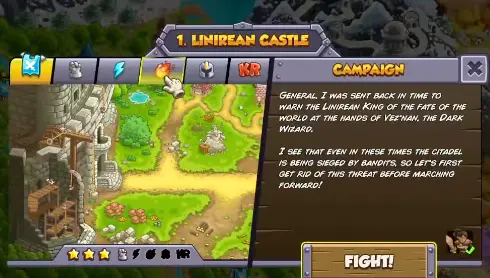
The challenge buttons under a completed stage are not just harder versions of Campaign.
Each one removes or exaggerates a system you normally rely on. Iron can restrict the tower solution and gives you one life. Blitz compresses the battle into three fast waves while spells recharge much more quickly. Hero Party gives you four heroes but removes spells entirely. Spell Rush does the opposite: your heroes disappear and faster spells have to cover the holes they normally fix.
Reusing the Campaign layout without accounting for that missing system is the fastest way to lose.
Iron, Blitz, Hero Party and Spell Rush Rules
| Mode | Main rule change | Lives | What I change first |
|---|---|---|---|
| Iron Challenge | One elite wave with stage-specific restrictions | 1 | Build around the limited tower roster instead of the Campaign loadout |
| Blitz Challenge | 3 compressed waves, faster enemies and faster spells | 3 | Spend Gold earlier and cycle spells instead of saving every cooldown |
| Hero Party | 4 heroes, no spells | Stage-specific | Assign heroes to lanes before pressure splits |
| Spell Rush | No heroes, faster spells | 3 | Use towers as permanent anchors and spells as the mobile response |
| Classic Rush | 1 hero, classic towers and classic spells | Stage-specific | Use the classic tower roster rather than normal Genesis builds |
Classic Rush changes the tower roster enough that I treat it separately. Its tower choices, Sorcerer Mage, Tesla and classic build order are covered in the Classic Rush Guide.
Iron Challenge Is a Build Puzzle, Not a Short Campaign Run
Iron gives you one elite wave and one life.
That removes the recovery phase a normal stage gives you. There is no weak opening wave where a questionable tower can slowly earn enough Gold to become useful later. The opening build has to answer the actual Iron enemy set immediately.
The available towers can also be restricted by the stage. On an early Arcane Academy Iron run, for example, the usable setup was reduced to Barracks and Mage towers.
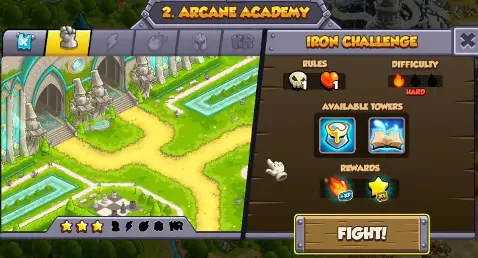
With physical ranged and artillery options gone, I cannot solve the map by recreating the Campaign defense. The useful shape becomes a concentrated blocking area with Mage towers firing into it.
Gold should follow that restriction.
If the permitted Barracks already hold long enough, another Barracks may add less value than upgrading the Mage that is doing most of the killing. If the soldiers collapse before the wave spends enough time in magic range, damage is not the first problem; the blocking point needs help.
One life makes small leaks fatal. I keep Reinforcements and the available hero close enough to the exit that one enemy slipping around the main group does not end the run.
Iron is also the mode tied to IRON FIST, which requires clearing the campaign’s Iron challenges. The rest of the achievement cleanup order is in All 53 Achievements.
Blitz Rewards Spell Throughput More Than Spell Hoarding
Blitz shrinks the stage into three waves, gives you three lives, speeds up the enemies and increases the pace of spell use.
The first time I played it, the most obvious difference was not the enemy count. It was how quickly the spell buttons came back.
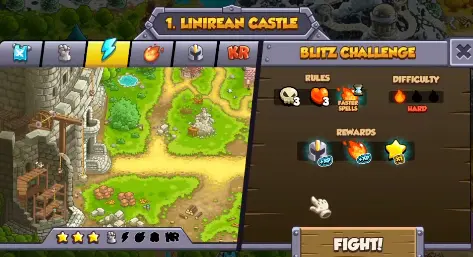
In Campaign I often hold Rain of Fire because another dangerous wave may arrive before the cooldown returns. Blitz changes that calculation. Leaving a useful spell ready for most of a three-wave battle throws away a large part of the mode’s advantage.
I cast early when the effect will remove real pressure, then watch whether the cooldown will complete before the next dangerous group arrives.
Gold behaves differently for the same reason. There is less time for a slow investment to recover its cost. I prefer upgrades that affect the next group immediately rather than buying toward a setup whose payoff would normally arrive around wave eight or ten.
A long-economy choice such as Gold Prospectors is therefore less attractive when the mode ends before its extra income has enough time to transform the whole defense.
Three lives give a small safety margin, but they are not enough to ignore lane coverage. A fast enemy slipping through the same weak route three times can end the challenge before an expensive tower elsewhere has paid for itself.
Do Not Copy a Campaign Build Into Blitz
A normal Campaign layout often spreads its economy across a long fight:
basic coverage first, Tier IV towers later, then expensive abilities for the final waves.
Blitz compresses those decisions.
The build points that can attack immediately become more valuable, while towers whose strength depends on a long ramp-up have less time to justify themselves. A spell that normally feels like an emergency button can become part of the regular damage rotation because its cooldown is shorter.
On a simple one-lane stage, Blitz can feel surprisingly easy once the spell rhythm clicks. That can be misleading. A later split-lane map still demands enough permanent coverage that one fast wave cannot flood the second exit while the spells are being spent on the first.
I use the first familiar stage to learn the faster timing, then stop treating Blitz as a free Star once the map begins splitting pressure.
Hero Party Gives You Four Heroes and Takes Away Every Spell
Hero Party reverses the normal Genesis balance.
You get four heroes, but no spells.
That means no emergency Rain of Fire, no Reinforcements filling a broken frontline, and no utility spell repairing a bad lane assignment after the wave has already passed your towers.
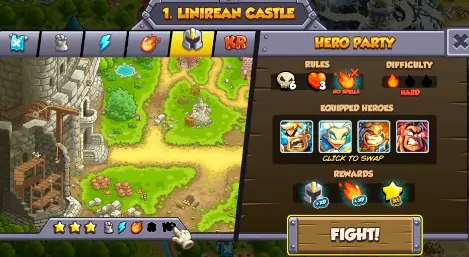
The extra bodies are strongest before the crisis happens.
On a two-lane stage, I begin with two heroes covering each side rather than stacking all four around the most obvious choke. Once the wave shows which side needs more help, a ranged or mobile hero can cross over while the remaining hero keeps the quieter route occupied.
During one run, the second lane opened and my first instinct was to hit Reinforcements. Nothing happened because Hero Party had removed spells completely.
That is the habit this mode punishes.
A hero death is also more expensive than it looks. Four heroes give a lot of map control while they are alive, but sending all four into the same dangerous melee can produce a simultaneous respawn gap that towers then have to survive alone.
I prefer different jobs across the four slots: at least one durable frontliner, a ranged hero for flyers or distant targets, and enough mobility that both lanes can be reinforced without abandoning the other side.
The individual hero roles and pair strengths still help when choosing the four characters, even though Hero Party changes the normal two-hero setup. See Best Heroes & Hero Pairs for the roster itself.
Spend Gold on Towers Even Though Hero Party Gives You More Units
Four heroes can make the opening look safer than it really is.
The danger is using that extra control as an excuse to underbuild the permanent defense. Heroes can move; towers keep firing while your attention is somewhere else.
I use the heroes to delay purchases, not replace them.
If four heroes can comfortably hold the first pressure, that creates time to put Gold into the build point that will still matter five minutes later. Once the tower line is established, the heroes can move outward and handle leaks, flying enemies or isolated threats instead of acting as four expensive Barracks.
This becomes increasingly important on larger maps. Constantly dragging all four portraits between two routes creates more work than letting towers own the routine traffic and reserving hero movement for real pressure.
Spell Rush Removes the Safety Net Your Heroes Normally Provide
Spell Rush gives you three lives, removes the heroes and shortens spell cooldowns.
The absence of heroes changes the map more than the faster spells initially suggest.
A normal Genesis run lets a hero chase an enemy that escaped the choke, move from one lane to another, or stand on an awkward section of road where there is no good tower pad. Spell Rush has no permanent movable unit doing that job.
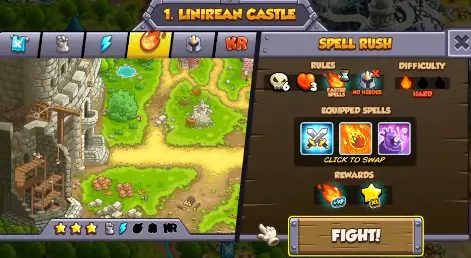
That makes my tower placement more conservative.
I want a real defensive anchor near the section of road where an escaped enemy would otherwise require hero movement. Reinforcements become especially useful because they can temporarily recreate a blocker at the point that needs it rather than forcing another permanent Barracks into every lane.
The faster cooldown changes the rest of the loadout. Damage and utility spells can be used much more often, but I still avoid spending all three tools on the same harmless group. A second entrance can become active while the first lane looks completely under control.
Across the early stages from Linirean Castle through Lozagon Tower, the no-Hero rule becomes more noticeable as maps add longer routes, multiple pressure points and enemies that do not politely remain inside one central kill zone. The tower line has to survive the seconds between spell casts rather than waiting for a hero to arrive and repair the mistake.
The nine-spell roster, upgrade branches and best three-spell combinations are covered in Best Spells & Spell Tier List.
Reinforcements Matter More in Spell Rush Than Their Damage Suggests
Reinforcements are easy to judge by their small combat numbers and overlook.
Spell Rush makes their real value more obvious: position.
Without heroes, a temporary unit appearing exactly where an enemy is about to leave tower range can buy another round of attacks from every nearby tower. That extra firing time can matter more than the Reinforcements’ own damage.
I place them inside existing coverage rather than far ahead of the defense. Stopping enemies where Royal Catapult, Archers or Mages are already firing turns one spell cast into more damage from several systems at once.
They are also useful for recovering a lane after the previous blocker died. Waiting for a permanent Barracks unit to respawn can be too slow when the mode only gives three lives.
Spell Rush Does Not Mean “Cast Everything on Cooldown”
Faster cooldowns reward activity, but the stage still has dangerous moments.
The useful rhythm is to spend a spell when its effect changes the current wave, not merely because the icon is ready.
Rain of Fire is wasted on enemies that the existing towers will kill before they reach the exit. A relocation or control spell is wasted when every enemy is already trapped inside the main kill zone. Reinforcements are wasted when a healthy Barracks is already blocking the same targets.
I usually keep one response available once a map has more than one active route.
That does not have to be the same spell all stage. The important part is having something ready for the pressure point the fixed towers cannot reach quickly.
Which Challenge Should You Clear First?
On a stage I already know, I usually start with Blitz.
Three lives give enough room to understand the faster pace, and the short three-wave structure makes a failed attempt inexpensive. It also teaches the most transferable lesson: spell timing can change enough that the Campaign rotation is no longer optimal.
Spell Rush comes next when the normal stage layout is already familiar. Knowing where the heroes used to rescue the defense tells you where the tower line now needs extra support.
Hero Party is easier to read once the map’s lanes are known. Four heroes provide a huge amount of control, but the mode becomes messy when their assignments are being invented in the middle of the wave.
I leave Iron until I have seen the stage’s restricted roster. One elite wave and one life make experimentation expensive, and the best answer may have very little in common with the Campaign build that originally cleared the map.
Classic Rush sits outside that order because it replaces the normal Genesis tower toolkit rather than simply removing one part of it. Use the Classic Rush Guide when you begin those clears.
When to Return for Challenge Stars
I do not stop after every Campaign victory and immediately clear all four alternate modes.
A newly unlocked tower, spell or hero can make an older challenge much easier, and spending twenty minutes forcing one restricted setup can be slower than continuing the campaign and returning with more options.
I go back when one of three things is true:
- I already understand the stage well enough that the alternate rules are the only new problem;
- I need more Stars for a progression threshold;
- I am cleaning the related achievement or full challenge completion.
The Star requirements and the difference between Steam and mobile progression are covered in Progression & Unlocks.
When a challenge fails, the mode itself usually tells me what to change. Iron means I misread the restricted solution. Blitz means the three-wave economy or spell rotation was too slow. Hero Party means the four heroes were assigned poorly. Spell Rush means a lane depended on hero movement that no longer exists.
Fixing that missing piece is much faster than copying a different Campaign build and hoping the restrictions matter less on the next attempt.