Kingdom Rush 6 Genesis Best Spells & Spell Tier List
Rank all 9 spells, choose the best three-spell loadouts, and pick upgrade branches for bosses, swarms, split lanes and emergency defense.
Updated:

Quick Answer
For a general campaign loadout, I start with Reinforcements + Rain of Fire + Royal Edict.
Swap Royal Edict for Teleportation Sigil when enemies are leaking past a spread-out defense, and use Wintersong’s Wrath once you want stronger late-game crowd control instead of another damage button.
Kingdom Rush 6: Genesis lets you equip three spells at a time, which makes the spell screen a real loadout decision rather than a collection of extra buttons.
The three slots work best when they solve different failures. I want one spell that can create time, one that can remove a dangerous wave, and one that improves the defense already on the map. Loading three damage spells can look strong until a single fast enemy gets through a choke with every cooldown pointing at the same crowded lane.
The other important difference is progression. Every spell develops its own upgrade tree, and the branch choices can change what the spell is actually good at. A Level 6 spell does not simply own every upgrade at once.
Kingdom Rush 6 Genesis Spell Tier List
| Spell | Tier | Base cooldown | Best use |
|---|---|---|---|
| Reinforcements | S | 15s | Emergency blocking, extending tower firing time, catching leaks |
| Rain of Fire | S | 60s | Dense waves, true damage, clearing a collapsing choke |
| Royal Edict | S | 50s | Buffing a concentrated tower cluster and refreshing tower skills |
| Wintersong’s Wrath | S | 40s | Late-game crowd control, slowing and stunning large groups |
| Teleportation Sigil | A | 45s | Resetting enemies that have already broken through |
| Thunder Zapper | A | 50s | True-damage pressure across a crowded stretch of road |
| Aspect of Sol | A | 60s | Durable priority targets, bosses and temporary frontline support |
| Ace Musketeers | A | 20s | Frequent ranged support, armor pressure and finishing targets |
| Gnome’s Shop | B | 50s | Long-duration AoE and freeze support in a busy kill zone |
The tier is about how reliably a spell earns one of only three slots. Gnome’s Shop can outperform an S-tier spell on the right choke, while Teleportation Sigil can be useless in a battle where nothing ever gets close to the exit.
Reinforcements Are Still the Spell I Miss Most When They Are Gone
Reinforcements look modest on the spell screen: two soldiers, 15-second cooldown, temporary duration and low personal damage.
Their value comes from putting bodies exactly where the defense needs another few seconds.
At base level, the spell summons two soldiers for 12 seconds. I usually drop them inside an existing firing zone rather than far ahead of it. Holding four enemies under a Catapult and Mage for several extra attacks is more useful than letting the soldiers fight alone where no tower can help them.
This matters most when a Barracks has just lost its units or a fast enemy has passed the main choke. Reinforcements can rebuild that stop immediately instead of waiting for the normal respawn.
For general play, I prefer the upgrade route that improves time on the road and survivability over pure soldier damage. A longer block creates more total tower attacks, and that scales with the rest of the defense instead of asking the temporary soldiers to become the main damage source.
At higher levels, the defensive branch also becomes much harder to remove, while the Level 6 Bannerman adds another durable unit and buffs nearby allies.
Reinforcements stay in my balanced loadout even after all nine spells are available because a 15-second spell can solve small mistakes without forcing a 60-second emergency cooldown.
Rain of Fire Is the Best Emergency Damage Spell
Rain of Fire begins with three meteors, each dealing 30–45 true damage, on a 60-second cooldown.
The true damage is the important part. Armor and magic resistance do not turn the spell into the wrong answer just because the enemy roster changed.
I save it for a wave that is actually capable of breaking the defense.
One of the clearest campaign failures came after spending Rain of Fire on a manageable group and then reaching the real armored pressure with the spell still unavailable. The towers were not suddenly worse; the emergency button had been spent one wave too early.
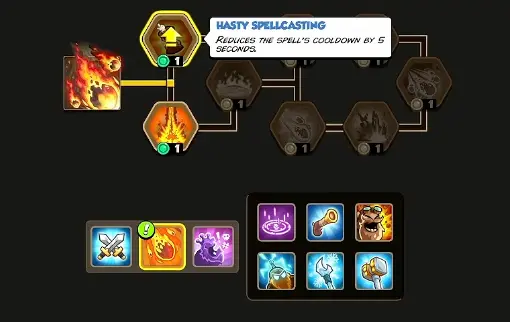
At Level 2, I prefer Hasty Spellcasting for general campaign play. Cutting the cooldown by 5 seconds matters every time the spell is used, while a small damage increase only matters when that extra damage crosses a kill threshold.
The next mandatory upgrade adds burning ground for 36–60 true damage over 3 seconds.
At Level 4, the more interesting choice is:
- Heatwave — burning ground damage +50% and much longer duration;
- Scorching Fragments — two additional meteors.
I use Heatwave when the map has one important choke and enemies remain inside the burning area. Its following upgrade adds a 50% slow for 7 seconds, turning the spell into damage plus control.
Scorching Fragments fits a more immediate burst setup and eventually adds a second explosion to each meteor.
Level 6 is strong regardless of branch: five additional meteors across the stage and another 10-second cooldown reduction.
Royal Edict Is Excellent When Several Good Towers Share One Area
Royal Edict starts at 50 seconds and increases the damage of nearby towers by 75% for 6 seconds.
That can be enormous or disappointing depending on the map.
On a compact defense where a Catapult, Mage and ranged tower all cover the same choke, one cast multiplies several expensive investments at once. On a spread map where the important towers sit on opposite sides, the same spell can reach too little of the defense to justify the slot.
I ran into exactly that decision on a difficult stage: Royal Edict was strong in principle, but the useful towers were too spread out to buff enough of them at the same time. That was the point where Teleportation Sigil became a serious alternative instead of automatically carrying Edict into another attempt.

For the first branch, Blessed Sight is my normal pick because the affected towers gain 20% range. More range lets those buffed towers remain relevant after the enemy starts leaving the original kill zone.
A Barracks-heavy defense can justify Rallying Call instead because it instantly respawns Barracks units.
Level 3 increases the spell’s own range by 50%, which removes much of the early placement frustration.
At Level 4, Fierce Determination is the combat branch I prefer: the tower damage bonus increases again, and its following upgrade Team Efficiency instantly refreshes normal tower skill cooldowns.
The economy branch, Juicy Rewards, becomes more attractive on long stages where extra Gold still has time to turn into another major upgrade.
Teleportation Sigil Is for a Defense That Already Failed Once
Teleportation Sigil does not prevent an enemy from reaching the dangerous part of the road. It gives you another chance after it happens.
The base spell sends four enemies backward on a 45-second cooldown.
That makes it strongest when a few dangerous units have escaped the main kill zone rather than when fifty weak enemies are still packed together at the entrance.
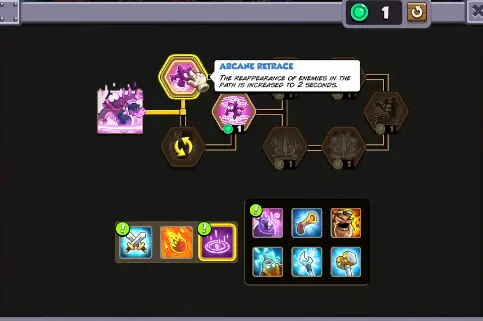
Its early upgrades already change the kind of reset it provides. You can make enemies remain displaced longer or slow them after they return, and Level 3 adds a 30% chance of a second teleport.
At Level 4 I usually choose from the map:
Sigil Proficiency reduces the cooldown by 5 seconds. I prefer it when several dangerous elite enemies keep reaching the back half of the road at different times.
Extended Reach increases the target count from 4 to 6. I use that on crowded maps where the leak is normally a group rather than one elite.
The branches continue in the same direction. The cooldown route can make teleported enemies deal 50% less damage and silences them for 5 seconds, while the larger-group route can stun enemies after a second teleport.
It is one of the few spells I actively swap in and out between stages instead of leaving permanently equipped.
Wintersong’s Wrath Is My Favorite Late-Game Control Spell
Wintersong’s Wrath does not need a huge damage number to change a wave.
At base level, Elora creates a blizzard that slows nearby enemies by 40% for 8 seconds on a 40-second cooldown.
That gives every tower more time to attack and every Barracks more time to recover.
The first branch is a choice between keeping the blizzard active for 12 seconds or increasing its affected area by 35%. I prefer the larger area on split or wide bends, while duration is better when enemies are already being held inside one compact choke.
Level 3 adds ice spikes that deal 24–36 magic damage along the road.
At Level 4, Heavy Snow is the branch I value most for difficult campaign waves because it pushes the slow to 70%. Its next upgrade makes the ice spikes stun enemies for 4 seconds.
That amount of control can turn a lane that was barely holding into one where the same towers get several additional attacks before enemies reach the exit.
Level 6 also slows enemies across the entire stage for 6 seconds, giving the spell value even outside the original blizzard area.
For late-game three-spell builds, this is often the spell that replaces Royal Edict when control matters more than amplifying a tower cluster.
Thunder Zapper Is the Cleaner Damage Choice for a Busy Road
Thunder Zapper travels along the path for 10 seconds and its field deals 240–400 true damage over that duration.
Its 50-second cooldown is long enough that I want to cast it on a route with real traffic, not the first small group I see.
The spell gets more interesting as it levels. The first choice gives either a 25% larger field or increases its duration to 12 seconds. Level 3 adds lightning that jumps between enemies every two seconds.
At Level 4, the two useful identities become clearer:
- Reinforced Coils cuts the cooldown by 7.5 seconds and leads into +50% field damage;
- Electrifying Arcs adds a 25% slow and leads into a 3-second stun around the summon point.
I prefer the control branch when the Zapper is being used on a crowded choke. The damage branch is better when the rest of the loadout already has enough blocking and slowing.
Thunder Zapper fits especially well beside Reinforcements: one spell holds a group inside the road section while the other keeps damaging it.
Ace Musketeers Are Better Against Targets That Need Focused Ranged Pressure
Ace Musketeers have a much shorter 20-second cooldown and summon two ranged units for 12 seconds.
At base level each Musketeer has 30 health and deals 10–16 physical damage.
That puts the spell in a different category from Rain of Fire. The Musketeers are not a single rescue explosion; they can keep contributing while enemies move through their range.
At Level 2, I prefer High Coverage on large maps because it increases range and movement speed by 20%. Long Hunt’s extra four seconds is useful when the summon already has a good position, but it cannot help a Musketeer that spends too much of its lifetime getting into range.
Level 3 is the major damage jump: +50% damage and +25% attack speed.
The Level 4 choice depends on the enemy roster:
- Lethal Aim deals 35% extra damage to blocked or stunned enemies;
- Steel Core Bullets ignores 50% of enemy armor.
Steel Core Bullets is the safer pick when armor is the reason the current physical setup is failing. Lethal Aim becomes stronger when the rest of the loadout already creates reliable blocking and stun windows.
Gnome’s Shop Wants One Busy Location
Gnome’s Shop lasts 20 seconds, attacks repeatedly and deals 15–25 explosive damage per hit on a 50-second cooldown.
Its value falls when enemies are spread across several distant lanes. The Shop has enough duration to produce good total pressure, but only if the battlefield keeps giving it targets.
The early upgrade I prefer is Quick Restocking, which cuts 10 seconds from the cooldown. That is a large reduction on a 50-second spell and makes the Shop available more often across a long stage.
Level 3 adds Frozotovs that deal explosive damage and freeze enemies for 1.5 seconds.
At Level 4, the control route improves how often those freezing attacks happen, and its Level 5 upgrade extends the whole spell to 24 seconds. The damage route instead improves the normal attacks and eventually reduces their attack interval.
Level 6 adds a periodic mini Fat Boy dealing 100–300 explosive damage.
I rank the Shop lower overall because the battlefield has to cooperate with it. On a dense single choke, however, its long duration and freeze effects are much better than the tier letter suggests.
Aspect of Sol Is a Late-Game Answer to One Important Target
Aspect of Sol summons a temporary fighter with 750 health, 50% armor and 42–64 true damage per attack for 18 seconds.
That is much more focused than throwing another AoE spell at the road.
I use it when one boss, elite or dangerous unit needs to be occupied and damaged while the permanent defense continues handling the rest of the wave.
Its Level 2 branch lets you choose between increasing the summon duration to 24 seconds or adding 30% damage.
For a boss-focused setup I prefer the damage route. For a lane that needs a temporary frontliner, duration gives the surrounding towers more time to work.
Level 3 also buffs nearby allies by 30% damage and 30% armor for 5 seconds, so placing the Aspect next to existing troops creates more value than summoning it alone at the edge of the map.
Later branches either strengthen that rally/damage role or add more crowd control around the summon.
I would not use Aspect of Sol as the only emergency spell. Its 60-second cooldown is much easier to manage when one of the other two slots can still handle a sudden leak elsewhere.
Best Three-Spell Loadouts
Best General Campaign Loadout
Reinforcements + Rain of Fire + Royal Edict
This covers three different jobs without much overlap.
Reinforcements buy time, Rain of Fire deletes the wave that exceeds the normal defense, and Royal Edict turns an already-developed kill zone into a much stronger one.
It is the setup I would use when entering a new stage without knowing exactly what the last waves will contain.
Best Split-Lane Loadout
Reinforcements + Teleportation Sigil + Wintersong’s Wrath
A spread map reduces Royal Edict’s efficiency because too few towers may fit inside one buff area.
Teleportation gives the weak lane another chance, Wintersong slows the largest group, and Reinforcements can appear exactly where a temporary blocker is missing.
Best Swarm-Control Loadout
Rain of Fire + Wintersong’s Wrath + Thunder Zapper
This is the loadout I want when the problem is the number of enemies rather than one boss.
Wintersong slows the group, Thunder Zapper keeps dealing true damage along the road, and Rain of Fire remains available for the wave that still breaks through.
Best Boss Loadout
Royal Edict + Rain of Fire + Aspect of Sol
Royal Edict increases the output of the expensive towers already aimed at the boss. Aspect of Sol supplies another durable attacker, and Rain of Fire handles the regular enemies that arrive during the boss phase or provides burst when the road becomes crowded.
Do not spend all three on the boss at once if normal enemies are still reaching the exit.
Which Spell Upgrades Should You Buy First?
Spells gain their own levels and upgrade points, and a fully leveled spell cannot keep every node simultaneously.
I prioritize upgrades that fix the reason I equipped the spell in the first place.
For Reinforcements, that means better blocking and staying power.
For Rain of Fire, I want the shorter cooldown first, then stronger area control.
For Royal Edict, I favor the combat branch when several developed towers can share the buff.
For Teleportation Sigil, I choose cooldown against repeated elite leaks and extra targets against grouped leaks.
For Ace Musketeers, range and armor penetration are the safer general choices.
For Gnome’s Shop, cooldown and freeze uptime make the spell easier to justify.
For Thunder Zapper, the slow/stun branch is my default on crowded maps.
For Wintersong’s Wrath, stronger crowd control is the reason I equip it, so the heavy-slow branch gets priority.
For Aspect of Sol, damage suits a boss slot while duration suits a temporary frontline role.
The upgrade choices are free to swap in the spell screen, so there is little reason to force one branch onto every stage.
Spell Rush and Blitz Change the Same Spells Differently
Both modes shorten spell cooldowns, but the rest of the battlefield is not the same.
In Spell Rush, there are no heroes. A spell has to replace some of the mobility and emergency blocking that the hero pair normally provides.
In Blitz, the battle only lasts three waves and spell cycling is much more aggressive.
That is enough of a rules change that I do not use a normal Campaign tier list as a complete strategy for either mode. Their exact restrictions and build adjustments are covered in the Challenge Modes Guide.
When I Swap a Spell Instead of Changing Towers
Changing a tower slot affects the entire stage. Changing one spell can fix a single repeating failure without disturbing a tower setup that is otherwise working.
When one elite keeps reaching the exit, Teleportation is a smaller adjustment than rebuilding the whole backline.
When several upgraded towers already control one choke but lack enough damage during the final waves, Royal Edict fits the existing defense.
When enemies are surviving because they move through the kill zone too quickly, Wintersong’s Wrath can create more firing time without buying another Barracks.
When a stage is already stable and only the boss remains difficult, Aspect of Sol or another focused spell can replace the emergency tool that was no longer being used.
Spell unlocks and platform-specific availability are part of the wider progression system. If the spell you want is not available yet, check Progression & Unlocks before changing the build around a slot you have not unlocked.