How Do You Build the Research Centre on Catuaí in FS25?
Complete Catuaí's Research Centre in FS25 with all 28 construction steps, exact material requirements, delivery tips, common problems, and rewards.
Updated:
Quick Answer
Find the Research Centre construction site in Catuaí’s rainforest, beyond the Carpentry and Pigment Factory area. Bring 500 L of Long Planks to the construction delivery trigger to start Work Step 1/28. Use a trailer and pallet-handling equipment to transport the materials.
The Research Centre takes 28 construction steps to finish, and the first 500 L of Long Planks are only a small part of the job. A complete build requires five different materials, including 41,000 L of Wood Beams and 33,000 L of Straw.
The expensive mistake is treating the first delivery as an indication of what the entire project will cost. Several early steps ask for just 500 L, but the requirements increase sharply as the foundations and timber structure take shape. Later, construction switches to Straw, regular Planks, and Furniture.
You receive money for accepted material deliveries, so the project is not simply a matter of spending the full purchase value of every pallet. However, buying and hauling 113,000 L of materials is still a substantial commitment, especially when the Warehouse and building site are on opposite sides of Catuaí.
Where Do You Deliver Materials to the Research Centre?
The Research Centre construction site lies in Catuaí’s rainforest, off the industrial road beyond the Carpentry and Pigment Factory area.
Use the Catuaí map guide to find the connecting road. Once you reach the unfinished site, look for its construction delivery trigger.
This is an existing 28-step construction project, not a production building you need to purchase from the Construction menu.
How Do You Start the 28-Step Research Centre Project?
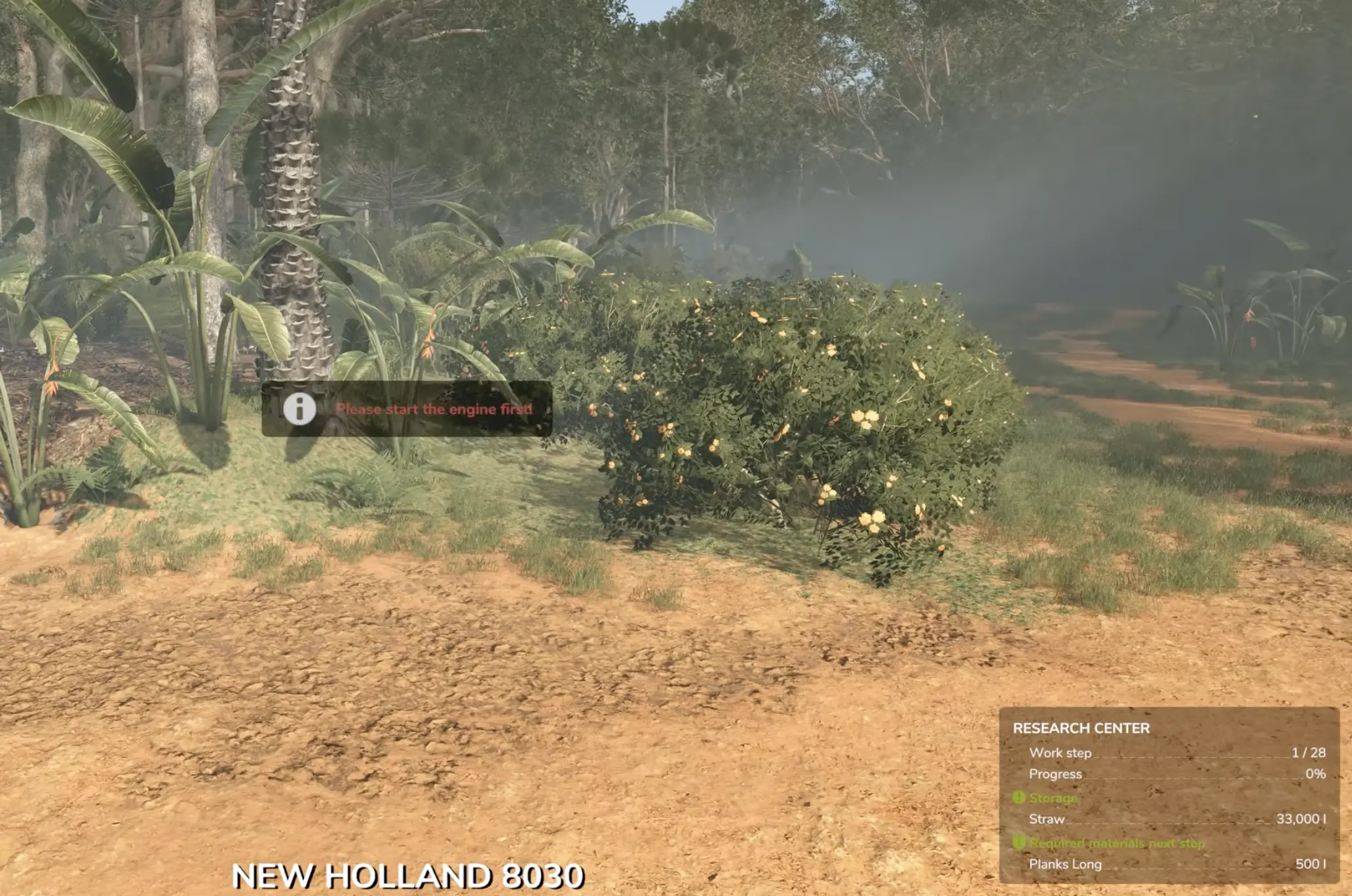
The construction interface initially shows Work Step 1/28 and requests 500 L of Long Planks.
Obtain a Long Planks pallet, transport it to the worksite, and move the material into the delivery trigger. Watch the construction interface and your farm balance to confirm the delivery has been accepted.
The project begins consuming the supplied material over time. Once the active requirement has been processed, it advances to the next work step.
Step 2 also requires 500 L of Long Planks. Bringing at least 1,000 L for the opening stages avoids an unnecessary second journey.
The construction interface separates stored supplies from the material required for the active step. Seeing another product already listed under Storage does not mean construction is ready to use that product immediately.
The existing structure may appear almost unchanged during the first few steps. Check the work-step counter and material progress instead of judging completion by the building’s appearance.
What Materials Does the Research Centre Need in Total?
A complete 28-step construction requires the following quantities:
- Wood Beams — 41,000 L
- Long Planks — 22,000 L
- Straw — 33,000 L
- Regular Planks — 10,000 L
- Furniture — 7,000 L
That is 113,000 L of delivered materials across the entire project.
Wood Beams account for the largest timber requirement, while Straw becomes the second major resource demand once construction reaches the roof. Furniture is needed only at the very end, so buying it at the beginning ties up money without helping the early stages progress.
Long Planks and regular Planks are separate products. Delivering one does not satisfy a requirement for the other. This distinction becomes particularly important near the final stages, when the project requests regular Planks before switching back to Long Planks.
Paint Buckets and Roof Plates are not part of the completed 28-step material requirements. There is no need to purchase them simply because the building eventually gains a roof and finished walls.
Which Materials Are Required at Each Construction Step?
The project uses the following sequence. The grouped steps each require the stated amount individually, not one shared amount for the group.
Steps 1–10: Clearing and early groundwork
- Steps 1–2: 500 L of Long Planks per step.
- Steps 3–4: 500 L of Wood Beams per step.
- Steps 5–6: 500 L of Long Planks per step.
- Steps 7–10: 500 L of Wood Beams per step.
These early requirements are comparatively small. The old structure is gradually removed as construction proceeds, and the site begins making room for the new building.
Steps 11–16: Foundations and initial structure
- Step 11: 4,000 L of Wood Beams.
- Step 12: 7,000 L of Wood Beams.
- Step 13: 1,000 L of Wood Beams.
- Step 14: 8,000 L of Long Planks.
- Steps 15–16: 2,000 L of Long Planks per step.
The jump to 4,000 L and 7,000 L of Wood Beams is the first substantial material bottleneck. A farm that has been buying one small pallet at a time will need to organize larger deliveries here.
The longer Long Planks stage follows the heavy groundwork. By the middle of construction, platforms, stairs, and parts of the timber layout become visible.
Steps 17–22: Main timber structure
- Step 17: 7,000 L of Wood Beams.
- Step 18: 8,000 L of Wood Beams.
- Step 19: 5,000 L of Wood Beams.
- Steps 20–22: 2,000 L of Wood Beams per step.
This is the heaviest continuous stretch for Wood Beams.
Across Steps 17–22 alone, the project consumes 26,000 L of Wood Beams. Prepare for this section before committing your remaining money to another farm purchase or production building.
Steps 23–28: Roofing and interior completion
- Step 23: 11,000 L of Straw.
- Step 24: 22,000 L of Straw.
- Step 25: 10,000 L of regular Planks.
- Steps 26–27: 4,000 L of Long Planks per step.
- Step 28: 7,000 L of Furniture.
Once the timber stages finish, the remaining work changes substantially. A stockpile of extra Wood Beams will no longer solve the next requirements.
The last six steps are where planning the different product types matters more than simply transporting more timber.
What’s the Best Way to Deliver the Construction Materials?
The main choice is whether to buy finished goods from the Warehouse or produce them through your own farming and production operations.
Both approaches work, but they have different demands on your farm’s available money, equipment, and time.
Buying Materials From the Warehouse
The Warehouse is useful if you have not established the production facilities needed to make Long Planks, Wood Beams, or Furniture.
Purchase the required pallets, load them onto a flatbed trailer, and take them to the Research Centre. The Warehouse is a considerable distance from the rainforest construction site, so arranging several compatible products into one trip saves driving time.
A tractor with a trailer is enough to transport the load, but you still need a practical way to handle pallets. A pallet fork or suitable loading machine is more useful than buying a larger tractor solely for this project.
The first requirements are known in advance, making it reasonable to buy enough Long Planks for both opening stages. Later, use the material sequence above to plan deliveries around the larger demands.
There is one important limitation: accepted deliveries are paid for, but the payment is not automatically equal to your purchase cost.
Check the money received against what you spent at the Warehouse. Treat the project as a construction objective with some costs recovered through deliveries, not as a guaranteed profit-making loop.
Producing the Materials Yourself
If your farm already has access to wood-processing and manufacturing facilities, supplying the construction site from your own production can be a sensible alternative to buying every pallet.
Wood Beams deserve the most attention because the project consumes 41,000 L of them. Building up a usable supply before the large timber stages can prevent repeated delays.
However, there is little reason to establish an expensive new production operation solely to provide the first 500 L of Long Planks. Buying that small opening quantity allows construction to begin while your existing farming business continues producing income.
The choice changes as the project advances. A farmer already producing timber goods has a stronger reason to supply the larger stages directly, while a farm focused on crops or livestock may prefer occasional Warehouse purchases.
Do not buy a new Sawmill, Carpentry facility, or transport machine without considering whether it will remain useful after the Research Centre is finished.
Can You Deliver Materials Before Their Step Is Active?
The construction site has storage for accepted materials. You can bring products needed later and have them registered before the project reaches that stage.
This can save journeys, particularly when a trailer is already carrying several required product types.
But stored materials do not skip the construction sequence. The active step must still finish processing before the next one begins.
For a farm with limited funds, purchasing every remaining product in advance is unnecessary. Supplying the current requirement and carrying a modest amount for the next known step keeps more money available for ordinary farming.
How Do You Finish the Straw, Planks, and Furniture Stages?
The final six stages differ from the timber-heavy construction that precedes them.
At Step 23, the project requests 11,000 L of Straw. The following step requires another 22,000 L, bringing the total to 33,000 L.
Straw is accepted at the construction delivery interaction, including suitable Straw bales. The material is used as the building’s thatched roof develops, rather than requiring a separate Roof Plate product.
A single 9,000 L Straw bale is not enough for the first 11,000 L stage. Arrange enough material to cover the full requirement, then allow the construction process to advance.
After both Straw steps, the project switches to 10,000 L of regular Planks at Step 25.

Do not assume that leftover Long Planks can replace this requirement. The two materials must be supplied separately.
Steps 26 and 27 each return to 4,000 L of Long Planks, completing the structural work before the last interior stage.
Finally, Step 28 requires 7,000 L of Furniture.

Deliver the Furniture and wait for the final construction progress to complete. Simply unloading the last product is not the same as receiving the finished-building confirmation.
Why Is the Research Centre Construction Not Progressing?
A stationary work-step counter does not always indicate a broken project. Construction can pause because supplies are missing, the current stage is still processing, or the next product has not been delivered.
The first check should always be the construction interface.
The Project Has Materials but Is Not Advancing
Look at the current step, the active material requirement, and the stored quantity.
For example, Straw may already be in Storage while the project is requesting Long Planks or Wood Beams. That stored Straw cannot complete an unrelated timber stage.
Supply the material shown for the active requirement and allow enough in-game time for it to be consumed.
Increasing the time scale can make construction stages finish sooner in real playing time, but there is no need to leave your farm completely unattended. You can work your fields or handle other production jobs while construction continues.
A completed build that began in February reached its final stage in December with accelerated in-game time. That should not be interpreted as a fixed ten-month waiting requirement for every save.
Only 1 L or a Few Liters Remain
A construction step can sometimes display a very small unfinished quantity, such as 1 L or 9 L.
First confirm that the project still has the correct material available. If it has run out, deliver a little more of the same product rather than assuming the stage has completed automatically.
For pallet deliveries, check whether the last pallet was fully accepted or whether some of its contents remain outside the delivery trigger.
Do not switch to the next material until the work-step counter actually advances.
Materials Are Disappearing, but the Building Looks Unchanged
Visible construction is not evenly distributed across all 28 steps.
The early work removes the existing structure and prepares the site. Later steps assemble the foundations, platforms, timber frame, roof, and interior.
Judge progress by the work-step number and remaining material quantity, not by whether a new wall or decoration appears after every delivery.
The Project Stops Completely After a Step Change
If the correct materials are stored, the active requirement is satisfied, and construction still refuses to advance after allowing time to pass, save your game before making further changes.
Try reloading the save and checking the construction interface again. If you use developer tools or construction-related mods, test without them before treating the save as permanently blocked.
A stalled construction attempt can behave differently from ordinary material shortages. Repeatedly delivering additional pallets will not necessarily fix a genuine progression problem.
Also, some pallets visible on the developing structure are construction scenery rather than usable supplies. Their presence does not establish that the delivery trigger has enough real material.
What Do You Unlock After Building the Research Centre?
Finishing Work Step 28 replaces the unfinished site with the completed Research Centre, which players can enter and explore.
Inside are displays covering local crops, environmental subjects, and Catuaí’s farming traditions. The completed building includes information about coffee, alpacas, plant resilience, water conservation, soil health, and regional subjects.
It is primarily an exploration and construction achievement, not a normal crop-processing factory that you need to purchase and activate afterward.
The completion reward also includes an Alpaca Hat.

After receiving the unlock, open the Wardrobe to find the new hat among the available clothing options.
You do not need to purchase another building to claim it.
With construction finished, there are no further material stages to supply. Any additional farming or production activity can return to your own business rather than the Research Centre worksite.