Which Lotus Upgrades I Buy First in Echoes of Mystralia
My Lotus upgrade route for getting stronger without wasting currency, including rising costs, survivability picks, resets, and the shortcut that did not work.
Updated:
Quick Answer
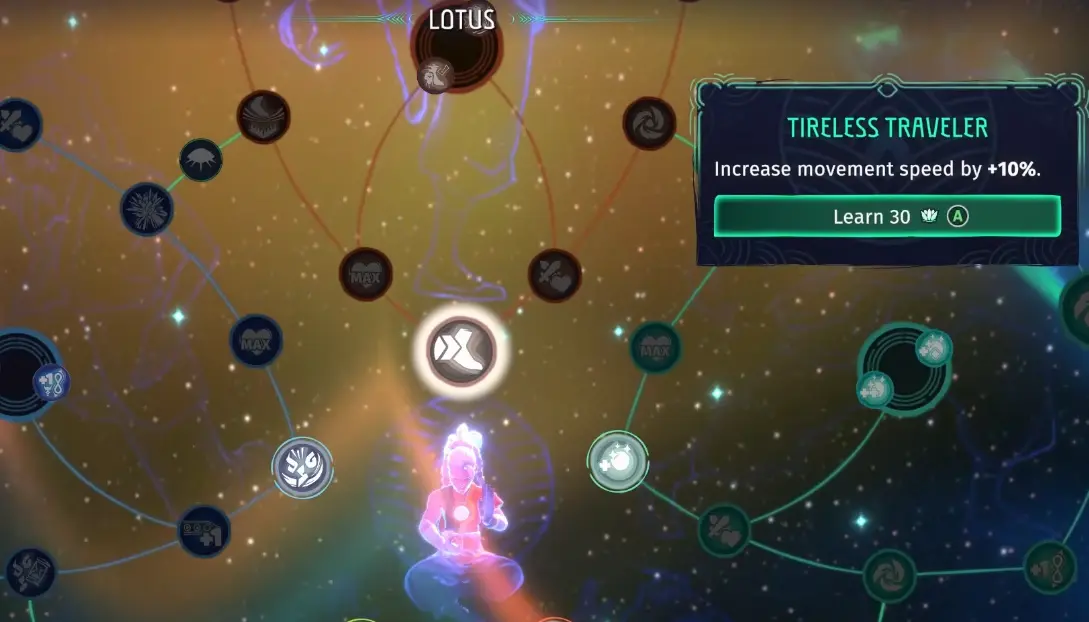
I spend Lotus on upgrades that make every ordinary room easier before I chase expensive back-row bonuses. Early on, I value maximum health, reliable healing and useful starting resources more than narrow damage bonuses. The other reason I plan ahead is cost: my early Lotus purchases showed the price climbing from 30 to 40, and later purchases continued rising. Later, a five-purchase route starting at 70 would take 450 Lotus to finish. I also tested resetting the front of a branch after reaching deeper nodes; it did not let me keep the back upgrades disconnected.
The Lotus looked much simpler to me the first time I opened it.
There were upgrades everywhere.
More damage.
More movement.
Starting Soul Beads.
A shield.
Health.
Memory-related upgrades.
My first instinct was:
Just buy the strongest-looking node and keep going.
That stopped making sense as soon as I bought one.
The next upgrade became more expensive.
Then the next one became more expensive again.
That turned the Lotus from a normal skill tree into a budgeting problem.
I now decide what I want from the next several purchases before I spend the first one.
Lotus Costs Rise as I Buy Upgrades
The first time I seriously looked through the Lotus, I found several useful starting options.
Among the early effects I could see were:
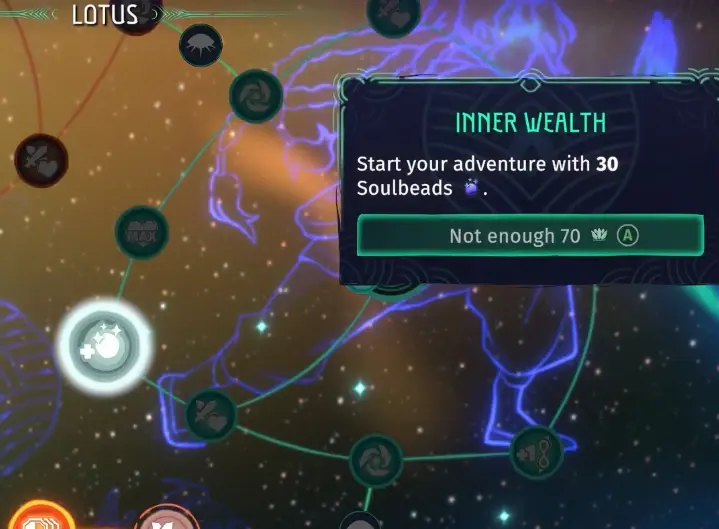
- starting a run with 30 Soul Beads;
- beginning with 25 Shield;
- increasing maximum health by 10;
- movement-related improvements;
- damage and status improvements;
- Memory-related progression;
- and upgrades that eventually open access farther through the tree.
My early Lotus options included upgrades costing 30 Lotus.
After I invested further, the next available price had climbed to 40, and the cost continued rising as I bought more upgrades.
That was the moment I stopped treating Lotus like currency I should spend whenever I had enough.
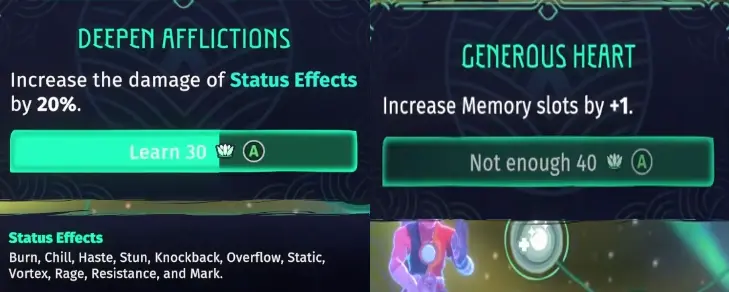
If I spend early Lotus on something I barely notice, I have not only wasted that purchase.
I have also made the upgrade I really wanted more expensive.
That changes my entire priority order.
I Buy Reliability Before Specialized Damage
My early runs were not usually ending because I lacked one more clever damage modifier.
They ended because I took too much damage before reaching the important fight.
That is why I started valuing the boring Lotus upgrades more.
A +10 maximum health increase is easy to understand.
It helps whether my current spell uses lightning, fire, ice or something completely different.
The same is true of reliable recovery.
Later in the tree, I found a route that included healing 1% after each encounter together with additional health-related progression.
That branch immediately looked more useful to me than another bonus that only worked with one specific build.
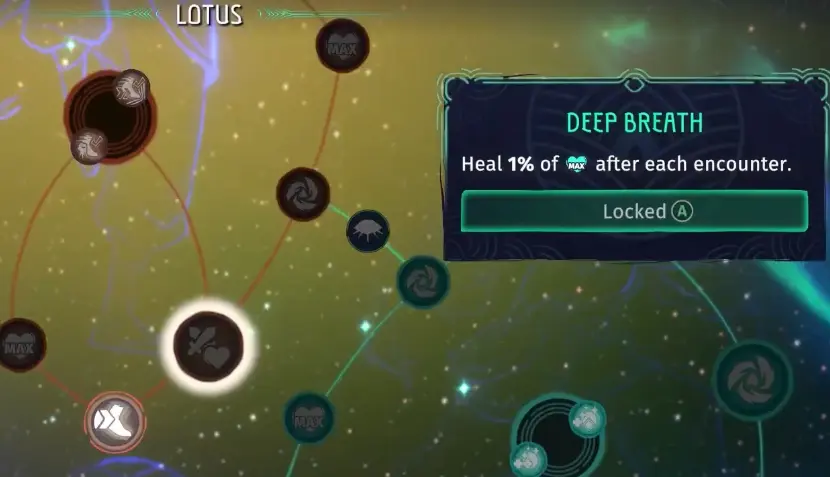
That distinction matters because my spell changes every run.
My permanent progression does not.
If I buy a Lotus upgrade that only feels good when the right Memory appears, I am making permanent progression depend on temporary luck.
I would rather use the Lotus to reduce that luck.
The detailed decisions about which Memories and Spell Forms I take during the run belong in my Spellcrafting Guide.
For Lotus, my question is different:
Will I still be glad I bought this when the next run gives me a completely different spell?
If yes, it moves up my priority list.
I Do Not Overvalue the 25 Starting Shield
The 25 starting Shield looked excellent when I first saw it.
Twenty-five extra protection at the beginning of a run sounds like exactly what I want.
In practice, I stopped treating it as an automatic priority.
A rough opening room can remove that buffer very quickly.
It is still useful.
But after repeatedly taking damage through the forest, I preferred upgrades that improved my ability to survive over more than one encounter.
That pushed me toward:
- maximum health;
- repeatable healing;
- and progression that improves the run beyond the first room.
There are still situations where I like the Shield.
If I am consistently taking one bad hit in the opening rooms and then stabilizing, 25 Shield gives me useful forgiveness.
But if my health keeps draining across five or six encounters, I fix the larger problem first.
The 30 Starting Soul Beads Are an Economy Choice
Starting with 30 Soul Beads is different.
That upgrade does not directly make me tougher.
It moves my economy forward.
I like it more when I am regularly reaching shops early and finding upgrades I want but cannot afford.
In that situation, starting currency can change an actual route decision.
Instead of entering the first shop and leaving empty-handed, I can arrive much closer to a useful purchase.
But I do not buy it just because 30 is a visible number.
If I am dying before the shop matters, more Soul Beads are not fixing the problem.
My order is:
survive consistently first
then:
improve the economy that supports those runs
That keeps me from buying a progression upgrade for a situation I am not reaching yet.
I Plan a Whole Branch Because Five Purchases Can Get Expensive Fast
The rising cost becomes much more noticeable later.
At one point, my next purchase was going to cost 70 Lotus.
I was looking at a route of roughly five upgrades that I actually wanted.
Following the increasing cost through:
70 → 80 → 90 → 100 → 110
meant I needed 450 Lotus to complete that route.
That is not a small impulse purchase.
It is a progression goal.
This is why I no longer think:
I have enough Lotus for a node. I should buy something.
I think:
Does buying this move me toward the next two or three upgrades I actually want?
If the answer is no, I am comfortable saving.
Lotus does not expire between runs.
A purchase does not become better just because I can afford it now.
When I Save Instead of Buying
I usually hold Lotus when one of these is true.
The next node is only a prerequisite I do not want yet
If I know the branch beyond it is my real target but I cannot afford to continue, I may save until I can make meaningful progress through the route.
My current problem is not solved by the available upgrade
If I keep reaching the Guardian with low health, I do not spend on an economy node simply because it is available.
I am still deciding between two expensive branches
Because every purchase raises the next cost, changing direction repeatedly is more painful than it first appears.
I do not understand what the upgrade changes
I made this mistake with a Memory-slot-related node.
I expected a more obvious improvement.
When I could not identify what it was doing for my current progression, I stopped defending the purchase just because I had already paid for it.
That is where reset became useful.
I Use Reset When an Upgrade Is Not Doing What I Expected
The Lotus lets me reset purchased progression.
That gave me room to correct a bad assumption instead of carrying it forever.
I had invested in a Memory-related upgrade because I expected a larger immediate benefit.
After checking my setup again, I still was not seeing what I thought I had bought.
So I reset it.
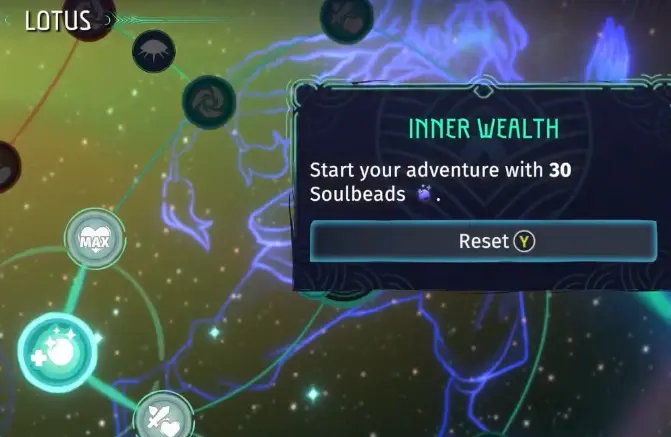
I do not reset constantly.
If an upgrade is clearly useful, I leave it alone.
For example, after reviewing another part of my setup I still had 110 maximum health, and I was happy to keep the upgrades supporting that route.
The reset is most useful when:
- I misunderstood a node;
- I committed to the wrong branch;
- my progression goal changed;
- or I want to test whether a different route gives me more practical value.
But reset led me to another question.
And this one was much more interesting.
I Tried to Reach the Back of the Lotus and Remove the Front
Once I knew I could reset nodes, I thought I had found a shortcut.
The idea was:
buy the prerequisite nodes
→ reach a powerful upgrade farther back
→ reset the cheap nodes at the front
→ keep the valuable back node
→ use the refunded progression to open another branch
If it worked, I could repeatedly strip away the path behind me and keep only the best upgrades.
For a moment, that looked like the obvious way to optimize the Lotus.

It did not work.
When I cut the route, the downstream progression did not remain independently active.
The shortcut died with the path.
That means I cannot treat prerequisite nodes as temporary scaffolding.
If a powerful upgrade sits deep in a branch, I need to budget for the route that keeps it connected.
This is one of the most useful things I learned about the Lotus because it changes how I evaluate deep upgrades.
The real price is not just the number printed on the final node.
It is:
the entire connected route I need to keep to reach it.
Deep Memory-Slot Upgrades Become More Interesting Later
Later I reached a Lotus option that increased Memory slots by 3.
That is a very different value proposition from the earlier progression I was unsure about.
Three additional slots are large enough that I can plan around them rather than wonder whether anything changed.
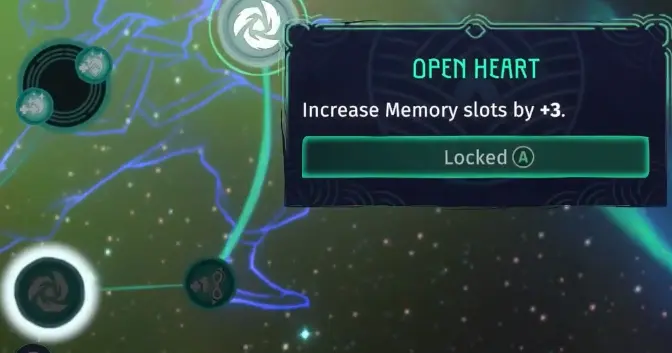
I still do not rush it immediately.
Extra Memory capacity matters most when I can consistently find and use enough good Memories to fill the space.
If my runs are still ending because I cannot stay alive, three extra slots are potential power I may never get to exploit.
So my priority changes over time.
Early:
survive
Then:
stabilize the run economy
Then:
expand what a strong spell can become
That is the point where Memory capacity becomes much more attractive.
I Match Lotus Purchases to the Problem That Ended My Last Run
The easiest way I found to avoid random spending is to look at the previous run.
If normal rooms drained my health
I look toward maximum health and repeatable healing.
If I survived but could not afford useful shop choices
I value starting Soul Beads more.
If I reached late encounters comfortably but the spell stopped scaling
I start looking harder at Memory capacity and deeper progression.
If the opening room repeatedly destroys me
A starting Shield or another immediate defensive benefit becomes more attractive.
If none of the available nodes fix the problem
I save.
I do not need to spend Lotus after every run.
Sometimes the correct upgrade is simply farther down the route than I can currently afford.
I Check the Lotus Before I Start Another Serious Run
Once I return to the hub, I do not immediately jump back into Mistralia.
I check the Lotus first.
My order is:
1. Look at how the previous run ended.
Was it health, damage, economy or scaling?
2. Check the current Lotus price.
The number matters because one purchase also affects what comes next.
3. Follow the branch past the first node.
I want to know what I am committing toward.
4. Decide whether I can afford one node or actually progress the route.
Those are not always the same thing.
5. Reset only if I can name the upgrade I would rather have.
I do not respec just to move numbers around.
6. Leave some Lotus unspent when the current choices do not solve anything.
Saving is a progression decision too.
That approach made the Lotus feel much less grindy to me.
The rising prices are still real.
But instead of treating every increase as a reason to buy whatever is available, I use the increasing cost as a reason to make each purchase more deliberate.
The Lotus is permanent progression.
That makes every early mistake more expensive than it first looks.
So I spend for the runs I am actually playing now, keep the route connected, and only chase the deep upgrades once the basics are already carrying me there.