My Echoes of Mystralia Guide for Building a Run That Keeps Going
I use this hub to decide what matters next: stabilize my spell, spend permanent progression carefully, clear the Ash Forest, then push into the mountains.
My spellcrafting process for choosing a reliable base Spell, adding Memories that work now, upgrading duplicates, reshaping the Canvas, and using extra sockets without breaking a good build.
My way to trace a broken spell chain: find what each Trigger belongs to, see which Modifier it changes, check the activation condition, then test one effect.
My Lotus upgrade route for getting stronger without wasting currency, including rising costs, survivability picks, resets, and the shortcut that did not work.
The Guardian Seal puzzles that stopped my Ash Forest runs, the solved layouts I use, what actually needs to connect, and the timed version I do not rush into blind.
The two hidden discoveries I found while pushing past the Ash Forest: where Zia's Statue appeared, how I reached the Hidden Laboratory, and what I did after each.
My Luciame fight route in the Ash Forest: why my first attempt failed, when I take recovery, how I handle her homing attacks, and why Burn helped me finish.
My Echoes of Mystralia progression became much easier once I stopped trying to
“clear the map” and started giving each run one main job. Early on I learn
the Watcher’s Heart and make one spell reliable. Then I use permanent
progression to make future attempts more consistent, take Ancient Lessons when
the run can support them, and push the Ash Forest toward Therakan. After that,
the run continues into the mountains with new enemies, discoveries, and harder
route decisions. If I am already strong enough for my next Guardian, I stop
turning every optional branch into a requirement.
Echoes of Mystralia clicked for me when I stopped thinking of each run as:
How much stuff can I collect before I die?
and started thinking:
What am I trying to accomplish before this run ends?
That sounds like a small difference.
It changed almost every route decision I made.
Sometimes the right run is about finding more permanent progression.
Sometimes I want Ancient Lessons.
Sometimes I already have a strong spell and the best decision is to stop
experimenting and go to the Guardian.
And sometimes I find something unexpected enough that I change the plan and
protect what I have already gained.
This hub is how I organize that journey.
I keep the exact mechanics in the dedicated guides so I do not have to solve
the same problem in five different places.
My First Job Is Learning What the Current Spell Actually Does
The Watcher’s Heart appears almost immediately.
That is also where the game starts throwing a lot of terminology at me at once:
Spells;
Memories;
Triggers;
Modifiers;
sockets;
and eventually more Canvas options.
My first instinct was to attach everything that looked powerful.
That produced spells I did not fully understand.
Now I do the opposite.
I make one change.
I cast the spell.
I check whether the effect I expected actually appeared.
Then I add another piece.
My early runs are for learning as much as progressing. I would rather understand one reliable spell interaction than fill the Canvas with effects I cannot explain.
That separation saves me a lot of unnecessary rebuilding.
I Do Not Need a Perfect Build Before I Start Progressing
One of my early mistakes was constantly waiting for the “real build” to arrive.
A better Memory.
Another Trigger.
One more status payoff.
A stronger Relic.
There is always another possible upgrade.
If the current spell already clears normal rooms without destroying my health
bar, I keep moving.
That is my first meaningful readiness test:
Can I clear ordinary encounters without needing a lucky recovery afterward?
If yes, the run has permission to progress.
I do not need a showcase build.
I need something consistent enough to carry me to the next important decision.
My First Failed Run Still Moves the Game Forward
I do not judge an early run only by whether I reached the Guardian.
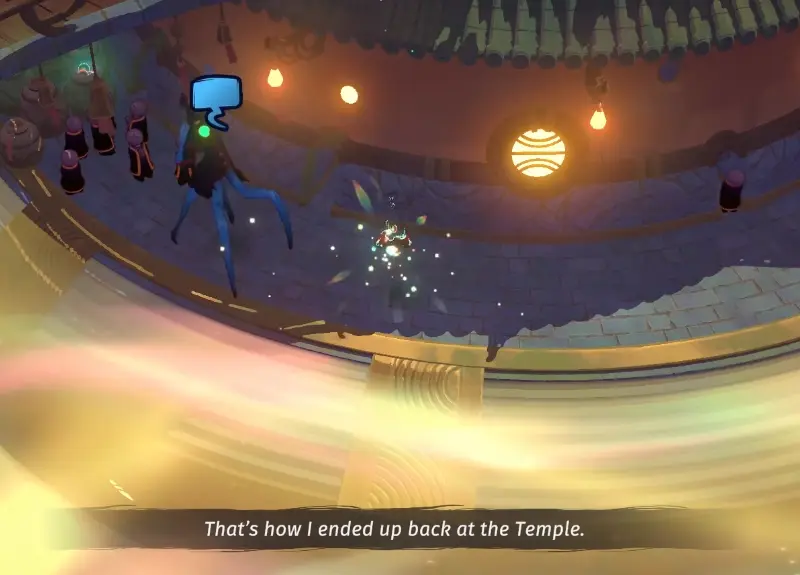
One of my first real attempts eventually ended with me being fished back to the
Azimuth.
That felt like a failure for about a second.
Then the game immediately turned the return into progression.
I was back at the hub with more information about:
what my spell was missing;
which route choices I misunderstood;
how long I could survive;
and which resources actually followed me back into the larger progression.
Getting fished out is not where I mentally reset to zero. I use the return to decide what actually ended the run and which permanent upgrade should address it.
That is how I treat later deaths too.
I ask:
What specifically ended this run?
Not:
What upgrade looks coolest now that I am back?
If I was slowly losing health across normal encounters, that sends me toward
survivability.
If I survived comfortably but could not scale my damage, I make a different
choice.
If the spell was good and I simply took a bad optional route, I do not rebuild
the entire character around one mistake.
I Spend Lotus to Fix Repeated Problems, Not One Bad Room
The Lotus is where I make permanent progression decisions.
I keep the detailed costs, reset behavior, individual nodes and tested route
logic in my
Lotus Upgrades guide.
At Hub level, the only rule I need is:
I buy permanent upgrades for problems that keep happening across runs.
If one unusual enemy hits me once, I do not rebuild my progression plan around
it.
If three runs in a row arrive at the Guardian in terrible health, that is a
pattern.
That deserves permanent investment.
The same applies to economy.
Starting resources matter more once I am surviving long enough to reach the
places where I can spend them.
I do not buy an economic solution to a survival problem.
Ancient Lessons Become More Important Once My Runs Stabilize
Ancient Lessons are another decision I stopped treating as automatic.
They move my Spell progression forward.
That is valuable.
But a route reward can still be badly timed.
When I am healthy and the current spell already works, I am happy to use the
run to progress toward more basic Spells.
When I am barely surviving, I take the option that keeps the run alive.
Once I am consistently reaching Therakan with a functional build, I stop
farming the forest and learn the Guardian.
Defeating Therakan Is a Transition, Not the End of the Run
The first time I beat Therakan, it felt like the natural endpoint of everything
I had been doing.
Then the run kept going.
The Forest Echo moves the larger objective forward, and the progression beyond
the Guardian gives me another opportunity to strengthen the continuing run.
More importantly, the route changes.
The Ash Forest stops being my destination.
The mountains become the next problem.
Therakan is a progression gate, not a credits screen. Once the Ash Forest is handled, I stop farming the same route and start learning what the mountain run asks from my build.
That transition is important psychologically too.
A spell that dominated the forest may only be adequate in the next region.
An optional fight I would casually take earlier can suddenly become dangerous.
A route choice that used to be about “more power” can become:
Do I preserve this run or gamble on another improvement?
That is where the game starts rewarding restraint much more.
In the Mountains, I Become More Protective of a Good Run
The further I push, the more valuable the current run becomes.
I have:
more progression invested;
more Memories accumulated;
more knowledge about the route;
and potentially discoveries I do not want to throw away.
That changes how I choose rewards.
If an option has a downside I do not fully understand, I am much more willing to
skip it.
I do not accept a strange modifier simply because it is offered.
I do not enter every dangerous room because “it might be good.”
Late-run curiosity has a much higher price than early-run curiosity.
This is also where I found the Hidden Laboratory.
I did not begin the run hunting specifically for it.
I was simply willing to keep pushing an unfamiliar mountain route after the
build proved it could handle the area.
My location-specific route and what I do after finding it stay in the
Hidden Locations guide.
I Protect Permanent Discoveries Once I Have Them
The same idea applies to Zia’s Statue.
Once I find something that creates permanent or hub-related progression, I stop
thinking about the run as disposable.
I do not necessarily return immediately.
If the build is still strong, I continue.
But my tolerance for unnecessary risk drops.
That is the difference between:
I have nothing to lose; let’s see what this room does
and:
I already found something valuable; do I really need another risky branch?
That decision becomes more important the further I get.
I Do Not Build Around an Unfinished Meda Strategy Yet
I have reached Guardian Meda.
That does not mean I have a complete Meda guide.
One useful mechanic became clear during the fight: Meda can damage her own
tentacles.
But I have not completed enough of the fight to turn that observation into a
reliable full strategy.
So for now, Meda stays at Hub level:
she is the next major Guardian problem after progressing through the
mountains
and nothing more.
I do not create a dedicated boss page from a failed attempt.
Once I have a complete kill and can explain the whole sequence — not just one
interesting mechanic — then the topic earns its own Owner Page.
I Treat Healing as a Route Problem Before I Treat It as a Separate Guide
Early on, I spent a surprising amount of time simply asking:
Where is my health coming from?
Healing can appear through several systems and route rewards.
But right now I do not think that deserves its own page.
My practical rule is:
If health is already low, I stop valuing theoretical future power above
guaranteed recovery.
I learned that the hard way by repeatedly choosing interesting rewards while
hoping healing would appear later.
Sometimes it did.
Sometimes the run ended before that mattered.
So if I see recovery and I am already in danger, I take the recovery.
If healing/checkpoint queries start appearing consistently in GSC, I can
separate the topic later with actual search evidence rather than preemptively
creating a thin page.
I Do Not Try to Complete Achievements During Every Progression Run
The current achievement list gives me plenty of long-term goals.
I do not carry all of them into every run.
My normal priority is:
progression first
then:
cleanup once I know what the game is actually asking me to collect
At Hub level, I only distinguish two kinds of achievement.
Progression achievements
These usually happen while I:
defeat Guardians;
meet people;
discover regions;
unlock basic systems;
and find important landmarks.
I do not farm them separately unless I missed something.
Completion achievements
These ask me to deliberately clean up things such as:
full collections;
remaining variants;
hidden objectives;
and things I did not naturally encounter.
Those are much better late-run goals.
I would rather finish the available progression first and then know what I am
actually missing.
My Progression Order
If I start again and want the shortest version of the entire guide, this is the
order I follow.
1. Make one spell understandable
I learn what the base Spell does and add one useful interaction at a time.
2. Survive long enough for route decisions to matter
I stop choosing interesting rewards over health when the run is already
failing.
3. Use Lotus to address repeated weaknesses
I fix patterns across multiple attempts rather than one isolated mistake.
4. Take Ancient Lessons when the run can support them
I progress the basic Spell set without sacrificing every weak attempt to do it.
5. Explore healthy runs
Unknown branches can hold meaningful progression.
I investigate them while I can afford the risk.
6. Solve Ash Forest Guardian Seals when they fit the run
I use verified layouts instead of rediscovering solved variants.
7. Commit to Therakan once the build is ready
I stop endlessly farming for a perfect spell.
8. Treat the mountains as a new difficulty check
I become more conservative about unclear rewards and optional danger.
9. Protect important discoveries
Once I find something permanent, I value getting the run safely through the
next decision more highly.
10. Leave completion cleanup until the route is familiar
Achievements, full collections and later variants are easier once I have
actually opened the content that contains them.
That progression order is what keeps my runs moving.
I am not trying to finish every system at the same time.
I am solving the problem that is actually stopping me now.
Echoes of Mystralia FAQ
Where should I go first in Echoes of Mystralia?+
I focus on progressing the early run rather than clearing every side branch. My first goals are learning how the Watcher's Heart works, finding upgrades that keep the run stable, and following the Ash Forest progression toward its Guardian.
Should I restart a run if my spell build feels weak?+
Not immediately. If the build still clears normal encounters, I keep progressing while looking for a compatible Memory or safer upgrade. I only stop gambling on optional branches when both my health and damage are falling behind.
What should I do after defeating Therakan?+
I finish the post-Guardian progression before rushing onward, then continue toward the mountain route. Therakan is the end of the Ash Forest objective, not the end of the run.
Is there a complete ending guide yet?+
I am not treating the current Early Access story endpoint as a final ending. I will only split a dedicated ending guide once the full narrative route is available and I can verify it from start to finish.
Should I make every map symbol a priority?+
No. Until I know exactly what a symbol offers, I compare the route against my current health, build strength, and progression goal. I do not risk a strong Guardian run just to investigate every unknown node.