The Builds and Synergies I Trust in Yet Another Zombie Survivors 1.0
The team cores, weapon paths and synergy decisions I use when a run needs more damage without spreading upgrades across too many unfinished options.
Updated:
Quick Answer
The early 1.0 team core I trust most is:
Tank → Huntress → Engineer
I use Tank to stabilize the opening, recruit Huntress early enough to develop her Bow into Multi-shot, then add Engineer when his Electric tools and paired effects fit what the team is already doing.
The most important rule is not the exact trio:
finish one strong damage source before spreading levels across several unfinished weapons.
In my runs, Huntress Multi-shot repeatedly produced enough damage that I stopped assuming the leader or the highest-tier weapon automatically deserved the next upgrade.
The biggest improvement to my 1.0 runs came when I stopped trying to develop every Survivor at the same speed.
There are too many tempting directions:
- weapons;
- abilities;
- new Survivors;
- paired effects;
- damage tags;
- gems;
- utility;
- economy.
Taking a little of everything feels flexible.
What I usually ended up with was three Survivors holding six half-developed attacks while the Horde was already strong enough to punish that lack of focus.
My better runs start with a much narrower question:
What is killing most of the screen right now?
I develop that first.
Then I build the rest of the team around it.
Tank Gives Me a Reliable Opening
On a fresh account, Tank has been one of the easiest leaders for me to stabilize.
His Pump Action gives me a clear early weapon path, and I can feel the difference when I keep investing in it instead of immediately adding unrelated attacks.
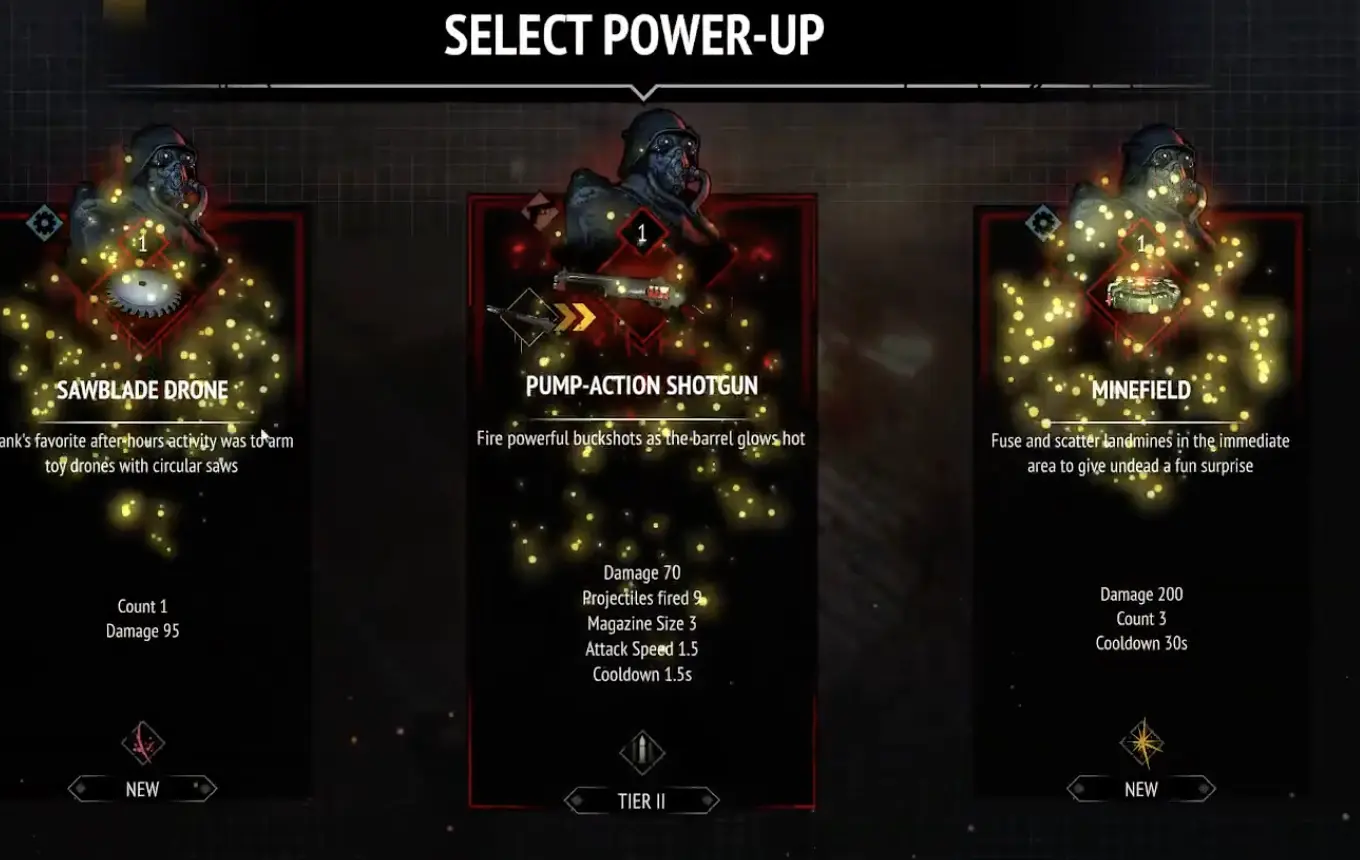
The opening matters more than the final damage screen makes it look.
Later in the run I may have:
- three Survivors;
- evolved weapons;
- several items;
- strong tags;
- passive bonuses.
At the beginning I have almost none of that.
If Pump Action cannot keep the first waves under control, I do not start planning an elaborate late-run synergy.
I fix Pump Action.
Once Tank can create enough space without constantly retreating, I start looking for the Survivor who can become the second damage engine.
For me, that has usually been Huntress.
I Recruit Huntress Early Enough to Develop Her
I do not want Huntress arriving after most of the useful progression has already happened.
If she is part of the plan, I bring her in early.
Then I push:
Bow → Multi-shot
instead of spending every Huntress level on whichever option happens to appear first.
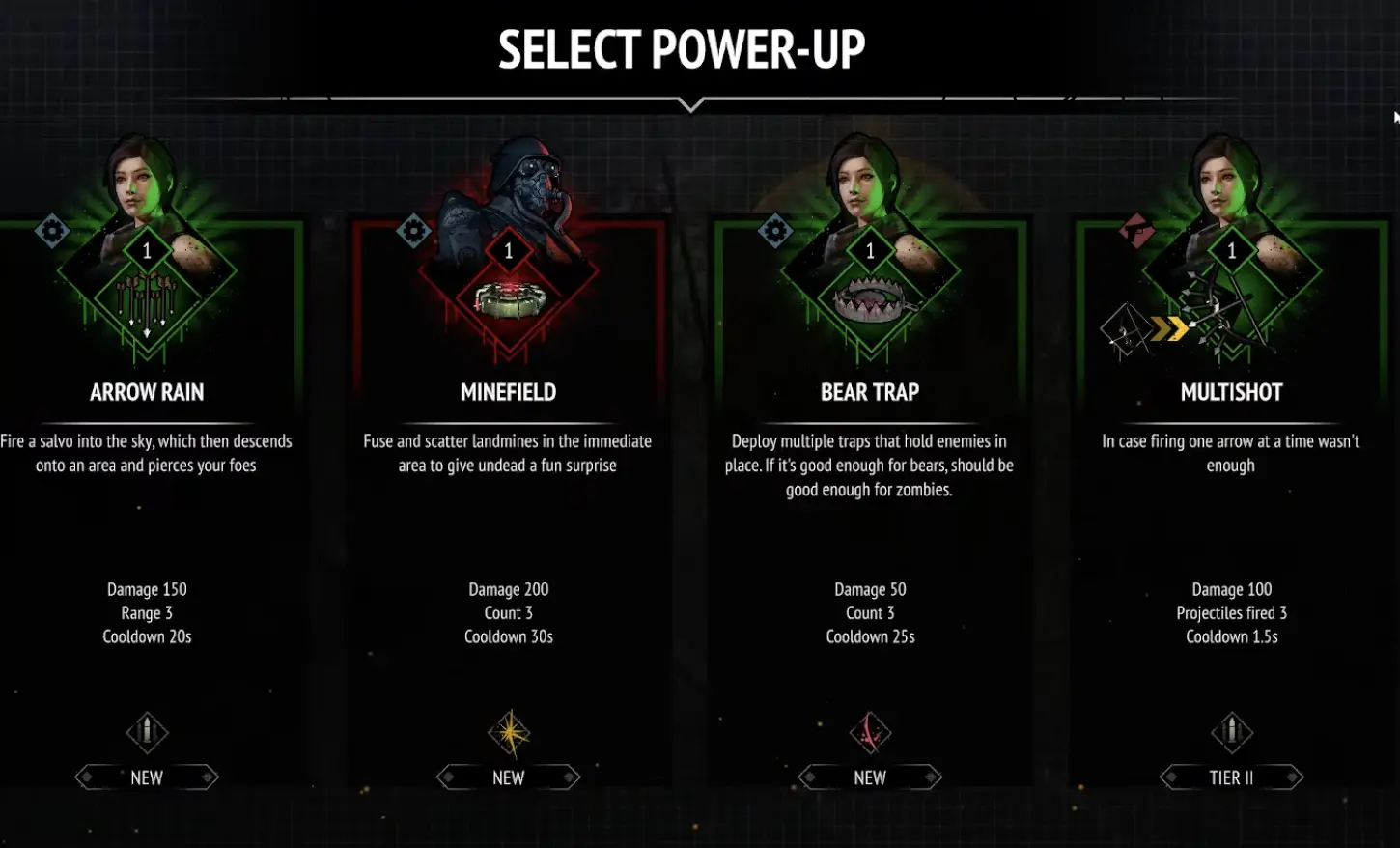
Multi-shot was the point where Huntress stopped feeling like support damage to me.
The change was visible in the run results.
Multi-shot Outperformed a Much More Invested Pump Action
In one early successful run, Tank’s Pump Action had received much heavier investment than Huntress’s Multi-shot.
I expected Tank to dominate the damage result.
He did not.
Multi-shot still finished ahead.
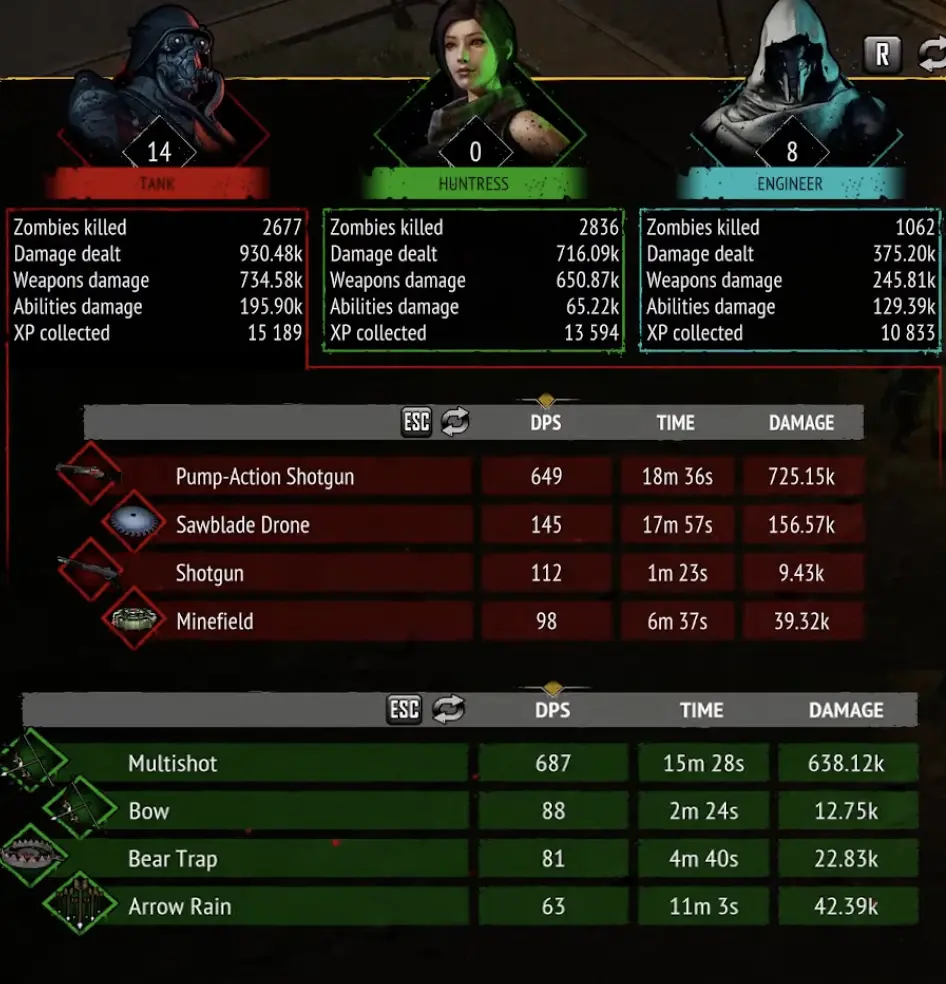
That result changed one of my assumptions.
I had been thinking:
Tank is my leader, so Tank is my carry.
After seeing the actual output, I started thinking:
the weapon doing the work is my carry.
If Huntress is already clearing more efficiently, I do not keep feeding Tank just because his portrait is first.
Tier Alone Does Not Tell Me Which Weapon Is Better
A later result made the same point more clearly.
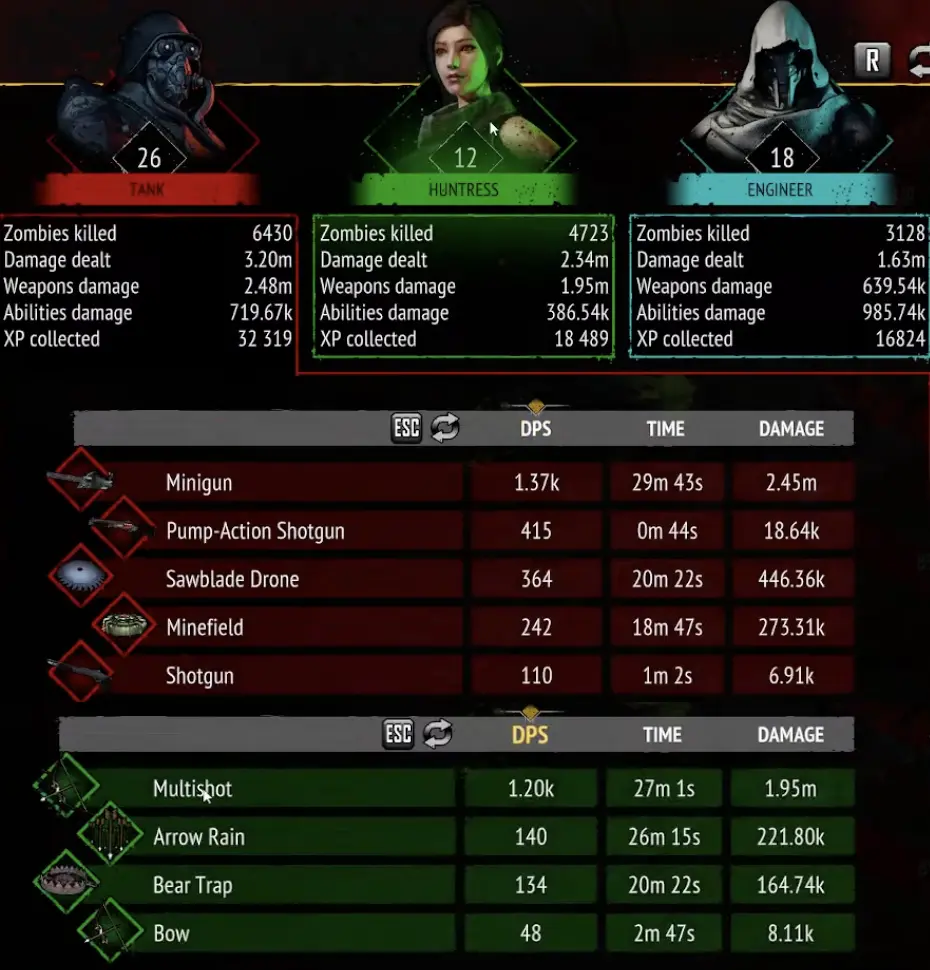
Tank had reached a Tier 3 Minigun.
Huntress was still running a Tier 2 Multi-shot.
Multi-shot remained one of the major damage sources.
I do not take that to mean:
Multi-shot always beats Minigun.
Different ranks, items, tags and permanent upgrades can change the result.
What the run proved to me was narrower and more useful:
weapon tier by itself is not enough information.
I look at what the weapon is actually doing to the Horde.
If it is already deleting enemies efficiently, I keep feeding it.
Huntress Is My Best Tested Early-to-Mid Carry So Far
For early and mid progression, Huntress has been the most convincing damage carry I have tested.
Multi-shot gives me:
- good screen coverage;
- reliable pressure on normal enemies;
- damage that stays relevant as the run develops.
That does not mean I treat Huntress as the final answer to every 1.0 mode.
I have not seen every fully developed Rank setup, Boss Rush team and late Bio Lab build under identical conditions.
So I use the conclusion I can actually support:
if I am progressing a newer account and Huntress is available, I am happy building around Multi-shot.
I do not need a universal tier list to make that decision.
Engineer Joins After the Damage Core Works
Engineer is most useful to me after Tank and Huntress already have a clear job.
I am not adding him simply because:
three Survivors must be better than two.
I want the third Survivor to make the team more coherent.
Engineer gives me access to Electric tools and paired effects that can connect with what Huntress is already doing.
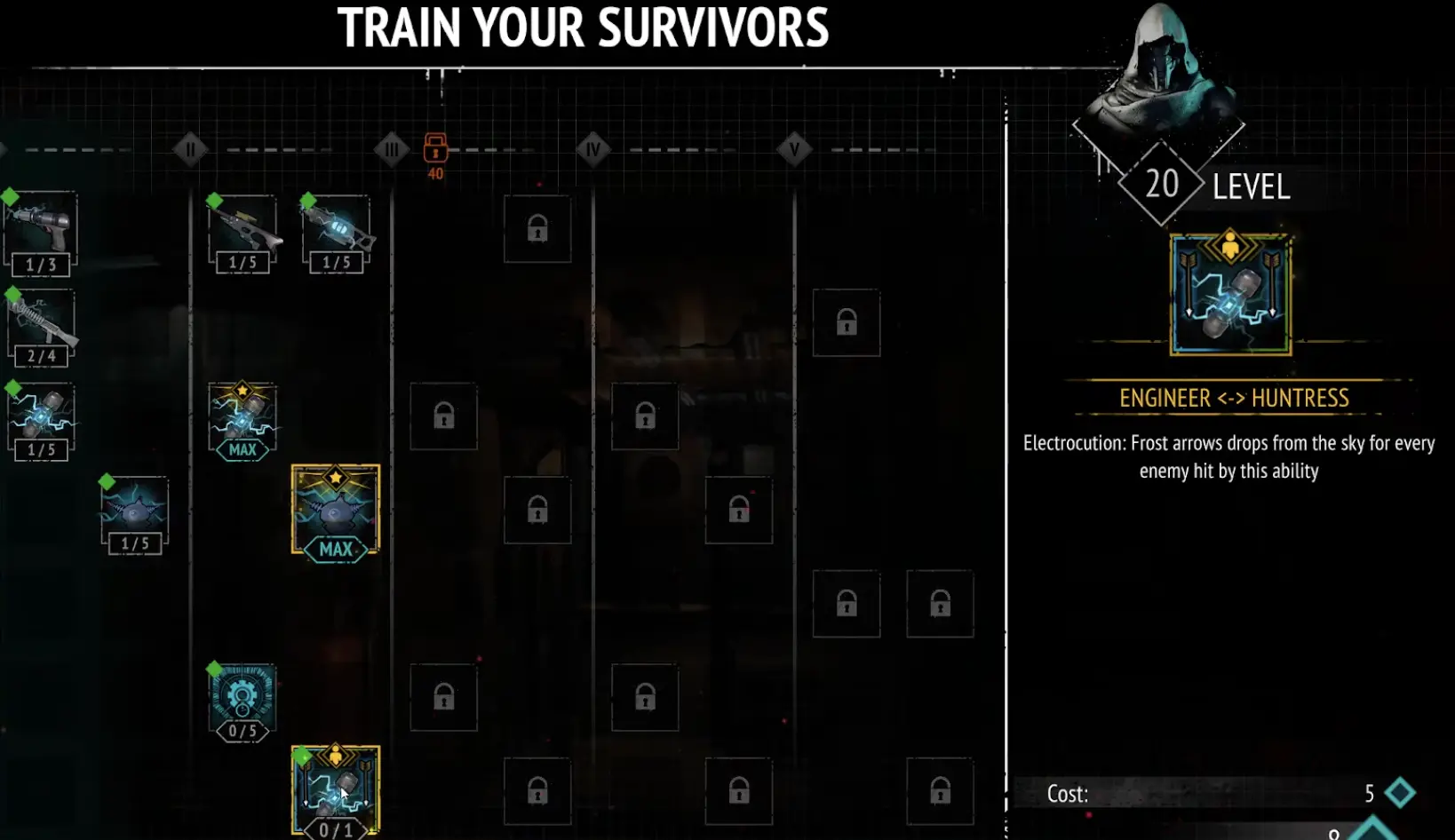
I have also seen other pairings in permanent progression, including:
Ghost + Engineer
and:
Pyro + Huntress
Those pairings are useful clues.
I do not treat the existence of a pairing as proof that it is automatically a top build.
The pair still has to support what the run needs.
If Huntress is carrying and Engineer adds useful Electric pressure or a relevant paired effect, I like the combination.
If neither character is developed enough for the interaction to matter, I do not dismantle a stable team just to activate a named synergy.
I Do Not Force Synergies Into a Weak Run
The word synergy can make an upgrade look more important than it really is.
I have learned to ask one question before committing:
Does this interaction strengthen something that is already working?
If yes, I am interested.
If activating it requires me to spend several levels on weak or unrelated options while the Horde is already gaining ground, I leave it alone.
A synergy should make a coherent build better.
It should not be the excuse for making the first ten minutes worse.
Recruitment Order Matters When I Want to Develop a Survivor
When I am trying to grow a specific Survivor, I do not leave that character until the last possible recruit.
Earlier members of the team have more time to gain progression during the run.

So if Huntress needs progression, I either:
lead with Huntress
or:
recruit Huntress early.
There is a trade-off.
An underdeveloped Survivor can make a difficult run weaker.
If the run itself is already unstable, I keep the stronger team.
If the current content is comfortable, I am much more willing to spend a squad slot developing someone I want to use later.
That is how I decide whether progression or immediate power matters more.
I Prefer Finished Weapons Over a Wide Upgrade Pool
One of the easiest ways for me to ruin a strong start is taking too many new options.
The problem is not just that each new ability costs levels.
Every additional direction also gives future level-up screens another thing they can offer me.
If I already have:
- Pump Action close to another meaningful upgrade;
- Bow approaching Multi-shot;
- Taser becoming a real damage source;
I prefer finishing one of those.
I do not want six attacks sitting halfway to their useful form.
I want one or two attacks that are already solving the Horde in front of me.
I Use Rerolls to Protect a Build Path
I do not reroll every average level-up screen.
I save rerolls for choices that can materially change the build.
I am most willing to use one when:
- Multi-shot is close and none of the choices help Huntress;
- my main weapon is one step from its next major upgrade;
- every option pushes into damage types I am not using;
- the run has enough damage but desperately needs movement or survival;
- a useful paired effect is close enough that keeping the path clean matters.
The point is not finding the theoretically perfect choice every level.
I use rerolls to avoid adding something that makes the rest of the run less focused.
I Let the Horde Tell Me Who Gets the Next Damage Upgrade
I do not permanently reserve upgrades for one Survivor.
Tank still gets damage when Tank is the reason I am surviving.
For example, I favor Tank when:
- Pump Action is keeping the opening clear;
- Minigun is already doing serious work;
- Huntress has not reached Multi-shot;
- the run is falling apart before Huntress can scale;
- the offered Tank upgrade gives me an immediate power spike.
If Huntress is already wiping the screen, I lean toward Huntress.
If Engineer has become the important part of an Electric setup, I can feed Engineer.
The team changes as the run changes.
That is more useful than deciding before the run that one Survivor gets every offensive upgrade.
I Stop Buying Damage When Damage Is No Longer the Problem
There are runs where I kill normal enemies quickly and still lose.
That usually means the next problem is not DPS.
I may be:
- getting trapped by overlapping elites;
- failing to move out of dangerous lanes;
- losing too much health to repeated small mistakes;
- taking risky routes for pickups;
- lacking enough recovery.
At that point, another small damage increase can make the results screen prettier without making the run safer.
I switch priorities.
Movement becomes more valuable.
Recovery becomes more valuable.
A defensive item becomes more valuable.
Once the current damage is already enough to control the screen, I stop paying for damage simply because damage was useful earlier.
Damage Tags Work Best When They Follow the Weapons
Damage Tags are useful, but I do not start a run by trying to collect every tag.
My weapons come first.
Then I look at what tags those weapons are already building.
Items such as Ruby Gem and Emerald Gem can benefit from the damage-type structure I have created.
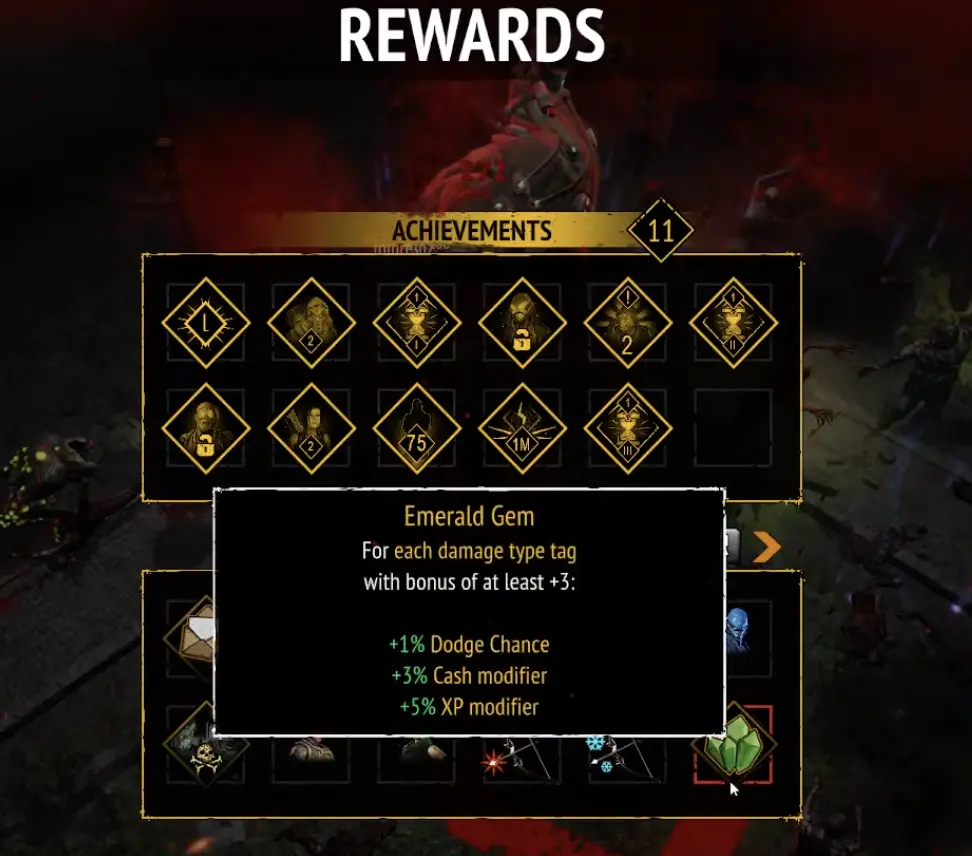
Some tag effects want 10 or more points before their stronger behavior becomes relevant.
That makes spreading across too many types expensive.
I would rather have:
one developed damage direction
plus:
one useful secondary type
than several counters sitting below the thresholds I actually wanted.
I Do Not Choose a Gem First and Build Backward
The order matters.
I do not take a Gem and then start collecting random attacks purely to justify the item.
I look at the current team first.
If my weapons already give the Gem useful scaling, great.
If taking the item would pressure me into several unrelated damage paths, I skip it.
The weapons decide the direction.
The tags describe what that direction is becoming.
The Gem rewards it.
That order keeps the build much cleaner.
Tank, Huntress and Engineer Solve Different Parts of the Run
The trio works for me because I am not asking all three Survivors to do the same thing.
Tank
I want a stable opening and reliable early weapon progression.
Huntress
I want Multi-shot to become a major screen-clearing damage source.
Engineer
I want another damage angle plus useful paired interactions once the core is already stable.
That gives me a progression sequence rather than three Survivors competing to become the same carry.
It also makes upgrade decisions easier.
If the opening is weak, I fix Tank.
If sustained screen damage is weak, I keep developing Huntress.
If the team is already stable, I look at whether Engineer can add a useful interaction.
I Do Not Force Ranger Into Every Team Yet
Ranger is one of the biggest additions in 1.0, and I absolutely want the character available.
But new does not automatically mean better.
I have seen Ranger and Good Boy working in actual 1.0 runs, but I do not have enough developed late-progression comparisons to replace a proven team simply because Ranger is unlocked.
So when I reach Ranger, I test the kit.
I level the character.
I watch which weapons and pairings actually perform.
I do not remove Huntress or another proven carry until Ranger gives me a reason to.
If I am still working toward the unlock itself, the Cash and Survival Level route is in my fast leveling guide.
The Build I Use for Early Progression
When I want a straightforward 1.0 progression team, my route is:
start with Tank
→ invest enough in Pump Action to control the opening
→ recruit Huntress early
→ push Bow toward Multi-shot
→ let actual damage results decide whether Tank or Huntress gets the next offensive investment
→ add Engineer once the first damage core is stable
→ use paired effects and damage tags to support the weapons already working
→ stop adding new attacks once the screen is under control
That last step matters as much as everything before it.
A good build is not the one with the most systems activated.
It is the one where every major investment is solving a problem I can actually see during the run.