Ghost of Yotei Most Wanted Guide: What to Upgrade First
Build Atsu in Most Wanted with Global and Class skills, weapon upgrades, charms, hunter unlock thresholds, perk choices, and Max Threat progression.
Updated:
Quick Answer
Start with Atsu and put early Mon into useful Global Skill Tree upgrades first, especially basic combat and survival tools that benefit every hunter. Then improve the weapon Atsu is actually using and add Class upgrades that strengthen Call of the Pack or Onryō’s Howl.
Do not save Mon just to unlock another hunter. Most Wanted tracks total Mon spent: Oyuki unlocks at 3,500, Nagato at 10,200, and Jin Sakai at 28,800 total spent.
Most Wanted gives Atsu a separate progression path built around repeatable Hunts rather than the equipment you finished the main campaign with.
You earn Mon and Player EXP inside Hunts, spend Mon between attempts on permanent improvements, and assemble temporary perks as each run develops. The useful early goal is not to unlock as many options as possible. It is to make Atsu strong enough that the later stages of a Hunt stop consuming all of your health and Spirit before the bounty fight begins.
How a Most Wanted Hunt Works
Each bounty is a six-stage run.
The first two stages are enemy gauntlets. Stage 3 brings in a miniboss drawn from bounty enemies, followed by two more combat stages. Stage 6 is the main bounty fight against one of the Yōtei Six.
The bounty ladder begins with The Spider and becomes harder as you move through The Kitsune, The Oni, The Snake, The Dragon, and Lord Saito.
Normal stages can place Atsu in different combat arenas and provide consumables, throwable weapons, Sake, and heavier tools such as Massive Weapons. Clearing a miniboss can provide health or Spirit recovery along with Player EXP and Mon, while completing the main bounty pays out a larger reward and can also provide Charms and Boss Tokens.
A failed Hunt does not erase all of that work. Mon and Player EXP already earned during the attempt are retained, so reaching a miniboss or later stage can still advance permanent progression even when the final bounty kills you.
What Should You Upgrade First?
The strongest early purchases are the ones that continue helping after you switch hunters.
Start With the Global Skill Tree
Each hunter has a Global Skill Tree and a Class Skill Tree.
Global upgrades apply across your hunters. They include basic combat improvements such as stronger parry stagger, access to Perfect Parry, additional maximum Spirit, and increased health.
That makes the Global tree the best place to look when the same weakness keeps ending every Hunt. Missing a basic defensive tool or running out of survivability late in a run is more important than opening another weapon path that you are not yet using.
Some nodes require a specific Player Level. When the upgrade you want is level-gated, more Mon will not bypass the requirement. Continue clearing stages, minibosses, and main bounties to earn Player EXP instead.
Spend on Atsu’s Class Tree When You Are Staying With Atsu
Class upgrades belong to the individual hunter.
For Atsu, that means improvements tied to abilities such as Onryō’s Howl and the rest of her character-specific kit. Her starting setup includes the Katana, Dual Katana, Metsubushi, and Blind Bomb, while Call of the Pack gives her two wolves that can attack and distract enemies.
Do not pour early Mon into every character-specific branch simply because it is available. A Class upgrade is most useful when you are actually going to keep using that hunter for the next several Hunts.
Upgrade the Weapons You Are Actually Taking Into Hunts
The Weapon Skill Tree improves main weapons and Quickfire tools.
Main-weapon upgrades increase the strength of the weapon type, while Quickfire upgrades can improve their effects or increase ammunition capacity.
Early Mon is limited, so spread-out investment is noticeably weaker than improving the equipment already doing most of your work. With Atsu, that usually means strengthening the melee option you are consistently using before paying for several secondary paths at once.
Spirit should be treated the same way. Increase it when later stages are repeatedly leaving you unable to heal or use an important ability. There is no need to buy Spirit simply because the node is visible if health, damage, or a missing defensive technique is the actual reason the run is ending.
Revives Can Come From Techniques and Charms
Most Wanted begins with very little room for a fatal mistake, but permanent progression can give you additional chances.
One revive can be unlocked through the Technique tree, while another can come from a Charm. A revive returns you with very little health, so it does not reset the encounter; it gives you a chance to recover a run that would otherwise have ended.
That makes a revive valuable once you are regularly reaching late stages. It is less useful as a substitute for basic defense if early waves are still taking most of your health.
Charms have their own progression requirements, and a hunter can equip up to three Charm slots. Build around effects that reinforce what the character already does rather than filling the slots with unrelated bonuses.
Choose Temporary Perks Around the Current Hunt
Permanent upgrades and Hunt perks solve different problems.
Perks only last for the current run, but they can substantially change how a weapon behaves or give a hunter access to equipment outside the starting loadout.
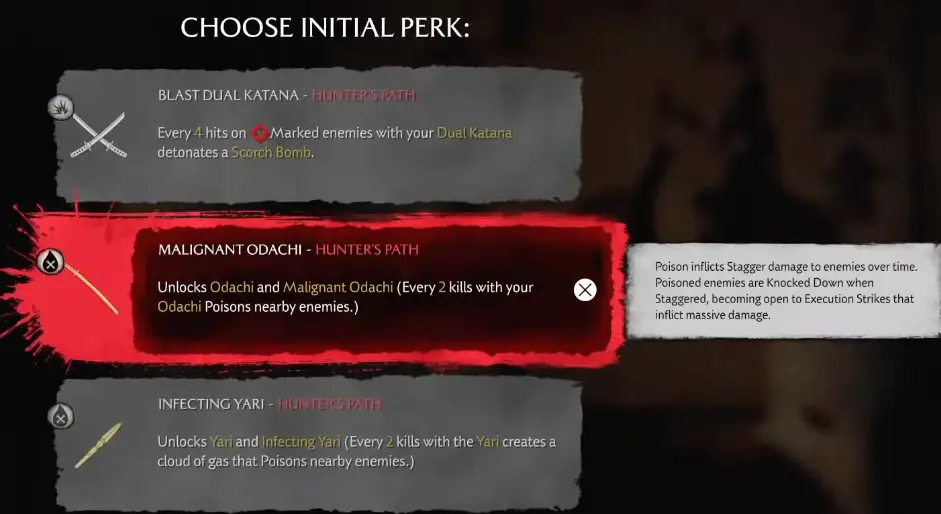
Some perks do much more than add a percentage bonus. Malignant Odachi can unlock the Odachi while adding a poison-gas effect after kills with it. Marked Booming Odachi can create a Scorched Bomb after killing a marked enemy with the weapon, while a Lightning Yari effect can call down Lightning after repeated Yari kills.
A weapon-unlock perk can be especially useful when it gives your hunter an answer they did not start with. The Odachi is valuable because it provides a broad melee answer instead of forcing the current loadout into an unfavorable matchup.
Once the run already has a working setup, strengthen that interaction instead of repeatedly adding unrelated weapon types. A fire, poison, Lightning, marked-enemy, or Quickfire perk becomes much stronger when another part of the build is already triggering the same effect.
Do Not Hoard Mon for Hunter Unlocks
Most Wanted unlocks its hunters by tracking how much Mon you have spent, not how much you currently hold.
Buying Skill Tree nodes, weapon upgrades, and qualifying Merchant purchases therefore moves character progression forward while also making your current hunter stronger.
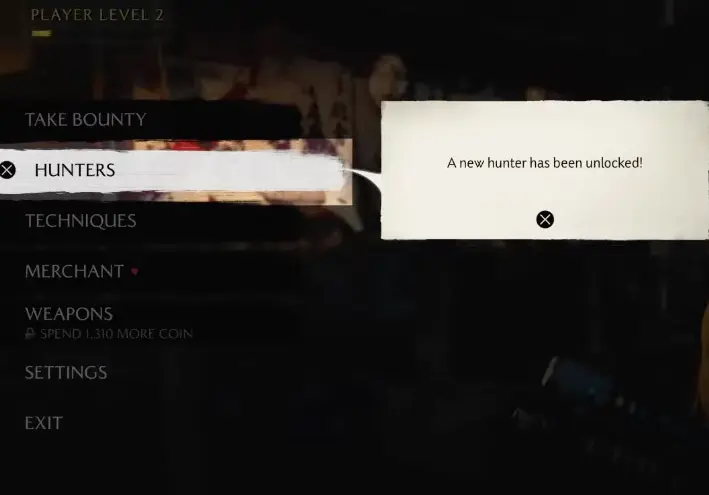
The thresholds are cumulative:
- Oyuki — 3,500 Mon spent
- Nagato — 10,200 Mon spent
- Jin Sakai — 28,800 Mon spent
Saving 28,800 Mon in your wallet does not unlock Jin. Spending toward useful Global upgrades, weapons, Class skills, Charms, and other qualifying purchases is what moves the requirement.
Jin’s Hunters screen also shows how much spending remains. If he is your main target, how to unlock Jin Sakai covers that counter and his stance-based combat after he becomes selectable.
Meals Are for One Hunt, Not Permanent Progression
The Merchant sells Meals that provide a temporary benefit for a single Hunt.
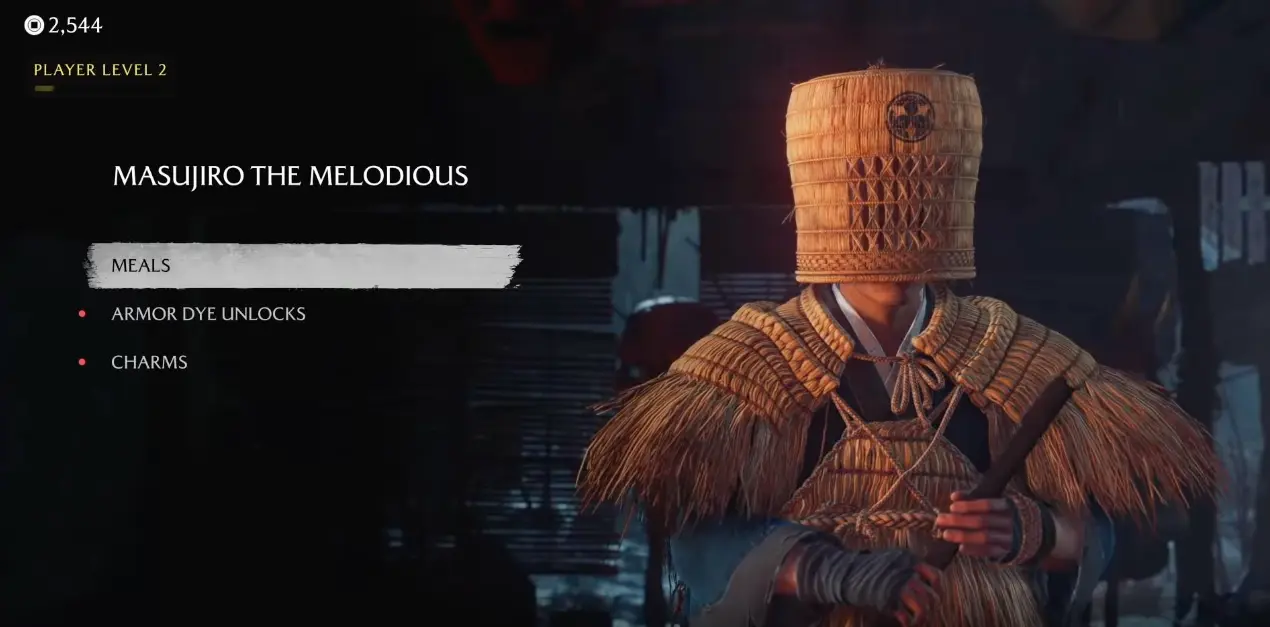
Meals are inexpensive compared with larger progression purchases, but the effect disappears after the run. Buy one when you already know what you are preparing for: a bounty that has stopped you before, a harder difficulty, or a final target you can consistently reach but struggle to finish.
A routine farming Hunt that is already comfortable rarely needs the extra expense.
The Merchant can also sell Charms and cosmetic unlocks. Armor skins bought with Boss Tokens apply to the main game rather than improving the Most Wanted run itself, so do not treat those purchases as combat power.
The Four Hunters Have Different Starting Kits
Atsu is the only hunter available at the beginning. Oyuki, Nagato, and Jin become available as your total spending increases.
| Hunter | Total Mon Spent | Starting Weapons / Tools | Character Abilities |
|---|---|---|---|
| Atsu | Start | Katana, Dual Katana, Metsubushi, Blind Bomb | Call of the Pack summons two wolves; Onryō’s Howl terrifies nearby enemies and forces one to flee |
| Oyuki | 3,500 | Kusarigama, Kunai, Tanegashima | Smoke enables chain assassinations; Shadow Shinobi summons a Nine Tails ally |
| Nagato | 10,200 | Yari, Tanzutsu, Yumi, Hankyu | Gambler’s Mark tracks two targets for guaranteed headshots; Blast Arrow uses an explosive arrow and refills Concentration |
| Jin Sakai | 28,800 | Four katana stances, Sticky Bomb, Hankyu | Dance of Wrath delivers consecutive unblockable attacks; Ghost Stance gives Jin his signature kill-streak attack |
Unlocking another hunter does not remove the value of Global upgrades because those improvements continue applying across the roster. Class and weapon spending is where you should become more selective.
That distinction is especially useful while working toward Jin: the Mon spent on strong Global nodes still advances his unlock without leaving the earlier investment behind when you eventually switch characters.
When Should You Move to a Harder Bounty?
Move forward when the current Hunt stops exposing a meaningful weakness.
If normal waves are draining most of your health, Spirit, and Quickfire resources before the miniboss, another permanent upgrade is more useful than forcing a harder bounty. If those stages are comfortable and the final target is the only serious test, the next bounty gives you more useful information than another easy clear.
Ranged enemies deserve particular attention as the encounters become denser. An archer interrupting Atsu while several melee enemies close in can create more trouble than the strongest enemy in the group. Remove the ranged pressure early, then use fear, smoke, wolves, fire, poison, or other crowd-control effects to keep large waves manageable.
After you defeat Lord Saito for the first time, Max Threat becomes available for completed Hunts. Max Threat adds much heavier enemy pressure and gives bosses more to work with, so it is better treated as a test for a developed hunter rather than the next automatic farming step.
Reach Lord Saito first, spend the Mon earned along the way, then return to Max Threat once the hunter you intend to use has the Global, weapon, Class, and Charm support needed to survive the longer fights.