Dune Awakening Ornithopter Guide: Parts, Materials & Build
Build your first Scout Ornithopter in Dune Awakening with the Mk4 parts list, material locations, assembly steps, fuel, storage, and flight tips.
Updated:
Quick Answer
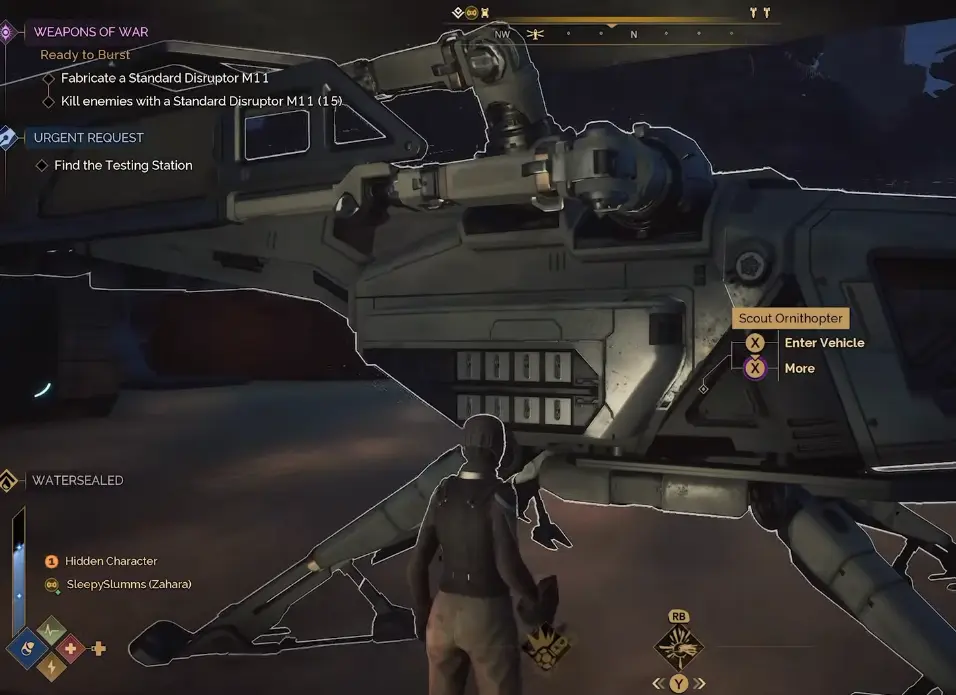
The Airborne! Journey requires a Scout Ornithopter Mk4 with a Chassis, Hull, Cockpit, Engine, Generator and 4 Wings.
The four Wings need 8 Industrial Pumps total. If you already have the Solari, Zoe at Crossroads Tradepost sells Industrial Pumps for 2,500 Solari each, so all eight cost 20,000 Solari. Otherwise, collect Pumps while working through their Hagga Basin sources.
You also need 16 Particle Capacitors for the Engine and Generator and 16 Armor Plating for the Hull and Cockpit. Keep Aluminum processing while you collect those components, then assemble the aircraft with a Welding Torch and have fuel ready before the first flight.
The Scout Ornithopter is the point where long Hagga Basin routes stop dominating the session. The difficult part is getting the first one assembled: its mandatory modules spread the cost across bulk Aluminum and several components found in different places.
If Steel production, the Cutteray Mk3 or first Aluminum is still blocking you, finish that sequence in the Progression Guide first.
Once Aluminum can keep processing while you leave the base for components, start the aircraft.
Scout Ornithopter Mk4 Parts and Materials
The Airborne! Journey asks for:
- 1 Scout Ornithopter Chassis Mk4
- 1 Scout Ornithopter Hull Mk4
- 1 Scout Ornithopter Cockpit Mk4
- 1 Scout Ornithopter Engine Mk4
- 1 Scout Ornithopter Generator Mk4
- 4 Scout Ornithopter Wing Mk4
The Mk4 recipes below total 217 Aluminum Ingots before optional modules. Custom Single Player crafting settings can change the costs displayed in your own game.
| Part | Qty | Aluminum | Other Materials |
|---|---|---|---|
| Scout Ornithopter Chassis Mk4 | 1 | 45 | 10 Advanced Servoks, 11 Cobalt Paste, 6 Carbide Scraps, 260 mL Water |
| Scout Ornithopter Hull Mk4 | 1 | 45 | 10 Advanced Servoks, 11 Cobalt Paste, 8 Armor Plating, 6 Diamondine Dust, 260 mL Water |
| Scout Ornithopter Cockpit Mk4 | 1 | 45 | 10 Advanced Servoks, 11 Cobalt Paste, 8 Armor Plating, 6 Diamondine Dust, 260 mL Water |
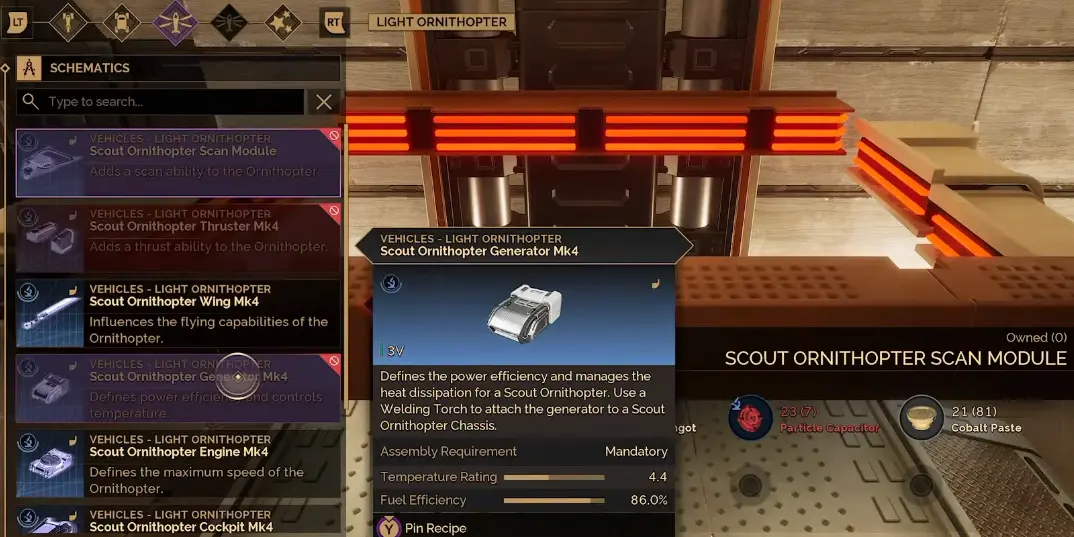
| Scout Ornithopter Engine Mk4 | 1 | 27 | 4 Particle Capacitors, 11 Cobalt Paste, 6 Complex Machinery, 260 mL Water |
| Scout Ornithopter Generator Mk4 | 1 | 27 | 12 Particle Capacitors, 11 Cobalt Paste, 260 mL Water |
| Scout Ornithopter Wing Mk4 | 4 | 28 total | 16 Advanced Servoks, 12 Cobalt Paste, 8 Industrial Pumps, 260 mL Water total |
| Mandatory build total | — | 217 | 46 Advanced Servoks, 67 Cobalt Paste, 16 Particle Capacitors, 16 Armor Plating, 12 Diamondine Dust, 8 Industrial Pumps, 6 Carbide Scraps, 6 Complex Machinery, 1,560 mL Water |
Do not wait until every line in this table is sitting in one chest before starting. Crafting the Chassis first and attaching parts as they become available makes the remaining shortages much easier to track.
Place the Chassis Before Farming Every Last Component
The Chassis is the frame for the rest of the vehicle and uses:
- 45 Aluminum Ingots
- 10 Advanced Servoks
- 11 Cobalt Paste
- 6 Carbide Scraps
- 260 mL Water
Before leaving for another facility, check old storage, vehicle inventories and component boxes. Particle Capacitors, Advanced Servoks and Armor Plating often accumulate well before the Ornithopter recipe turns them into urgent requirements.
Once the Chassis is placed, keep a Welding Torch nearby and attach finished pieces instead of storing the entire aircraft as separate crafted parts.
Industrial Pumps — Buy 8 or Farm Them
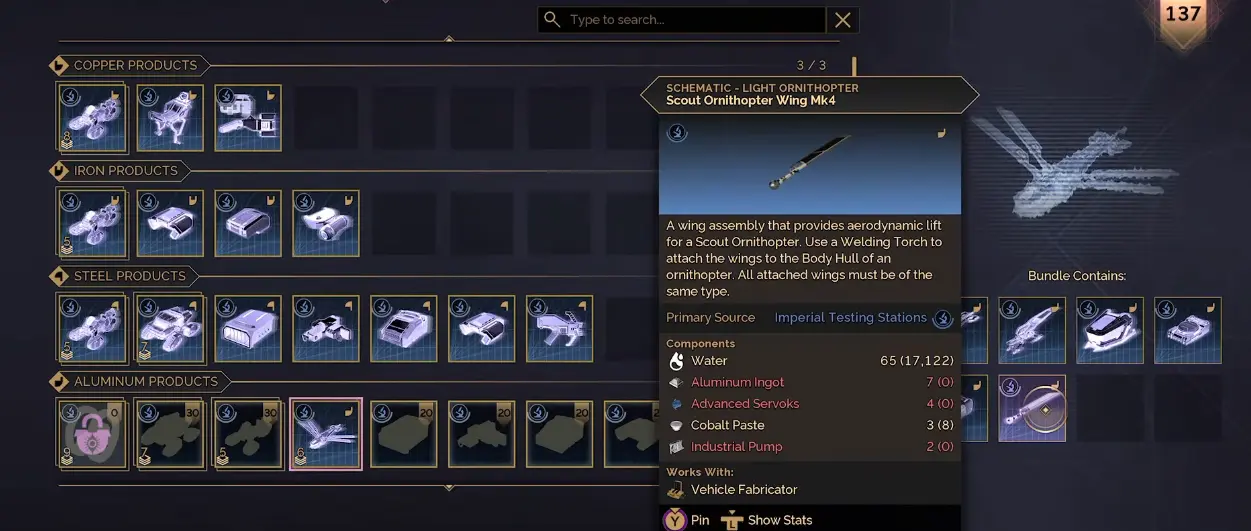
Each Scout Ornithopter Wing Mk4 requires:
- 7 Aluminum Ingots
- 4 Advanced Servoks
- 3 Cobalt Paste
- 2 Industrial Pumps
- 65 mL Water
The Airborne! objective requires four Wings, so the first Scout needs 8 Industrial Pumps.
There are two straightforward ways to cover this requirement.
Buy them: Zoe at Crossroads Tradepost sells Industrial Pumps for 2,500 Solari each, with enough stock to cover the first aircraft. Eight Pumps cost 20,000 Solari.
Farm them: Industrial Pumps are associated with Sandfly operations around Sentinel City, and they can also appear in Hagga Basin component loot such as Fallen Shipwrecks.
Buying is attractive when Solari is already plentiful and the aircraft is only waiting on Pumps. Farming makes more sense when you also need other loot or would rather preserve the money for later purchases.
Particle Capacitors — Run Imperial Testing Stations
The mandatory Scout needs 16 Particle Capacitors:
- Engine Mk4 — 4
- Generator Mk4 — 12
Particle Capacitors are Old Imperial components found in Imperial Testing Stations and other Old Imperial remnants.
Testing Stations are particularly useful because the same trips can also produce Advanced Servoks, another material used heavily across the Chassis, Hull, Cockpit and Wings.
If you are short on both materials, loot the containers throughout the facility instead of leaving as soon as the main objective completes.
Testing Station No. 2 is already part of earlier Hagga Basin progression, so check what you brought home from those runs before starting another dedicated Capacitor trip.
Optional modules can consume many more Particle Capacitors. Do not spend the first stock on a Thruster or another utility module while the Engine and Generator are still unfinished.
Armor Plating — You Need 16 for the Body
The Hull and Cockpit each require 8 Armor Plating, making 16 total for the mandatory Scout.
Armor Plating appears throughout Hagga Basin loot and is also sold by several merchants. If only a few pieces are missing, purchasing them can be cheaper in time than starting another long combat run.
Wrecks and vehicle-related salvage are also worth checking when you already pass them during normal travel.
Once the Hull and Cockpit are complete, Armor Plating is no longer part of the mandatory first-flight requirement. There is no reason to delay assembly while building a large surplus for unrelated equipment.
Advanced Servoks and the Remaining Components
Advanced Servoks are another Imperial component, so they overlap naturally with Particle Capacitor runs through Testing Stations.
The mandatory Scout needs 46 Advanced Servoks in total:
- Chassis — 10
- Hull — 10
- Cockpit — 10
- four Wings — 16
The Engine uses 6 Complex Machinery, while the Hull and Cockpit together use 12 Diamondine Dust. The Chassis needs 6 Carbide Scraps.
Before turning any one of these into a dedicated farming trip, check merchants and materials already collected during northern Hagga Basin progression. These smaller shortages are often faster to solve than the Pumps or Capacitors.
The two materials that should keep moving in the background are Aluminum and Cobalt Paste. Those are bulk production requirements rather than one-off component finds.
Keep Aluminum Processing While You Leave the Base
The mandatory aircraft consumes 217 Aluminum Ingots with the Mk4 recipes listed above.
That is enough Aluminum that component farming and refining should happen at the same time.
Queue a substantial batch, leave for Industrial Pumps or Particle Capacitors, return to craft the next finished part, then start another Aluminum batch before leaving again.
The aircraft builds much faster when the refinery keeps working during component runs.
If every new batch of Aluminum still requires stopping all other projects, the production loop is probably not ready for the Scout yet.
Assemble Chassis, Hull, Cockpit, Engine, Generator and 4 Wings
Use a Welding Torch to attach the completed modules.
The finished Airborne! build needs:
Chassis + Hull + Cockpit + Engine + Generator + 4 matching Wings
All attached Wings must be compatible with one another.
Storage, Thrusters and other utility attachments are optional. If the aircraft is not completing, check the mandatory modules before crafting another upgrade simply because an empty utility slot is visible.
Engine Mk4 — 75 km/h and 25.8 Power per Second
The Scout Ornithopter Engine Mk4 lists:
- 75 km/h powered speed
- 25.8 power consumption per second

The Engine requires 4 Particle Capacitors and the Generator requires another 12, which is why spending Capacitors on optional Holtzman equipment too early can stop the entire aircraft at the final stage.
Finish the mandatory pair first.
Make Fuel Before Installing the Last Mandatory Part
The easiest first-flight mistake is finishing the aircraft with no fuel prepared.
While the last parts are being fabricated, gather:
- vehicle fuel;
- water;
- basic repair supplies;
- enough empty inventory space for the first trip.
Then the moment the Scout becomes usable, it can actually leave the base.
There is little value in finishing one of Hagga Basin’s most expensive mobility upgrades and immediately parking it while you start another supply run on foot or by Sandbike.
Add Storage After the Scout Can Already Fly
The Scout does not require a Storage module for its first flight.
The Scout Ornithopter Storage Mk4 currently uses:
- 41 Aluminum Ingots
- 23 Advanced Servoks
- 21 Cobalt Paste
- 380 mL Water
Its current stats list 10 item slots and 500 maximum volume.
Forty-one additional Aluminum is a substantial follow-up cost immediately after the main build.
If the first Scout is mainly solving travel, fly it first. Add Storage when cargo space begins limiting the farming runs you are actually making.
That is when the module starts replacing extra return trips rather than merely making an already expensive first build more expensive.
Empty Cargo Before Using Vehicle Backup
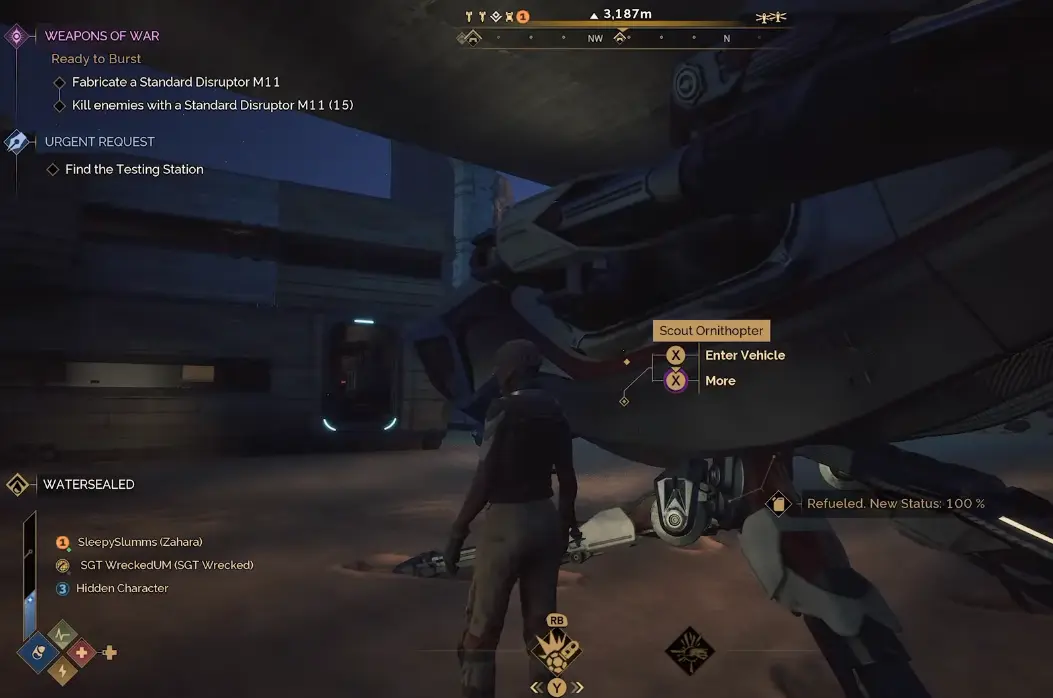
The Scout can use Vehicle Backup, which makes it possible to combine different vehicles in the same trip.
Storage adds one complication: deal with the cargo before putting the aircraft away.
Before a resource run, decide whether the Ornithopter or another vehicle is carrying the haul home. Reaching the end of a trip with valuable items still loaded into the aircraft is a poor time to discover that the planned vehicle swap requires inventory rearrangement.
Unload first, then use Vehicle Backup.
Land Outside Hostile Facilities
Flight makes it possible to put the Scout almost directly beside a Testing Station, Sentinel City objective or other hostile site.
That does not mean you should.
Look for protected ground nearby, land outside the immediate fight and finish the approach on foot. The return trip is still much faster than arriving by Sandbike, while the aircraft stays out of enemy fire.
A slightly longer walk is usually cheaper than repairing an expensive vehicle because it was parked beside the target.
Protect the Scout Before a Sandstorm
An Ornithopter parked beside the base is still exposed if the location does not actually protect it from the storm.
Move it under proper shelter before bad weather reaches you, or use Vehicle Backup once any cargo has been dealt with.
The important time to make that decision is before visibility collapses.
If the Scout is loaded with materials, unload it. If it is sitting outside, move it. Replacing the aircraft is far more expensive than spending a minute securing it before the storm.
Climb With Power, Then Glide
Powered climbing is useful when altitude changes the route.
Use the Engine for takeoff, clearing cliffs, gaining height and correcting a bad approach. Once the Scout has enough altitude and forward momentum, let it glide and add power again only when terrain requires it.
A simple rhythm is:
climb → gain speed → glide → correct with power → glide again
This stretches the fuel supply and gives you more time to inspect an unfamiliar destination before committing to a landing point.
Flying directly over a hostile facility at full power is fast until you discover that the only nearby landing ground puts the aircraft inside the fight.
What to Build After the First Scout
Use the basic aircraft before deciding which optional module comes next.
If farming trips keep ending because the aircraft cannot carry enough materials, add Storage.
If another module solves a repeated travel or combat problem, build it when the component cost makes sense.
If the Scout is already doing what you built it for, keep the materials.
The first Ornithopter does not need to be fully upgraded to deliver its biggest benefit: turning long Hagga Basin routes into short flights.