How to Get Through the Facility in Shroom and Gloom
A Janitor route through the Facility focused on Data, Gunk, cleaning, Machines, Foresight choices and surviving the final stretch without losing the deck's engine.
Updated:
Quick Answer
Once Janitor enters the Facility, build around what the run is already giving you. If Machines are carrying fights, spend Data and upgrades on making that engine more reliable. If the run is producing Gunk on purpose, make sure you also have a dependable way to clean it before taking more Gunk payoffs.
The final stretch punishes fragile combo decks. I would rather arrive with a smaller, redundant engine and useful cleaning than a huge HP total attached to one hand pattern that collapses as soon as cards start getting discarded.
The Facility taught me one lesson much faster than the Forgotten Path did: Janitor can ruin his own deck while appearing to make it stronger.
Gunk cards can scale damage. Machines can create repeated value without spending normal attacks. Data opens a different shop economy. Foresight can push the whole run toward one of those plans. The problem is that taking pieces from every system at once produces a hand full of conditional cards that never line up when the difficult fights begin.
My better Facility attempts became much more deliberate. I stopped asking whether a reward was strong and started asking which version of Janitor I was actually building.
If Janitor or the Facility is still locked, the progression and unlocks guide covers the route that opens them.
Gunk Is Not Just Something to Remove
The first instinct is to treat Gunk as contamination: a card gets dirty, its cost becomes awkward, so clean it as soon as possible.
That is only half of the mechanic.
Janitor has cards that become stronger because Gunk exists. I have used attacks that gain damage for every Gunk on the card, cards that add Gunk while healing, and cleaning effects that turn that buildup into another payoff. On a dedicated Gunk run, removing everything immediately can destroy the same resource the deck was trying to exploit.
The danger is letting that idea go too far.
More Gunk can also mean more energy pressure. I have reached hands where several promising cards were effectively locked behind costs I could no longer support. A real Gunk build therefore needs both halves of the cycle:
add Gunk deliberately → get value from it → clean it before the deck chokes
Without the cleaning half, it is not a synergy. It is just a slower way to lose access to the hand.
Data Changes What a Shop Is Worth
The Facility’s economy does not feel like the Forgotten Path with different scenery.
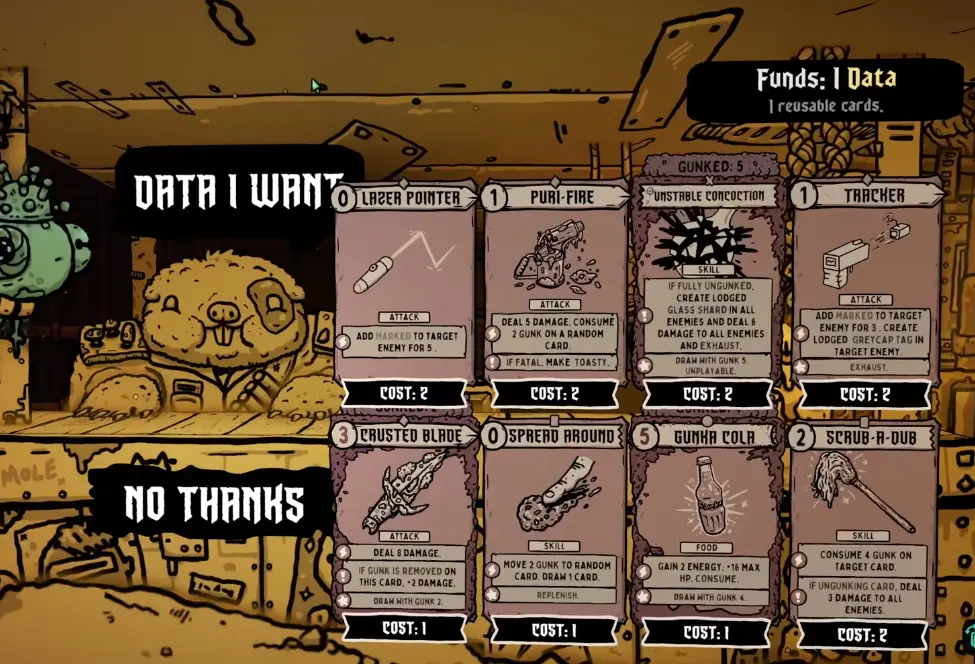
At one merchant I had only 1 Data available, while the shop was offering cards at 1–2 Data. That immediately made the purchase decision more serious: spending the currency on a merely decent card meant giving up the chance to improve consistency elsewhere.
I removed Slap instead.
That choice was not about Slap being unusable. It was about the deck already having better things to draw.
When Data is scarce, I spend it where it changes the run rather than where it produces the largest-looking number on the current screen. A Machine card that completes an engine can justify the cost. So can a card that fixes draw, cleaning or route access. A sidegrade usually cannot.
This becomes even more important later because Janitor has ways to generate or improve Data value. Once the run leans into that side of the kit, Data stops feeling like an occasional shop token and starts functioning as part of the build itself.
The Decontaminator Lets Me Choose What Stays Dirty
The Decontaminator is one of the clearest examples of why I do not clean cards indiscriminately.
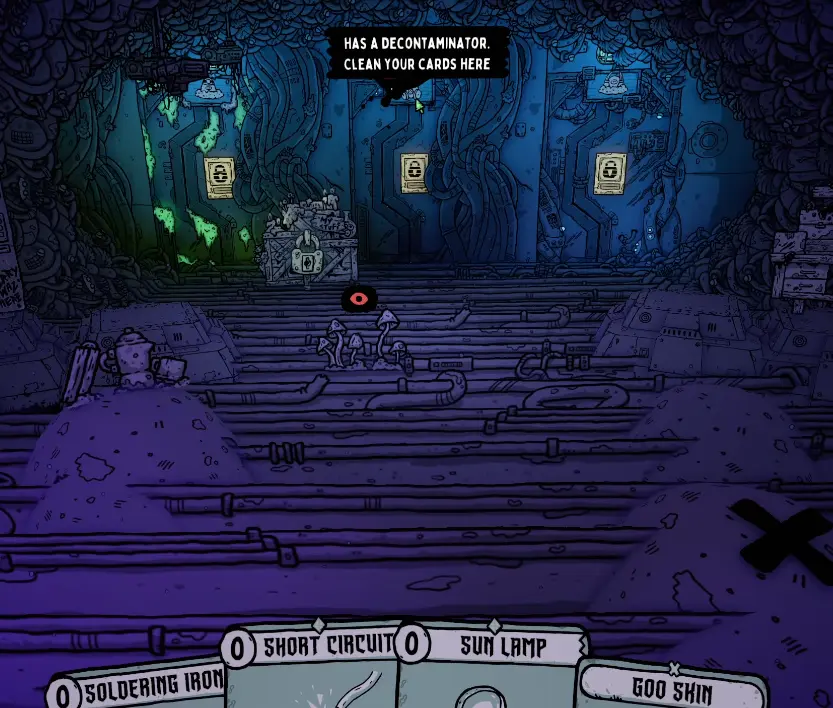
When I find one, I look at the hand in terms of urgency.
If Gunk has landed on the attack that is carrying the run, the Machine trigger I need this combat, or the exploration card required to open the next structure, cleaning has immediate value. A low-impact card can stay dirty longer if I am not planning to use it soon.
That distinction matters because cleaning itself is a resource. Spending it on the least important card in the deck can leave the actual engine trapped behind an inflated cost a few turns later.
The Facility became much easier once I started thinking in terms of which Gunk matters now, rather than trying to make the whole deck visually clean.
Foresight Can Push Janitor Toward a Completely Different Run
Foresight sits outside the normal Combat and Explore hands, but some of the choices are strong enough that I change the run around them.
One Facility choice gave me three very different directions. Data Miner could draw extra Data at the start of combat. Another passive would keep adding Gunk. Clean Freak would draw a cleaning card when three or more cards in my hand had Gunk.
At that point my deck was not really built around Gunk, so I took Data Miner.
That is exactly how I use Foresight now: as a commitment test.
If the current deck already has repeated Gunk generation and real cleaning payoffs, Clean Freak fits naturally. If the run is leaning on Machines and Data instead, taking the Gunk passive just because it looks interesting creates another system the deck now has to support.
Later Facility runs gave me the same kind of decision again. A Foresight that improved Decay made sense when Decay was already part of the damage plan; another Gunk passive would only have added noise.
Foresight is therefore not background flavor for Janitor. It can decide whether the next part of the run becomes cleaner or more complicated.
Machine Janitor Is the Easier Route to Read
The Machine route was the first Facility setup that gave me a stable sense of direction.
Once Cover Fire, Clunker, turret effects and Machine triggers started supporting each other, ordinary fights became much easier to evaluate. I was no longer looking at every reward as a possible new build. I was looking for things that made the existing Machine loop fire more often or made its damage scale harder.
That included cards such as Employee Handbook, Machine-trigger effects, Melties and Decay support.
The important change was consistency. A Machine engine can keep dealing useful damage while the rest of the hand handles healing, Gunk or exploration problems. That is why I would still prefer it for an early Janitor progression attempt over a complicated Gunk deck that has only half of its pieces.
The builds guide goes deeper into the actual Janitor archetypes. On the Facility route itself, I mainly need to recognize whether Machines are already doing enough work that the next reward should reinforce them rather than compete with them.
Toad Removal Matters More Because Janitor Has More Ways to Bloat
The Toad is useful in both pathways, but Janitor gives me more reasons to use it.
Machines, Gunk cards, cleaning cards, Data interactions and generic attacks can all look reasonable in isolation. If I take several from each group, the deck starts drawing setup without payoff or payoff without setup.
That is when a basic card such as Bash or Slap becomes expensive in a different sense: not because its printed cost is high, but because drawing it delayed the card the engine actually needed.
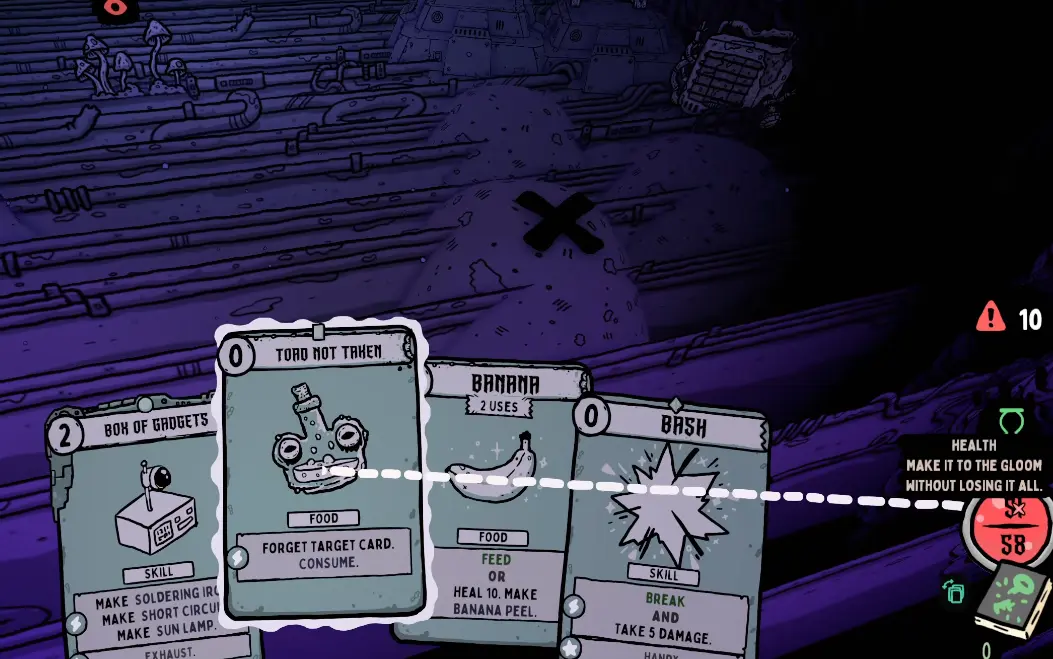
I do not turn every Toad into an automatic removal stop. If the deck is still short on basic functionality, cutting cards too early can leave it unable to handle ordinary fights. The best removal opportunities came after the direction was already obvious and the weak cards had become genuinely redundant.
Facility Camps Are Valuable for Different Reasons
The general danger of overstaying a camp does not change here, so I do not handle every Facility camp as a new puzzle from scratch. What changes is the value of the structures inside it.
One camp gave me healing, a Flashlight, Streamliner and a Max HP option in the same area.
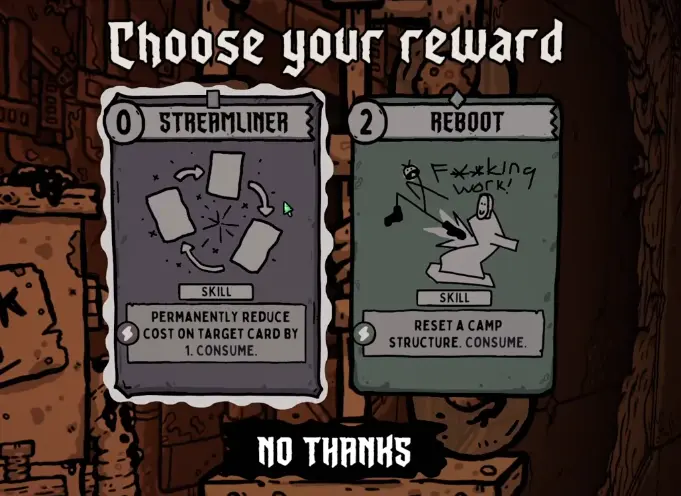
I healed first because the run was vulnerable enough that another poor fight could erase the value of every later upgrade. After that, a permanent cost reduction or Max HP increase could be judged on what the deck actually needed.
The basic camp logic is already established much earlier in the game: take the important value and do not keep paying escalating threat for low-impact leftovers. In the Facility, the more interesting decision is which Janitor-specific resource deserves the limited interactions that remain.
A Decontaminator, Machine structure or useful Data interaction can justify staying. A minor object usually does not.
I Choose Left or Right From the Build, Not From Memory
I have taken both sides of Facility splits, including a run where I deliberately went left after repeatedly using the other route.
Neither side turned into a permanent answer.
By the time a branch appears, I usually know enough about the deck to make the choice from its weakness. A Machine-heavy run wants opportunities that improve Machines or supply Data. A Gunk-heavy hand values cleaning much more highly. A damaged run may have to ignore the theoretically better synergy route because it will not survive long enough to use it.
This is also where the map becomes more useful late in the Facility. On one deep attempt, I checked it and could see the boss was next with another point beyond it. At that stage I stopped routing for speculative value and started preserving what the deck needed for the end.
The Final Stretch Exposes Fake Stability
The most dangerous Janitor runs were not the obviously weak ones. They were the runs that felt dominant for an hour and then reached a fight that attacked the structure of the engine.
I had a Cover Fire setup that was clearing normal encounters cleanly. Another run reached the boss with 185 HP.
Both still failed.
That 185-HP attempt was the clearest reminder that raw survivability is not enough. The final encounter can introduce an effect where playing a card discards a random card. Once that starts happening, a deck built around preserving several specific pieces in hand can unravel without taking a huge amount of direct damage first.
The question before the boss is therefore no longer “Do I have enough HP?”
It is whether the deck still works after losing a card I expected to keep.
Shivering Horror Is Brutal Against Cover Fire
The forced-discard pressure was especially bad for the Machine run.
My Cover Fire engine depended on keeping the right pieces available long enough for repeated triggers to matter. Once Shivering Horror started forcing random discards, Cover Fires disappeared before I could use them. At one point I was left with only one because the others had already been discarded.
That changed the fight from a Machine damage problem into a redundancy problem.
If all meaningful damage comes from one card type, a random discard can remove the engine faster than I can rebuild it. I now value a second damage line much more heavily before committing to the final encounter, even when Cover Fire has been strong enough to carry the route up to that point.
The boss can also introduce Thick Sludge and a Stubborn interaction during the fight. I treat that as a clue that forced discard is something the encounter expects me to manage, but I would not build an entire Facility run around seeing one specific counter. The safer preparation happens earlier: keep the engine compact, maintain more than one useful line, and avoid entering with every important function concentrated in the same fragile hand pattern.
Gunk Builds Fail Differently
A second deep run reached the same general problem from another direction.
The deck had finally learned how to use Gunk rather than merely survive it. It could add Gunk intentionally, clean it for value and create powerful repeated turns. The run still died at the end.
The mistake was not identical to the Machine attempt. Too many self-damage and resource trades had been taken because the engine could usually repair the loss afterward. That works while the deck controls the pace of combat. It becomes much more dangerous when the boss is simultaneously disrupting the hand.
So I became less willing to pay HP just because a Janitor combo technically returns more value later. Near the end of the Facility, immediate survival and hand stability start carrying more weight than theoretical efficiency.
What I Want Before Committing to the Boss
The strongest checklist I have for the Facility is not based on a target HP number.
I want a damage plan that can survive losing one card, enough cleaning that Gunk cannot lock the key cards at the wrong time, and enough sustain that the deck is not depending on perfect self-damage sequencing just to stay alive.
If Machines are the core, I want more than one way to produce meaningful damage. If Gunk is the core, I want both generation and cleaning already established rather than hoping the boss room supplies the missing half.
And if the deck only works when one exact hand stays intact, I know the final encounter is likely to expose it.
That is the point where the Facility stopped feeling like a longer Forgotten Path to me. Janitor can reach the end with an impressive deck and still discover that the build was solving the wrong problem.