SAND Raiders Storm Dive vs Voyage: Best Mode First
Compare Storm Dive and Voyage in SAND Raiders: shrinking storm, Voyage exits, Storm Dive extraction types, loot risk, Dreadnought, Sandworm Pit, and when to switch back.
Updated:
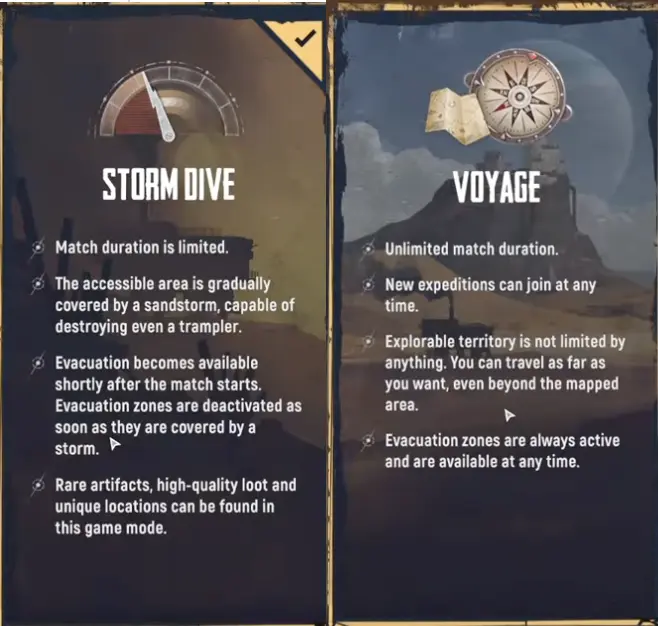
Quick Answer
I start SAND Raiders in Voyage, not Storm Dive. Voyage gives me open routing, always-available evacuation zones, and enough room to learn the Trampler, storage, repairs, radio tower extraction, and rebuild planning. I switch to Storm Dive only after I can extract cleanly, handle shrinking storm pressure, choose the right extraction type, and accept that Dreadnought, Sandworm Pit, and central exits will attract other crews.
Mode choice in SAND: Raiders of Sophie is not just a difficulty setting.
Voyage and Storm Dive change how I value time, loot, repairs, Trampler size, extraction options, PvP, and risk. In Voyage, I can learn the loop and leave after a good haul. In Storm Dive, the shrinking storm turns every delay into a cost, pushes players toward hotter zones, and makes late extraction decisions much more expensive.
Voyage vs Storm Dive quick comparison
| Mode | Best for | Main pressure | Extraction feel | My recommendation |
|---|---|---|---|---|
| Voyage | Learning, solo routes, rebuild runs, first extractions | Other players and normal route mistakes | More open, with evacuation zones available at any time | Start here |
| Storm Dive | Geared crews, confident solos, high-risk endgame loot | Shrinking storm, contested exits, concentrated PvP | More urgent, with storm and extraction-point pressure affecting exits | Switch later |
| After a loss streak | Voyage | Rebuild pressure | Easier to reset the economy | Go back here |
| After consistent extractions | Storm Dive test runs | Time, storm, and PvP compression | Higher-risk exits with better payoff potential | Try one controlled push |
The wrong question is “Which mode has better loot?”
The better question is: which mode can I actually extract from today?
What is Voyage mode in SAND Raiders?
Voyage is the mode I use to learn, rebuild, and stabilize.
Voyage has a more open route structure. I can travel more freely, evacuation zones are available at any time, and I have more room to learn the basic loop: drive, park, loot, store, call the radio tower, wait through extraction, climb out, and rebuild after losses.
That makes Voyage the better first mode for beginners and solo players.
| Voyage feature | Why it helps |
|---|---|
| Evacuation zones available at any time | I can practice leaving before greed ruins the run |
| No shrinking-storm route timer | I can learn without constantly racing the circle |
| More flexible pacing | I can stop, repair, store loot, and decide calmly |
| More open travel | I can learn map flow without being forced inward too quickly |
| Better for first extraction | Radio towers, 90-second countdowns, shelves, and exit angles are easier to learn |
| Better for solo learning | One player has more room to scout smoke and avoid bad fights |
| Better for rebuild runs | I can focus on mechanical parts, shells, Energy Rods, food, and raw materials |
| Better for testing builds | I can see whether a Trampler layout works before risking it in Storm Dive |
Voyage is not a waste of time. It is where I build the habits that make Storm Dive possible.
What is Storm Dive in SAND Raiders?
Storm Dive is the higher-pressure mode.
I treat it as a shrinking-zone extraction run. The important part is not only that loot can be better. The important part is that the playable space gets compressed, the storm changes safe routes, extraction points become more contested, players are pushed toward the same areas, and every slow decision becomes more expensive.
Storm Dive can also be a longer commitment than it first looks. Public timing references vary by build and test window, but I plan it as an hour-plus match, often discussed around 80 minutes to roughly two hours rather than a short five-minute loot run. Because the numbers can shift with patches, I use the timer as planning context, not a hard promise.
| Storm Dive pressure | What it means in practice |
|---|---|
| Shrinking safe zone | Slow looting becomes dangerous |
| Progressive storm damage | Being outside the safe area gets worse as the storm advances |
| Compressed routes | Other players become harder to avoid |
| Contested extraction options | I need backup exits, not one lazy tower plan |
| More urgent repairs | I may only have time to fix movement, reactor cover, or captain defense |
| Endgame POIs | Dreadnought, Sandworm Pit, red boxes, and artifacts become the main prize |
| Higher PvP concentration | Crews are pushed toward the same exits, loot, and final routes |
Storm Dive is not where I go to learn basic driving, storage, or extraction. It is where I go to test whether those basics still work when the map starts forcing decisions.
Is Storm Dive like a battle royale mode?
Storm Dive can feel like a battle royale-style pressure mode because the playable area shrinks and players are pushed toward contested space.
But I do not play it like pure battle royale. I still play it like an extraction run.
The goal is not to chase every fight. The goal is to enter with a plan, reach the loot or objective that justifies the risk, and leave before the storm, PvP, repair problems, or a bad extraction choice deletes the run.
If I enter Storm Dive and come out with nothing, the “high loot mode” did not help me.
Storm Dive extraction types
I no longer think about Storm Dive extraction as one simple “radio tower” rule.
For planning, I separate extraction options into practical categories. Exact availability can change by match, map state, and patch, but this framework helps me decide where to go when the storm is moving.
| Extraction type | When I use it | Main risk | My rule |
|---|---|---|---|
| Standard / edge exit | I already have loot and can leave before the storm cuts the route | Long travel from deep objectives | Best when I value safety over one more loot stop |
| Secondary / mid-map exit | I need a shorter route from POIs or ruins | More traffic and better camping angles | Scan smoke and terrain before committing |
| Emergency extraction | My planned exit is no longer realistic | Broadcast or visibility can attract multiple crews | Use when damaged, storm-cornered, or forced |
| Central Storm Dive exit | Late Storm Dive, near final routes or endgame loot | Highest PvP pressure | Approach only with hull integrity, weapons ready, and a backup plan |
A central exit is not just “the closest exit.” It is often the exit everyone else is also thinking about. I do not approach it casually with a damaged Trampler, messy storage, empty guns, or no repair plan.
For the full extraction loop, use:
How to Extract in SAND Raiders
Trampler choice changes Storm Dive routing
Storm Dive makes Trampler weight and role more important.
A lighter, faster, or cleaner Trampler can usually respond to early storm movement more easily. A heavy or armored Trampler can be better at holding a fight near Dreadnought or Sandworm Pit, but it cannot wait as long before rotating. If I bring a heavy machine, I move earlier.
| Trampler style | Storm Dive advantage | Storm Dive risk | My routing habit |
|---|---|---|---|
| Light / fast Trampler | Better early storm escape and repositioning | Weaker in direct fights | Loot quickly, rotate early, avoid long brawls |
| Compact solo Trampler | Easier to repair, park, and hide | Lower staying power | Use edges, avoid central fights, extract after value |
| Medium crew Trampler | Balanced storage, guns, and repair access | Needs clear role discipline | Good for controlled Storm Dive tests |
| Heavy armored Trampler | Better at holding Dreadnought or Sandworm Pit fights | Slow storm rotation and higher fuel pressure | Move toward center before the storm forces it |
| Overbuilt Trampler | Looks strong | Too slow to manage under pressure | Test in Voyage before risking Storm Dive |
The Storm Dive mistake is waiting too long in a heavy Trampler because the first phase feels manageable. Early storm pressure is survivable. Late storm pressure punishes every slow turn, bad repair, and greedy detour.
How progression and risk carry between modes
I treat mode switching as flexible, but not harmless.
I can move between Voyage and Storm Dive, and I do not think of them as permanent character branches. But the Trampler, gear, supplies, and route risk I bring into a deployment still matter. Loot and run rewards are settled by the run, so a Storm Dive loss can still hurt my rebuild economy.
That means I do not use Storm Dive as a “free test queue.”
This is also why I switch back to Voyage after a bad Storm Dive streak. I am not protecting pride. I am protecting the next run.
What Storm Dive does better
Storm Dive is for higher-risk runs where time, route pressure, PvP concentration, and endgame loot are part of the reward.
The main reason to enter Storm Dive is not that every random box becomes amazing. The reason is that the mode can push players toward higher-value objectives and endgame POIs, especially Dreadnought and Sandworm Pit.
Those areas can become the real prize: artifacts, red boxes, stronger items, and the kind of loot that makes the danger worth considering.
| Loot signal | How I treat it |
|---|---|
| White / common crates | Useful, but not enough reason to die in Storm Dive |
| Green / uncommon crates | Better route value if extraction is realistic |
| Red boxes / rare crates | Main reason to take Storm Dive risk |
| Artifacts | High-value target, especially near endgame POIs |
| Rare weapons and tools | Worth chasing only if I can still extract |
If I enter Storm Dive and spend the whole match picking up ordinary side loot while the storm closes, I am probably playing the wrong mode. Side loot becomes dangerous when it delays the real objective: reaching valuable loot and leaving before the pressure wins.
Storm Dive endgame: Dreadnought and Sandworm Pit
The two endgame names I pay attention to are Dreadnought and Sandworm Pit.
I do not treat them as casual first stops. I treat them as contest zones. If I drive there, I assume other players may be doing the same thing for the same reason: artifacts, red boxes, rare items, and the chance to turn one run into a big win.
My Storm Dive endgame rule is simple:
| If I push Dreadnought or Sandworm Pit… | I want this first |
|---|---|
| I am solo | Clean route, small profile, enough shells, and a planned exit |
| I am in a crew | Driver, gunner, repair, storage, and boarding roles assigned |
| I want red boxes | Enough time to loot and still leave |
| I want artifacts | A realistic extraction route, not just a screenshot moment |
| I see smoke nearby | Assume another crew is already in the contest |
| The storm is close | Leave or commit fast; do not half-play the objective |
A good Storm Dive push is not random greed. It is a planned risk.
Using the storm offensively
Storm Dive is not only defensive.
Once I understand how the storm is pushing the map, I can sometimes use it to predict other crews. Players with loot have to move. Heavy Tramplers have to rotate earlier. Damaged crews will look for emergency or central exits. Crews that waited too long may be forced through the same safe routes.
That creates ambush opportunities, but I do not treat them as free kills.
My offensive storm rule is:
- I only ambush if I already have an exit plan;
- I do not fight with the storm behind me unless I know I can leave;
- I watch for forced routes near emergency or central extraction;
- I let the storm create pressure, then I decide whether the fight is worth the timer.
When I would switch from Voyage to Storm Dive
I switch modes only after Voyage becomes consistent.
| I am ready for Storm Dive when… | Why it matters |
|---|---|
| I can extract from Voyage reliably | Storm Dive does not forgive basic extraction mistakes |
| I can store loot quickly | Slow storage gets punished by the storm |
| I know how to repair legs and reactor | Movement failures become run-ending faster |
| I have spare shells and Energy Rods | Storm Dive burns resources faster |
| I can read smoke and avoid bad fights | PvP density becomes harder to ignore |
| My crew has roles | One confused crew loses time and control |
| I can leave without greed | Red boxes are useless if I never extract |
I do not need to be rich before trying Storm Dive. I do need to be stable.
When I would switch back to Voyage
Switching back is not failure. It is how I stop Storm Dive from deleting my economy.
| I switch back when… | Why |
|---|---|
| I lose rebuild materials | Voyage is better for restoring mechanical parts and raw materials |
| I run low on shells or Energy Rods | Storm Dive pressure burns supplies faster |
| I fail extraction twice in a row | I need to fix the loop before adding more pressure |
| My Trampler layout feels too slow to repair | Voyage lets me test and adjust the build |
| My crew roles are messy | Storm Dive exposes bad role discipline |
| I die with ordinary loot, not rare loot | I am taking Storm Dive risk without Storm Dive payoff |
| I am solo and every route feels contested | Voyage gives me more room to scout and reset |
The strongest players do not stay in Storm Dive out of pride. They choose the mode that matches the current goal.
Mode choice by player type
Mode choice is not permanent. It changes with gear, map knowledge, crew communication, rebuild reserve, and how cleanly I extracted last session.
| Player type | Mode I recommend | Why |
|---|---|---|
| New player | Voyage | Learn controls, storage, extraction, and Trampler damage |
| Solo beginner | Voyage | Lower pressure and more room to avoid fights |
| Solo with rebuild reserve | Voyage first, Storm Dive test later | One bad Storm Dive run should not force a reset |
| Two-player crew | Voyage until roles are clean | Driver and gunner still need repair and storage answers |
| Three- or four-player crew | Storm Dive becomes more realistic | Roles can be split under pressure |
| PvP-focused crew | Storm Dive | Better chance to find high-value fights and contested loot |
| Rebuild after losses | Voyage | Restore basics before gambling again |
| Artifact hunter | Storm Dive | Dreadnought and Sandworm Pit are worth planning around |
My Storm Dive pre-deploy check
This is not another gear checklist. I already checked supplies before deciding to enter Storm Dive. This is the final pressure check I do before I commit.
| Check | What I want before committing |
|---|---|
| Run goal | I know whether I am chasing red boxes, artifacts, PvP, or a test run |
| Match time | I have enough time for an hour-plus Storm Dive commitment |
| Endgame target | I know whether Dreadnought, Sandworm Pit, or a smaller objective is the plan |
| Trampler role | I know whether my build is light enough to rotate or heavy enough to hold a fight |
| Backup exit | I know what I will do if the nearest exit is used, camped, inactive, or stormed out |
| Crew roles | Driver, gunner, repair, storage, and boarder watch are assigned |
| Storage space | Shelves are ready for the loot I am actually risking the run for |
| Repair plan | Legs, reactor, walls, and flywheel are reachable |
| Extraction trigger | I know what makes me leave before the storm decides for me |
| Backout rule | I know when to switch back to Voyage after losses |
If I cannot name the goal, the Trampler role, the backup exit, and the extraction trigger, I am not preparing for Storm Dive. I am donating a Trampler.
Common mode choice mistakes
| Mistake | Why it hurts | Better habit |
|---|---|---|
| Starting Storm Dive before learning extraction | I lose loot to basic exit mistakes | Practice in Voyage first |
| Treating Storm Dive as only better loot | I ignore the storm, extraction types, and PvP compression | Enter with a goal and exit trigger |
| Staying in Storm Dive after a loss streak | My rebuild economy collapses | Switch back to Voyage and stabilize |
| Side-looting too long in Storm Dive | I burn storm time for ordinary loot | Chase the objective or leave |
| Relying on one exit | A used, camped, inactive, or stormed exit can ruin the run | Plan a backup extraction option |
| Taking a heavy Trampler but rotating late | The storm punishes slow movement | Move earlier or bring a lighter build |
| Entering without enough real-world time | Storm Dive can be an hour-plus commitment | Do not queue if I only have a short window |
| Entering without spare shells or Energy Rods | I cannot handle pressure or distance | Stock supplies before high-risk mode |
| Going to Dreadnought or Sandworm Pit casually | Endgame POIs attract other players | Treat them as contest zones |
| Playing solo Storm Dive like crew Storm Dive | One player cannot cover every role | Keep the route smaller and extract earlier |
| Assuming mode switching is harmless | Gear and Trampler risk still matter | Only risk what I can afford to lose |
Mode choice should protect the next run. If the mode is deleting my ability to keep playing, I chose wrong.
Related Guides
- SAND Raiders Beginner Guide — Start here for the first-voyage checklist, Trampler basics, loot priorities, and beginner FAQ.
- SAND Solo Guide — Use this if you are choosing modes as a solo player and need safer routes, smoke scouting, shovel routes, and rebuild planning.
- How to Extract in SAND Raiders — Learn doorway icons, radio towers, 90-second countdowns, green smoke, escape lines, loot storage, and beacon boxes.
- SAND Trampler Guide — Build a Trampler that survives reactor, legs, walls, flywheel, storage, reachability, and boarding pressure.
- SAND Raiders 40mm vs 80mm Cannon Guide — Pick the cannon and shell plan before pushing higher-risk mode fights.
FAQ
Should I play Voyage or Storm Dive first in SAND Raiders? +
I would start with Voyage. It gives me more room to learn Trampler control, storage, repairs, radio tower extraction, food respawns, smoke scouting, and rebuild planning before adding shrinking storm pressure.
What is Voyage mode in SAND Raiders? +
Voyage is the more flexible mode for learning and rebuilding. It has a more open route structure, more room to travel, no Storm Dive timer pressure, and evacuation zones that are available at any time.
What is Storm Dive in SAND Raiders? +
Storm Dive is the higher-pressure mode where the playable space shrinks, the sandstorm changes route decisions, extraction options become more contested, players get pushed toward hotter areas, and higher-value loot targets become more realistic but more dangerous.
How long does Storm Dive last? +
I treat Storm Dive as an hour-plus commitment, not a quick loot run. Current public references vary, with some planning around roughly 80 minutes and others describing a storm that can shrink the map over about two hours, so I plan for a long match and patch changes.
What is the main difference between Voyage and Storm Dive? +
Voyage gives me more time and route freedom. Storm Dive adds shrinking storm pressure, stronger PvP concentration, more urgent extraction timing, more contested extraction choices, and higher-risk loot targets such as Dreadnought and Sandworm Pit.
Are Storm Dive extraction points different? +
Yes. I do not treat Storm Dive extraction as one simple tower rule. I plan around standard exits, emergency extraction opportunities that can attract everyone, and central storm-only exits that become extremely contested.
Can the sandstorm damage my Trampler? +
Yes. I treat the sandstorm as direct danger, not just a timer. As the storm progresses, the safe area shrinks and damage pressure becomes more punishing, especially for slower or heavily loaded Tramplers.
Do Voyage and Storm Dive share progress? +
I treat mode choice as a risk decision, not a separate safe save slot. I can switch between Voyage and Storm Dive, but the Trampler and gear I bring still matter. Loot and run rewards are settled by the run, so I do not enter Storm Dive assuming losses are harmless.
Where is the best Storm Dive loot? +
Storm Dive finals can concentrate players around endgame POIs such as Dreadnought and Sandworm Pit, where artifacts, red boxes, and higher-tier loot are the real reason to take the risk.
When should I switch back to Voyage? +
I switch back to Voyage after losing rebuild materials, running out of spare shells or Energy Rods, failing Storm Dive extraction, or realizing my Trampler, storage, repairs, or crew roles cannot handle storm pressure.