How Do You Repair a Broken RV in Nomad Drive?
Fix an overheated engine, recharge or replace a dead battery, refill the radiator, repair worn tires, and keep your vehicle running during long road trips.
Updated:

Quick Answer
Stop the vehicle and check its engine condition, radiator coolant, battery, and tires. Refill an empty radiator before driving again, use an Engine Repair Kit if the engine is damaged, and charge or replace a failed battery. Repair worn tires with a Tire Repair Kit or fit a better replacement.
An RV can have fuel in the tank, a working engine installed, and enough supplies for another day yet still break down in the middle of a road trip. The cause is not always the part you first suspect.
An overheated engine may be the result of an empty radiator. Replacing the coolant alone may leave you with an engine already badly damaged. A battery can reach 0% while the rest of the vehicle is still serviceable, forcing you to stop and install a spare. Tires gradually lose condition, creating another maintenance job even when you have avoided major crashes.
These failures become more expensive in time once your vehicle is carrying furniture, food, water, and collected equipment. A small stock of repair supplies can save the entire trip, provided you know which component actually needs attention.
Why Is Your Engine Overheating in Nomad Drive?
Check the radiator before spending an engine repair kit.
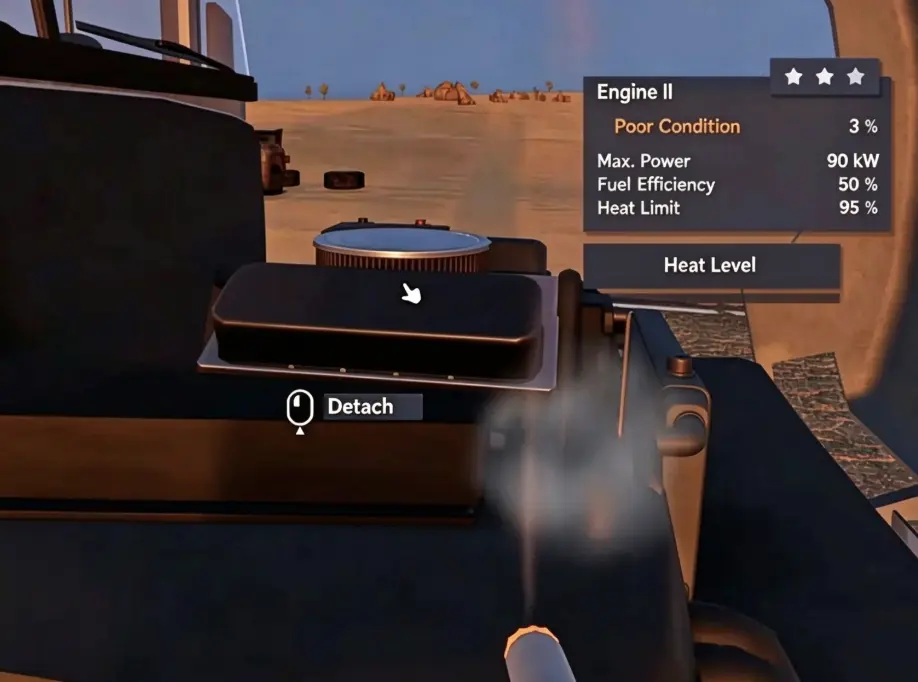
The dashboard warning appeared after the radiator ran out of coolant. By the time the vehicle was inspected, Engine II had fallen to 3% condition.
Refilling the radiator addressed the cooling shortage, but the engine also needed a separate repair before the journey could continue safely.
Refill the Radiator Without Removing It
Bring your vehicle to a stop and inspect the installed radiator.
- Check how much coolant remains in the radiator.
- Find a container holding spare coolant.
- Use the coolant transfer interaction to move liquid into the radiator.
- Confirm that the amount inside the radiator has increased.
- Inspect the engine’s condition before attempting another long drive.
Pay particular attention to the transfer direction.
While refilling one radiator, a player accidentally transferred coolant the wrong way. The bottle became fuller instead of delivering its contents into the cooling system. The mistake was noticed before the vehicle continued.
The radiator and its coolant are separate things. Removing the radiator is unnecessary when the installed part is serviceable and only needs fluid.
After the mistaken transfer was corrected, the radiator displayed approximately 7.16 L of coolant. The players retained several additional liters rather than emptying every bottle into it.
That is a useful approach when traveling between uncertain supply stops. Coolant has to cover more than the next few seconds of driving, and a spare container gives you another opportunity to recover before the engine is damaged again.
How Quickly Does Coolant Run Out?
The amount consumed depends on the vehicle’s current setup and operation.
In the overheating incident, a displayed reading was 0.42 L per minute. The radiator eventually ran dry during the trip.
Treat that number as an example from one operating vehicle, not a universal rate for every engine and radiator combination.
The important decision is whether the remaining coolant is sufficient for the next stretch of travel. A partially filled radiator can keep the vehicle moving, but the warning will return when its usable supply is exhausted.
Whenever you stop at an abandoned vehicle or roadside building, check for extra coolant. Small amounts are worth collecting when you have room to store them, particularly before long drives through areas where the next supplies are uncertain.
How to Repair a Damaged Engine
Refilling coolant will not automatically restore an engine that has already lost condition.
After the overheating incident, the engine was still at 3%. The players used an Engine Repair Kit, bringing its condition to 53%.
That was enough to continue the journey after the cooling issue had been addressed.
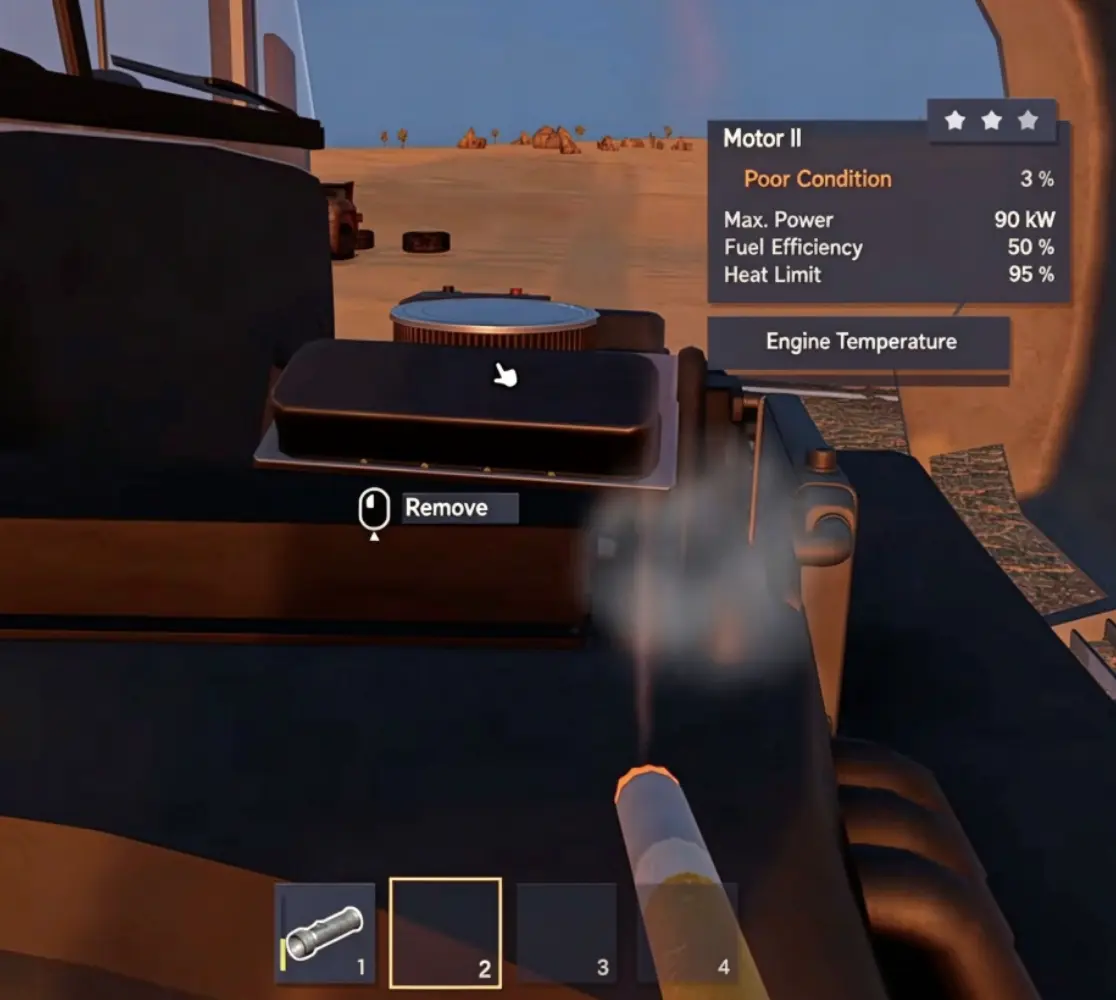
The repair restored 50 percentage points in that particular case. It should not be assumed that every kit always produces the same result under every condition.
For an engine that has just overheated, use this recovery order:
- Correct the coolant shortage.
- Inspect the current engine condition.
- Apply an Engine Repair Kit if its condition is poor.
- Check the engine again before setting off.
- Continue only after the cooling supply and engine condition are both acceptable.
Repairing only the engine while leaving the radiator empty means the original cause of the failure remains.
Should You Repair the Engine or Replace It?
A replacement can be the better choice when you find a compatible engine with higher condition or better specifications.
Engine parts have different tiers and performance readings. One Engine 3 found during exploration displayed 83% condition and 110 kW. The vehicle’s existing engine was rated at 90 kW.
That comparison made the higher-tier engine attractive for more than its condition alone: it offered additional power.
However, an engine found beside an abandoned vehicle is not automatically an upgrade. Inspect the actual numbers before removing the engine you are using. A lower-tier replacement in poor condition may accomplish little beyond occupying storage space.
For a low-condition engine with no worthwhile replacement nearby, a repair kit offers a more immediate solution. Once a better engine is available, compare its performance and condition with the installed one rather than choosing by tier alone.
A spare engine can also be stored for emergencies, although it takes considerably more room than a repair kit.
How Do You Fix a Dead Battery?
A failed battery produces a different roadside problem from overheating.
During another trip, the vehicle’s battery failed completely and showed 0% condition. Rather than trying to repair the failed component immediately, the players used a spare battery already stored inside the vehicle.
The failed battery was a Level 2 part. The available replacement was only Level 1, but it was usable as an emergency substitute.
After the batteries were exchanged, the vehicle’s electrical functions returned and the journey continued.
Replace the Battery When You Have a Working Spare
When the battery has reached 0%, inspect it and check whether another usable battery is available.
Remove the failed battery from its vehicle slot, install the replacement, and check whether the vehicle’s electrical systems respond again.
The replacement does not have to be a higher-tier part to serve as a temporary solution. In the recorded breakdown, a working Level 1 battery was more useful than the failed Level 2 battery it replaced.
Keep the failed battery if you have room to restore it later. Throwing it away immediately can waste a better-tier component that may still be recoverable.
How Do You Charge a Battery?
Look for a Battery Charger Kit while scavenging.
Charging equipment was collected during the road trip, and battery charging was successfully used to restore a battery to full condition.
Use charging equipment on the battery that needs attention, then check its condition or charge reading rather than assuming the interaction has finished the job.
A later stop also included an opportunity to charge a battery while other supplies were being organized. This made charging a maintenance task that could be handled during ordinary roadside exploration rather than waiting for another complete failure.
The practical distinction is straightforward:
- Battery Charger Kit: Used for restoring battery charge.
- Working spare battery: Allows you to replace a failed battery immediately.
- Engine Repair Kit: Repairs the engine, not the battery.
- Tire Repair Kit: Repairs tires, not the battery.
When the vehicle has no usable battery and you have neither charging equipment nor a spare, collecting the correct equipment becomes the immediate priority.
Do not use up unrelated repair supplies hoping that one will restore the battery.
What Should You Check When the RV Will Not Start?
Start with the vehicle’s current condition rather than stripping it apart.
A dead battery is one possible cause, but a newly assembled or recently modified vehicle also needs the appropriate components installed.
If this is your first departure and you are still fitting the original parts, follow the first RV setup and road trip steps before treating every missing component as a mechanical failure.
For a vehicle that was previously driving normally, check the battery and available fuel first. Then inspect the engine and cooling system for damage or missing parts.
An engine that overheated during the previous trip may need more than fuel. Likewise, an engine that appears healthy will not compensate for a failed battery.
How to Repair Worn Tires
Tires have condition values that decline during use. You can repair a worn tire with a Tire Repair Kit or replace it with another compatible tire found during exploration.
One roadside repair began with a tire at approximately 48% condition. After the player applied a Tire Repair Kit, its visible condition improved substantially.
The same journey also included tires at 44%, 42%, and 65%, giving the players several candidates for maintenance.
When kits are limited, those condition readings make the decision easier. A tire in the low-40% range deserves attention before a tire that remains in substantially better condition.
Use the Tire Repair Kit on the Tire That Needs It
Inspect the vehicle’s tires individually.
Find the lowest-condition tire, take a Tire Repair Kit from your supplies, and apply it to that tire. Check the result before using another kit.
Repairing one tire does not mean the others have been restored. Each wheel may have a different condition value, especially after a long journey or a vehicle change.
The players repeatedly compared tire conditions while collecting replacements. This prevented them from choosing tires purely by appearance.
For a vehicle carrying several spare tires, the best replacement is generally the compatible tire that provides a useful condition improvement for the driving ahead.
Highway, Off-Road, and Sand Tires: Which Should You Keep?
Nomad Drive includes different tire types, including Highway Tires, Off-Road Tires, and Sand Tires. Tire condition is only one part of the comparison. The vehicle inspection panel also displays Grip and Load Capacity, allowing you to compare compatible tires before fitting them.
For example, one Tier III Highway Tire showed 1.33 grip and 14.0 kN load capacity, while a Tier III Off-Road Tire showed 1.12 grip and 15.0 kN load capacity. Both had a 0.40 m radius.
These figures reveal a measurable trade-off between the two available tires. The Highway Tire had the higher displayed grip, while the Off-Road Tire supported a greater load. Their remaining conditions also differed, at 56% and 98% respectively, so the healthier tire may be the more practical immediate replacement.
Check the specifications and remaining condition of the actual tires you find rather than assuming that a higher tier or a particular tire type automatically provides the best result in every situation.
Should You Carry Spare Tires?
One spare is useful when you have no repair kit. A full set can become excessive if it crowds out the fuel, coolant, and other supplies needed to keep the vehicle running.
Larger vehicles may provide roof space, external mounting positions, or storage compartments for spare parts.
Use those spaces deliberately. Carrying a replacement wheel is valuable when a current tire is already in poor condition; accumulating several mediocre tires just because they are available adds clutter without necessarily improving your ability to recover.
How to Replace a Radiator Without Wasting Coolant
A radiator that is low on coolant does not necessarily need replacing. Inspect its condition and maximum capacity before removing a working part.
A Radiator I displayed 6 L capacity, compared with 12 L for a Radiator II. Both examples showed 100% cooling efficiency and 0.42 L/min coolant use. The larger unit could therefore hold twice as much coolant in this comparison without showing a lower consumption rate.
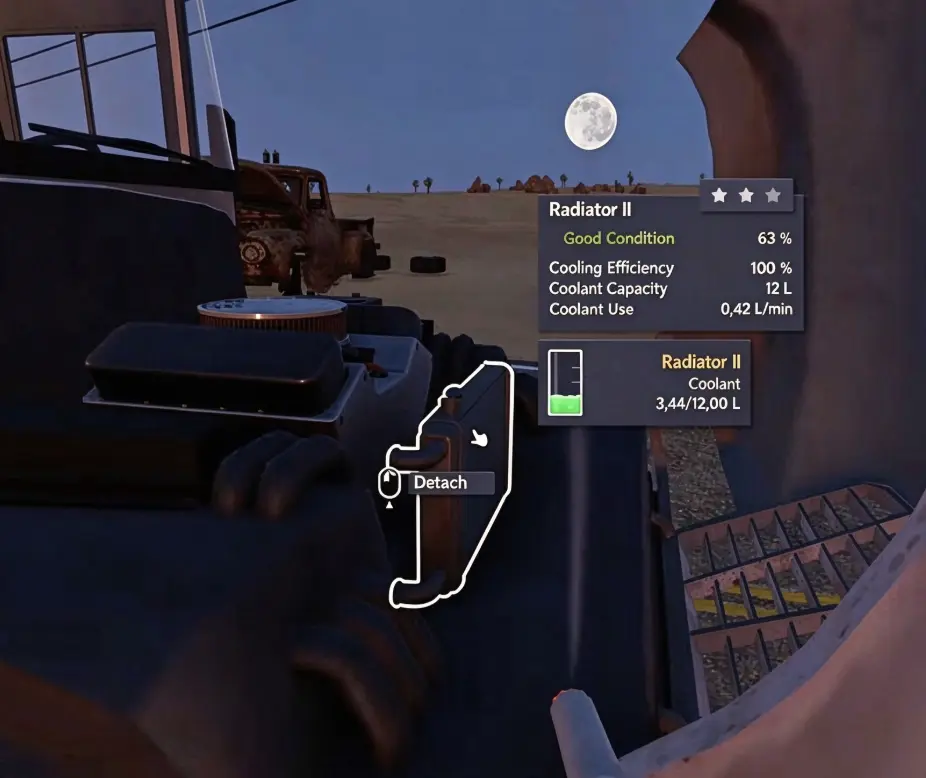
During a later upgrade, a compatible Radiator III offered approximately 6 L more capacity than the installed radiator. That extra reserve was useful for extended driving, provided enough coolant was available to fill it.
Compare the new radiator’s condition and capacity before swapping parts. A larger empty radiator will not solve a coolant shortage.
Move the Coolant Before Discarding the Old Radiator
When changing radiators, account for the coolant already inside the installed unit.
A vehicle upgrade included transferring coolant from one radiator to another rather than leaving the original fluid behind.
Before departing:
- Inspect how much coolant the old radiator holds.
- Fit the compatible replacement.
- Transfer or refill coolant into the new radiator.
- Check the resulting amount in the installed unit.
- Keep additional coolant available for later stops.
The new radiator’s greater capacity does not help when it has been installed without enough fluid.
This is particularly important when upgrading a vehicle that already runs normally. A careless swap can create a cooling problem that did not exist before the upgrade.
What Vehicle Parts Are Worth Keeping as Spares?
Prioritize supplies that let you recover without abandoning your current vehicle. Coolant, repair kits, and a usable spare battery cover several common roadside problems while taking less room than a collection of complete replacement parts.
A spare tire becomes worthwhile when your fitted tires are wearing down, particularly before a long trip without reliable supply stops. A complete replacement engine can also save a stranded vehicle, but it occupies considerably more space and should offer a clear advantage over the engine already installed.
Keep emergency supplies somewhere accessible. A repair kit buried beneath furniture is much less useful when the vehicle has stopped in the middle of the road.
Repair Now or Save the Kit?
Condition and immediate travel needs should determine the timing.
An engine at 3% after overheating requires attention. A battery at 0% needs charging or replacement. A heavily worn tire is worth repairing when the next journey is long and no better replacement is available.
A healthier component can often remain in service until you find better supplies or reach a convenient stop.
That choice matters because the road regularly offers replacement parts of different tiers. Repairing a low-tier component immediately before fitting a healthier, higher-tier replacement can consume a kit without much lasting benefit.
On the other hand, postponing a necessary repair just because a better component might appear later can leave you stranded before reaching it.