Find buried treasure in Nomad Drive using the metal detector, dig up hidden chests with a shovel, and open them with keys without wasting time at roadside stops.
Fix an overheated engine, recharge or replace a dead battery, refill the radiator, repair worn tires, and keep your vehicle running during long road trips.
Get your first vehicle running in Nomad Drive, find missing parts and coolant, survive the opening road trip, and decide when to switch to a larger RV.
Track all 53 Nomad Drive achievements, including three hidden achievements, with a completion checklist and routes for survival, vehicles, treasure, farming, and multiplayer.
Check your Main Objective and follow the road toward the next location or biome. Stop for fuel, drinking water, food, and coolant whenever supplies run low. If the vehicle cannot continue, inspect its condition before spending more resources or searching farther away.
Your first goal in Nomad Drive is to get a vehicle onto the road. After that, the game becomes much less prescriptive. A roadside stop might offer a better engine, a building full of food, a buried chest, or an entire RV that would take time to make roadworthy.
Taking everything is rarely necessary. Driving past every location is not much better, especially when the next stretch of road has no convenient place to refill your fuel or coolant.
The useful rhythm is to follow the current destination, stop for what your vehicle actually needs, and make bigger upgrades when they improve the journey ahead. You can explore, cook, grow plants, and furnish your vehicle along the way without turning each activity into an obstacle to reaching the next area.
Where Should You Go After Starting Your Vehicle?
Look at the Main Objective displayed in the game. It gives you a direction even when there is no named quest character, fixed mission route, or marked dungeon entrance to find.
Early objectives include Discover Your First Location. Later objectives direct you toward new regions, including Reach the Grassland and Reach the Winterland.
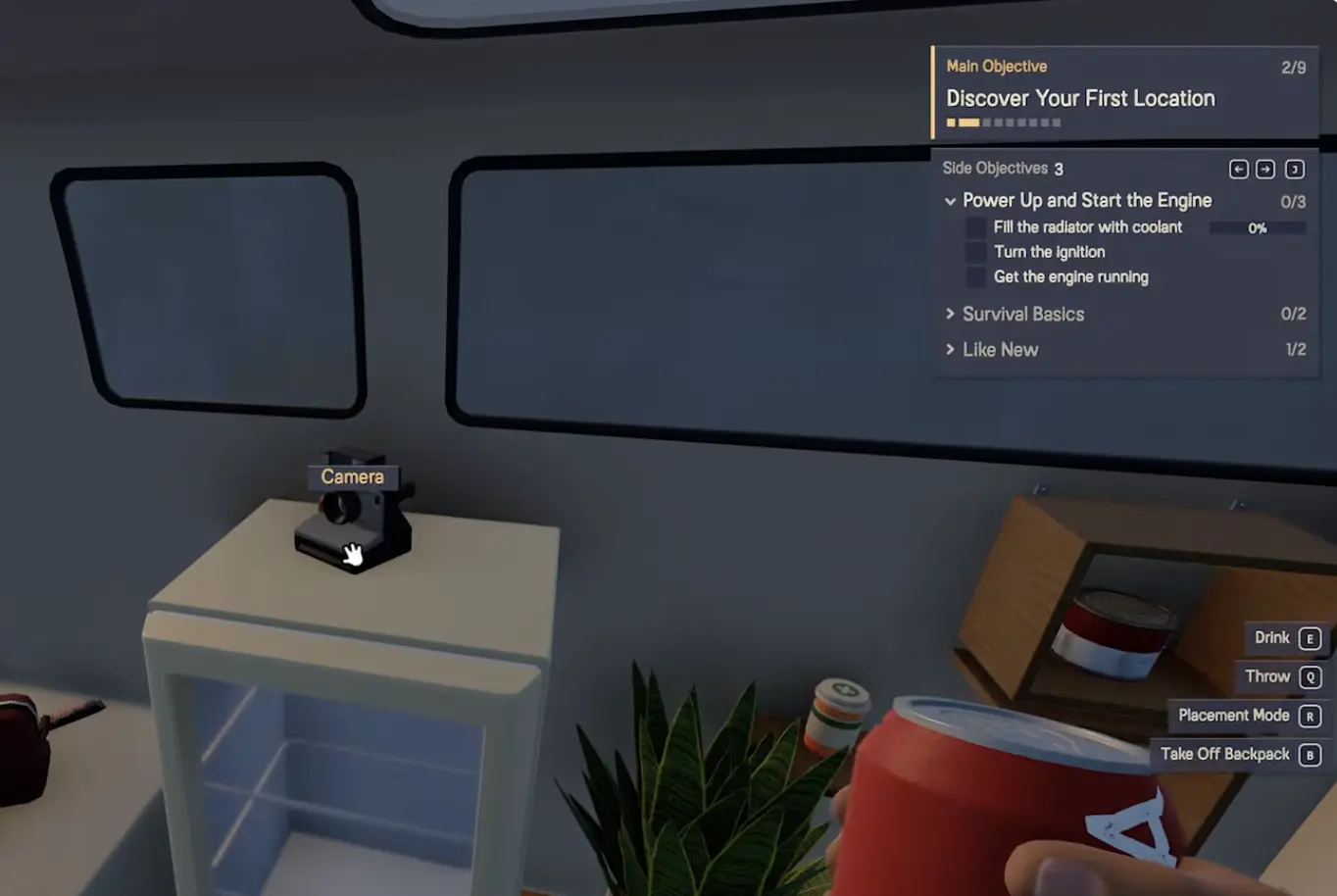
The Main Objective shows your next destination, while the side objectives track vehicle startup and survival tasks.
The objective panel also displays smaller tasks such as Survival Basics and Power Up and Start the Engine. These tell you which immediate actions are still unfinished, but you should not confuse every listed task with a separate destination.
For Discover Your First Location, get the vehicle moving and follow the road toward a roadside stop. Check buildings, abandoned vehicles, and other accessible locations as you travel. The next useful stop is not necessarily the largest structure visible from the starting property.
If you are still at the house with an incomplete vehicle, the beginner guide covers the initial assembly, missing controls, coolant preparation, and first departure.
Does the Game Have a Fixed Walkthrough Route?
Nomad Drive uses a road-trip structure rather than a sequence of conventional story chapters.
The Main Objective advances as you travel, while the surrounding world provides opportunities to find supplies, vehicles, equipment, and upgrades. The exact contents of a roadside location can vary, so a route that depends on finding one particular object at one exact stop is unreliable.
A useful rule is to follow the road until the next objective or new biome is reached, exploring side locations when your supplies and current equipment justify the detour.
Later travel objectives can be straightforward instructions to continue along the road. There is no need to assume that a new objective always introduces a puzzle, boss, or special interaction.
How to Decide Whether a Roadside Stop Is Worth Looting
A nearly empty tank makes a small roadside wreck more valuable than a large furnished building with no fuel. When your vehicle is fully supplied, the same wreck may offer almost nothing worth carrying.
Before you leave the driver’s seat, check three things: your fuel, your coolant, and your available food and drinking water.
Those determine whether you are stopping to keep the trip alive or looking for optional improvements.
Low Fuel: Inspect Vehicles and Fuel Containers First
Gasoline can be collected during roadside exploration, including from usable containers and fuel found around abandoned vehicles.
Carry a jerry can when you have room. It gives you a way to transport additional fuel instead of depending entirely on whatever is already in the vehicle’s tank.
Gas stations are particularly useful stops when you find working fuel equipment. You can fill your vehicle or portable containers there, depending on the available interaction.
One detail is easy to overlook: keep the fuel container within reach of the nozzle. Moving a jerry can too far while handling the pump can interrupt the operation or make the nozzle difficult to use.
When a working pump has more fuel available than you can carry, fill the vehicle first and then use suitable portable containers for the surplus. A trip with almost no fuel in the main tank should not end with all your gasoline stored in loose containers that you have forgotten to transfer.
Do not drive far from the road merely because a distant structure resembles a gas station. Large signs, towers, and roadside silhouettes can be difficult to identify until you approach.
Low Water or Food: Take Supplies You Can Actually Use
Drinking water and food serve your character rather than the vehicle.
Bottles, water jugs, buckets, packaged food, fruit, canned goods, and other consumables appear during exploration. Their immediate usefulness depends on your current hunger and thirst.
Milk can be useful when both needs are low, as it has been used to satisfy hunger and thirst during travel. Check the item you find rather than assuming every drink provides the same effect.
Raw food can be stored for cooking later. However, carrying a large amount of food is less valuable when you have no space to organize it or when some items are already deteriorating.
Food condition is worth checking before eating. Spoiled or poisonous food can cause additional problems, turning what should have been a quick supply stop into a search for medicine.
Keep a small reserve of food and water where you can reach it without unloading furniture. You can accumulate more once the vehicle has suitable storage.
Low Coolant: Do Not Confuse It With Drinking Water
The engine’s cooling system and your character’s thirst are separate concerns.
Coolant is used in the radiator. Drinking water is intended for your character, even though the game also allows you to handle different liquids through container interactions.
The radiator interface displays its capacity and current liquid amount. Check the actual quantity before setting out, not merely the part’s condition or cooling efficiency.
A radiator can be in good condition while holding too little coolant for the journey ahead.
If the engine has already overheated, refilling the radiator may not be the only necessary action. The vehicle repair instructions explain how to diagnose engine damage, failed batteries, and worn tires.
When Should You Stop Collecting Everything?
As the journey continues, your vehicle can become crowded with spare parts, furniture, tools, food, and objects picked up simply because they were available.
That affects how easily you can recover from the next problem.
A replacement battery is valuable when your installed battery is close to failure. Another large cabinet may be far less useful when you already have storage space and need somewhere accessible to keep coolant.
Make the decision around what is currently limiting your journey:
Vehicle running poorly: Collect appropriate repair supplies or a worthwhile replacement component.
Fuel reserve too low: Search for gasoline before taking optional decorations.
Survival supplies running short: Use storage for food, water, and medicine.
The aim is not to leave every stop empty. It is to leave with items that improve your next stretch of travel.
A crowbar is worth keeping accessible because some roadside doors and containers require one. It is also useful to have spare carrying space when you discover an unexpectedly good vehicle component.
If you collect a Metal Detector, shovel, and keys, nearby buried treasure becomes another worthwhile activity. The treasure instructions explain how to follow the detector’s response and recover locked chests without repeatedly digging at random spots.
What Changes When You Reach Grassland and Winterland?
The scenery becomes a practical navigation cue as you travel away from the desert.
In one extended journey, patches of green terrain and growing numbers of trees appeared before the players entered the grass-covered region. Continuing along the road eventually brought them toward snowy terrain.
The objective display remains more dependable than scenery alone. Seeing trees or snow in the distance does not mean the next biome objective has already been completed.
How Do You Reach the Grassland?
When your Main Objective changes to Reach the Grassland, continue driving along the road toward the greener terrain.
You do not need to locate a special entrance or defeat an enemy to begin the journey.
The transition becomes increasingly visible as the dry desert gives way to vegetation. Continue through the region until the game’s objective advances instead of turning around after seeing the first patch of grass.
Roadside stops along the way are useful for replenishing fuel and finding better vehicle components. You can continue following the destination while making short detours for supplies.
What If Reach the Winterland Does Not Complete Immediately?
Keep following the road into the snowy region and watch the objective display.
During one arrival, the vehicle had already reached visibly snowy terrain while Reach the Winterland was still displayed. Continuing into the region was followed by the objective updating.
That makes returning to the previous biome an unnecessary first response. Give the transition a little more distance and check whether the objective changes.
There is no need to look for a cave, checkpoint gate, or special activation object simply because snow has appeared.
Why Does Driving Become Difficult in Winterland?
Snowy terrain can coincide with noticeably slower driving and more awkward handling.
One vehicle slowed to below 20 km/h during a snowy approach. In another journey, the driver struggled to maintain control through a bend and reduced speed while continuing.
That slowdown does not by itself establish that you must equip a particular winter tire or snow chain. The vehicle’s setup, slope, speed, and road conditions all need consideration.
On a difficult snowy stretch, slow down before corners and avoid forcing the vehicle up an incline at full throttle without first checking its response.
A vehicle that accelerates poorly in one region may also have worn components or be carrying a substantial amount of equipment. Inspect its actual state before assuming the terrain is the only cause.
Is a Bigger RV Always Better?
A larger RV becomes worth considering when spare parts, food, and furniture are taking over your van’s living space. External compartments are particularly useful because they let you store tools and replacement components without blocking access to the interior.
Before moving anything, check whether the replacement has a usable engine, battery, radiator, and fuel supply. Extra space offers little benefit if the new vehicle cannot leave its parking spot. For your first vehicle change, follow the starter van replacement steps before abandoning the vehicle that brought you there.
Major decorating can wait until you have found a vehicle you want to keep. Moving a few essential supplies is considerably easier than transferring an entire furnished interior.
When Should You Add Cooking and Gardening to Your RV?
Roadside food can cover your early meals, so a complete kitchen is not required before leaving the starting area. Cooking becomes more useful once you have a stove, cookware, raw ingredients, and somewhere to store the finished food. A refrigerator also becomes more practical when you are regularly collecting ingredients instead of eating supplies as soon as you find them.
Gardening begins with seeds and a plant pot, but growing food takes time and space. Start with a small setup when you have water available and room to keep the plants accessible. Filling an already crowded van with planters is less useful when fuel, medical supplies, and spare parts still have no organized storage.
Both activities are worth developing during a longer stay in the same world. If you are working toward completion, the achievement checklist identifies the separate cooking, planting, and crop-growth requirements.
What Should You Do in Multiplayer?
Co-op travel lets one player drive while another collects supplies, prepares food, or organizes the RV. It can make roadside stops more efficient, but sharing a vehicle also means agreeing on where important items belong.
Keep fuel containers, medical supplies, repair equipment, and keys in locations both players can reach. When something goes wrong, searching several cabinets for a battery or a bottle of coolant wastes time that could be spent getting the vehicle moving again.
For a longer multiplayer run, agree on who is driving and who is managing supplies before departing. Hosting, joining, and reviving teammates also have separate completion conditions in the achievement checklist.
When Does a Road Trip Become Long-Term Survival?
Once your vehicle is dependable, there is no reason to treat every roadside stop as urgent.
You can continue exploring different biomes, accumulate better equipment, cook, grow food, take photographs, collect soundtrack cassettes, and gradually turn the RV into a more useful home.
That changes the value of the items you find.
A spare engine or full fuel container remains important for recovery. A refrigerator becomes more appealing when you cook regularly. Plant pots become worthwhile when you want to grow more of your own food. Roof space and external compartments help when the interior is already carrying a kitchen and supplies.
You can also continue in the same world rather than repeatedly starting over. That is particularly helpful when working toward survival milestones and collecting equipment across many locations.
The longer-term approach is to keep your vehicle reliable enough that exploration becomes a choice rather than a struggle to reach the next supply stop.
Before heading toward the next biome, check the Main Objective, make sure you have enough fuel and coolant for continued travel, and leave room for something genuinely useful at the next roadside location. The road itself provides the direction; your supplies determine how comfortably you can follow it.