How to Enter and Survive the Toxic Zone in DayZ Badlands
Enter Nasdara's contaminated tunnel with NBC equipment, manage gas mask filters, search the underground passages, and escape with your loot.
Updated:
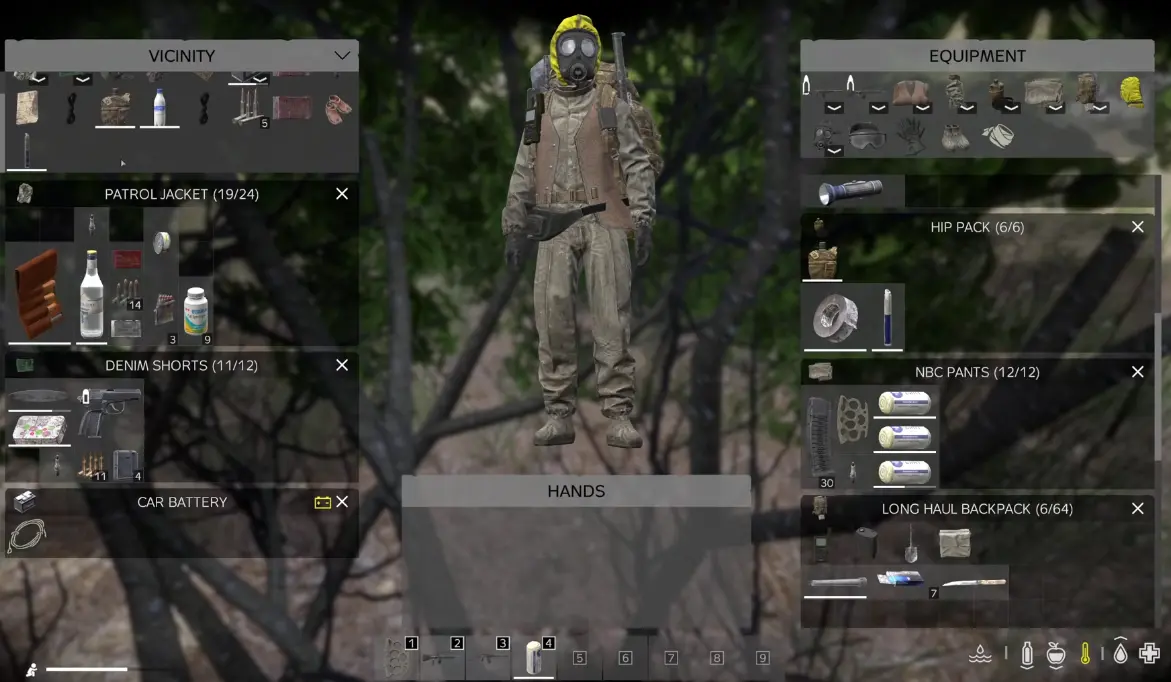
Quick Answer
To enter the Toxic Zone in DayZ Badlands, equip a complete NBC outfit, a gas mask with a working filter, and carry several replacement filters plus a light.
Approach Nasdara’s contaminated tunnel, check for an accessible way back outside, and enter with your protection already equipped. Follow recognizable junctions and begin your return while you still have enough filter capacity to escape.
A SCAR-pattern rifle on the ground is tempting when you have spent hours collecting the equipment needed to enter Nasdara’s contaminated tunnel. During one expedition, however, the survivor already had a loaded FAMAS and no suitable magazine or ammunition for the SCAR. Taking the rarer-looking weapon would have meant giving up a firearm that was immediately usable.
The decision also had to be made while the gas mask filter was draining.
That is what makes the Toxic Zone dangerous even when your NBC equipment is complete. The underground complex contains branching corridors, blocked passages, stairways, and valuable military loot, but every minute spent searching uses up protection needed for the return journey.
The expedition eventually recovered weapons, magazines, and other equipment before escaping with filters remaining. Several detours were abandoned along the way, and the survivor had to retrace familiar junctions after losing track of the route.
Where Is the Toxic Zone in Nasdara?
Nasdara’s Toxic Zone contains a contaminated underground tunnel complex with collapsed road sections, side openings, and interconnected passages.
The area extends beyond a single storage room. Inside are corridors that branch in different directions, stairways between sections, underground vehicle areas, and places where military equipment can be found.
One survivor approached the area by motorcycle, left the vehicle outside, and continued toward the tunnel on foot. Before entering the gas, the player stopped to reorganize inventory and change into protective clothing.
Arriving with a vehicle is useful when you have several pieces of NBC equipment to transport or want to carry weapons back afterward. It is not a requirement for entering the tunnel, but travelling on foot across Nasdara may leave you with less room for supplies and recovered equipment.
The entrance area is also a potential ambush point. Other survivors have a reason to watch it because anyone approaching is likely to be carrying valuable protective gear.
Finish organizing your inventory before moving into the contaminated passages, and avoid remaining exposed near the entrance longer than necessary.
What NBC Equipment Do You Need?
A gas mask is only one part of the equipment needed to enter safely.
Prepare a complete protective outfit:
- NBC Hood
- NBC Jacket
- NBC Pants
- NBC Gloves
- NBC Boots
- Gas Mask or compatible respirator
- Working gas mask filter
Every part of the outfit matters. Missing protective clothing leaves part of your character exposed, while an exhausted filter prevents the respirator from providing reliable protection.
The successful expedition began with a substantial inventory adjustment. The survivor had collected protective equipment and several filters, but still needed to decide which ordinary belongings could be left behind to make room for supplies and potential rewards.
The final equipment selection included a flashlight, replacement filters, bandages, repair materials, and a weapon. An NBC Pack was also available for additional storage, although carrying the pack did not replace wearing the required protective clothing.
How Many Filters Should You Bring?
Bring several usable replacement filters. The one already attached to your mask may not provide enough capacity for a lengthy search through the tunnel.
There is no reliable fixed number that guarantees you can explore every passage. Consumption depends on how long you remain inside and how much usable capacity your filters have when you begin.
The condition of your supplies matters as much as the number of filters in your backpack. A nearly exhausted filter provides much less protection than one with substantial capacity remaining.
During the successful run, the survivor took multiple replacements but still began worrying about whether there would be enough protection to reach the opposite side of the complex.
For a first visit, prepare for a shorter expedition with a safe return rather than assuming every corridor can be cleared in one trip.
What Else Should You Carry?
A light is particularly important because some underground passages are difficult to distinguish without additional illumination. The survivor kept a flashlight while removing less essential equipment from the inventory.
Bandages and a usable firearm are sensible precautions against injuries, infected, or other players encountered along the route. Duct Tape may also be useful for repairing compatible damaged gear.
Epoxy Putty was brought in case repairable equipment such as a plate carrier was found, but it was not necessary for entering the contaminated area.
Free inventory space is another practical consideration. Valuable equipment can be found inside, and sorting a completely full backpack while your filter drains is a poor use of your remaining protection.
Leave enough room to collect useful items without having to reorganize your entire loadout at every stop.
Eat and Drink Before Entering
You cannot conveniently eat or drink while wearing a protective gas mask.
The survivor accounted for that restriction during preparation, carrying a canteen but planning not to remove the mask inside the gas.
Eat and drink before entering so that ordinary survival needs do not force you to interrupt the expedition. If you need to collect safe drinking water first, use the Nasdara water survival instructions.
Removing your respirator inside the contaminated area is not a safe solution to thirst.
Check the Entrance and Find a Way Back Outside
Near the collapsed roadway, look for side openings that may lead into or out of the tunnel structure.
During the expedition, the survivor checked an opening before committing to deeper exploration. After testing it, the player confirmed that it was possible to get outside through that route.
Knowing a usable exit existed was valuable because the tunnel was unfamiliar and the available filters were limited.
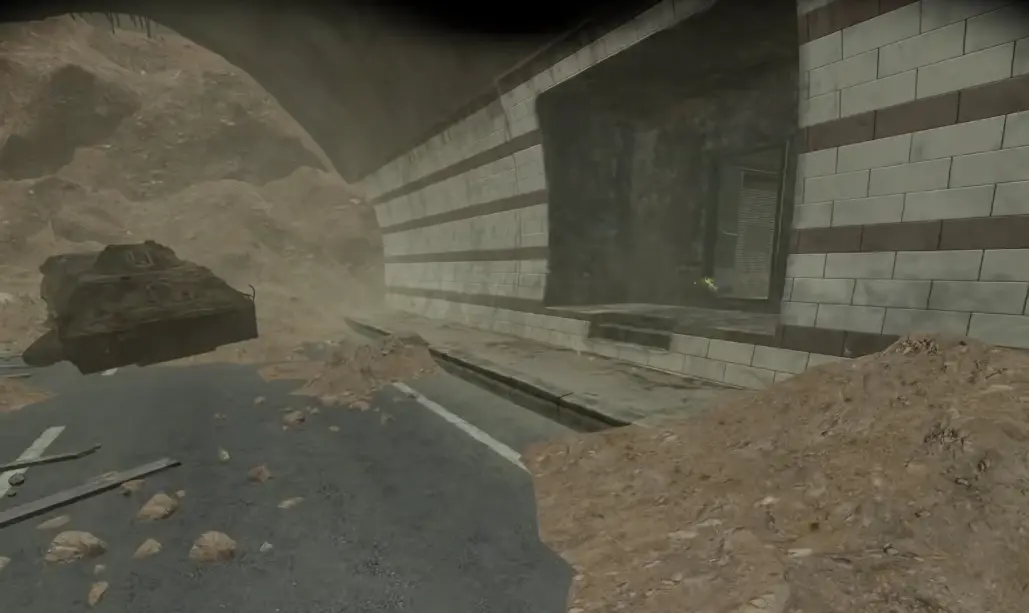
The image shows a recognizable opening near the collapsed road, but you should check the passage yourself before relying on it as an escape route.
An opening that looks promising from outside may lead to a blocked section or another underground corridor. The complex includes inaccessible passages as well as routes that can be traversed.
Before moving farther in, establish which direction returns to a usable exit.
Should You Leave Equipment Outside?
During the successful attempt, the player left unnecessary belongings near the motorcycle to make room for loot, then returned to collect the remaining equipment afterward.
This worked for that expedition, but leaving items on the ground carries a risk. Other players may take them, and dropped equipment should not be treated as permanent storage.
Vehicle storage or another secure container is preferable when available.
Keep the protective outfit, working mask, replacement filters, and essential survival supplies on your character. Items that will be needed before reaching clean air should not be left outside.
The survivor also used an item near an early passage as a recognizable landmark. That can help temporarily, but a route remembered through physical features is more dependable than assuming a dropped item will remain in place.
How to Navigate the Underground Tunnel
Inside the Toxic Zone, the passages become more complicated than they first appear.
The expedition began by descending into the underground network and following the available corridors. Some branches ended at blocked doors or dead ends, while others continued through connecting walkways and staircases.
At one point, the survivor found an opening low enough to crawl through. That allowed exploration to continue beyond an area that initially appeared inaccessible.
Elsewhere, a staircase reached a section on the opposite side of the complex. Several corridors looked similar, and the survivor eventually became uncertain about which routes had already been visited.
The useful approach is to explore one branch at a time while keeping track of the last identifiable junction.
Use the Blue Directional Marker
One of the recognizable landmarks inside the tunnel was a blue directional marker near a junction.
After exploring an unproductive section, the survivor returned toward the sign before choosing another corridor.
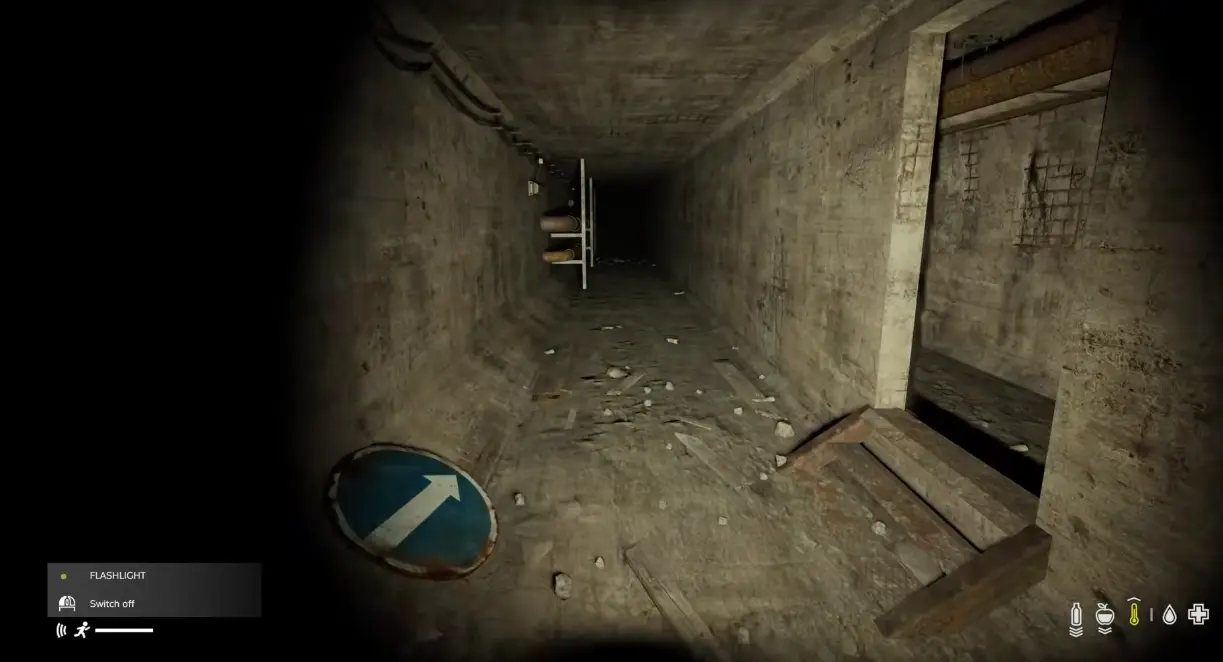
This marker is useful for recognizing a location you have already passed. It does not mean every nearby corridor leads toward the exit.
When you encounter a junction, identify the passage you arrived through before entering another one. If the new branch ends without useful equipment or another accessible route, return to the recognizable intersection.
During the expedition, the survivor spent additional time checking passages that resembled earlier areas. Some led back toward familiar sections, while others were dead ends.
Repeating those searches consumed filter capacity without producing much progress.
Do You Need a Key for the Locked Doors?
Not every locked-looking section has to be opened to recover valuable equipment.
The player encountered an inaccessible door and continued through other available passages. Military equipment was found later without opening that particular section.
If a door does not respond and you have no clear way to operate it, search the accessible route instead of waiting for an interaction that may not be available.
The nighttime radio-controlled shelters elsewhere on Nasdara use a separate entrance system. Their access requirements involve radio messages and keypad codes, explained in the Radio Bunkers walkthrough.
How Quickly Do Gas Mask Filters Run Out?
Filter capacity can disappear surprisingly quickly while exploring the underground network.
In one sequence, the survivor replaced a nearly depleted filter with another showing 67% usable capacity. After continuing through the corridors and searching nearby sections, its displayed capacity had fallen to 44%.
Further exploration reduced the remaining capacity until another replacement became necessary.
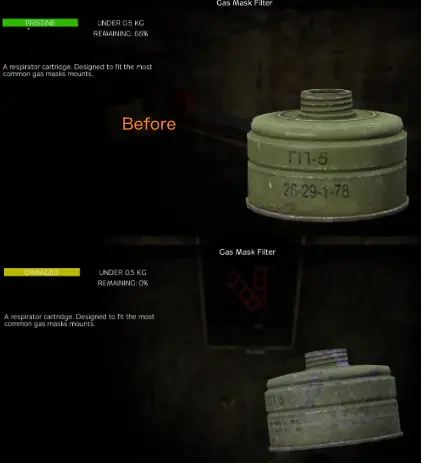
The screenshot compares filters with different remaining capacities; it does not show the complete 67% to 44% sequence.
That observed change illustrates the risk of spending too long navigating unfamiliar passages. It should not be treated as a universal drain rate or a guarantee that every filter will last the same amount of time.
Keep an eye on the active filter when you reach major junctions, finish searching a room, or decide whether to continue into another branch.
When Should You Replace a Filter?
Replace a nearly exhausted filter before it reaches 0%, while you still have enough protection to perform the change safely.
During the expedition, the survivor watched the remaining percentage closely and changed filters when capacity fell to the final few percent.
Keeping replacements easy to access made those changes less disruptive.
A filter with no remaining capacity is not useful as reserve protection. If it is exhausted, discarding it can also recover inventory space for equipment found underground.
The more serious mistake is failing to notice a depleted filter while continuing farther away from the exit.
How Do You Know When to Turn Back?
The return decision depends on the distance to safety as well as the capacity remaining in your inventory.
At one point, the survivor considered exploring the opposite side of the tunnel while several filters were still available. The idea became less attractive after additional branches, dead ends, and confusing intersections made the route harder to remember.
Later, with only a small reserve remaining, the player decided to leave rather than continue searching.
That decision protected the equipment already collected.
Before taking another unfamiliar passage, compare the likely benefit with the remaining risk. A nearby unchecked room is a different commitment from a staircase leading into another extensive section.
If you cannot identify how to return to the last familiar junction, use that uncertainty as a reason to retrace your route rather than continue deeper.
What Loot Can You Find in the Toxic Zone?
The underground area contains high-value military firearms, magazines, ammunition, and other equipment.
During the expedition, the survivor encountered abandoned weapons alongside several empty filters. The equipment included a SCAR-pattern rifle, a DMR, and an M79 launcher.
The presence of empty filters near the abandoned equipment was a reminder of how dangerous the environment could be, although it did not establish exactly what had happened to the previous survivor.
Other sections contained additional ammunition, magazines, and weapons near underground vehicles and storage areas.
Some of the items were immediately useful. Others would have required different ammunition or compatible magazines before they could replace the equipment already being carried.
Which Weapons Are Worth Carrying Out?
The SCAR-pattern rifle created an immediate inventory decision.
The survivor initially considered replacing a FAMAS but had no compatible magazine or ammunition for the SCAR. The FAMAS, by contrast, already had a loaded magazine.
The usable firearm was kept.
Later, during the return journey, the player compared damaged military rifles and decided to keep a DMR rather than carry every weapon encountered.
Those choices helped reduce unnecessary inventory management while still inside the gas.
The tunnel can provide valuable weapons, but the equipment you recover still has to be usable after you leave. A firearm without its required ammunition may not justify giving up one that is already loaded.
For specific firearm spawn areas, ammunition types, and magazine compatibility, see the Nasdara weapons and loot locations.
Is the SCR-17 Guaranteed to Spawn?
No. The contaminated tunnel is one of the relevant locations for SCR-17 loot, but that does not guarantee a rifle will be waiting in a particular room.
Other survivors may have already collected the available equipment.
The successful expedition found several valuable weapons, but some were discovered among belongings left by another player. That is different from finding every weapon at a fixed loot position.
Search the accessible military areas, but do not continue deeper solely because you expect one particular rifle to appear.
How to Escape the Toxic Zone
The return journey became difficult after the survivor lost track of the route through the underground branches.
Several familiar-looking passages turned out to lead toward dead ends or areas that had already been searched. The player had to retrace earlier intersections and use recognizable objects to identify the correct direction.
The blue directional marker and previously visited sections helped narrow the possibilities. Eventually, the survivor recognized the route back toward the entrance and reached the outside.
The expedition ended successfully, with valuable equipment recovered and replacement filters still remaining.
If you become disoriented while returning, follow a controlled sequence:
- Stop searching for additional loot. Continuing into unexplored corridors makes the return harder.
- Check your active filter. Replace it before its capacity is exhausted.
- Return to the last familiar junction. Use a staircase, directional sign, or distinctive passage you remember.
- Avoid previously checked dead ends. Do not repeat searches that have already failed.
- Continue toward the confirmed exit. Wait until you are outside the contaminated area before removing protective equipment.
During the successful trip, the survivor recovered the belongings left near the entrance after reaching safety.
That result is important because the expedition did not require every branch to be explored. The player left with useful equipment without completely exhausting the available filters.
What If Your Filter Runs Out Before You Escape?
An exhausted filter leaves you without reliable respiratory protection while you remain in the contaminated area.
At that point, stop collecting items and head directly toward the closest exit you know is accessible. Additional loot has little value if reaching it prevents you from getting outside.
If another usable filter remains, replace the depleted one immediately.
Trying to explore another branch while your protection is exhausted only increases your exposure and reduces the chance of leaving safely.
Keep the mask equipped until you have reached clean air. Removing it to eat or drink inside the contaminated tunnel compromises the protection you need to escape.
Is It Worth Exploring the Entire Toxic Tunnel?
A complete exploration can produce valuable military equipment, but the underground layout and ongoing filter consumption make every additional branch a commitment.
The successful expedition recovered firearms, magazines, and other supplies, yet several weapons were left behind because they were damaged, lacked compatible ammunition, or would have consumed too much inventory space.
The survivor also abandoned further exploration once the remaining filter reserve became less comfortable.
For a first trip, a shorter search of the accessible areas can still be worthwhile. If you have already collected usable equipment and can identify the way outside, returning with that loot is a successful outcome.
You can come back with more supplies rather than risk everything on the final unexplored corridor.