How I Unlock and Build the Hippodrome
I unlock Hippodrome Plans, find a workable 60x28 site in Latium, prepare Albion shipments, and keep all five construction phases supplied.
Updated:
Quick Answer
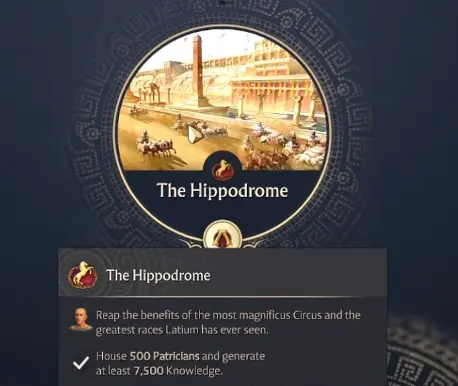
To unlock the Hippodrome, I reach 500 Patricians, hold at least 7,500 Knowledge, and research Hippodrome Plans.
On an older save, I first make sure the DLC is enabled under Save Settings.
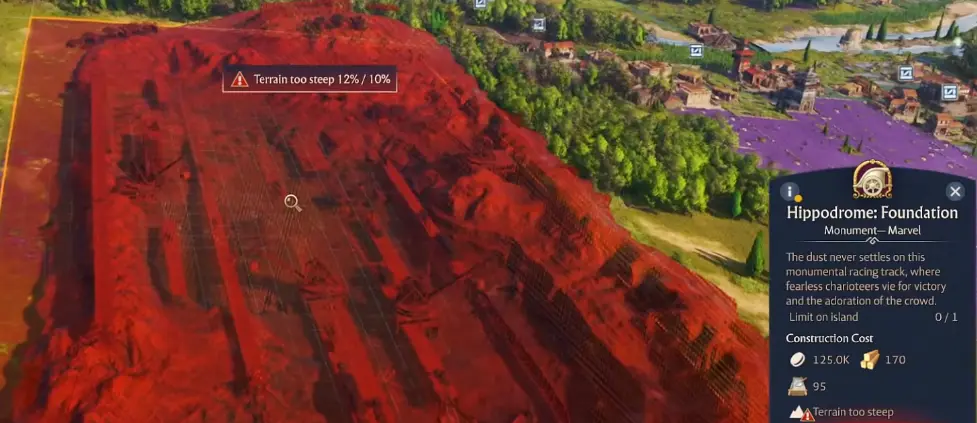
For the build itself, I reserve a 60×28-tile site in Latium before moving an established district. I preview the entire foundation first because enough empty land is not enough if the terrain is too steep.
I also prepare the cross-region supply route early. In my build, Granite and later Bronze came from Albion, so I treat Albion as part of the construction chain even though the monument project is in Latium.
The Hippodrome has five construction phases. The displayed timer is rarely my real bottleneck; stalled carts, missing workforce and one late material can add far more time than the timer suggests.
Enable the Hippodrome on an Existing Save First
I do not restart a developed city just because the Hippodrome does not appear immediately.
If I am returning to an older save, I go back to the save-selection screen, open Save Settings, enable the new Hippodrome content for that save, confirm the change and then load the city again.
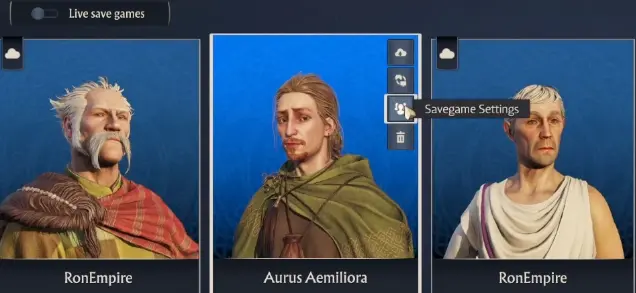
I do this before touching the city itself.
If the content is disabled, changing population, demolishing buildings or rearranging research will not solve the actual problem.
Unlock Hippodrome Plans With 500 Patricians and 7,500 Knowledge
Hippodrome Plans appears at the Patrician population tier.
I need:
- 500 Patricians
- 7,500 Knowledge
Once both requirements are satisfied, I can research the Plans and move toward construction.
On an established save, I check both numbers instead of assuming a late-game city automatically qualifies. Moving workforce between islands can leave me with fewer Patricians than I expected.
I also keep my existing research queue.
If Hippodrome Plans enters behind a long list of queued research, I drag it forward rather than deleting work I already paid for.
Once the Plans are finished, I stop buying Hippodrome research at random. The later tree affects Trials and charioteer development, so I handle those choices separately in my Hippodrome research order.
I Build in Latium but Prepare Albion as Part of the Supply Chain
The physical Hippodrome project in my run is in Latium, but that does not make it a Latium-only logistics problem.
Albion becomes important during construction because some of the late materials have to cross regions.
The first major example is Granite.
By Phase III, I am already loading Granite in Albion and shipping it back to my Latium construction island.
Later I do the same kind of planning for Bronze.
That means I prepare the route before the monument is sitting at zero waiting for a ship.
My sequence is:
confirm Albion stock
→ assign a ship
→ set the Latium destination
→ watch the first shipment unload
→ then rely on the route for construction
If Granite is still sitting in Albion while Phase III is already stopped, I have started the logistics too late.
Find the Full 60×28 Site Before Moving the City
The Hippodrome occupies:
60 × 28 tiles
That is large enough that an apparently empty patch can still fail once I preview the real foundation.
I learned not to begin by demolishing a residential or production district.
I first find open land, rotate the complete footprint and see whether the game accepts the terrain.
In one placement attempt, 12% was already shown as too steep. I therefore use roughly 10% or flatter as a practical target rather than spending time trying to force a marginal slope.
That is a working rule from placement, not a reason to rebuild around an exact threshold.
If the foundation remains invalid, I move to a flatter area.
The Hippodrome’s effects work across the island, so I do not need the monument sitting in the middle of my densest residential block just to receive the benefits.
A flatter edge of the developed city is usually a much cheaper compromise than dismantling a layout that already works.
I Put Several Warehouses Nearby, but I Do Not Spam Them Forever
Once I know where the foundation will sit, I prepare local storage.
One distant warehouse is not enough for a project moving this many materials.
I have had the construction carts split toward several warehouses at the same time, so I normally start with around four to five nearby warehouses around a large established build.
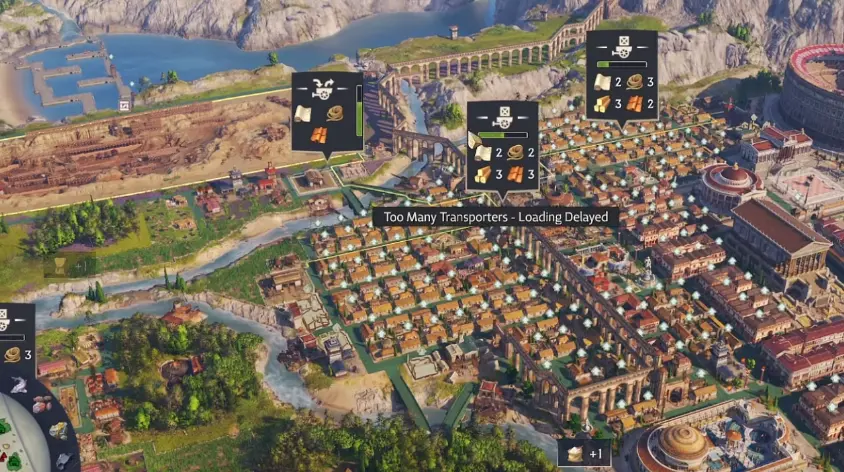
I do not treat five as a magic requirement.
What matters is whether the material is actually reaching the construction site.
The same screen can show Too Many Transporters - Loading Delayed, which is a useful warning against solving every delay by adding another warehouse or more cart traffic.
If material is sitting in storage but construction is still slow, I check whether the loading points themselves are congested before expanding again.
My order is:
check local stock
→ check warehouse distance
→ check loading congestion
→ check incoming route
Only after that do I consider building more production.
This is why the displayed build time can be misleading. A phase can show 30 or 50 minutes and still run much longer when deliveries stop repeatedly.
Hippodrome Construction Phases and Resources
I keep the quantities in one place so I can stage the next phase while the current one is still building.
| Phase | Main requirements | Workforce | Displayed time | | | | | | | I | Place the foundation | — | — | | II | 180 Timber, 150 Rope, 150 Tiles, 120 Cloth | 600 Tier 1 | 30 min | | III | 160 Timber, 160 Tiles, 200 Concrete, 120 Iron, 160 Granite | 600 Tier 1 | 40 min | | IV | 300 Tiles, 250 Concrete, 200 Iron, 200 Granite, 300 Marble, 300 Mosaics | 500 Tier 3 | 50 min | | V | 180 Concrete, 240 Marble, 120 Mosaics, Bronze, 300 Cushions, 300 Ornate Wood | 300 Patricians | 50 min |
The final Bronze requirement is the one quantity I do not assume will look identical in every save or build state.
I saw 240 Bronze on one final-phase screen and 250 Bronze on another.
Instead of gambling on the lower number, I stage at least 250 Bronze.
The table is where I keep the quantities. During the build, I focus on the bottleneck that can actually stop each phase.
Phase II Tells Me Whether the Local Logistics Work
Phase II uses relatively ordinary goods:
Timber, Rope, Tiles and Cloth.
On a mature island, producing those materials is usually easier than delivering them efficiently to a monument this large.
The displayed construction time is 30 minutes, but one of my Phase II builds was closer to an hour once delivery delays were included.
That is why a slow Phase II is a warning.
If I already have plenty of Timber and Rope somewhere in the empire, I do not immediately add more Timber and Rope production.
I first check whether the material is in the correct local warehouse and whether the carts are actually moving.
If an easy-material phase is already stalling, the later Granite, Marble and Mosaics stages will expose the problem much more severely.
Phase III Is Where Albion Logistics Need to Be Working
Phase III adds:
- 200 Concrete
- 120 Iron
- 160 Granite
on top of Timber and Tiles.
Granite is the important change because I bring it from Albion.
I do not wait until the Phase III counter reads zero.
While Phase II is running, I want Granite already traveling toward Latium.
Once the ship arrives, I confirm that the destination warehouse stock actually rises. A trade route that exists on paper but is unloading in the wrong place is not useful to the monument.
Phase III also needs 600 Tier 1 workforce.
So if all the resources are visible but construction still refuses to move normally, workforce is one of the first things I check.
Phase IV Is the First Material Wall I Prepare for Deliberately
Phase IV is where I stop relying on whatever happens to be in storage.
It requires:
- 300 Tiles
- 250 Concrete
- 200 Iron
- 200 Granite
- 300 Marble
- 300 Mosaics
- 500 Tier 3 workforce
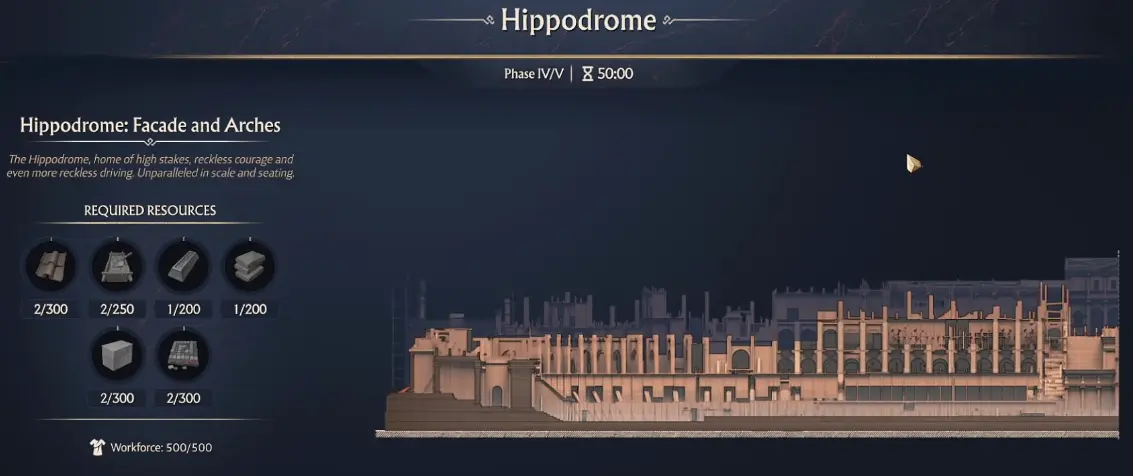
The screen shows 50 minutes, but my real build could run closer to an hour and a half once all of those materials had to reach the project.
This is also where NPC traders become useful.
I found traders offering one-off blocks such as 150 Marble and 150 Mosaics, while another had 100 Marble alongside easier materials.
For a monument spike, I will buy those shipments if they remove the only missing resource.
I do not interpret that as a reason to buy everything.
The decision is:
one-time construction shortage + trader has enough stock = buy
but:
the same shortage keeps returning = fix the production or trade route
If I already make plenty of Marble and the problem is transport, buying Marble only hides the real bottleneck.
I Prepare Phase V Before Phase IV Ends
The last phase is where several awkward late goods arrive together.
I need:
- 180 Concrete
- 240 Marble
- 120 Mosaics
- at least 250 Bronze in my stock plan
- 300 Cushions
- 300 Ornate Wood
- 300 Patrician workforce
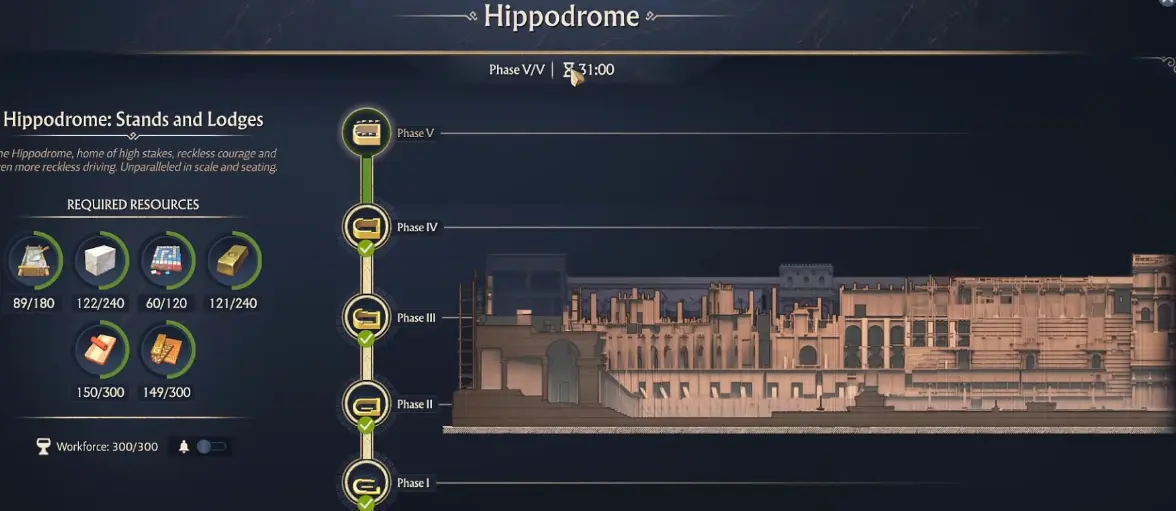
This is where I stop looking only at the final good shown in the menu.
In one city, Ornate Wood was the visible shortage, but the actual problem was further upstream: I did not have enough Gold feeding the chain.
Building more of the final producer would not have fixed that.
I trace the shortage backward until I find the first missing input.
I also get the Bronze shipment moving early and protect the 300 Patrician workforce.
It is completely possible to have every physical resource ready and still stop the monument because another part of the city has consumed the workforce.
The final phase again shows 50 minutes, but I have seen the real completion time reach roughly an hour and a half when delivery and production were not perfectly staged.
If Construction Stops, I Check Four Things
When the project says construction has stopped, I do not rebuild the entire island.
For me, the cause normally falls into one of four categories:
- The required material is actually at zero.
- The material exists, but not in a useful nearby warehouse.
- The final good is blocked by an upstream input.
- The required workforce has fallen below the phase requirement.
I check them in that order.
Concrete is a good example of why this matters.
I can have a functioning Concrete economy and still starve the Hippodrome because another large project is drawing from the same stock.
That does not automatically mean I need twice as many Concrete buildings.
If the Hippodrome is the priority, I may simply pause the competing project or redirect the shipment until this phase finishes.
The same logic applies to Marble, Mosaics and late imported goods.
I prefer a temporary routing decision over permanently overbuilding an economy for a construction spike that will disappear once the monument is finished.
I Keep a Workforce Margin Before Starting the Late Phases
The resource list gets most of the attention, but workforce can stop the build just as effectively.
I do not start Phase IV or V while sitting exactly on the required population number.
A residence can lose a need, another production building can start, or workforce can shift elsewhere and suddenly pull the project below its requirement.
So if I need 500 Tier 3 workers or 300 Patricians, I want some margin above that before I commit.
I use the same rule for goods.
I do not empty every warehouse into the Hippodrome if those materials are still needed to keep the population functioning.
The monument is supposed to become an island-wide asset.
I do not want the construction process to break the island that will benefit from it.
Once Phase V Finishes, I Stop Solving Construction Problems
When the last phase completes, Marble, Bronze and warehouse traffic stop being the important questions.
The next question is:
Which Specialist do I test before I start paying for proper races?
I use the available Trial before moving into the main-event loop, then progress from Amateur races toward harder events in my Hippodrome chariot racing guide.
The construction itself is much easier once I separate it into four jobs:
unlock the Plans
→ confirm a valid 60×28 Latium site
→ prepare Albion and local logistics
→ stage the next phase before the current one finishes
The Hippodrome is huge, but most of the delays I ran into came from one missing link in that chain rather than from the monument’s size itself.