The Hippodrome Research Order I Use
I prioritize Tireless Training and Mass Trials early, reveal useful racer potential next, then move into Daring Research and Mentorship only when my racer is ready.
Updated:
Quick Answer
After my first Hippodrome main event opens more of the research tree, I focus on training efficiency first and late-game gates second.
My usual early route is:
reveal maximum Sprint potential
→ Tireless Training
→ Mass Trials
→ reveal the remaining maximum racer stats
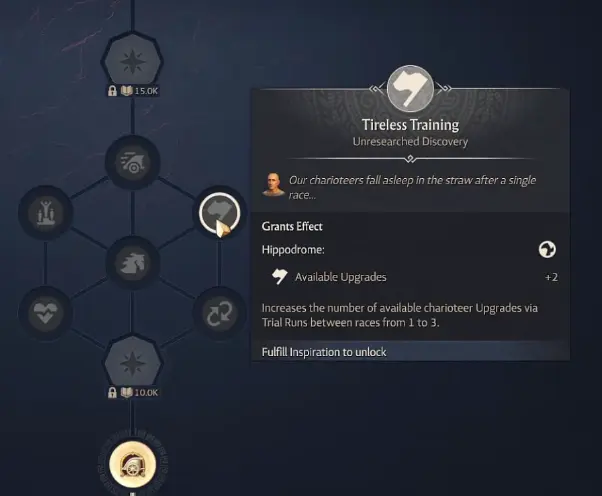
Tireless Training is the upgrade I feel most immediately. It adds 2 available charioteer upgrades, increasing the useful Trial upgrades between races from 1 to 3.
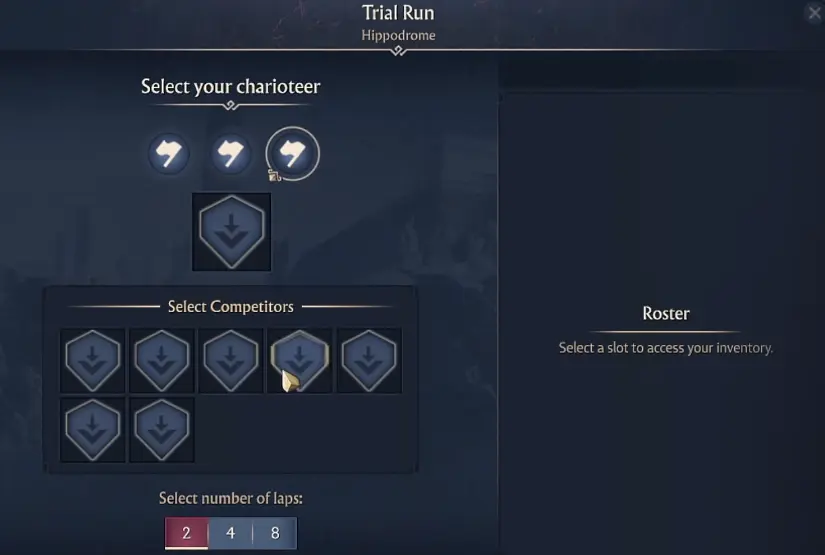
I take Mass Trials while I am still comparing several Specialists, because it lets me use one Trial to screen my main charioteer alongside 7 additional competitors.
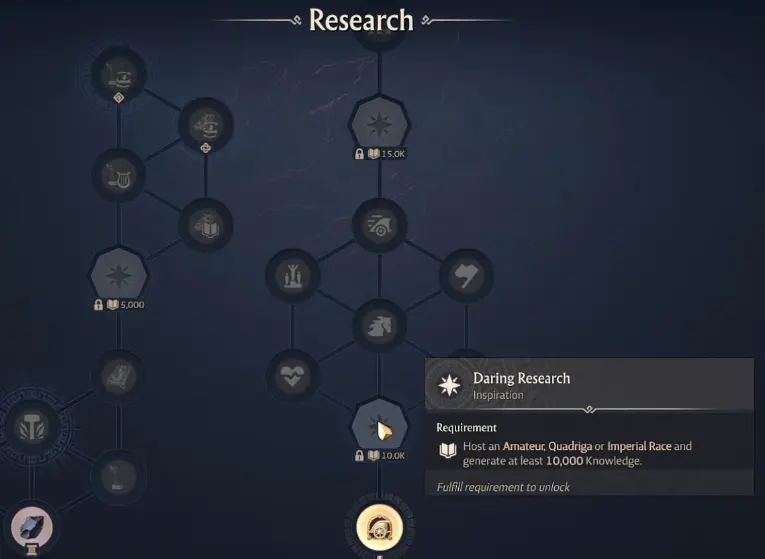
Later, I stop following the same routine. Daring Research requires an Amateur, Quadriga or Imperial race plus at least 10,000 Knowledge, while the upper branch eventually reaches a separate 15,000 Knowledge gate before Mentorship.
Once a Champion’s Trial screen says No upgrades left, I stop spending Trials on that racer for stat growth. At that point, proper races are the progression path.
I Start Research After the First Main Event
Building the Hippodrome gives me access to the system, but I do not try to plan the entire research tree while the monument is still under construction.
I finish the build, use the early racing options, host my first main event and then return to research.
That is when the tree becomes easier to judge because I know which of two problems I actually have:
I already have a racer I want to develop.
or:
I still need to find the racer worth developing.
Those two situations lead me down slightly different priorities.
If I already have a strong candidate, training efficiency matters more.
If my Specialist pool is still uncertain, screening efficiency matters more.
That is why I do not treat this as a rigid list where every player must buy every node in exactly the same order.
I Reveal Maximum Sprint Potential Early
One of the first central upgrades I take reveals a charioteer’s maximum Sprint potential.
I like getting this information early because current stats only tell me what the racer can do today.
Potential tells me whether continued investment has somewhere useful to go.
I do not need the whole racer-selection discussion on this page. When I am comparing the actual ceilings of several candidates, I use my best Hippodrome racer process.
For research, the important point is simpler:
I prefer unlocking useful information before spending several progression cycles on an unknown ceiling.
That becomes even more valuable once I start collecting several plausible Specialists at the same time.
Tireless Training Is My Highest Early Priority
After the first potential information, I usually move toward Tireless Training.
This is the early upgrade that changes my Hippodrome routine the most.
The research gives:
Available Upgrades +2
and explicitly increases the number of charioteer upgrades available through Trial Runs between races:
from 1 to 3
That means I can turn three useful Trials into three separate stat improvements instead of getting one improvement and then waiting for another race cycle.
For a racer I already believe in, that is much more valuable to me than rushing toward an expensive late research requirement.
I am using the improvement immediately and repeatedly.
The exact timing of the main-event and Trial loop stays in my chariot racing guide. Here I only care that Tireless Training makes that period substantially more productive.
Mass Trials Comes Next While I Am Still Searching
Mass Trials solves a different problem.
Tireless Training helps me improve someone.
Mass Trials helps me find out who deserves that investment.
With Mass Trials available, I can put my main charioteer into the session while also bringing 7 additional competitors.
That changes how I handle a large inventory of Specialists.
Instead of testing one candidate, leaving the Hippodrome, checking another trader, returning and repeating the same process again, I bring several plausible racers into one session.
The upgrade becomes especially valuable after a shopping run where I have collected multiple candidates and do not yet know which one belongs in the long-term roster.
When I take Mass Trials early
I move it up the order when:
- I have several untested Specialists;
- none of my current racers looks clearly exceptional;
- I am still spending money looking for a long-term candidate.
When I delay it slightly
I am less urgent about Mass Trials when I already have a racer whose potential is strong enough that I intend to keep developing them.
In that situation, Tireless Training gives me more immediate value.
So my choice is not really:
Which research is objectively better?
It is:
Am I still searching, or am I already developing?
Then I Reveal the Rest of the Racer Potential
Once my training and screening tools are in place, I work through the research that reveals the remaining maximum charioteer stats.
The four racing stats are:
- Speed
- Stamina
- Sprint
- Reliability
At this stage, I am not trying to re-evaluate every racer inside the research screen.
I am removing uncertainty.
The research tells me more about the maximum potential available to the Specialists I am already testing, and that information feeds back into the racer decision.
If the ceiling is weak, I know not to keep investing just because I have already spent time on that character.
If the ceiling is strong, I have a reason to continue.
That is the useful part of these nodes for me.
I do not need rarity, purchase price or one lucky race result to make that decision when the research can expose the actual potential.
Daring Research Is the First Gate I Treat Differently
The later tree stops being only about spending Knowledge on another useful upgrade.
Daring Research has a real progression requirement.
It asks me to:
- host an Amateur, Quadriga or Imperial Race;
- and generate at least 10,000 Knowledge.
I like this gate because it gives me a clear stopping condition.
If I have the Knowledge but my Hippodrome progression is not ready, I do not sit there trying to solve the wrong problem.
I go back to the races.
If I have already cleared the race requirement but Knowledge is short, then I know the economy and research generation are the bottleneck.
Those are very different fixes.
If the race requirement is missing
I work on the Hippodrome.
If Knowledge is missing
I go back to my city.
That distinction saves me from hoarding resources without knowing what I am actually waiting for.
I Do Not Hoard 10,000 Knowledge From the Beginning
Seeing a five-digit requirement can make me want to stop every other research project and save everything for the Hippodrome.
I do not do that.
Early Hippodrome research gives me benefits that make the entire progression faster:
- more useful Trial upgrades;
- larger candidate screening;
- better information about racer potential.
If those are still locked, sitting on a pile of Knowledge does not help me nearly as much.
I only start treating the 10,000 Knowledge requirement as my immediate target when the rest of the Daring Research requirement is realistically close.
That is usually a better use of the city’s research economy than starving everything else just because I can see a large number higher up the tree.
Champion Is Where My Trial Strategy Changes
Eventually a developed charioteer can reach Champion.
This is an important stopping point because the early Trial strategy does not continue forever.
When the Trial selection screen tells me:
No upgrades left: This trial run will not improve charioteer stats.
I believe it.
I do not keep feeding the same Champion into Trials hoping another session will somehow produce another stat point.
The game also tells me that a Champion can continue improving through proper:
- Amateur races;
- Quadriga races;
- Imperial races.
So this is where I change the role of Trials.
That second part is important.
The Trial itself is not useless.
It is just no longer useful for that Champion’s stat growth.
If I have another promising Specialist, this is the perfect time to give those Trial opportunities to the next candidate instead.
The 15,000 Knowledge Gate Is a Late-Progression Problem
Higher in the research branch, I eventually reach a separate 15,000 Knowledge requirement.
I do not treat that as the number I should save for from the moment the Hippodrome opens.
By the time I am pushing this far, I want the earlier system to be working already:
a racer worth keeping
→ efficient Trial upgrades
→ a screened Specialist pool
→ higher-tier race progression
Only then does the larger Knowledge requirement become the real bottleneck.
If I am still unsure which racer I should train, reaching 15,000 Knowledge early does not fix that uncertainty.
So I save aggressively only when the branch ahead of me is actually ready to use it.
Mentorship Gives Me a Better Candidate Pool, Not a Guaranteed Legendary
At the upper end of the research progression I reach Mentorship.
The reward is important to read correctly.
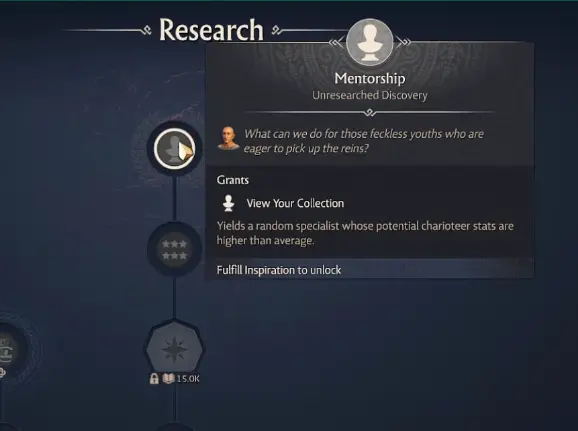
Mentorship yields:
a random Specialist whose potential charioteer stats are higher than average
It does not promise that the Specialist will be Legendary.
And it does not promise that the new Specialist automatically replaces the racer I already developed.
That makes Mentorship useful for a very specific reason:
it improves the quality of the candidate pool.
If I am still looking for an exceptional racer, that is valuable.
If I already have a Champion I am happy with, I do not derail the whole progression just because Mentorship gives me somebody new.
I test the new candidate and compare them through the process in my best racers guide.
The research produces a promising opportunity.
It does not make the decision for me.
I Change Priorities Once the Search Is Over
The research tree makes the most sense to me when I divide it into two stages.
Early on, I am reducing uncertainty and speeding up development:
reveal useful potential
→ Tireless Training
→ Mass Trials when I still need candidates
→ reveal the remaining maximum stats
Later, the problem becomes progression:
meet Daring Research requirements
→ move a proven racer beyond the Trial ceiling
→ clear the higher Knowledge gate
→ reach Mentorship and the rest of the upper branch
The exact order in the middle can change depending on my save.
If I have eight uncertain candidates, I want Mass Trials quickly.
If I already found the racer I expect to keep, I care much more about Tireless Training and the next progression gate.
If my Champion says Trials cannot improve them anymore, I stop spending research strategy around Trial growth and move forward.
That is the rule I keep coming back to:
I research the upgrade that removes the bottleneck I have now, not the most impressive node I can see higher in the tree.