Anime Shop Simulator Pricing: What Markup Should You Use?
A busy store can still lose money through stale prices, bad markups and constant small orders. This is how I price stock, read demand and keep profit available for growth.
Updated:
Quick Answer
Start from Market Price, add a modest markup, and watch whether the item actually keeps selling. I usually test just under 10% rather than forcing the full +10% button on everything. Check Store Computer → Stock before opening because Market Prices can move, keep extra inventory for products that repeatedly sell out, and combine planned restocks because every product order adds a $5 delivery fee.
The +10% Button Is a Test, Not a Rule
The easiest pricing mistake is assuming the game is giving me an answer just because it gives me a +10% button.
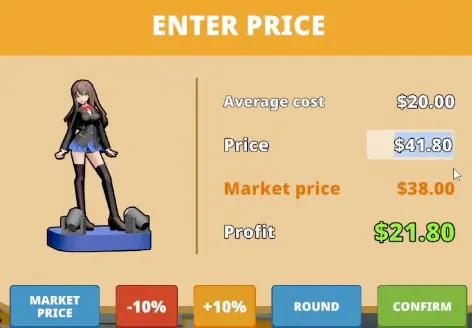
One figure made the tradeoff unusually clear. Its Average Cost was $20, its current Market Price was $38, and pressing +10% produced a sale price of $41.80 with $21.80 profit shown on the pricing screen.
On paper, $41.80 looks better than $40. In the shop, the extra margin only matters if customers keep buying.
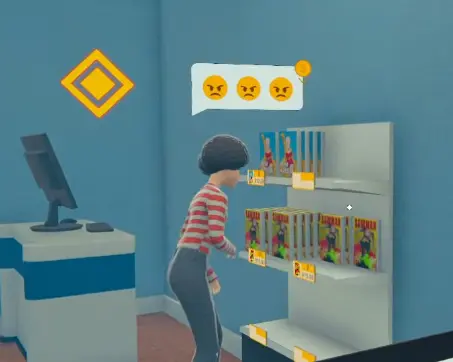
During early pricing tests I had nearly identical products behave differently when one sat just above the 10% range and the other stayed slightly below it. The higher-priced product could sit while the cheaper one continued moving. I also saw unhappy reactions at markups that looked modest enough that I initially expected them to be safe.
That is why my first price is usually not the highest price the controls allow. I start near Market Price, move upward modestly, round when it makes sense, then judge the product from actual customer behavior.
I Read Three Signals Before Touching a Price Again
One complaint by itself does not make me reprice the entire store. A useful pricing decision needs context: how customers react, how fast the shelf moves, and whether the current tag is still aligned with Market Price.
| What I see | What it usually means | What I change first | What I avoid doing |
|---|---|---|---|
| Several customers complain and the shelf barely moves | The markup is probably too aggressive | Drop that item slightly and test again | Repricing every category at once |
| The product sells steadily with normal reactions | The current price is doing its job | Leave it alone | Chasing another dollar just because there is room to raise it |
| A shelf empties repeatedly during the same day | Demand or stock depth is the immediate issue | Add backstock and verify the tag is not below Market Price | Assuming the answer is automatically a higher price |
| The product suddenly looks expensive after being fine earlier | Market Price may have moved down | Check the Stock menu before changing anything else | Blaming customer behavior without checking the baseline |
| Products fly off shelves but cash growth still feels weak | Some tags may be below current Market Price | Compare current prices with Market Price across the Stock screen | Treating high sales volume as proof of good margins |
One early day ended with 14 customers leaving without buying while I was still experimenting with pricing. I cannot attribute every lost sale to markup—stock availability and other shop conditions also matter—but that was enough evidence for me to stop treating higher prices as free profit.
When I change a price, I prefer to change one item or one small category at a time. If a product starts moving again after dropping from $17 to $16, the result is useful. If I reprice half the shop at once, I know sales changed but not why.
Clean Dollar Prices Are Easier to Run During a Rush
Rounding started as a checkout convenience and ended up fitting the pricing strategy surprisingly well.
Manual cash handling becomes much less pleasant once a queue forms. If Market Price plus my markup lands somewhere awkward, I would rather give up a few cents than make every transaction slightly harder to read.
With the $38 figure, for example, +10% produced $41.80. I would be much more comfortable testing $40 or $41 than blindly accepting $41.80 simply because that is what the percentage button produced.
That decision is easier when the underlying margin is already healthy. With a $20 Average Cost and a $38 Market Price, the product does not need every possible cent of markup to be profitable. Keeping it moving is more important than maximizing one individual sale.
This is also why I do not use one global rule such as “always price at 9%.” Different items can attract different reactions, and Market Price itself can change.
Market Price Can Move While Your Tag Stays Put
The quieter money leak appears after a price has been working for a while.
Later in the run, I opened the Stock menu and found products whose tags no longer matched the Market Prices I had used when setting them. One figure was still priced at $37 after its Market Price had moved to $38. Books, figures and body pillows needed the same kind of review.
Nothing was obviously wrong from the shop floor. Customers were still buying. I was simply giving away margin because I had not checked the baseline again.
The fastest place to catch that is:
Store Computer → Stock
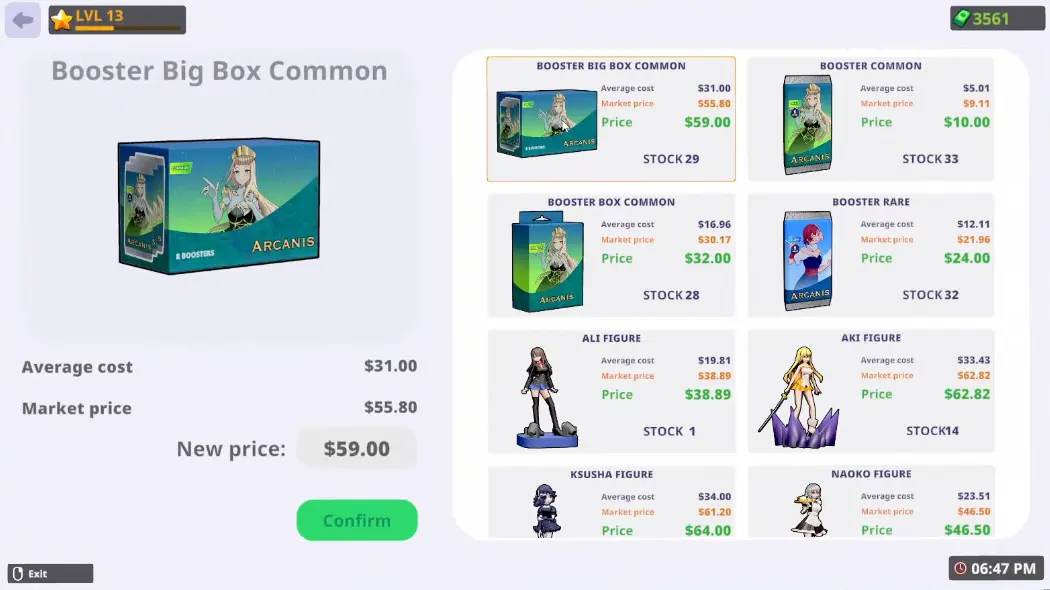
This view is especially useful because several products can be compared at once. In the same screen I could see, for example, a Booster Big Box Common with an Average Cost of $31, a Market Price of $55.80 and a selling price of $59, while other boosters and figures had their own cost, market and current-price relationships beside it.
That makes the problem easier to spot.
If Market Price moves upward and my tag does not, I quietly lose margin.
If Market Price drops while I leave an aggressive markup in place, customers may suddenly see an item as overpriced even though I never touched its tag.
A Product Selling Out Is Not Automatically a Pricing Opportunity
Fast sellers created a different temptation: every time something vanished quickly, I wanted to raise the price.
Body pillows convinced me to stop doing that automatically.
There were stretches where fresh body-pillow stock disappeared almost as soon as I placed it, and I was already ordering two more boxes while the current batch was being cleared. Figures and boosters could behave the same way; I saw customers take several boosters in one visit, while figure stock was repeatedly pulled out of the back room.
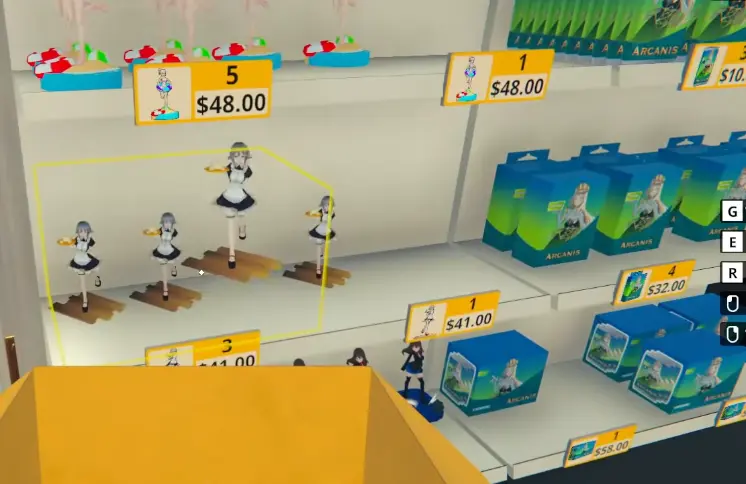
Before I raise a fast seller, I check whether it is actually priced correctly.
If I accidentally left it under the current Market Price, rapid sales tell me very little about true demand. Once the tag is corrected and the product still keeps disappearing, then I know the demand itself is strong.
This is how I judge products financially:
margin × sell-through × how reliably I can keep the shelf supplied
The item with the largest sticker price is not automatically my best product. A cheaper category that turns over several times in a day can contribute more useful cash than an expensive item that sells once and occupies shelf space for hours.
The $5 Delivery Fee Punishes Constant Tiny Orders
Product ordering has a small fixed cost that becomes noticeable only after I repeat the same mistake enough times.
Every product order adds a $5 delivery fee.
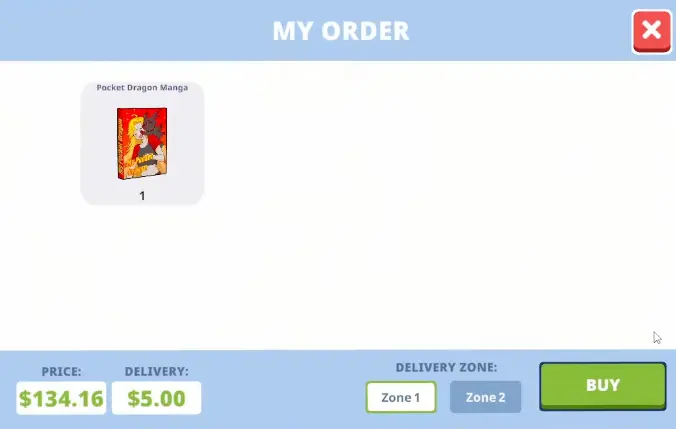
Five dollars does not threaten a healthy shop. Paying it again and again because I ordered one manga box, then one figure, then two pillows, then another booster order is different.
Once I have Storage, my preferred restock rhythm is to look at several shortages together near closing. Fast movers get enough backup stock for the next rush, slower categories stay lean, and the predictable shortages go into one larger order instead of several small ones.
Emergency orders still make sense. If a profitable category has completely sold out in the middle of a busy day, I am not going to leave the shelf empty just to protect $5.
The fee matters when the shortage was obvious enough that I could have planned for it earlier.
Backstock Should Follow Turnover, Not Fear of Running Out
Storage makes bulk ordering easier, but it also creates a new way to waste money.
Once boxes are out of sight, it becomes much easier to convince myself that buying more inventory is harmless. It is not. Slow stock sitting in the back room is still cash I cannot use elsewhere.
I give deeper backstock to products that repeatedly prove they need it. If a shelf empties twice in a normal day, keeping a replacement box ready makes sense. If a product survives several days without selling through, another three boxes are not insurance; they are money waiting on a shelf.
That distinction is especially important when several categories unlock close together. New products need their first order, existing fast sellers still need replenishment, and the shop itself may be approaching another major progression purchase.
The progression guide covers when I prioritize those unlocks. From the money side, the rule is that operating inventory should not consume every dollar I meant to keep for growth.
I Treat Growth Money as Already Spent
A profitable day can disappear surprisingly fast after closing.
A license becomes available, a display catches my eye, three products need more stock, and suddenly the money that looked like progress has become another collection of boxes and furniture.
I avoid that by separating two mental balances:
working cash pays for stock, bills and normal operations.
growth cash belongs to the next meaningful shop upgrade.
I do not need to repeat the exact Storage and shop-area prices here to use that rule. As I get close to the next major unlock, I protect the amount I expect to need before I buy optional furniture or place a speculative inventory order. The exact level gates and upgrade costs are in the progression guide.
This changed the way I looked at a strong sales day. A large balance is not automatically disposable money if part of it already has a job.
A $185 Cashier Is Worth It When the Register Is Costing More Than $185
The Junior employee gives a useful real-world test of operating cost.
My first Junior showed a daily salary of $185. That is the stable number I use when deciding whether the employee makes financial sense.
On a later day, the shop served 52 customers and only four left without buying while I had more freedom to keep stock moving instead of stopping for every checkout.
The salary is easy to see. The recovered time is harder to value, which is why an employee can feel expensive even when the shop is already losing more than that through empty shelves and a backed-up register.
When traffic is quiet, $185 is simply another daily expense. Once I am spending most of the rush behind the register while popular products sit empty, the calculation changes: the cashier is allowing me to protect sales elsewhere in the store.
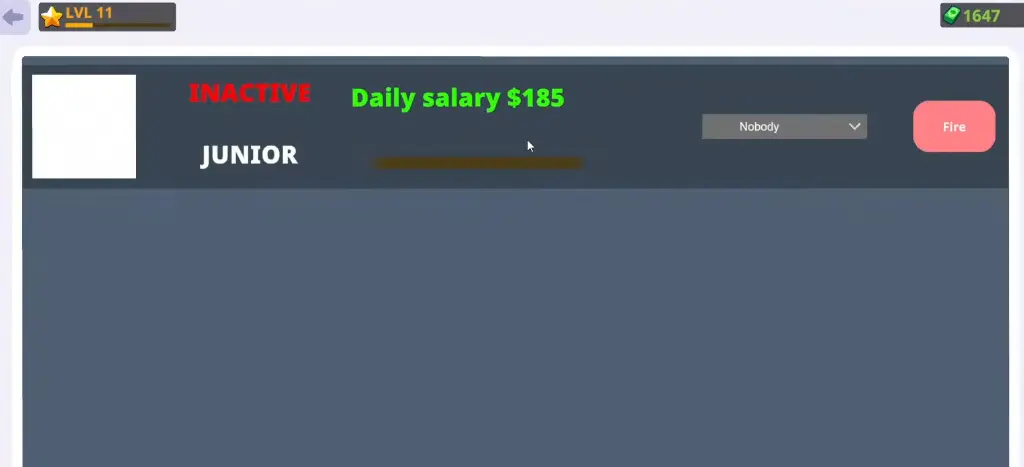
I also avoid using the first hiring moment to estimate the long-term cost if other same-day expenses are mixed into the balance. The $185 daily salary shown on the employee screen is the clean recurring number.
Loans Fix a Balance, Not the Habit That Emptied It
Bills can arrive at an awkward moment. I had stretches where a large stock order had already gone out, another expense was approaching and the balance suddenly looked much worse than it had during the sales rush.
My default response is still to let a profitable shop generate another day of cash before borrowing.
Most early shortages I ran into came from decisions I could correct: too many small orders, excessive slow stock, a purchase that did not increase capacity, or stale pricing that left money on the table.
A loan can cover the immediate gap, but it does not fix those patterns.
If the store is stocked, prices are sensible and customers are actively converting that inventory back into cash, waiting through another workday is often enough. I consider borrowing only when there is a specific reason I need the money now rather than because the balance looks uncomfortable after a spending-heavy evening.
The Routine That Keeps My Cash From Resetting Every Night
By the time the shop gets busy, I no longer think about money as one “best markup” problem. Pricing, stock depth, delivery costs, payroll and progression reserves all touch the same balance, so I handle them in an order that makes the next decision easier.
Before opening, I check the Stock screen for Market Price changes and correct stale tags. Then I look at inventory, giving fast sellers enough backup stock to survive the rush without filling Storage with slow products. Bills get checked before I mentally count the remaining balance as available.
Only after those three things are clear do I decide what can be spent on another license, optional furniture or extra inventory.
During the day, customer reactions tell me whether one of the newer prices needs another adjustment. Repeated sell-outs tell me which categories deserve deeper backstock. After closing, I combine the shortages I can already predict so I am not paying the $5 delivery fee over and over the next morning.
That routine does not create a spectacular single-day exploit. It does something more useful: it stops the cycle where the store looks profitable all day, I spend the balance at night, and the next meaningful purchase arrives while I am effectively broke again.