Anime Shop Simulator Guide: What Should You Do Next?
Not sure what to buy, unlock or fix next? Use this Anime Shop Simulator guide to choose the right move for growth, money, cards, co-op and daily shop problems.
Not sure what to buy after each shop level? This route shows which upgrades actually remove a bottleneck, when to save cash, and when a new unlock can wait.
A busy store can still lose money through stale prices, bad markups and constant small orders. This is how I price stock, read demand and keep profit available for growth.
Build the required 9-card deck, understand the trades that actually win fights, then clear five tournament wins to open the Secret Shop and Crystal economy.
Use an existing shop save, get friends into a private session, understand what carries into co-op, and split checkout and restocking without creating more chaos.
There are 38 achievements, but only a handful need special planning early. This route separates natural shop milestones from the League, collection and Level 80 grinds.
Keep the opening store simple enough that you can tell what is actually going wrong. If space and backstock are the problem, work on shop progression. If customers are buying but the balance is barely growing, fix pricing and ordering. If the current objective has moved into decks and tournaments, deal with the card branch without abandoning the store. New licenses, furniture and extra systems can wait until they solve a problem you already have.
What Should You Do Next?
Anime Shop Simulator throws new options at me much faster than I actually need to buy them. In the opening shop there are only a few shelves and a register, so nearly every purchase looks like progress. A few levels later I can be juggling licenses, Storage, employees, card battles, deliveries, cleaning, security problems and another piece of furniture that has just appeared in the computer.
The run became much easier once I stopped asking, “What just unlocked?” and started asking, “What is costing me time or money right now?”
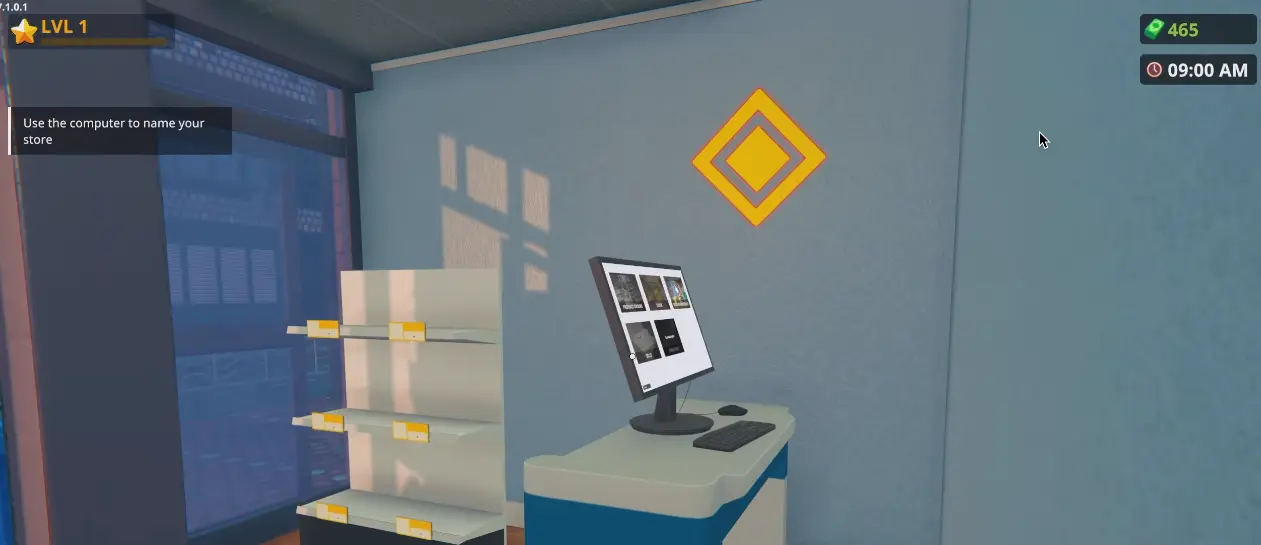
The opening store is simple enough that I can learn what actually sells before committing cash to a larger product range or specialized furniture.
What is going wrong
What I would deal with first
Where to continue
Boxes, fixtures and customers are fighting for the same space
Another license unlocked but the current range is already hard to stock
Delay the new product line
Keep the existing shelves healthy first
The floor is messy, theft is happening or checkout prompts are being missed
Fix the interruption before adding more complexity
Handle it during the normal shop loop
That table is the route I use rather than trying to follow every system at the same time. Each problem has a different answer, and solving the wrong one often just converts cash into another thing I have to manage.
More Space Only Helps When the Current Store Has Outgrown It
The shop becomes crowded surprisingly quickly, but crowding can mean two different things. Sometimes the sales floor is genuinely too small. Other times it only feels small because delivery boxes and spare stock are sitting everywhere.
Those need different fixes.
If backstock is the main problem, I would rather get it out of the customer area before paying for more selling space. If Storage is already doing its job and I still cannot place another useful fixture without blocking movement, then more floor space begins to earn its cost.
The exact level gates, upgrade costs and employee timing are in the progression guide. The part I keep in mind while playing is simpler: an expansion should immediately give me somewhere useful to put stock, customers or work capacity. Empty square footage is not progress by itself.
This also keeps furniture purchases under control. A new display can look like the obvious next purchase because it just unlocked, but if the current shelves still have empty spots, I am usually better off fixing stock or saving the cash.
A Busy Store Can Still Be a Weak Business
Heavy foot traffic fooled me early because it made the shop feel healthy even when the balance was not improving as quickly as I expected.
That can happen for several reasons at once. A price may have fallen behind its current Market Price, a markup may be high enough to slow one product down, fast sellers may spend too much time out of stock, or small restock orders may be eating money repeatedly throughout the day.
Once the store gets busy, customer count alone is not enough to judge how well it is running. Empty shelves and weak cash growth usually point to different problems.
When I notice that mismatch, I stop spending on the next shiny unlock and look at the money loop first. The Money and Pricing guide covers the pricing tests, Market Price checks, delivery costs and employee economics in detail.
From the shop floor, I mainly watch for three clues: customers rejecting a product, shelves repeatedly emptying, or a large balance disappearing every night without moving the store meaningfully forward. Those signals tell me much more than a single “best markup” percentage.
Card Progression Can Wait While the Shop Is Falling Apart
The card system becomes prominent enough that it can feel like the game wants me to stop running the store and follow the battle chain immediately.
I do not treat it that way.
If the shop needs stock, bills are due or the floor is already becoming difficult to manage, I keep operating the business and return to the card objective when things are under control. The tournament route does not require me to sacrifice the normal sales loop simply because it has appeared.
Once I am ready to deal with it, the Card Battle guide handles the deck requirement, combat rules, tournament progression and the route into the Crystal economy.
For the larger shop journey, the useful decision is timing. Card battles are easier to enjoy when I am not thinking about the shelves I left empty to go play them.
Co-op Works Best When There Are Actually Two Jobs to Do
The opening store can be so small that a second player has almost nothing meaningful to own. Once checkout, stock, deliveries and shop-floor interruptions start happening at the same time, that changes quickly.
My cleanest multiplayer sessions came from dividing responsibility rather than having everybody react to the same problem. One person can stay close to checkout while another moves through stock, deliveries and whatever else needs attention. When the bottleneck changes, the roles change with it.
If the difficulty is getting into the same game rather than running the shop, the Co-op guide covers hosting an existing save, private sessions, Steam joining and the difference I found between shared shop state and personal progression.
I would sort that connection out before opening for the day. Debugging a lobby while customers and deliveries are already active turns a simple multiplayer problem into a shop problem too.
When Is a New License Actually Worth Buying?
Licenses are one of the easiest places to overspend because they look like pure progression: unlock another brand or category, gain more things to sell, make more money.
In practice, every license creates another demand on the store.
More products need shelf space. The first order costs money before any of those items have sold. Another category has to be watched for stockouts, and some products may sit much longer than the fast sellers I already know how to move.
The product range expands quickly, but every new category also needs inventory money and display space. I add variety once the current range is under control.
I buy another license when the existing store has room for it in three different senses: physical display space, enough cash for the opening stock, and enough attention to keep that category supplied afterward.
If the current shelves are repeatedly empty because I cannot afford the replacements, a new license only spreads the same problem across more products. If the existing range is stable and I have unused display capacity, then the extra variety has somewhere to work.
The label on the product matters less to me than what happens after it reaches the floor. I pay attention to whether stock actually turns over, whether I can keep it available during a busy day and whether adding more of that category improves the shop rather than just making the catalog larger.
Good Layout Is Mostly About Cutting Repeated Walking
I did not spend much time perfecting the first version of the store because later unlocks inevitably force the room to change.
Layout starts becoming important when I notice myself running the same bad route over and over: delivery arrives, I squeeze around furniture, find the correct product, cross the store to restock it, then fight past the register area on the way back.
At that point, decoration is secondary to movement.
The path I try to preserve is roughly:
delivery or backstock → product display → checkout area → back toward stock
It does not need to be perfectly straight. It just needs to avoid unnecessary obstacles in a route I may repeat dozens of times during one workday.
This is also why specialized furniture has to justify its footprint. A display that looks good but blocks a high-traffic aisle or holds very little stock can make the shop worse even if it technically adds another fixture.
When a new area opens, I prefer moving the problem furniture after I have the extra room rather than trying to design a final layout several expansions in advance.
Cleaning, Thieves and Age Checks Are Interruption Problems
Some shop systems are important without deserving their own daily strategy.
Trash is the clearest example. Customers can leave rubbish behind, cleanliness drops, and a messy floor becomes another thing competing for attention during a rush. I clean obvious trash while moving through the store instead of waiting until enough has accumulated to require a separate cleanup session.
The same principle works for thieves. Once stealing starts appearing, I pay more attention to customers leaving the shop or behaving suspiciously around stock, but I do not build the entire store around catching them. The useful response is quick: deal with the theft, then return to whatever the business actually needed.
Age-restricted sales happen at the register instead of the floor. When the verification prompt appears, I read the ID and make the decision for that customer rather than clicking through the transaction on autopilot. It adds a small interruption, not a separate progression branch.
These systems become much easier when the rest of the store has spare capacity. An employee or another player can keep checkout moving while I leave the register, and a cleaner layout gives me a better view of what is happening around the floor.
Completion Makes More Sense After the Main Systems Are Running
The opening achievement milestones overlap heavily with normal play, so I do not bend the first several shop levels around them. The long-term requirements are different. Higher shop ranks, later card Leagues and large collectible counts become much more efficient when they can advance together rather than one counter at a time.
The Achievements guide separates the natural milestones from the longer completion route.
For me, that means completion sits behind a functioning store, not in front of it. Once money, staffing, shop space and card progression are all established, the remaining goals stop competing with the basic work of keeping the business alive.
The Fresh-Save Route I Use Now
I begin by proving the shop can support itself. Stock stays available, prices are sensible and the first few days tell me which part of the operation is beginning to fail first.
If boxes and customers are fighting for room, progression becomes the priority. If traffic looks healthy but the balance feels weak, I inspect prices, stock depth and ordering before I spend another dollar on expansion. New licenses enter only when the current product range is already manageable.
Card progression gets its turn once leaving the floor for a few battles is not going to create an inventory crisis. Co-op becomes more valuable when there are enough independent jobs to justify another person. Cleaning, theft and restricted sales stay part of the normal shift rather than becoming separate projects.
That leaves one question doing most of the work:
Which problem is costing the shop the most right now?
The game offers plenty of purchases that look like progress. The run moves faster when the next purchase, activity or system has a clear problem waiting for it to solve.