Anime Shop Simulator Card Battles: How Do You Build a Deck and Win?
Build the required 9-card deck, understand the trades that actually win fights, then clear five tournament wins to open the Secret Shop and Crystal economy.
Updated:
Quick Answer
If Build a Battle Deck is not advancing, put exactly 9 cards in the deck. Start with your stronger Power cards, keep useful ranged and ability cards, then play the first battle and follow the quest into the tournament. You need to win five tournament matches to continue the Secret Shop route; those battles also start earning Crystals.
If Build a Battle Deck Is Stuck, Check the Card Count First
The first thing that blocked me was not a difficult opponent. I had opened the collection, picked several cards that looked usable and assumed the deck was finished. The objective stayed there because the game wants a full nine-card deck.
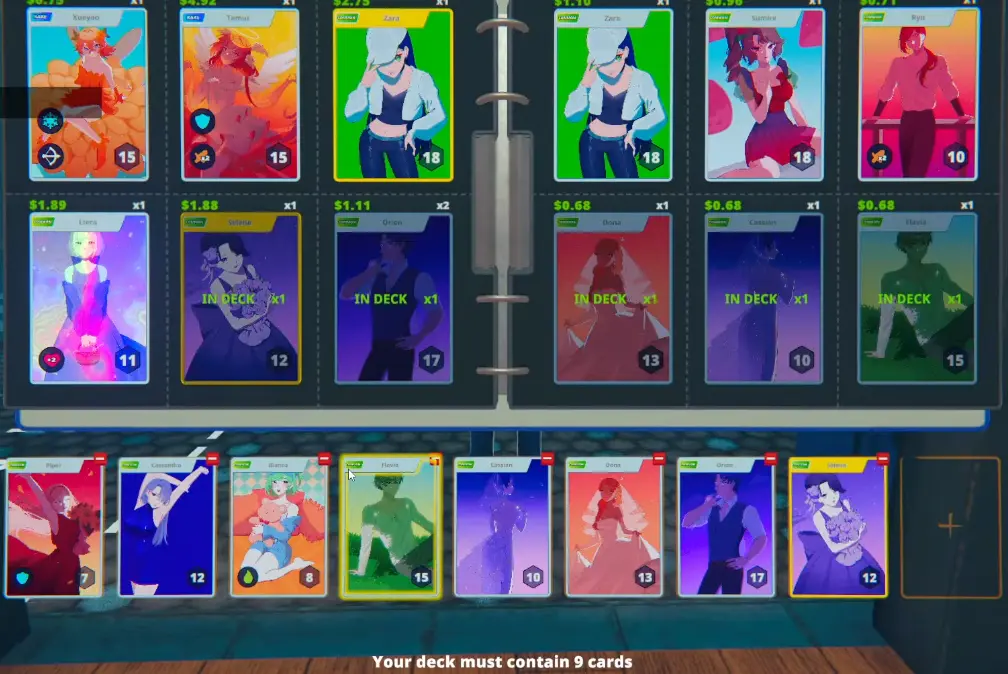
From the card collection, I use Build Deck, clear out an unfinished setup if necessary, add nine cards and then leave the builder with all nine slots filled.
There is a separate shop-side gate that can look like the same problem. If the Gaming Table itself is missing, the card quest cannot move through its next step yet. The table becomes available through normal shop progression, so in that case I go back to running the store rather than trying to solve the deck menu. The progression guide covers that unlock route.
Once the table is available, the useful question changes from “why won’t this objective complete?” to “which nine cards give me the best trades?”
Read a Card as Health and Damage at the Same Time
The tutorial’s most important rule is easy to miss because the game calls one number Power, even though that number effectively does two jobs.
Power is both the card’s damage and its health.
With a normal attack, both cards take damage. If my 20-Power card hits an 18-Power card, I am not simply removing an 18. I am also accepting the return damage from that exchange.
That changed the way I evaluate the board. I stopped asking only whether a card could kill the target and started asking what would be left afterward.
| Battle rule | What it means in a match | How I use it |
|---|---|---|
| Power | The same number acts as damage and health | High Power gives me both stronger attacks and more room to survive a trade |
| Normal attack | Both cards take damage | I avoid spending a strong survivor on an exchange a weaker card could handle |
| Ranged attack | The attacker avoids the normal return damage | I use ranged cards to remove dangerous targets without ruining another strong card |
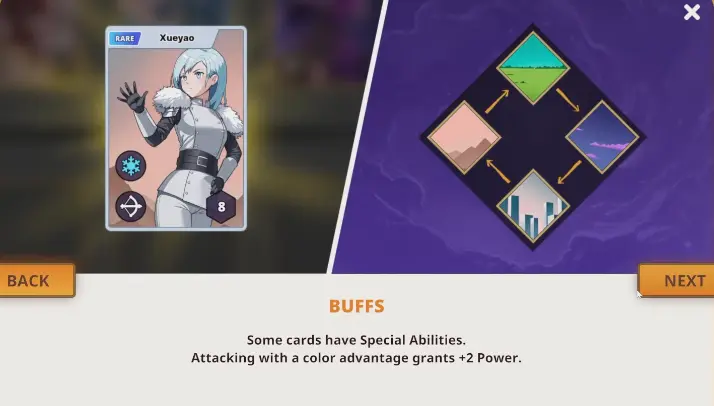
| Color advantage | The attacking card gains +2 Power | I check the matchup before sacrificing a higher-Power card |
| Shield | Changes how safely the card can absorb an attack | I account for the defensive effect before committing to what looks like an easy kill |
| Poison | Adds extra damage pressure after the effect lands | I treat poisoned cards differently from a clean Power-to-Power trade |
The table is enough to remember the rules during a match. What matters in practice is how they change which card I spend first.
Start With Power, Then Fix the Weakest Slots
For my first tournament deck, sorting by Power gave me a much better starting point than choosing by artwork, apparent rarity or card value.
I took the stronger cards first, with early values around 27, 20, 19, 18 and 17 Power, then filled out the required nine. That was not a sophisticated deck, but it immediately made the opening tournament matches easier to read.
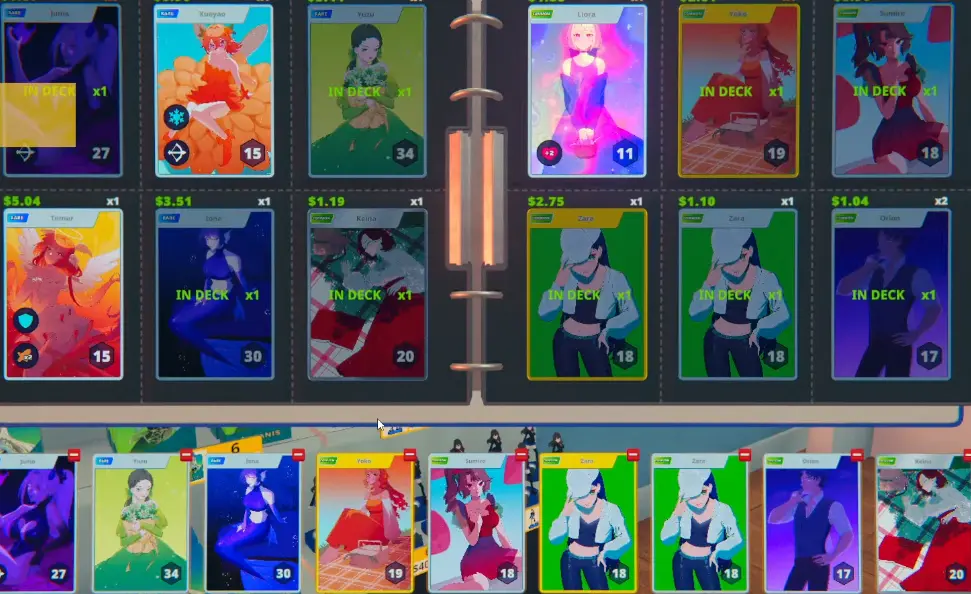
I did not keep rebuilding the entire deck every time I opened a booster. Instead, I watched which two or three cards kept giving me bad turns.
That matters more than chasing one exceptional pull. If the best card in my deck is already winning its matchup, replacing it with something slightly stronger changes very little. Replacing a weak card that repeatedly forces me into a losing trade improves the entire nine-card rotation.
Abilities become the tiebreaker once the raw numbers are close. A slightly weaker ranged card can be more useful than a higher-Power normal attacker because it can remove a target without taking the usual return hit. Shield and Poison create the same kind of situation: the number on the card still matters, but it is no longer the whole decision.
Color Advantage Can Rescue a Close Trade
The +2 Power from color advantage looks small until a fight comes down to two points.
If an opponent has several cards left, I check the color matchup before committing my largest card. A lower-Power attacker can sometimes win the exchange once the bonus is applied, which leaves the stronger card available for whatever the opponent plays next.
That became more important when tournament opponents started showing cards around 34 and 32 Power. At that point, throwing the strongest card forward every turn was no longer enough. I needed to decide which threat actually required the premium card and which one could be handled with color advantage, a ranged attack or a cheaper sacrifice.
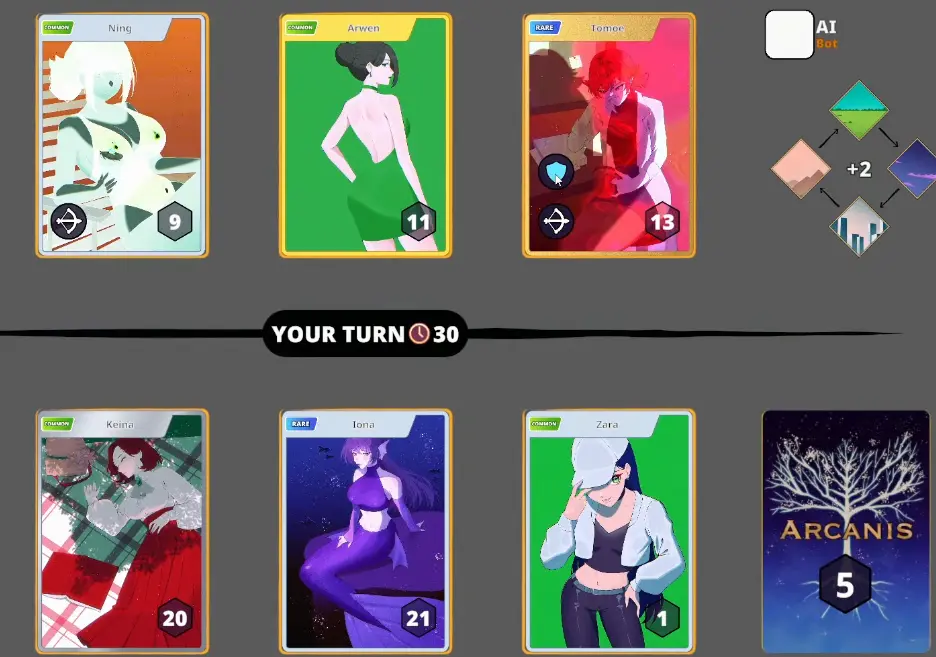
The win condition stays straightforward: destroy all enemy cards. There is no separate player-health bar I need to protect. Every decision is therefore about board value—remove their cards while leaving myself enough usable Power to answer the next one.
The First Battle and the Five Tournament Wins Are Two Different Steps
The quest sequence caused more confusion than the mechanics.
After building the deck and using the Gaming Table, I completed an initial battle. That teaches the system and advances the card storyline, but it is not the requirement that opens the next major part of the route.
A little later the objective changes to:
Win five matches in a tournament.
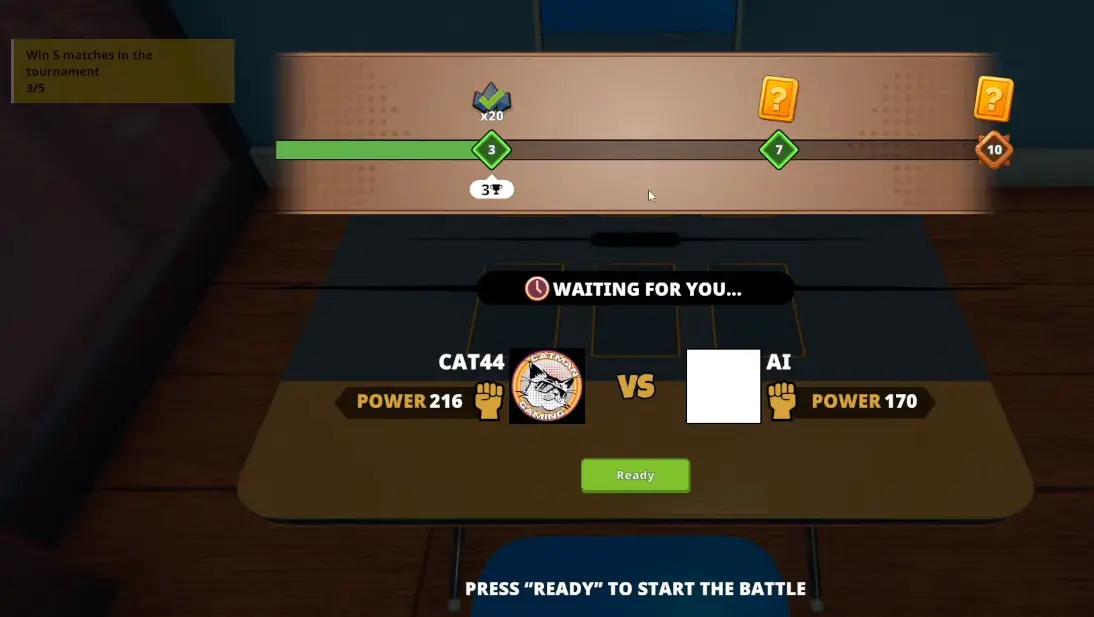
I initially read that too quickly and treated “play five” and “win five” as if they were the same thing. They are not.
A loss does not ruin the progression. I can leave the tournament, adjust the weakest part of the deck, open more boosters if the collection is still thin and try again.
There is also no need to force all five wins the moment the objective appears. I was able to keep running normal shop days while the tournament requirement was unfinished. If shelves are empty, bills need attention or I simply want a better card pool first, the store can keep moving.
That freedom is useful because the card branch and shop branch compete for attention, not because one completely blocks the other.
Five Wins Open the Secret Shop Route
The fifth tournament win is the point where the card system starts feeding into something larger than the battle table.
After the win, the objective changed to talk to the owner of the Secret Shop. By the end of that five-win sequence, my Crystal balance had reached 35.
I do not treat 35 as a guaranteed payout for every player or every set of five wins. What the run clearly established is the currency loop:
winning card battles earns Crystals, and the Secret Shop spends Crystals.
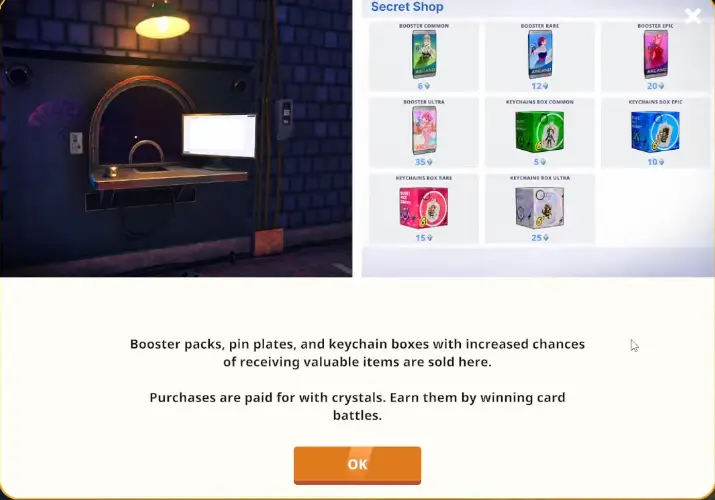
The shop inventory I found included special booster packs, pin-related items and keychains, with different Crystal costs. Some of those products also advertise better chances at valuable collectibles.
So if I reach the Secret Shop early and the owner is not offering the full route yet, I do not look for a hidden shop level or another furniture purchase. I check the battle progression first:
build the deck → complete the opening battle → win five tournament matches → talk to the Secret Shop owner.
That sequence is the real gate.
I Do Not Spend the First Crystals Just Because I Can
Opening the Secret Shop creates a second economy alongside normal shop cash.
Cash is still paying for products, bills and business growth. Crystals come from card battles and feed the collection side of the game, so I keep those two resources mentally separate.
The first Secret Shop visit is more valuable to me as an unlock than as a shopping spree. Special boosters, keychains and pin-related items are all competing for the same currency, and spending everything immediately can leave me short when I decide which collection I actually want to push.
This becomes more relevant later because the TCG does not stop at the five-win gate. There is a longer League ladder and much larger collection goals waiting after the early tournament route. Those completion targets are covered in the Achievements guide; here, the useful milestone is simply reaching the point where I have a working deck, a repeatable way to earn Crystals and access to the Secret Shop.
The Best Time to Return to Tournaments Is After the Shop Has Fed the Deck
Trying to brute-force every card objective with the same early nine cards made the system feel more grindy than it needed to be.
The shop naturally helps the deck improve over time. Normal business keeps money coming in, more booster openings expand the collection, and better cards replace weak tournament slots. When I return later, I am not asking the same nine-card deck to solve increasingly stronger opponents.
That creates a much cleaner rhythm than treating cards as a separate game that must be completed in one sitting.
My opening route now looks like this:
get the Gaming Table → build exactly nine cards → learn how Power and mutual damage work → sort the collection by Power → strengthen the weakest deck slots → use ranged attacks, abilities and +2 color advantage to improve trades → win five tournament matches → talk to the Secret Shop owner → let the shop build a better card pool before pushing deeper.
By that point the card system has done everything I need from the early game: the rules make sense, the deck works, Crystals are flowing and the Secret Shop is open. The longer League grind can wait until the collection is strong enough to make the next return worthwhile.