Tower of Babel Gear, Item Level, and Legendary Items Guide
A practical Tower of Babel Survivors of Chaos gear guide explaining item level, gear slots, identifying items, legendary effects, shop prices, class restrictions, old gear, stolen items, and when equipment is worth keeping, selling, storing, enhancing, or socketing.
Updated:
Quick Answer
In Tower of Babel: Survivors of Chaos, judge gear in this order: can your class equip it, is the item level close to your current floor range, does the main stat improve your build, and does the legendary effect support a skill you actually use? Keep build-defining legendary effects, sell obvious low-level junk, store useful off-class gear, and only enhance or socket items that will last more than one or two runs.
Start Here
Gear is one of the main reasons Tower of Babel feels different from a simple survivor-style game.
Your level-up skills matter, but your equipment decides whether those skills scale. A weapon can raise your damage. Armor can keep you alive. A legendary effect can change how a skill behaves. A class-exclusive item can be useless for one character and perfect for another.
The basic gear loop is:
clear a floor → collect items → identify gear → compare item level and effects → equip upgrades → sell junk → enhance or socket only long-term pieces
Gear Decision Table: Keep, Sell, Store, or Enhance
This is the main table to use when your inventory is full. It replaces the usual three separate keep/sell tables.
| Gear situation | What to check | Best action | Why |
|---|---|---|---|
| High item level and useful stats | Class fit, main stat, damage or armor value | Keep / Equip | This is usually a real upgrade for your current floor range. |
| Low item level but build-defining legendary effect | Whether the effect supports your main skill | Store / Transfer later | The base item may be weak, but the effect may still be valuable. |
| Low item level and no useful effect | Item level, rarity, sell value | Sell | It is taking space and probably will not matter again. |
| Wrong-class item with strong effect | Whether you plan to play that class soon | Store | Keep it only if you will actually use that class. |
| Wrong-class item with weak stats | Class restriction and item level | Sell | Off-class junk is still junk. |
| Shop legendary with strong build effect | Buy price, item level, class restriction | Buy if affordable | A good legendary can enable a build immediately. |
| Shop legendary with unrelated effect | Skill name and class fit | Skip | Do not spend gold on an effect you will not use. |
| Socketable item with good stats | Long-term value and material cost | Enhance / Socket | Good crafting target if the item will last. |
| Temporary upgrade | How soon you will replace it | Equip but do not craft | Use it now, but save gems, jewels, and runes. |
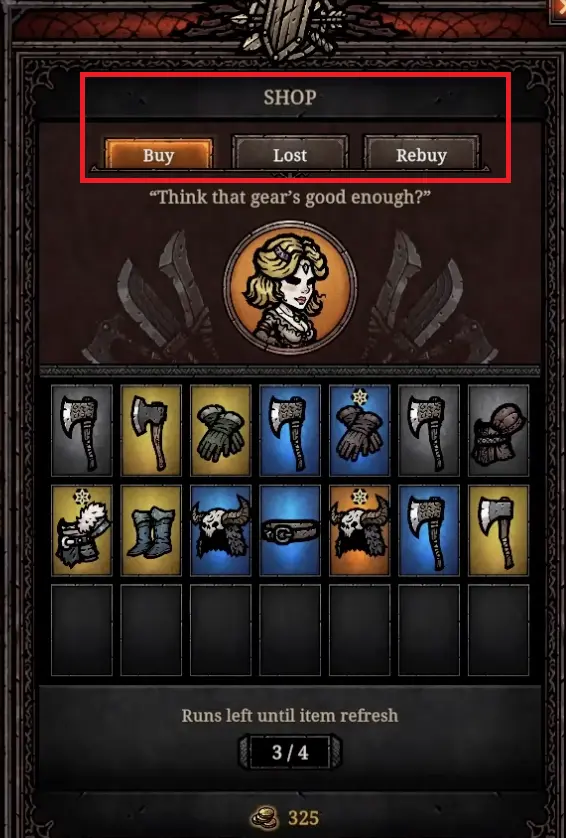
| Stolen valuable item | Legendary effect and gold cost | Recover from Lost tab | Buy it back only if it changes your build. |
Use this as your main gear decision table. One item can fit more than one row, but the action column gives the safest default choice.
Confirmed Item Level and Cost Examples
Players often need numbers, not just advice. These are confirmed examples from early and mid-progression play. Use them as reference points while more 1.0 data is collected.
| Situation | Confirmed value | What it means |
|---|---|---|
| Floor 1 Normal | Acquired Item Lv. 1-3 | Early gear should be judged against item level 1-3, not endgame items. |
| Shop Legendary example | Item Level 3, Buy Price 1,080 gold | Early legendary shop items can cost far more than one basic upgrade. |
| Early rare weapon comparison | Item Level 2-3 examples | Even early upgrades can differ by DPS, weapon power, and useful stats. |
| Socket unlock example | Empty socket equipment available after clearing Floor 3 | If socket options are locked, progress floors before assuming the item is broken. |
| Later enhancement sample | Item Enhancement cost shown at 137 gold | Enhancement costs appear after placing gear and should be checked item by item. |
| 1.0 later gear sample | Shop weapon around Item Level 34 | Old item level 20 gear can become automatic sell material once current drops are much higher. |
These are known examples, not a full item level database. Add more rows as you collect higher-floor screenshots.
Floor-to-Item-Level Reference
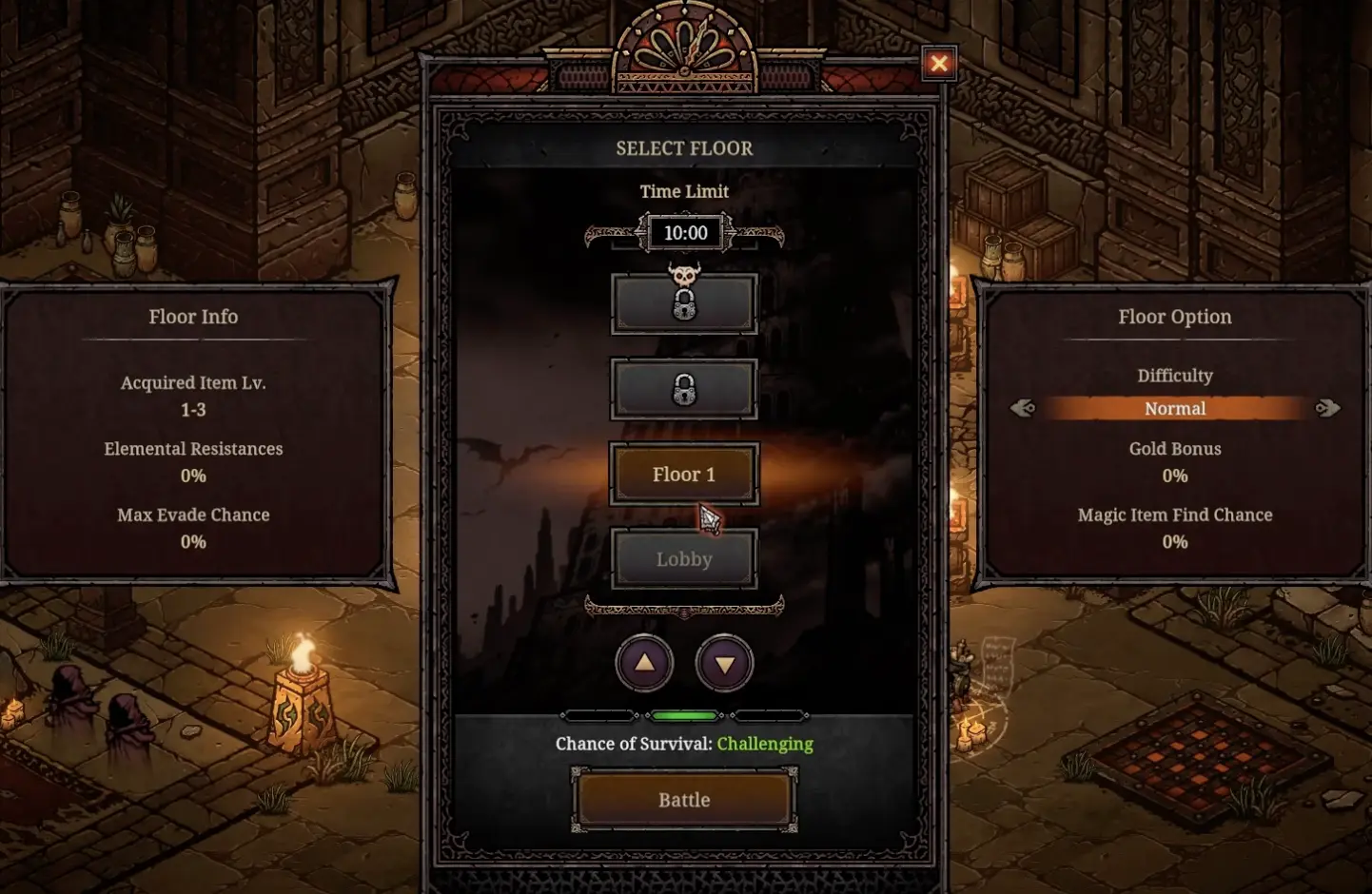
The floor select screen tells you the item level range before you enter. Check it every time you push into a new floor or difficulty.
| Progress point | Confirmed item level signal | How to use it |
|---|---|---|
| Floor 1 Normal | Acquired Item Lv. 1-3 | Level 1-3 gear is normal here. Equip clear upgrades, but do not waste rare materials on early throwaway items. |
| Early floors before socketing | Mostly low item level gear | Replace often; avoid serious enhancement, sockets, gems, jewels, or runes until the item is worth keeping. |
| After Floor 3 | Socket-related options begin opening | Start checking whether gear is worth socket support before spending materials. |
| Mid progression | Use the floor select item level range | If your gear is several levels behind the displayed range, farm upgrades before pushing. |
| 1.0 later shop sample | Item Level 34 shop weapon seen in higher content | Item level 20 gear can become outdated once current drops and shop items jump far ahead. |
| Floor 20 Nightmare | Acquired Item Lv. 37-43 | Use this as a current late-tower reference. If your gear is far below this range, farm upgrades before pushing Floor 20 or Floor 21. |
| Floor 21 / post-final boss endgame | Check floor select, shop item level, and dropped gear before deciding | Do not rely on old gear assumptions after reaching Warped Floor, Dual Boss Arena, or Final Greed. |
Use this as a confirmed item level reference. For floors not listed yet, check the Acquired Item Lv. range on the floor select screen before entering.
Gear Slots and Priority
The game does not only ask whether an item is rare. It asks whether that slot helps your current class.
Some slots are raw power slots. Some are survival slots. Some are good places to hold utility stats, resistances, or legendary effects.
| Slot type | What to prioritize | Keep an old piece if… |
|---|---|---|
| Weapon | DPS, weapon power, attack speed, main damage stat, build effect | It has a legendary effect that carries your main attack or skill. |
| Chest / armor | Armor, life, vitality, resistance, defensive legendary effects | It prevents deaths better than a higher armor piece. |
| Helmet | Damage stats, magic item find, skill utility, class fit | The effect supports your main build or farming route. |
| Gloves | Attack speed, crit, damage modifiers, recovery effects | It gives sustain or damage your build depends on. |
| Boots | Movement speed, evasion, armor, survival | Losing movement makes bosses or dense waves unsafe. |
| Belt | Utility stats, resistances, life, mana, build support | It gives mana or survival that your class needs. |
| Rings | Damage, mana, resistance, jewel or legendary synergy | The stat package helps your main scaling path. |
| Amulet / accessory | Build-defining bonuses, high-value stats, recovery | It holds a strong effect that is hard to replace. |
| Socketed slots | Gems, jewels, runes, resistances, damage type support | The base item is high enough level to justify materials. |
Use this as a practical slot priority table. Slot names can vary by class and item type, but the decision logic stays the same.
How to Identify Items
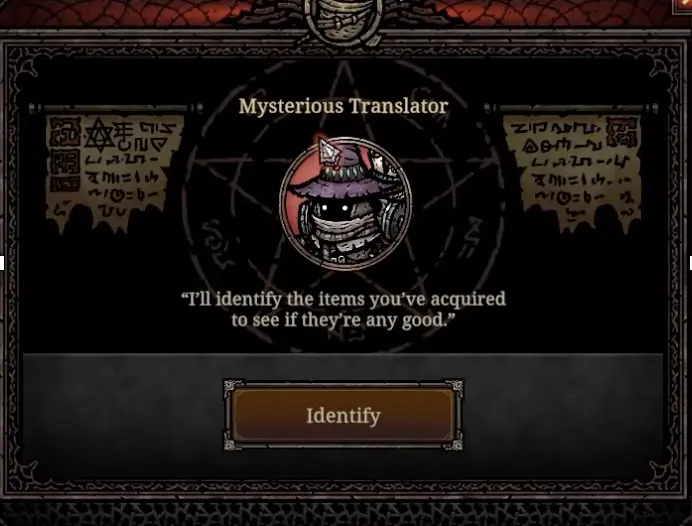
Items you pick up during a run are not always ready to judge. After a floor clear, identify your acquired items before making gear decisions.
If you do not identify items, you are guessing. You may sell a useful upgrade or keep junk because the color looks exciting.

| Step | Action |
|---|---|
| 1 | Finish the run or return to the hub. |
| 2 | Talk to the item identification NPC. |
| 3 | Select the identify option for acquired items. |
| 4 | Open the item bag. |
| 5 | Compare item level, stats, rarity, and class restriction. |
| 6 | Equip clear upgrades. |
| 7 | Store build-defining legendary effects. |
| 8 | Sell obvious outdated gear. |
Legendary Effects Matter More Than Color
A legendary item is valuable because of what the effect does, not because it is orange.
A legendary effect may change how a skill behaves, add projectiles, trigger a special effect, or improve a build-defining ability. That can matter more than a small stat increase.
| Legendary effect question | Why it matters |
|---|---|
| Does it affect my main skill? | A build-defining effect is usually worth keeping. |
| Does it affect a skill I never pick? | The item may be wasted on your current build. |
| Does it improve wave clear? | Useful for farming and dense floors. |
| Does it improve boss damage? | Useful when bosses take too long. |
| Does it improve survival? | Valuable for melee builds and hard floors. |
| Can the effect be moved later? | A weak base item may still be worth saving for extraction or transfer. |
| Is the item level still relevant? | A great effect on very old gear may eventually fall behind. |
| Is it class-exclusive? | The effect is irrelevant if your current class cannot equip it. |
Use this before keeping, buying, or enhancing a legendary item.
Should You Buy Legendary Items from the Shop?
The shop can show powerful gear, including legendary items, but shop gear can be expensive.
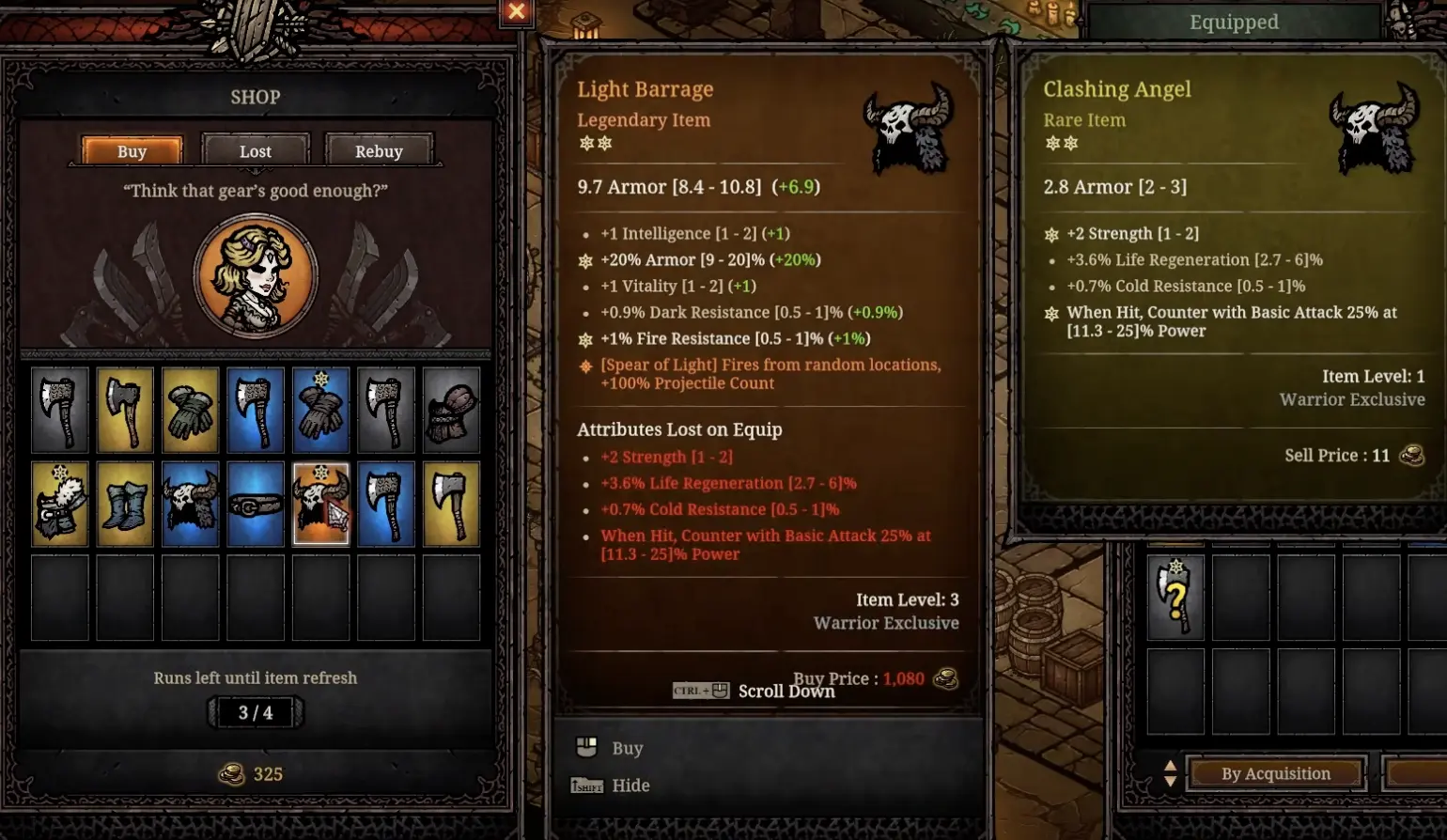
The early example above costs 1,080 gold for an Item Level 3 Legendary chest. That is a serious price early on, especially when you also need Altar upgrades, identification, and other progression spending.
| Buy it if… | Skip it if… |
|---|---|
| The legendary effect supports your main build. | The effect boosts a skill you never use. |
| The item level is good for your current floor. | The item is already behind your floor range. |
| The class restriction matches your character. | It is exclusive to a class you will not play soon. |
| The price solves a real problem. | It delays more important Altar or survival upgrades. |
| It enables a build you want to test. | You only want it because it is orange. |
| You can still afford your next key upgrade. | It drains your gold and leaves your build unstable. |
Use this checklist before spending gold on a shop item.
Class-Exclusive Gear
Some items are class-exclusive. That means they cannot be judged only by stats.
If an item is Warrior Exclusive, it may be useless to your Wizard right now but still valuable if you plan to play Warrior later. The same logic applies to other class-specific drops.
| Situation | Best choice |
|---|---|
| The item fits your current class. | Compare it normally and equip if it is better. |
| The item is exclusive to another class you play. | Store it if the item level and effect are good. |
| The item is exclusive to a class you do not plan to play. | Sell it unless the effect looks important for later testing. |
| A new class has empty gear slots. | Farm safer floors until you get class-compatible gear. |
| The item has a strong legendary effect but wrong class. | Keep only if you will actually use that class soon. |
Use this when class restrictions make inventory decisions confusing.
Stats That Usually Matter
Useful stats depend on your class and build. Do not chase every green number.
| Stat or effect | Best for |
|---|---|
| Weapon Power / DPS | Basic attack and weapon-based damage. |
| Armor | Reducing physical pressure and surviving mistakes. |
| Strength | Physical builds and melee-focused classes. |
| Intelligence | Spell-focused builds and magic scaling. |
| Dexterity | Crit, evasion, and attack-style scaling. |
| Vitality | More life and safer progression. |
| Movement Speed | Dodging, repositioning, and kiting bosses. |
| Life Regeneration / Life Restored | Sustain over longer runs. |
| Resistance | Reducing specific damage types. |
| Attack Area | Melee and area-control builds. |
| Mana Restoration | Wizard, Skull Crusher Spear Spin, and special attack builds. |
| Skill-specific effects | Builds centered on one main skill. |
Match stats to the problem your build is trying to solve.
How to Compare Two Items
When two items look close, do not only compare the green and red numbers.
Use this order:
| Step | What to compare |
|---|---|
| 1 | Can your class equip it? |
| 2 | Is the item level higher or lower? |
| 3 | Does the main value improve? DPS for weapons, armor for armor. |
| 4 | Are the stats useful for your build? |
| 5 | Does the legendary effect support your main skill? |
| 6 | What do you lose by equipping it? |
| 7 | Should the old effect be stored for transfer or later use? |
| 8 | Is the new item worth enhancing, socketing, or keeping? |
A good item is not always the one with the most green text. Sometimes you lose life recovery, movement speed, attack speed, mana support, or a legendary effect that was keeping your run stable.
Stolen Items and Lost Items
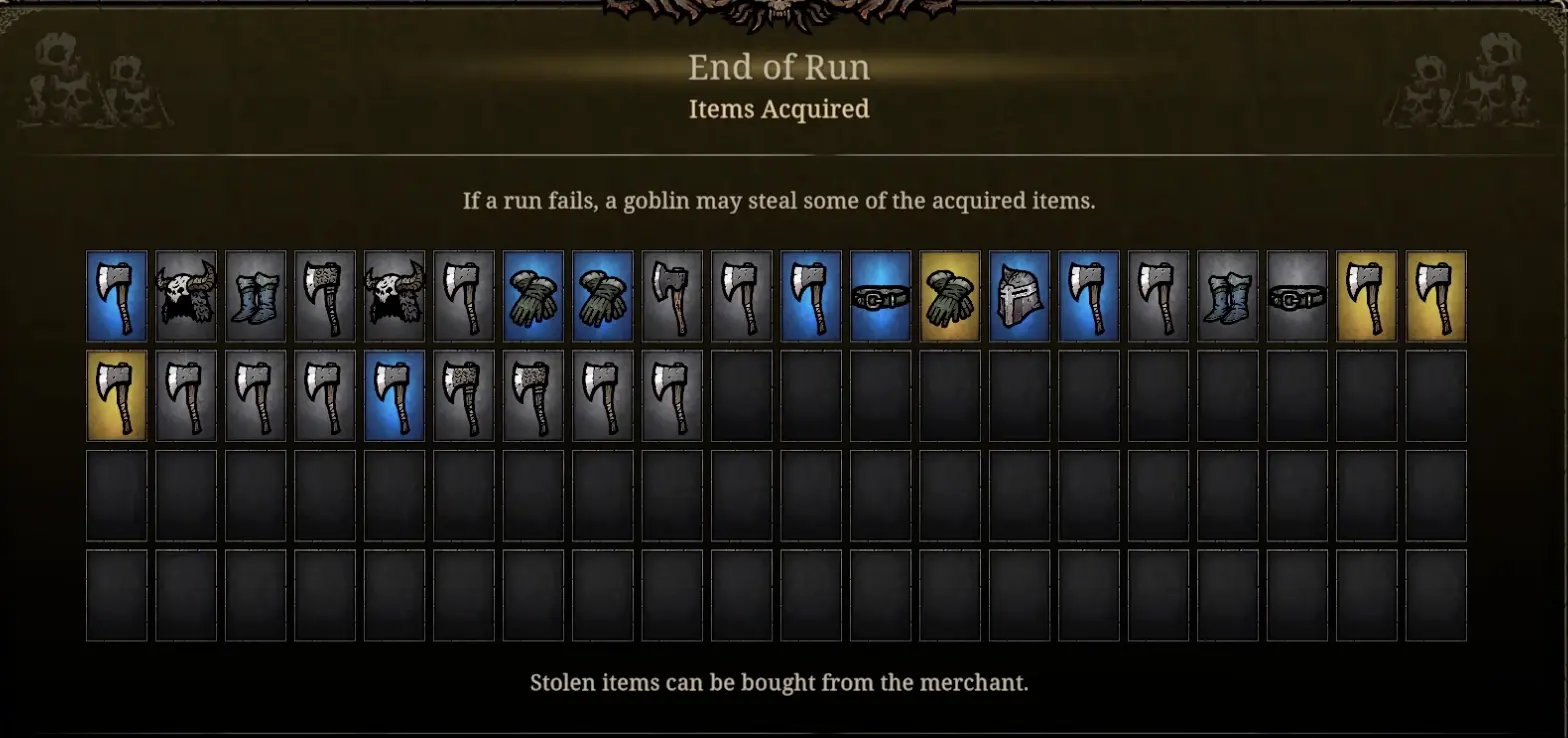
If a run fails, a goblin may steal some of the items you acquired during that run.
That sounds scary, but the game gives you a recovery path: stolen items can be bought from the merchant.
| Stolen item situation | What to do |
|---|---|
| The stolen item is low-level junk. | Let it go. |
| The stolen item is a clear upgrade. | Buy it back if the cost is reasonable. |
| The stolen item has a useful legendary effect. | Consider recovering it even if the base stats are not perfect. |
| You are short on gold. | Recover only build-changing items. |
| You keep losing loot on the same floor. | Farm a safer floor until your build improves. |
Use this table when a goblin steals loot after a failed run.
Inventory Tabs: Equipment, Jewels, and Runes
Your item bag is not only for equipment. It also has separate tabs for jewels and runes.
That matters because gear progression eventually connects to crafting. A weapon or armor piece may be the base item, while jewels, runes, and socket work become the upgrade layer.
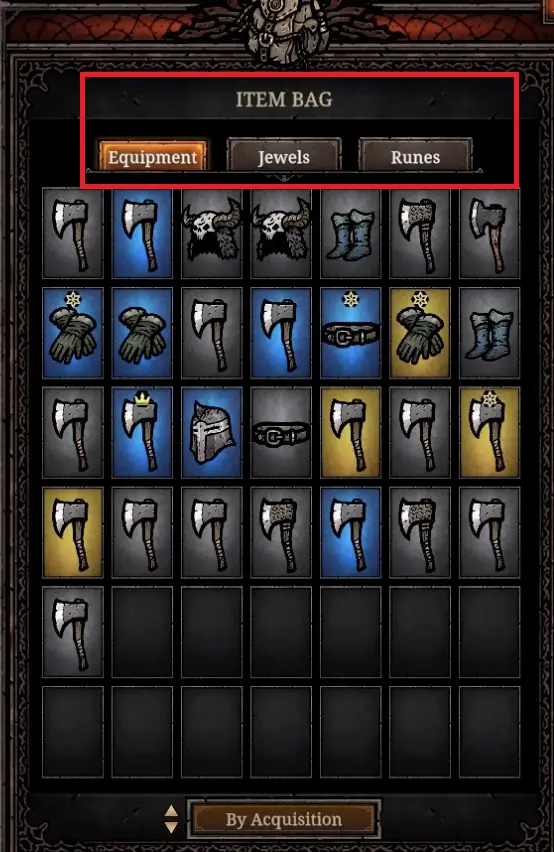
| Tab | What to check |
|---|---|
| Equipment | Weapons, armor, accessories, class restrictions, item level, rarity |
| Jewels | Materials or upgrade pieces for gear customization |
| Runes | Longer-term gear improvement resources |
| Sort options | Use sorting to find rarity, acquisition order, or likely upgrades faster |
What Gear Is Worth Enhancing or Socketing?
Do not enhance every item. Do not add sockets to gear you are about to replace.
Enhancement and socketing should be reserved for gear that will last. The Blacksmith can show item-specific costs after you place equipment; one confirmed early enhancement example shows a cost of 137 gold, but costs can vary by item and progression.
| Gear quality | Enhance or socket? |
|---|---|
| Low item level, no useful effect | No. Sell it. |
| Low item level, strong legendary effect | Store it for effect value, but be careful with materials. |
| High item level, useful stats | Good candidate. |
| High item level, wrong class | Store only if you play that class. |
| Legendary effect supports main build | Strong candidate if the item level is not too far behind. |
| Shop legendary with high buy price | Buy or enhance only if it changes your build immediately. |
| Socketed item with good base stats | Good candidate for gems, jewels, or runes. |
| Temporary upgrade | Equip now, but do not invest rare materials. |
Use this before spending materials on gear upgrades.
Final Greed and Final Enhancement
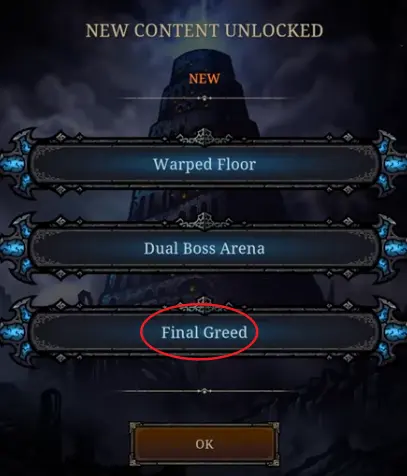
Final Greed unlocks after the Floor 21 final boss and connects to the late-game equipment layer.
The most important gear system here is Final Enhancement. Do not treat it like normal item enhancement. It is a final-step upgrade for equipment you already plan to keep.
| Final Enhancement rule | What it means |
|---|---|
| Can only be performed once per equipment piece | Do not use it casually on temporary gear. |
| Adds random effects | It may add one or two random effects, so the result is not fully controlled. |
| May add no effect | There is risk. Test carefully before using it on your best item. |
| Can be reverted | Check the cost and preview before relying on this. |
| Blocks some later changes | Enhancement reset, affix rerolling, and socketing may no longer be available after final enhancement. |
| Socket items can still be inserted and extracted | Socket item management is not completely locked out. |
| Best used last | Finish normal enhancement, affix choices, and socket planning first. |
Use this checklist before applying Final Enhancement to important gear.
Common Gear Mistakes and What Actually Happens
| Mistake | What actually happens |
|---|---|
| Selling before identifying | You may sell your best current weapon, armor piece, or hidden legendary effect without realizing it. |
| Keeping every legendary forever | Your stash fills with low item level effects, and real upgrades become harder to find. |
| Buying an orange shop item blindly | You can spend 1,000+ gold on a legendary that does not fit your class or main skill. |
| Ignoring item level | You keep wearing old gear while current floors are dropping much stronger base items. |
| Ignoring class restrictions | A good-looking item sits in your bag because your current character cannot equip it. |
| Only chasing DPS | You gain damage but lose the sustain, mana, movement, or resistance that kept you alive. |
| Enhancing temporary gear | You spend gold or materials on an item that gets replaced after one or two floors. |
| Not checking Lost items | A goblin may steal a real upgrade, and you leave it sitting in the merchant’s Lost tab. |
| Throwing away low-level legendary effects | You may lose an effect that could be transferred, tested, or used by another class later. |
These are the mistakes that cause real losses, not just messy inventory.
FAQ
How does gear work in Tower of Babel Survivors of Chaos? +
Gear gives item level, rarity, base stats, class restrictions, and sometimes legendary effects. A good item is not only about color. Check item level, useful stats, build fit, class compatibility, and whether the legendary effect supports the skills you actually use.
What does item level mean in Tower of Babel? +
Item level is a quick way to judge whether equipment belongs to your current floor range. Floor 1 Normal shows Acquired Item Lv. 1-3, while later 1.0 gear examples can reach much higher levels. Use item level as your first filter, then check stats and legendary effects.
How much do shop legendary items cost? +
Shop prices vary by item and progression, but an early example is the Legendary chest piece Light Barrage at Item Level 3 with a Buy Price of 1,080 gold. Always compare the price against your Altar upgrades and current gear before buying.
Should I buy legendary items from the shop? +
Buy a shop legendary only if it solves a real problem for your build. Check its item level, class restriction, buy price, stats, and legendary effect first. Do not buy it only because it is orange.
Should I keep old legendary gear? +
Keep old legendary gear if the effect is build-defining, if you can transfer the effect later, or if you plan to use it on another class. Sell or replace it if its item level is far behind and the effect does not matter for your current build.
What happens if a goblin steals my items? +
If a run fails, a goblin may steal some acquired items. You can buy stolen items back from the merchant through the Lost tab, but only recover items that are worth the gold.
What is Final Enhancement in Tower of Babel Survivors of Chaos? +
Final Enhancement is a late-game equipment upgrade connected to Final Greed after the Floor 21 final boss. It can only be performed once per equipment piece, may add one or two random effects, and should be used after normal enhancement, affix work, and socket planning are finished.
When should I use Final Enhancement? +
Use Final Enhancement only on gear you plan to keep. Do not use it on temporary gear, because enhancement reset, affix rerolling, and socketing may no longer be available after final enhancement.