How to Increase Nagash's Necropolis Limit in Warhammer 3
Use the Ritual of Undeath efficiently, lower its Necromantic Energy cost with corruption, create Undead Devastation, and raise Nagash's Necropolis limit.
Updated:
Quick Answer
Control more than half of the settlements in the province, then raise Vampiric Corruption before casting the Ritual of Undeath. Higher corruption reduces the current Necromantic Energy cost; use the Ritual on territory you can hold rather than a border province that may immediately be lost.
Applies to Update 9.0.2.
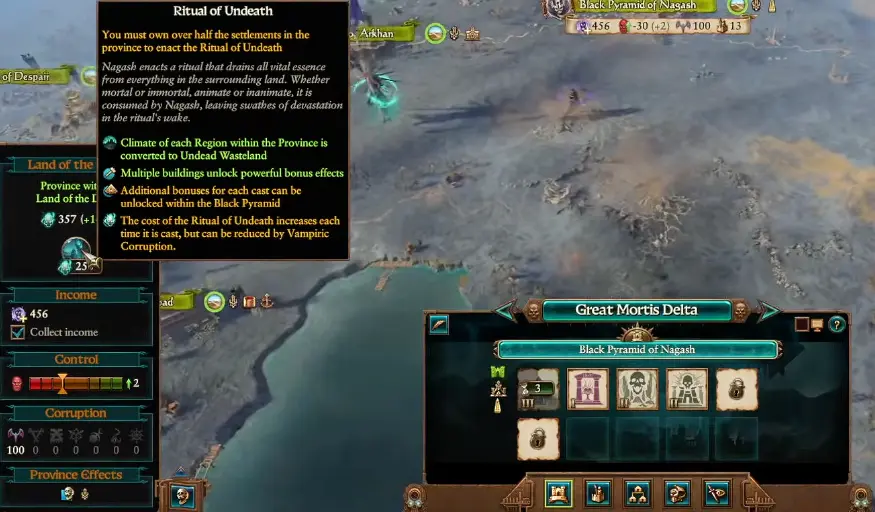
A full Necropolis limit can be expanded through the Ritual of Undeath, but the button is not available simply because a province has high corruption. Nagash must control more than half of that province’s settlements before the Ritual can be enacted.
Once that condition is met, corruption becomes the next concern. Vampiric Corruption reduces the current Necromantic Energy price, while repeated Rituals make later casts more expensive. The efficient sequence is therefore to secure the province first, raise corruption, pay for the Ritual only when the territory is safe, and save the resulting Necropolis capacity for a capital that improves the next campaign front.
High Corruption Makes the Ritual Cheaper, Not Permanently Cheap
Vampiric Corruption directly reduces the Necromantic Energy cost shown on the Ritual button. Raising corruption before casting is therefore worthwhile, especially once repeated Rituals have pushed the base price upward.
The tooltip also confirms what the Ritual actually changes: every region in the province is converted to Undead Wasteland, multiple buildings unlock additional effects, and further Ritual bonuses can be opened through the Black Pyramid.
The important resource trap appears later. An early province at 100 Vampiric Corruption can show a Ritual cost as low as 25 Necromantic Energy, while a later campaign state can still show 1250 at the same 100 corruption after many previous casts.

Do not treat maximum corruption as a guarantee of a cheap Ritual. It reduces the price you would otherwise pay at that point in the campaign; it does not reset the escalating cost.
When the current price is already consuming a large share of Nagash’s Necromantic Energy reserve, delay a low-value province. The Nagash economy guide covers the other demands competing for the same resource.
Devastation Changes What Settlement Buildings Give You
Vampiric Corruption and Undead Devastation are two different states. Corruption reduces the price of performing the Ritual; completing the Ritual converts the province to Undead Wasteland and activates devastation effects on buildings that support them.
The Black Pyramid gives a concrete example. Its Roused building state already provides income, defensive supplies, Vampiric Corruption, recruitment capacity, construction slots, and Lands of the Dead coverage. Once its province has been devastated by the Ritual of Undeath, the same tooltip adds two explicit effects:
Diplomatic relations: -1 with all factions
and
Empower 6 Sigils within the Black Pyramid.
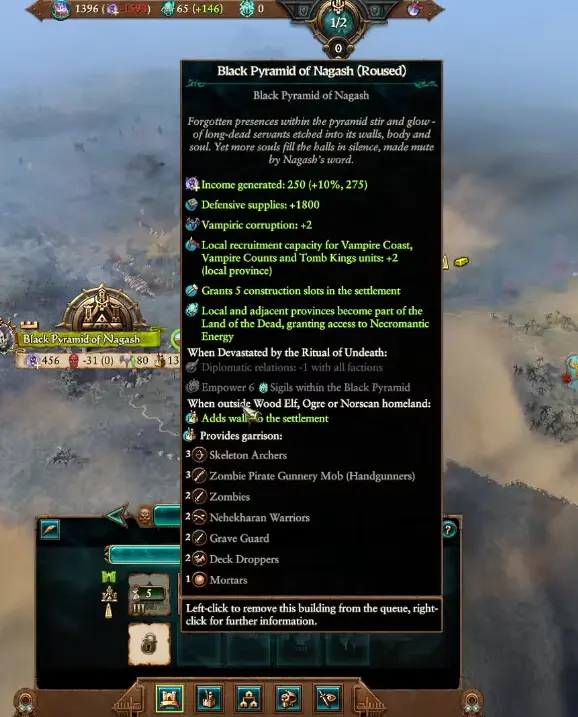
That makes the Ritual a trade rather than a free upgrade. Devastation can advance Black Pyramid progression and unlock stronger settlement effects, but every cast consumes Necromantic Energy, later Rituals become more expensive, and some bonuses carry their own campaign costs.
Three Devastated Provinces Open Another Necropolis Slot
Necropolis capacity grows as Nagash spreads Undead Devastation.
A practical cycle is three devastated provinces for the next Necropolis capacity increase. Once that additional capacity is available, a suitable province capital can be converted without deliberately pushing the faction over the limit.
The new slot does not need to be spent immediately. Save it until a capital extends the Lands of the Dead, supports a distant front, or provides enough strategic value to justify another Necropolis.
The Nagash economy guide covers the placement decision and the cost of exceeding the current limit.
Do Not Devastate a Province You Are About to Lose
This is one of the most expensive mistakes in the Ritual cycle.
Undead Devastation can be lost if enough settlements in that province fall out of Nagash’s control. In the campaign example, losing settlements could return a devastated province to its previous state.
The Ritual’s escalating cost does not rewind with that loss.
That means a province can consume one of your cheaper Ritual casts, lose its devastation after an enemy counterattack, and still leave later Rituals more expensive.
Before paying the cost, ask whether the province can realistically be held.
Interior territory behind an established front is a much safer target. A newly conquered province beside several hostile armies should usually wait until the border has moved farther away or a defensive army can protect it.
Spending one extra turn raising corruption is cheap compared with paying for the same strategic progress twice.
Later Rituals Cost More, So Not Every Province Deserves One
Ritual of Undeath costs climb as more Rituals are performed.
Maximum corruption does not stop that escalation. The earlier example at 100 Vampiric Corruption showed a cost of only 25 Necromantic Energy, while a much later Ritual at the same 100 corruption showed 1250.
That makes province selection increasingly important. Early in the campaign, a cheap Ritual can be easy to justify. Later, devastating a low-value province can consume enough Necromantic Energy to delay a Black Pyramid upgrade, recruitment, or another Ritual that actually increases useful Necropolis coverage.
Devastating a province is easy to justify when it does one or more of the following:
- completes the next group needed for another Necropolis slot;
- activates valuable settlement or Necropolis bonuses;
- adds useful Black Pyramid Sigils;
- secures a province that will remain part of Nagash’s core territory.
The case is much weaker when the province has no useful buildings, no Necropolis role, no immediate capacity value, and a high chance of being lost.
Necromantic Energy spent there cannot be used for the other systems competing for the same resource.
Use the Ritual to Turn Necropolises Into Sigil Progress
Undead Devastation also matters because some Nagash buildings award additional Sigils after the Ritual has changed the province.
The exact return depends on the building and its level. Higher-tier Necropolis infrastructure can produce substantially more Sigil progress than a low-value settlement that was devastated only because the Ritual button was available.
This makes the order important:
- choose a province worth keeping;
- raise its Vampiric Corruption;
- develop the buildings that benefit from devastation;
- cast the Ritual when the Necromantic Energy cost has fallen;
- use the resulting devastation toward the next Necropolis capacity threshold.
Those Sigils eventually contribute to the same Black Pyramid progression used throughout Nagash’s campaign. Mortarchs are another major source; the Nagash Mortarch requirements explain the 5-Sigil reward attached to each one.
When Should You Cast the Ritual of Undeath?
A province is ready when several conditions line up at the same time.
Corruption is high enough that the current Necromantic Energy price is acceptable. Maximum corruption can reduce the current price sharply, but repeated Rituals still push later costs upward; the observed 100-corruption examples ranged from 25 early to 1250 much later.
The province is secure. Do not pay for devastation on a front that is likely to lose settlements immediately.
The Ritual advances something useful. That may be the next Necropolis-cap increase, a strong devastation building bonus, or Sigil progression.
Nagash can afford the Energy now. If the same Necromantic Energy is needed for immediate recruitment, construction, or another campaign action, waiting can be better than devastating a low-priority province.
Once those conditions are satisfied, use the Ritual and move to the next stable province rather than spending Energy indiscriminately across the map.
The cycle becomes much more efficient when each cast has a specific job: lower the current cost with corruption, secure the devastation, reach the next three-province threshold, and place the new Necropolis where Nagash is actually going next.