How to Fix Nagash's Economy in Total War: Warhammer 3
Keep Nagash moving by prioritizing the Black Pyramid, protecting Necromantic Energy, using conquest cash flow, and avoiding bad Necropolis spending.
Updated:
Quick Answer
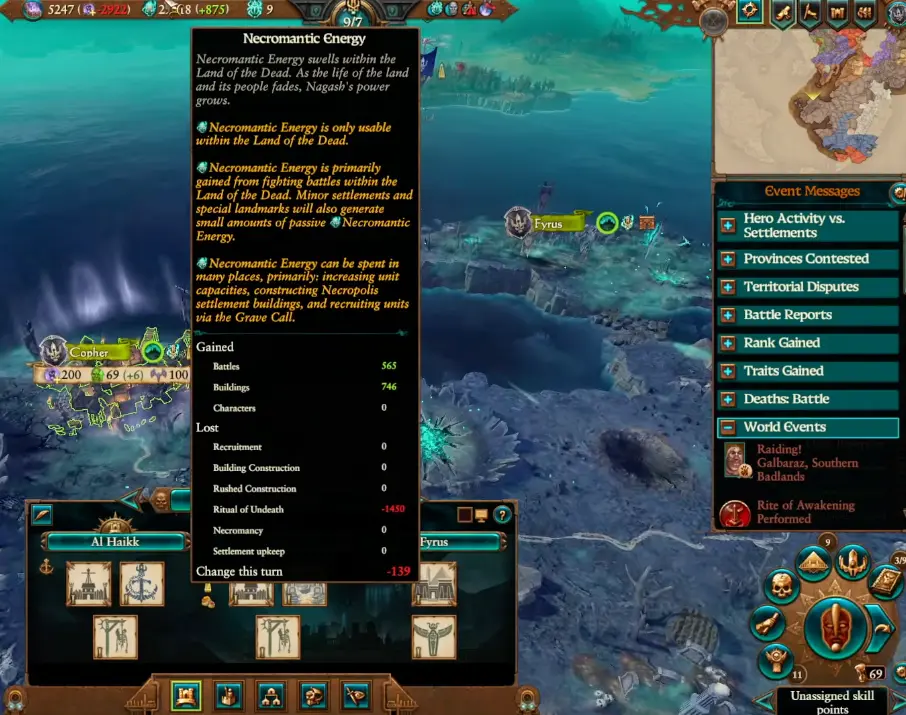
A negative Dark Energy income is manageable as long as your treasury can survive until the next profitable battle, sack, or settlement capture. Before recruiting another army, protect your next important Black Pyramid upgrade and avoid spending Necromantic Energy on disposable Grave Call units when normal recruitment is available.
Watch your Necropolis limit as well. Exceeding it can reduce building income and Necromantic Energy generation across the faction.
Applies to Update 9.0.2.
Nagash’s early economy behaves badly if it is treated like a normal faction that should stay green every turn. Minor settlements do not generate enough income to fund every army you can recruit, while the campaign constantly asks for Dark Energy, Necromantic Energy, Black Pyramid upgrades, new fronts, and expensive settlement development at the same time.
The useful question is not whether the income number is red. It is whether the treasury can keep Nagash moving until the next source of cash arrives, without sacrificing the Black Pyramid upgrades and Necromantic Energy that actually unlock more of his campaign.
Red Income Is Not the Same as a Broken Economy
Nagash can function in the red.
A negative per-turn number becomes dangerous when the treasury will run out before the next battle, sack, settlement capture, or other cash injection. Until then, a deficit can simply be the cost of keeping enough force on the map to continue expanding.
Before recruiting another expensive unit or starting another building, check the treasury as a runway:
How many turns of deficit can the current reserve absorb?
Will Nagash reach another profitable battle or settlement before that reserve is gone?
Can the next important Black Pyramid upgrade still be purchased on time?
If the answers are yes, staying temporarily negative is not automatically a mistake. If the army will run out of cash before the next objective and the Black Pyramid is already being delayed, military spending has gone too far.
This is also why chasing a perfectly green economy with ordinary minor-settlement income can be misleading. A settlement that barely pays for one low-tier unit will not solve the cost of multiple campaign armies by itself.
Check Settra’s Wars Before Choosing the First Major Target
Khemri is close, valuable, and dangerous enough that attacking Settra early can still make sense. It should not be an automatic Turn 1–2 target in every campaign.
Open diplomacy and look at what Settra is already doing.
If Settra is fighting Skarbrand, Mannfred, or another eastern threat, leaving him alive for a few more turns can be useful. Khemri sits on the route between Araby and the Badlands, so Settra can absorb pressure that would otherwise reach Nagash’s territory.
In that situation, clear the starting enemy to the north first, then consider turning west toward Volkmar. His coastal territory includes ports that can contribute much more meaningful early income than another ordinary inland minor settlement. Once that western front is secured, check Settra again. If his wars have weakened him or he has stopped serving as a buffer, Khemri becomes a much cleaner target.
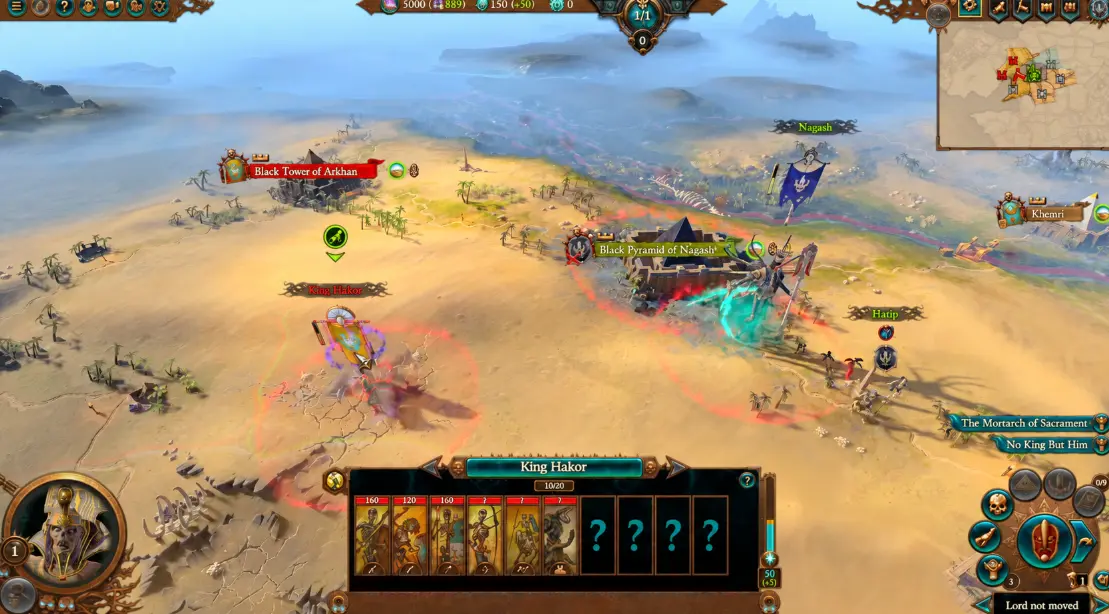
If Settra is not tied down and is expanding toward Nagash, pressure Khemri earlier. Letting an uncontested Settra grow stronger simply creates a harder war later.
The opening route is therefore conditional:
- Settra is busy with Skarbrand or Mannfred: use the breathing room to clear the north or pressure Volkmar and his ports.
- Settra is free and expanding toward you: make Khemri the priority before his position becomes more expensive to break.
Either route is better than fighting every nearby faction just because it is adjacent.
Fill Normal Recruitment Capacity Before Spending Necromantic Energy
Cheap units are not automatically cheap if they consume the wrong resource.
Nagash can recruit Tomb Kings units through normal capacity very early. If another Nehekhara Warrior or similar conventional unit is available without spending Necromantic Energy, use that capacity before paying for Grave Call Zombies simply to beat a minor starting army.
The early campaign needs Necromantic Energy for too many other jobs to treat it as disposable recruitment money. Grave Call becomes valuable when it solves an immediate emergency, replaces losses far from conventional recruitment, or provides a unit that materially changes the next battle. Spending it on bodies for a fight the existing army can already win slows more important progression.
Those early Tomb Kings recruits also help with Arkhan’s Mortarch requirement, so normal recruitment can advance two problems at once.
A rear Lord can still be useful when Nagash moves away from the Black Pyramid. Keep that force as small as the threat allows. Raising another Lord does not mean immediately filling twenty slots with whatever Grave Call offers.
Upgrade the Black Pyramid Before Chasing Minor-Settlement Income
A minor settlement income building can be useful, but it should not outrank an important Black Pyramid upgrade merely because the per-turn number turns greener.
The Black Pyramid affects Nagash’s campaign far beyond ordinary income. Its progression opens units, campaign effects, Mortarch-related requirements, travel options, and other systems that determine what Nagash can do next.
When Dark Energy is limited, spend in this order:
First, protect the next important Black Pyramid upgrade. If a minor building delays a meaningful unlock by several turns, the Pyramid usually wins.
Second, keep enough military strength to continue taking settlements and winning profitable battles. An army that keeps moving can generate cash; an overbuilt rear stack sitting in a safe settlement only consumes it.
Third, invest in settlement income where the return is actually meaningful. Ports, resources, landmarks, and strong province capitals deserve more attention than an ordinary minor settlement producing only a small amount each turn.
The Black Pyramid should not consume every resource blindly, but it is the wrong place to economize while paying for low-impact construction elsewhere.
Sack Settlements When the Cash Matters More Than Their Current Tier
Conquest is part of Nagash’s cash flow.
When a settlement offers a meaningful sack payout, take that money before occupying if the loss of settlement level and buildings will not hurt the next phase of the campaign. The extra Dark Energy can fund Black Pyramid construction, replacement troops, or several turns of negative upkeep.
Do not turn that into an automatic rule for every settlement.
A valuable capital, important landmark, developed port, or settlement that needs to become an immediate strategic anchor may be worth preserving at a higher tier. Destroying useful infrastructure for a small one-time payment only creates another bill later.
The decision is simple: compare the sack payout with what is being destroyed.
If the settlement’s existing tier and buildings are not important and the cash keeps Nagash moving, sack first. If preserving the settlement immediately unlocks something more valuable, occupy it intact.
Ports and Resources Matter More Than Ordinary Minor Settlements
Ports are especially useful because they give Nagash a form of recurring income that scales better than relying on basic inland settlements alone.
That is one reason Volkmar can be an attractive early target when Settra is busy elsewhere. Taking profitable coastal territory can improve the treasury while Settra continues shielding the eastern approach.
Resource settlements deserve similar attention. Gold, gems, and other valuable resources can justify an expansion route that would otherwise be optional, particularly when Nagash is already carrying a deficit.
The best economic territory does not merely make the income number larger. It buys additional campaign time before the treasury empties, which lets Nagash keep enough armies active to continue generating battle and sack income.
Battles Only Generate Necromantic Energy Inside the Lands of the Dead
Dark Energy can be recovered through conquest, but Necromantic Energy from battles depends on location.
Combat-generated Necromantic Energy is gained inside the Lands of the Dead. The Black Pyramid and Necropolis network create that coverage across their surrounding area; owning a distant settlement alone does not guarantee that a battle there contributes the same way.
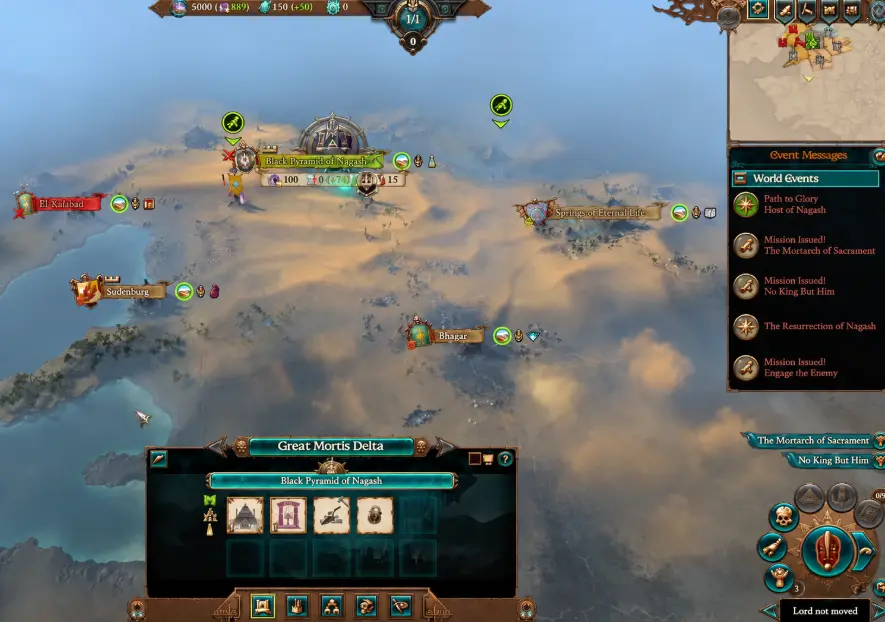
Before opening a long new front, check whether the route remains inside useful Lands of the Dead coverage. If several upcoming battles sit beyond it, a forward Necropolis can eventually make that entire war more productive.
This is also why spending Necromantic Energy on unnecessary early Zombies hurts twice: the resource is already limited, and Nagash needs it to build the infrastructure that helps future battles generate more of it.
Put Necropolises Where They Change the Next Campaign Front
Necropolis slots are too valuable to spend only because a capital is available.
A useful Necropolis should normally accomplish at least one of three things:
- extend the Lands of the Dead into the next war;
- support a valuable landmark, resource, port, or major capital;
- create recruitment and campaign support far enough from the existing network to matter.
An early Necropolis at the Black Tower of Arkhan overlaps heavily with territory already supported by the Black Pyramid. That uses limited capacity without adding much reach.
A more distant strategic capital can support several future battles that would otherwise occur outside the Lands of the Dead.
Holding an unused Necropolis slot is therefore not wasted capacity. If the next captured capital will extend the network much farther, wait.
Going Over the Necropolis Limit Hits the Whole Economy
The game allows Nagash to exceed the Necropolis limit, but the penalty reaches far beyond the extra settlement.
At 9 Necropolises with a limit of 7, the campaign UI shows:
- Necromantic Energy gain from battles: -20%
- Necromantic Energy gain from buildings: -20%
- Income from all buildings: -20%
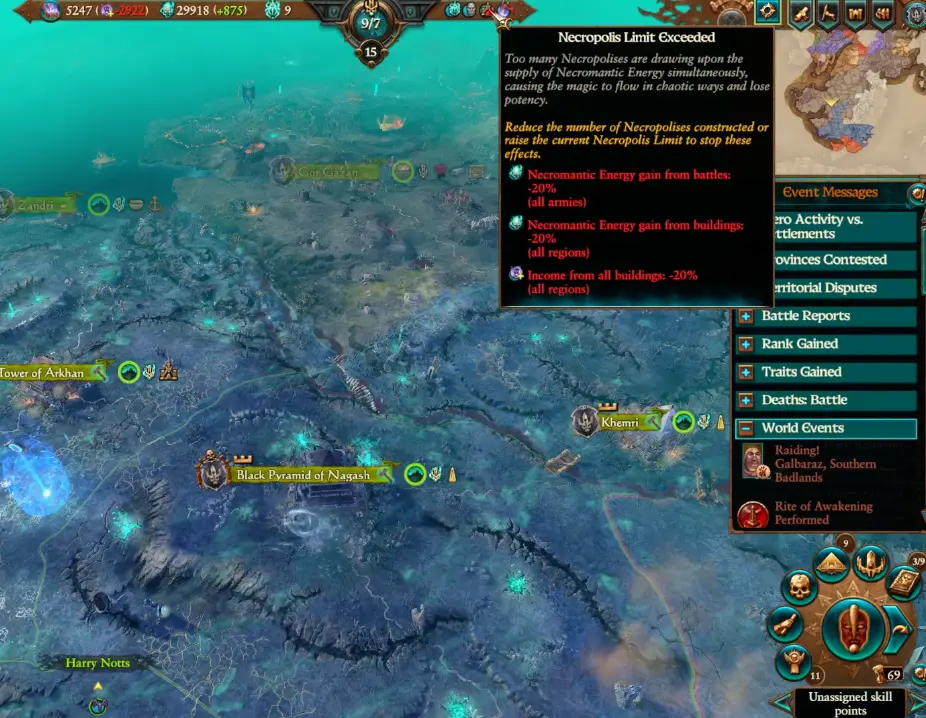
That is an expensive way to gain one more position. The extra Necropolis can make every existing source of money and Necromantic Energy worse at the same time.
When the limit is full, raise it through the Ritual of Undeath instead of accepting the faction-wide penalty. Save the new capacity for a capital that actually extends useful coverage or unlocks something the current network cannot provide.
A Second Full Army Needs a Job, Not Green Income
Nagash does not need to wait for a perfectly positive budget before adding another serious army.
The better test is whether that army will generate enough military value before its upkeep empties the treasury.
A second full stack becomes worthwhile when Nagash is leaving a real front behind, when the northern or western campaign is too far away for him to return quickly, or when that army will actively capture settlements and fight battles rather than sit inside the core territory.
Before upgrading a defensive Lord into a proper army, check three things:
Will the army fight during the next several turns? If it will mostly stand still, delay it.
Can the treasury survive its upkeep until the next expected sack or capture? Negative income is acceptable; an empty treasury before the next payout is not.
Does recruiting it delay a critical Black Pyramid upgrade? If so, the new army needs to solve a more urgent problem than the upgrade it is replacing.
This becomes much more important once Nagash moves toward the Empire. Early in the campaign, a small defensive force can cover the rear. Later, distance makes a second active army worth far more than another minor income building.
Use Mannfred as a Buffer When the Border Allows It
Mannfred does not always need to be absorbed the moment his requirements are nearly complete.
If another faction such as Wurrzag is pressuring the border, a settlement trade can sometimes give Mannfred territory positioned to absorb that threat while Nagash continues elsewhere. The purpose is to shape the front, not to keep handing settlements back and forth for money.
This only works while Mannfred remains eligible for later subjugation. His region count still matters, so do not solve one border problem by letting him expand beyond the limit needed for his Mortarch unlock.
Used carefully, he can hold a dangerous border for several turns and save Nagash the cost of another defensive army.
Spend Necromantic Energy on Progression Before Disposable Convenience
Necromantic Energy becomes easier to waste as more recruitment options appear.
Prioritize spending that changes the campaign:
- important Black Pyramid progression;
- Necropolis development;
- Ritual of Undeath when more capacity is actually needed;
- recruitment that solves a fight normal capacity cannot already handle;
- infrastructure that extends the Lands of the Dead into an active front.
A Grave Call unit that prevents a defeat is worth its cost. A stack of Zombies raised only because the button is available is much harder to justify when the same resource is delaying the systems that make Nagash stronger permanently.
The economy is working when the treasury lasts long enough to reach the next profitable conquest, the Black Pyramid keeps advancing, and Necromantic Energy is being spent on progression or genuine emergencies rather than routine convenience.