MechWarrior 5 Ashes & Ascension: All 13 Clan 'Mechs
Find all 13 new Clan 'Mechs in Ashes and Ascension, compare their variants, and decide which machines are worth salvaging, buying, repairing, or keeping.
Updated:
Quick Answer
Check your starting roster and the Salvage screen for the new Clan ‘Mechs. The Ashes & Ascension Career selection includes machines such as the Huntsman and Hunchback IIC.
Before taking a damaged Clan chassis or buying one from the market, check whether you have the weapons, ammunition, C-Bills, and repair time needed to deploy it. Take usable Clan equipment instead when the chassis cannot be ready for your next mission.
Ashes and Ascension adds 13 Clan ‘Mech chassis, but adding one to your hangar is not the same as adding one to your next lance.
A Huntsman can remain one of your most useful machines across several operations. A much heavier Clan assault ‘Mech may look like an obvious upgrade after a successful battle, yet spend the next few missions under repair. The difference becomes especially painful once Operation Bulldog starts moving your company between deployments faster than its damaged machines can return to service.
You can encounter the new machines as enemies, find them in salvage selections, and encounter available variants in the Mech Market. Their usefulness depends on the actual configuration, your Career date, and how much work the recovered chassis needs.
The right purchase or salvage choice should leave you with a machine you can field, not merely a more impressive name in Cold Storage.
All 13 new Clan ‘Mechs and their variants
The DLC adds the following 13 chassis. Some appear under alternate Inner Sphere reporting names, so check the designation as well as the displayed name.
| New Clan ‘Mech | DLC variants |
|---|---|
| Arctic Cheetah / Hankyu | ACH-PRIME, ACH-C, ACH-E |
| Arctic Wolf | ACW-1, ACW-2, ACW-PRIME, ACW-A, ACW-P |
| Ice Ferret / Fenris | IFR-PRIME, IFR-A, IFR-B, IFR-C, IFR-P |
| Hunchback IIC | HBK-IIC, HBK-IIC-A, HBK-IIC-B, HBK-IIC-C, HBK-IIC-DW |
| Huntsman / Nobori-nin | HMN-PRIME, HMN-A, HMN-B, HMN-C, HMN-P |
| Nova Cat | NCT-PRIME, NCT-B, NCT-P, NCT-WD |
| Sun Spider | SNS-PRIME, SNS-A, SNS-ML, SNS-AMB |
| Marauder IIC | MAD-IIC, MAD-IIC-X, MAD-IIC-Y, MAD-IIC-DN |
| Warhammer IIC | WHM-IIC, WHM-IIC-2, WHM-IIC-A, WHM-IIC-BL |
| Blood Asp | BAS-PRIME, BAS-B, BAS-D, BAS-SA |
| Supernova | SNV-1, SNV-2, SNV-BR |
| Stone Rhino / Behemoth | SR-1, SR-2, SR-4, SR-5, SR-6, SR-K, BHN-6H |
| Bane / Kraken | BANE-1, BANE-2, BANE-3 |
There are 56 listed configurations across these 13 chassis. That does not mean all 56 are immediately obtainable during the 3058–3060 Operation Bulldog campaign.
Some variants belong to later Career years. For example, the Arctic Cheetah ACH-E and several Arctic Wolf configurations have later availability dates than the opening campaign. Finding the chassis family in the DLC does not guarantee that every variant can appear in your current market or salvage selection.
This also matters when identifying your collection. The DLC separately adds the Inner Sphere Blackjack OmniMech, Black Hawk-KU, and Perseus. Those are not part of the 13 Clan chassis above.
Likewise, a Timber Wolf, Dire Wolf, Shadow Cat, Mad Dog, or Hellbringer encountered during the campaign should not be mistaken for one of the thirteen newly introduced chassis.
Which new Clan ‘Mechs are worth keeping first?
A new Career does not need an immediate collection of assault machines. The more useful question is which chassis improves a role your existing company cannot cover.
Huntsman — the most practical early machine to protect
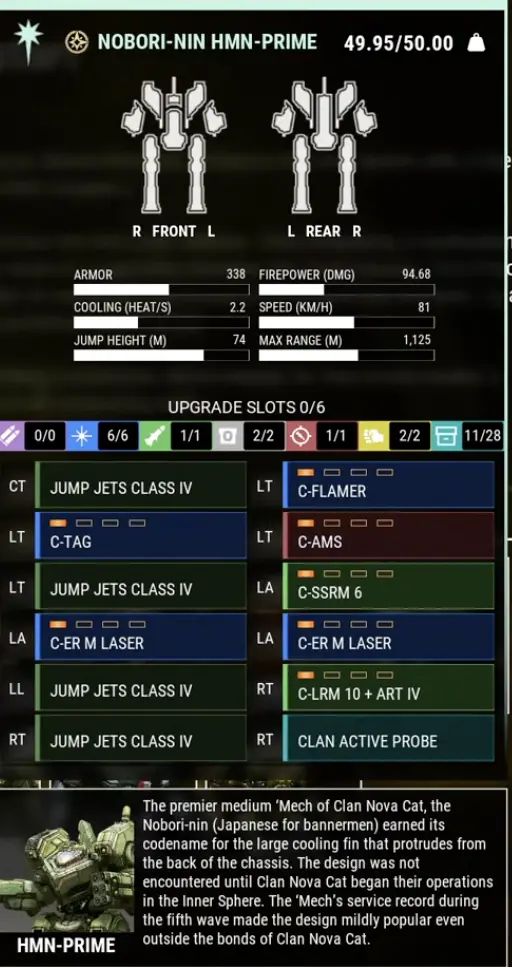
The Huntsman is one of the most immediately useful additions for a developing company.
Its 50-ton chassis provides a flexible medium-‘Mech platform, with different configurations offering a mixture of energy, missile, and other weapon hardpoints. It can contribute meaningful firepower without consuming the same drop tonnage as a heavy or assault machine.
The Huntsman is particularly valuable when your company needs a functioning machine rather than another reconstruction project.
During the campaign, a Huntsman can remain unavailable through several battles while repairs are underway, then return just in time for another deployment. That creates a choice between keeping its current workable configuration and spending additional days improving the loadout.
Returning it to service is usually the better immediate result when your lance lacks enough healthy machines.
Check the weapon groups and cooling before deploying. A configuration with useful energy and missile weapons still needs sufficient ammunition for its missile systems and enough heat capacity to maintain fire.
Do not remove working equipment merely because a more powerful weapon has appeared in the market. A refit that keeps the Huntsman unavailable through the next operation defeats the purpose of preserving it.
Hunchback IIC — powerful weapons, expensive mistakes
The Hunchback IIC is another early option worth inspecting carefully.
At 50 tons, its variants can carry substantial firepower for a medium chassis. The standard HBK-IIC has two large ballistic hardpoints, while other configurations emphasize energy or missile weapons.
That makes the exact variant important.
A ballistic Hunchback without enough compatible ammunition is not ready for a long battle. An energy-focused version may avoid ammunition dependence, but its heat generation and weapon condition still determine whether it can maintain useful damage.
The Hunchback IIC also demonstrates the danger of evaluating a machine only by its potential damage.
A heavily damaged example can require extensive work before it becomes operational again. One campaign preparation screen shows a repair estimate reaching 36 days while the company has a much shorter window before its next mission.
Before accepting a damaged Hunchback IIC, inspect the primary weapon locations and the repair estimate. Losing the major weapon systems can turn an attractive salvage choice into a lengthy rebuilding project.
Keep it when the weapons are still useful, the repair bill is affordable, and the machine can return before an important deployment. Otherwise, taking equipment from the same salvage selection may leave your active roster in better condition.
Arctic Cheetah, Arctic Wolf, and Ice Ferret — speed and specialist roles
These lighter machines are not direct substitutes for the heavier Clan chassis.
The Arctic Cheetah is a 30-ton light OmniMech suited to mobility and reconnaissance work. Its usefulness comes from reaching positions quickly rather than absorbing the same punishment as a heavy assault machine.
The Arctic Wolf is a 40-ton medium chassis family with missile-focused options. Its missile capacity makes ammunition supply and intended engagement distance important when comparing variants.
The Ice Ferret, also known as the Fenris, is a 45-ton medium OmniMech. Its mobility makes it a candidate for flanking and for keeping pace with a faster player-controlled machine.
The best reason to keep one of these machines is a specific job:
- A fast scouting machine for operations where identification and movement matter more than total firepower.
- A missile carrier that fills a gap in your available weapons.
- A mobile reserve that can support a faster lance without falling far behind.
Do not replace a functioning heavy simply because a new light or medium Clan chassis has appeared.
For an operation requiring prolonged fighting against heavy Jaguar units, check whether the lighter machine has the armor, ammunition, and damage output to survive the actual assignment.
Janette’s nine-target reconnaissance operation is a good example of a mission where mobility can matter more than raw tonnage. The campaign walkthrough covers the objective and extraction requirements.
When should you salvage a Nova Cat, Marauder IIC, or Warhammer IIC?
The heavier Clan chassis become tempting as Operation Bulldog moves into increasingly difficult engagements.
The Nova Cat offers substantial energy-weapon potential. The Marauder IIC and Warhammer IIC provide heavier combat platforms, including configurations built around powerful energy weapons.
But the practical difference between them depends on the variant and condition.
A fresh Nova Cat with functioning weapons can be worth retaining when your company needs another heavy machine. A Nova Cat that has lost critical components may spend much of the remaining campaign in the Mech Lab.
The same reasoning applies to an acquired Marauder IIC or Warhammer IIC. A high-damage loadout is valuable only if the important weapons and cooling equipment survive, or you have the resources to replace them.
Consider a salvage screen offering a damaged heavy Clan ‘Mech alongside several functioning weapons. The chassis promises more firepower after reconstruction, but the weapons may improve an existing machine without requiring the same amount of work.
That makes the salvage decision dependent on what is already available in your company.
If your lance has enough operational machines for the next few drops, taking the heavier chassis may be worthwhile. If two of your current machines have lost their primary weapons, the equipment is likely more useful.
Check heat capacity before keeping an energy-heavy loadout
Large Clan energy weapons can produce high damage at useful ranges, but heat management limits how consistently that damage can be delivered.
A damaged Nova Cat or an energy-heavy Marauder IIC can become less useful when its cooling equipment has been destroyed or removed.
Before approving a refit, compare the new configuration’s heat generation with its cooling capacity.
A loadout that performs well during a brief opening attack may struggle if the mission continues through several enemy waves without enough cooling.
Do not assume that replacing every medium laser with a heavier energy weapon automatically improves the machine. The result depends on whether the chassis can continue firing and whether the work finishes before the next operation.
Sun Spider, Blood Asp, Supernova, Stone Rhino, and Bane
The remaining heavy and assault chassis offer additional options, but not every one deserves an immediate purchase.
Sun Spider is a 70-ton heavy chassis. Evaluate the specific configuration against your current long-range and sustained-damage needs. A heavier chassis is not automatically a better fire-support platform if its weapons or equipment are damaged.
Blood Asp is a 90-ton assault OmniMech. It is worth examining when the company needs a high-firepower assault platform, but the final decision depends on the available configuration, repair requirements, and whether your active lance already covers the same role.
Supernova is another assault option, particularly relevant to players who favor heavy energy weaponry. You also fight a Supernova during the Gregor Nostra encounter on Janette. Defeating that enemy is part of the campaign, not an automatic guarantee that a fully operational Supernova will join your company.
Stone Rhino, also called the Behemoth, is a 100-ton assault chassis. Its size makes it attractive when you have room for a maximum-weight lance, but repairing a badly damaged example can require a long period of reconstruction.
Bane, also known as the Kraken, is a 100-ton assault chassis family with multiple ballistic-heavy configurations. Its weapons, ammunition availability, and repair requirements should be checked together.
The Stone Rhino is a particularly good warning against buying for tonnage alone.
A damaged Stone Rhino or Marauder IIC can remain in the repair queue for more than four months in a struggling Career. That is too long to help an operation scheduled within days or weeks.
The machine may still be worth keeping for later Career use, but it will not solve an immediate deployment problem.
The practical question is whether you are purchasing a machine for the next battle or for the company you want after Operation Bulldog.
Both decisions can make sense. They should not be confused.
Where do you get the new Clan ‘Mechs?
There are three practical acquisition routes to check: your starting Career roster, salvage after combat, and the Mech Market.
Starting Career roster
The Ashes & Ascension Career option can show new Clan equipment and machines such as the Huntsman and Hunchback IIC among the starting selections.
Check the actual roster after choosing your Career start.
The available machines determine whether you need to buy anything before Operation Bulldog begins. Several functional medium and heavy machines can be more useful than spending heavily on another assault chassis before the first deployment.
Starting an imported Career is a separate decision because it changes the inventory, company funds, pilots, and machines available to you. For the actual Career selection and campaign entry conditions, follow how to start Ashes and Ascension.
Battlefield salvage
After fighting Clan forces, inspect the salvage selection rather than automatically taking the heaviest chassis.
Enemy ‘Mechs may be badly damaged by the end of a battle. Losing their major weapons or taking substantial structural damage can dramatically increase the work required before they can be used.
Check the salvage cost, the condition of the chassis, and the equipment included with it.
Taking a heavily damaged Clan machine for its future value is reasonable when you have the resources to rebuild it. Taking one because you need a replacement for the next mission is a different calculation.
Mech Market purchases
The Mech Market can offer desirable Clan machines, but a purchase price is only the first expense.
A machine may still need repairs, new ammunition, replacement weapons, or a suitable pilot before it can join your lance.
During a fresh Career, expensive market options can appear while the company is already struggling to pay for essential repairs. A Clan machine costing around 16 million C-Bills is not much help if buying it leaves you unable to restore the machines you already own.
Inspect the market offering and compare it with your existing roster.
Buy when the offered machine is operational or can be repaired in time, fills a real combat role, and leaves enough money for the next set of repairs.
Leave it when it duplicates a working machine or would consume the funds needed to keep your primary lance operational.
The market is an opportunity to improve the company, not a requirement to collect every Clan chassis during the campaign.
Salvage a Clan chassis or take its weapons?
The strongest salvage choice changes as your roster changes.
A damaged Clan ‘Mech might be more valuable as a collection of working weapons than as another chassis waiting for repairs.
Clan ER weapons, pulse lasers, LB-X autocannons, Streak equipment, AMS components, and double heat sinks can be useful when they replace equipment your operational machines have lost.
That does not mean every Clan weapon is an automatic upgrade.
When equipment is the better choice
Suppose a ready machine needs a replacement ballistic weapon, while the salvage screen offers an intact Clan LB-X autocannon and a heavily damaged Clan chassis.
Taking the weapon may restore useful firepower without creating another extensive repair project.
Before selecting it, make sure the receiving machine has compatible hardpoints and that you have the correct ammunition.
Clan weaponry can create its own supply problem. A powerful LB-X autocannon is of little immediate use without enough ammunition to support it.
The same applies to Streak missile systems. A weapon should be judged together with the supplies needed to operate it.
An available weapon is worth more when it can be installed on a functioning machine and put into service before the next mission.
When the chassis is worth taking
Take the Clan chassis when it improves the roster in a way that individual weapons cannot.
That may mean adding a missing heavy or assault role, replacing several aging machines, or keeping a valuable configuration for later Career operations.
Check the repair estimate before committing.
A chassis requiring 15 days of repairs might be an excellent acquisition when the company has several weeks available. The same chassis cannot help when the next operation begins in three days.
If the salvage includes a machine you cannot repair immediately, keeping it in Cold Storage can preserve the acquisition for later without requiring you to force it into the active lance.
Do not dismantle functioning machines to finish a new project unless the resulting configuration will genuinely improve your deployable roster.
Why is a salvaged Clan ‘Mech still unavailable?
A successful salvage selection only adds the machine to your inventory. It does not guarantee that the machine is combat-ready.
The most common obstacle is a repair or refit order that finishes after the next launch.
A damaged Hunchback IIC can show a work order lasting several dozen days. A Nova Cat can remain unavailable after a difficult battle, while an extensively damaged assault chassis may need months to restore.
The company may technically own several impressive Clan machines and still be forced to deploy an older Warhammer, Victor, or other available reserve.
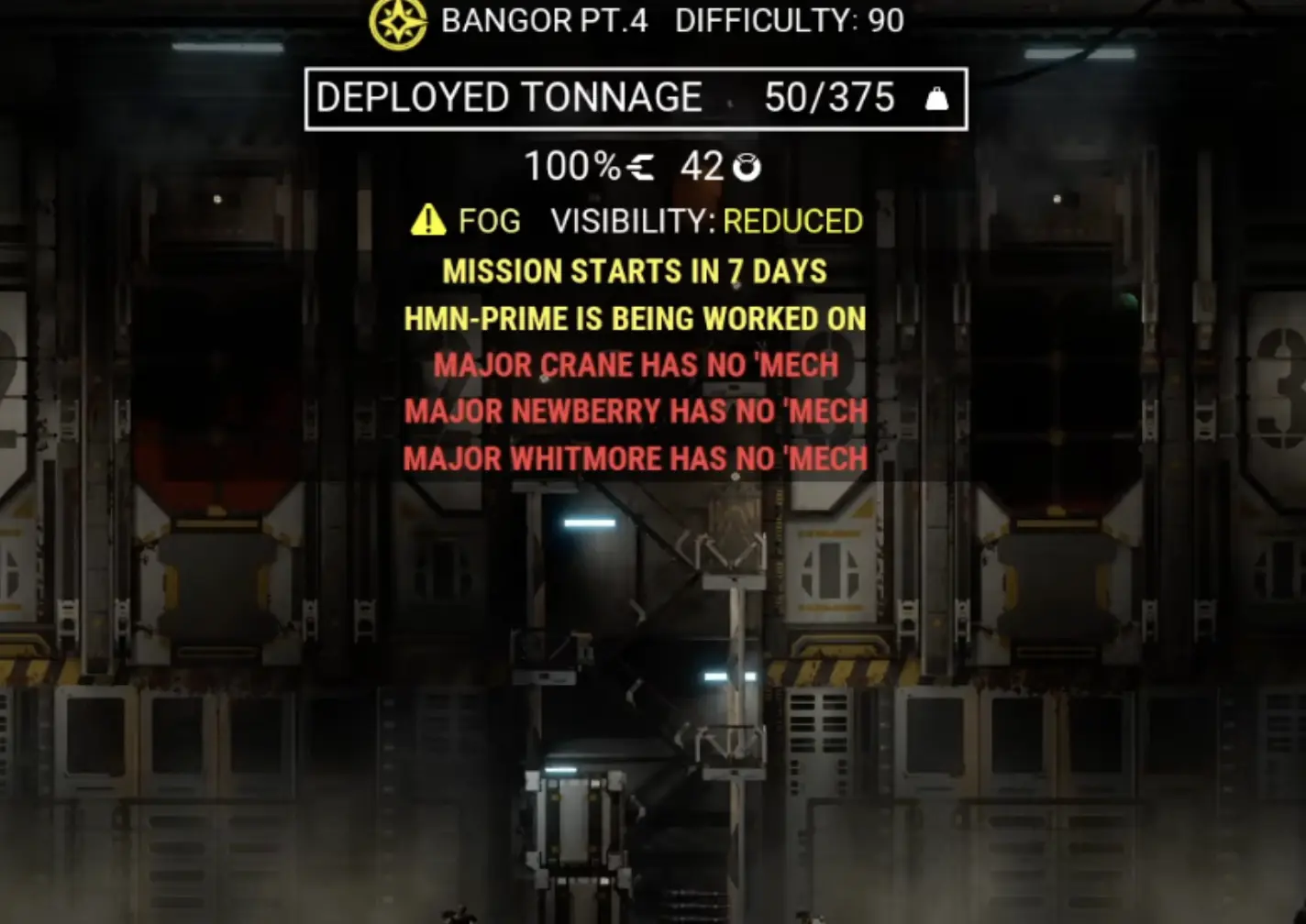
When a salvaged machine cannot be deployed, inspect the remaining work order, pilot availability, installed weapons, and ammunition.
Cancel or postpone optional refits that would make an otherwise usable machine miss the next deployment.
If the chassis still requires substantial work, leave it under repair and choose a ready replacement.
Trying to finish an extensive reconstruction immediately before another mission often consumes C-Bills without improving your available lance.
For the exact mission deadlines and withdrawal conditions across Matamoras, Janette, Hanover, Bangor, and Albiero, use the Ashes and Ascension campaign walkthrough.
Which Clan ‘Mechs should you keep after Operation Bulldog?
After the campaign, the purchase and salvage calculation changes because you are no longer preparing for the next tightly scheduled Operation Bulldog deployment.
Machines that were impractical during the campaign may become valuable long-term investments when you have enough time and money to rebuild them.
A damaged Stone Rhino, Blood Asp, or Bane can become a worthwhile project once repairs no longer compete with immediate story deadlines.
The smaller machines may remain useful as well. A functioning Huntsman can fill a medium-lance role, while the Arctic Cheetah and Ice Ferret offer mobility that a slower assault lance cannot provide.
Keep the machines that provide capabilities your current roster lacks. Sell unwanted duplicates or poorly equipped chassis when their value is more useful as C-Bills for restoring your preferred machines.
Before selling a damaged Clan ‘Mech, inspect its installed equipment. A weapon or component you still need elsewhere may be more valuable than the amount recovered from selling the machine with everything attached.
There is no reason to fill Cold Storage with every chassis solely because it was added by the DLC. A smaller collection of operational machines with reliable equipment can handle more contracts than a hangar full of damaged, unfinished projects.
The strongest Clan acquisition is ultimately the one that fits the company you can actually deploy.