SnowRunner Switzerland Walkthrough: What to Do First
Start SnowRunner Season 19 in Grüntal Hollow, repair early roads and bridges, move construction cargo, and prepare routes into Schneetal and Eiswandspitze.
Updated:
Quick Answer
Start Season 19 in Grüntal Hollow. Scout the roads around the Garage, identify the Worksites blocking your first cargo routes, and collect the materials needed to restore the crossings you intend to use. Prepare those routes before beginning the larger construction deliveries.
Switzerland begins with a working Garage and a road network that is only partially useful. Several crossings need repairs, construction sites interrupt otherwise convenient routes, and the mountain roads can become dangerous once you attach a loaded trailer. A scout can usually find a way around these obstacles, but getting several tonnes of cargo through the same terrain is a different job.
Season 19: Research & Restore covers three maps: Grüntal Hollow, Schneetal, and Eiswandspitze. Grüntal Hollow is the starting area, with early infrastructure projects and access to useful cargo facilities. Schneetal and Eiswandspitze can be explored before the first map is fully completed, although their mountain roads and limited services require more preparation.
The opening progression is therefore less about clearing every visible task and more about establishing dependable transport routes. Repairing a crossing that you will use repeatedly can save several trips around the mountains, while an isolated construction contract may be better left until you have the appropriate truck and cargo equipment.
Start in Grüntal Hollow: Garage, Watchtowers, and Early Roads
Enter Switzerland through the Global Map and begin at the Grüntal Hollow Garage. The nearby Trailer Store makes this a convenient place to prepare your vehicles, but there is little reason to purchase a large trailer before inspecting the available contracts and blocked roads.
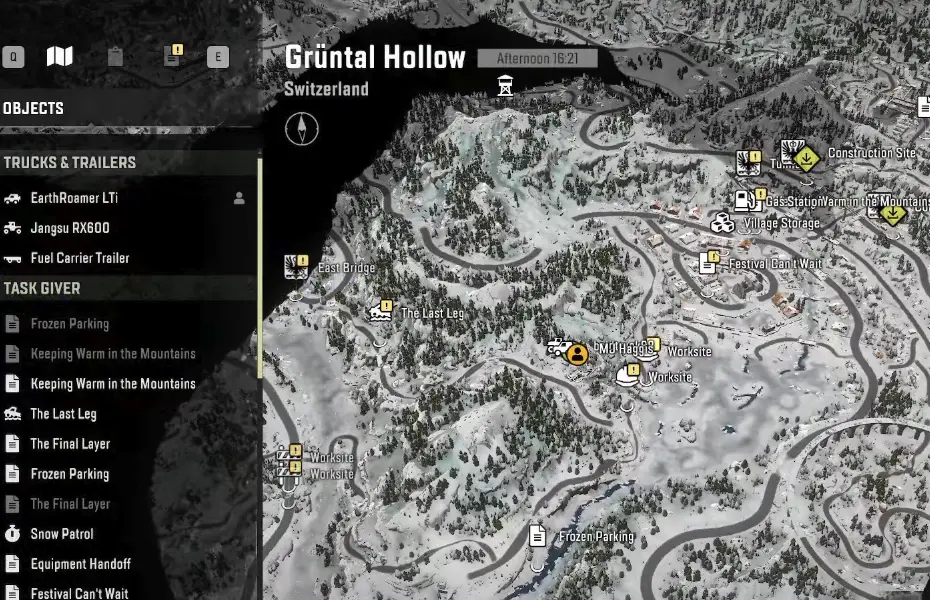
Take a scout out first and uncover the roads connecting the Garage to the surrounding villages, industrial areas, and Worksites. The map contains multiple construction markers, and some of them are positioned close enough together that a single scouting trip can reveal several useful objectives.
The East Bridge area, nearby Worksites, Village Storage, and the industrial roads are useful landmarks during this first pass. You can also identify a Gas Station and construction locations as more of the map becomes visible.
Watchtower exploration helps, but you do not need to uncover the entire map before accomplishing anything. Once you have identified a blocked route and the materials required to restore it, that information is enough to begin a productive supply run.
Tires for Grüntal Hollow’s Mixed Roads
Grüntal Hollow combines icy paved roads with muddy approaches and deeper snow. Chains can help control a truck on exposed ice, especially during downhill turns, while off-road or mud tires may provide better traction on the softer sections between construction locations.
Check the route before choosing a setup. A scout travelling mainly on icy roads has different requirements from a loaded truck climbing through deep snow toward a Worksite.
Repair the First Worksites Before Repeating Cargo Runs
Several early Worksites restore blocked roads or damaged crossings. Their value is not limited to immediate mission rewards: completing them can eliminate detours that would otherwise affect every later delivery.
One early Worksite requires two Consumables and one Service Spare Part. Other construction locations use different materials, so inspect the requirements at the specific marker rather than loading the same supplies for every road repair.
The Cargo Management interface will tell you what can be collected at a particular location. Before heading toward a Worksite, identify both the pickup point and the delivery zone. A trip becomes unnecessarily expensive when you arrive at the blocked road with only part of the required cargo and have to drive all the way back for the missing item.
Repairing a Crossing With Wooden Planks and Spare Parts
Another early crossing repair uses:
- 2 Wooden Planks
- 1 Service Spare Part
The important detail is that the unloading interface tracks cargo already delivered. For example, after delivering one Wooden Plank, the objective shows 1/2 Wooden Planks and 0/1 Service Spare Parts. You still need one more plank and the spare part to finish the repair.
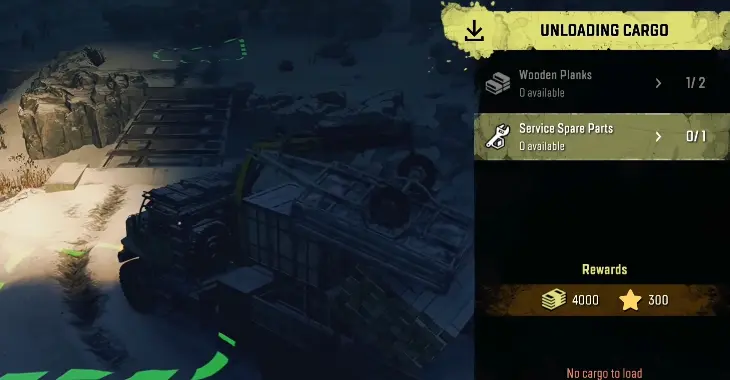
Check these remaining quantities before setting off on the final supply run. If the materials are available from different locations, combining nearby pickups is more efficient than treating each item as an independent journey.
The repair is also worth completing before taking a heavily loaded vehicle across the affected area. A scout might manage an improvised river crossing or a steep detour, but a cargo truck with a trailer has less room to recover from a mistake.
After restoring the crossing, inspect the road beyond it. Some routes contain another Worksite farther along, and repairing one bridge does not necessarily remove every obstruction between your pickup location and the destination.
Which Worksite Should You Complete First?
Prioritize the repair that opens the road needed for your next deliveries.
A nearby Worksite may be inexpensive to complete but offer little immediate benefit if its road leads away from the cargo facilities you currently need. Another crossing might save a longer detour every time you transport Metal Beams or construction supplies.
I would choose the second repair first when it removes a recurring transport problem. In SnowRunner, a reliable crossing is often more valuable than the short-term payment attached to another contract.
The same reasoning applies to equipment purchases. If your planned Worksite only needs a few ordinary cargo items, check whether an available truck or trailer can handle them before buying a specialized transport setup.
The Way Back and Sturdy Crossing: Planning Construction Cargo
Once the first roads are easier to use, The Way Back and Sturdy Crossing become useful contracts to inspect.
These projects introduce a broader range of construction materials than the smaller road repairs. The Way Back involves cargo including Metal Beams, Packaged Sand, and Concrete Slabs, while Sturdy Crossing also creates demand for Metal Beams.
The materials are not all collected from the same area. Industrial facilities provide metal cargo, including Metal Beams, while Packaged Sand is associated with the mountain pickup locations. Concrete Slabs need their own pickup planning.
This creates a practical choice when a contract is available but your next load is not nearby.
If you are already at an industrial facility carrying Metal Beams, check which active destination can use that cargo and whether another required material lies along the return route. Delivering the beams immediately is not always the best decision if it leaves you far from your next pickup.
The same applies to construction projects that require multiple stages. A delivery can advance the contract without making the road fully usable. Before sending your next truck through the affected area, confirm that the corresponding repair or construction objective is actually complete.
When to Delay The Way Back or Sturdy Crossing
A contract does not have to be completed simply because it appears in the list.
If its remaining materials require a long trip across an unreliable road, it may be more productive to finish a nearby Worksite first. Restoring the road can make the larger delivery easier and reduce the risk of losing a truck or trailer along the way.
Concrete Slabs deserve particular attention because they occupy more transport capacity than small repair supplies. Check the required cargo slots and the pickup location before committing a truck to the journey.
For these early contracts, the useful decision is not a fixed order that ignores your current progress. It is determining which completion will make the next several journeys easier.
Light at the End of the Tunnel: Railway Cargo and the Four-Slot Rails
Light at the End of the Tunnel introduces a more specialized transportation problem.
The contract concerns the railway tunnel, which is blocked by a snowdrift. The work involves bringing construction supplies and railway materials to restore operations. As the objectives advance, the required cargo changes, so keep the active contract selected when preparing another load.
The railway tunnel is part of Switzerland’s local infrastructure. It is not a gateway connecting the three regional maps.
One of the most troublesome deliveries involves Rails, which require four cargo slots.
Why Rails May Refuse to Pack
The large Rails load is not handled like a small collection of ordinary metal cargo. Its four-slot requirement means your truck bed or trailer must have sufficient compatible cargo capacity.
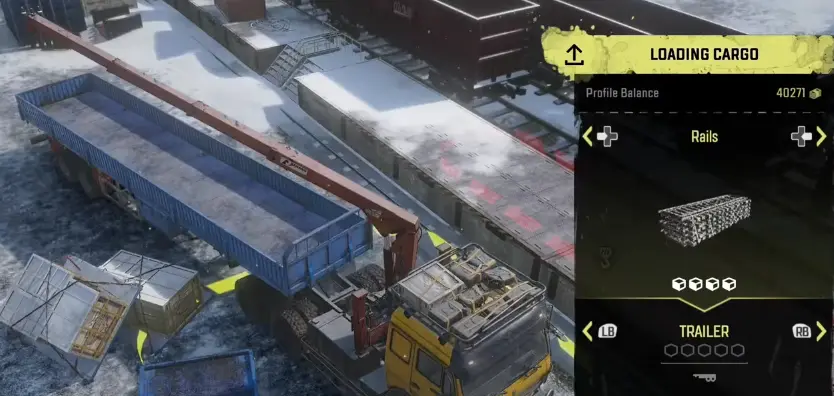
A trailer can appear large enough to hold the load physically and still be unable to pack it. Moving the Rails into position with a crane does not guarantee that Cargo Management will accept them.
That distinction matters because unpacked cargo can shift or fall during transport, particularly on the snowy mountain roads.
Before beginning the delivery:
- Select the Rails in Cargo Management and check the four-slot requirement.
- Make sure the truck bed or trailer supports that cargo and has enough available space.
- Pack the cargo before leaving the pickup area.
If the packing option remains unavailable, change the cargo equipment rather than repeatedly repositioning the load on an incompatible trailer.
The railway area can involve other materials as well, but smaller pieces of cargo should not be confused with the full four-slot Rails load. Check the active contract to ensure you are transporting the item required by the current stage.
Completing Light at the End of the Tunnel
Once the remaining railway materials have been delivered and the contract is completed, the snowdrift blocking the tunnel is cleared and railway operations resume.
The completed contract awards $12,500 and 1,440 XP.
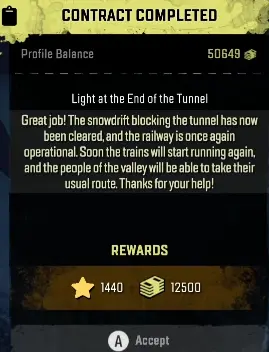
This is a meaningful infrastructure result, but it does not open a passage to Schneetal or Eiswandspitze. Travel between those maps still uses the regional gateways.
When to Recover Switzerland’s New Trucks
Switzerland adds two recoverable heavy trucks. Neither requires you to finish every construction task on Grüntal Hollow, although their recovery conditions and difficulty are different.
The Wortek 250T can be found on the starting map through Old Reliable, southwest of Town Warehouse near the gateway to Eiswandspitze. If your current fleet struggles with heavy loads, recovering the Wortek 250T can provide another transport option without first completing the region’s larger projects.
The Derry Savior is found in Eiswandspitze. Its recovery requires completing Scouting the Region to unlock Forgotten Ally. For players needing a capable heavy hauler, unlocking the Derry Savior can be worthwhile before tackling more demanding transport work.
The important consideration is how much those vehicles would improve your current fleet. If you already have reliable heavy trucks, finishing the roads that support your next construction deliveries may provide a more immediate benefit.
Entering Schneetal: What to Check Before Hauling Cargo
You can travel from Grüntal Hollow to Schneetal while work remains unfinished on the starting map.
Follow the marked gateway on the World Map. On arrival, you enter a snowy settlement area with additional roads leading toward industrial and mountain objectives.
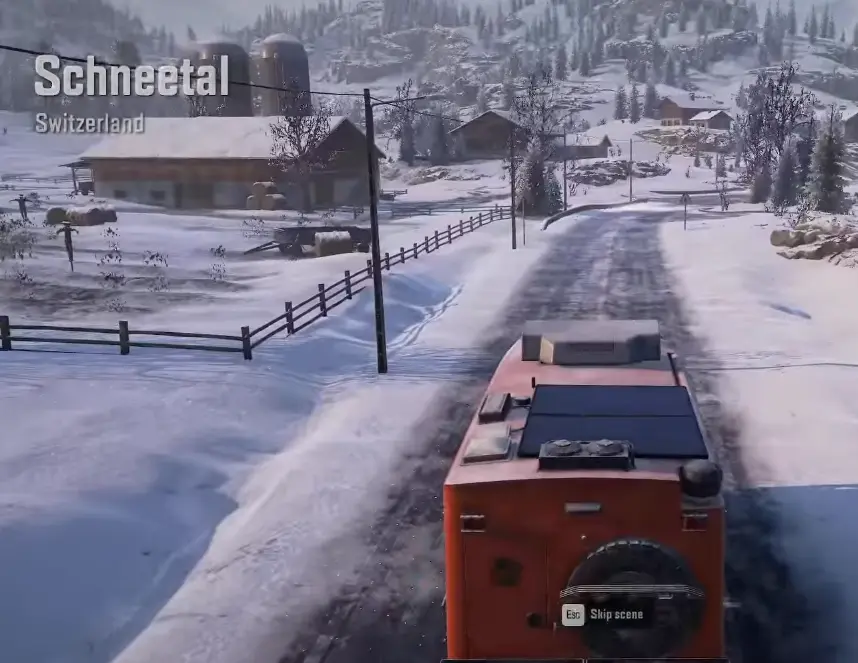
Schneetal contains additional facilities and transport objectives, but it is important not to treat the map as though it immediately provides the same support as the starting Garage.
Why the Schneetal Garage May Not Be Available
Schneetal has a Garage, but reaching the map does not automatically provide a fully operational service base. The facility needs to be discovered and restored through the relevant local objective before you can depend on its normal services.
Restoring the Garage is important for vehicle customization and access to the Truck Store. Until those facilities are operational, Grüntal Hollow remains your reliable starting support base.
This affects your first trips into Schneetal.
A scout can travel through the gateway and explore the surrounding roads, but bringing several heavy trucks into the region before securing repair and refueling options may create unnecessary return journeys.
Look for the Garage-related objective while surveying the map. If your immediate contract does not require a large cargo delivery, identifying the available services first is a reasonable use of the scouting trip.
Prepare for the Longer Mountain Routes
Schneetal introduces steep terrain and more complicated access to some of its industrial locations. A road that appears manageable on the map can become difficult when a long trailer has to navigate a narrow turn or climb over uneven ground.
Bring enough fuel for the initial exploration and a possible return to Grüntal Hollow. Check the road before committing a large cargo combination, especially when the destination lies beyond a damaged crossing or an unfamiliar mountain track.
The Garage restoration and local supply network are worth addressing before beginning repeated heavy deliveries. Once those facilities become available, they can reduce the amount of travelling back and forth between maps.
Reaching Eiswandspitze: What to Prepare
Eiswandspitze is accessible through Switzerland’s regional gateways, including the connection near Old Reliable in Grüntal Hollow. You can begin exploring it before completing all construction work on the starting map.
The mountain roads contain steep snowy inclines, exposed bends, and sections of breakable ice. A scout or compact off-road vehicle is suitable for identifying the roads and facilities before bringing in larger cargo equipment.
Fuel is an important consideration on the higher routes. Check the distance to your next working service location and avoid sending a truck that cannot safely complete the return journey.
Eiswandspitze also contains vehicle upgrades and the Derry Savior recovery. These objectives can be approached during regional exploration, although towing a heavy vehicle through the mountain passes requires substantially more preparation than an ordinary scouting trip.
What to Do After the Early Road and Tunnel Repairs
Once the first useful crossings are repaired and Light at the End of the Tunnel has been completed, the next step depends on what remains unavailable to you.
A practical way to choose your next task is to check the current limitation:
- Blocked delivery route: Inspect the Worksite or construction contract associated with that road and complete the missing repair before repeating the detour.
- Missing cargo or insufficient transport capacity: Identify the actual pickup location and required cargo slots before selecting or purchasing a trailer.
- Long cross-map journeys: Scout the destination, confirm available fuel and Garage services, and establish a reliable route before sending heavy equipment.
Grüntal Hollow still has additional construction and transport contracts after these early repairs. Schneetal and Eiswandspitze also contain objectives that may involve moving materials between different parts of Switzerland.
It is possible to explore all three maps before finishing the first, but that flexibility does not make every route equally practical. Repairing a bridge, opening an important supply location, or restoring Garage services can change which contract is worth doing next.
Once the roads you regularly use are dependable, the larger cargo deliveries become easier to organize. You can then spend more time completing the actual construction work and less time recovering vehicles or repeating journeys around the same blocked crossings.