Witcher 3 Remastered Skill Tree: What Should You Unlock First?
Learn how the new skill tree works, which early skills are worth taking, when to save points, and how to rebuild an old character after the reset.
Updated:
Quick Answer
Choose the next skill you actually want to reach, then follow its connected prerequisites. Do not use the old rule of spending 6, 12 or 18 points in a branch to open deeper rows; Remastered uses visible paths between skills.
For an early character, one reliable damage path plus a defensive option such as Quen / Active Shield works well. Keep spare points when the available upgrade does not help your current fights, and take Undying only when you already generate enough Adrenaline for it to save you.
The first thing that felt different about the Remastered Character screen was not any individual skill. It was the route between them.
In the older game, I could think about a branch as a set of rows: spend enough points in Combat, Signs or Alchemy and the next tier opens. Remastered asks a different question. If I want a deeper ability, which skill connects to it?
That change affects almost every early decision. A point can improve Geralt right now, open the route toward something stronger later, or send the build toward a part of the tree I barely use. Familiar skill names also do not guarantee familiar value because several talents now use different triggers, different ranks or new interactions.
How the Remastered Skill Tree Unlocks New Skills
Abilities are joined by visible prerequisite lines. Buying a skill opens the connected routes below it rather than simply adding another point toward a global row requirement.
Most skills are also built around three ranks. That creates two separate decisions every time a node opens:
- Is the first rank worth buying?
- Is another rank worth more than opening the next connected skill?
That second question matters surprisingly early. Some third ranks substantially change how an ability works, while other skills are already useful after one point and can wait until the build has more points to spare.
| Part of the tree | Older system | Remastered | What to do now |
|---|---|---|---|
| Deeper unlocks | Spend enough points in the branch to open later rows | Follow connected prerequisites | Choose the destination first, then trace the route back |
| Tier thresholds | Later rows opened after roughly 6, 12 and 18 invested points | Those old branch totals are no longer the routing rule | Stop counting total red, blue or green points as your main unlock plan |
| Skill ranks | Rank counts varied between skills | Skills are structured around three ranks | Compare the next rank with the next connected node before spending |
| Combat layout | Five regular columns for Fast Attack, Strong Attack, Defense, Crossbow and Adrenaline | Familiar abilities are rearranged into connected paths | Build around the sequence you actually use in fights |
| Signs layout | Each Sign largely followed its own vertical progression | Early Sign skills remain recognizable, while later paths create more interactions | Plan around Sign combinations rather than one isolated column |
| Alchemy layout | Brewing, Oils, Bombs, Mutation and Trial of the Grasses formed five clear columns | Familiar Alchemy themes remain, but the new network no longer follows the old rows cleanly | Use the current connections instead of an old Alchemy chart |
The old 6 / 12 / 18 point thresholds are especially easy to remember if you played The Witcher 3 for years, which is exactly why they can now waste points. If a skill you want is visible three connections away, the useful question is not “How many points do I have in Combat?” It is “Which prerequisite gets me there?”
Do Not Spend Every Skill Point Just Because You Have It
A fresh character does not need every available point assigned immediately.
At level 11, one early Remastered run had 2 points in Combat, 3 in Signs and 2 points still available. The character was already functioning normally in combat, so those two points could wait until the next useful route became clear.
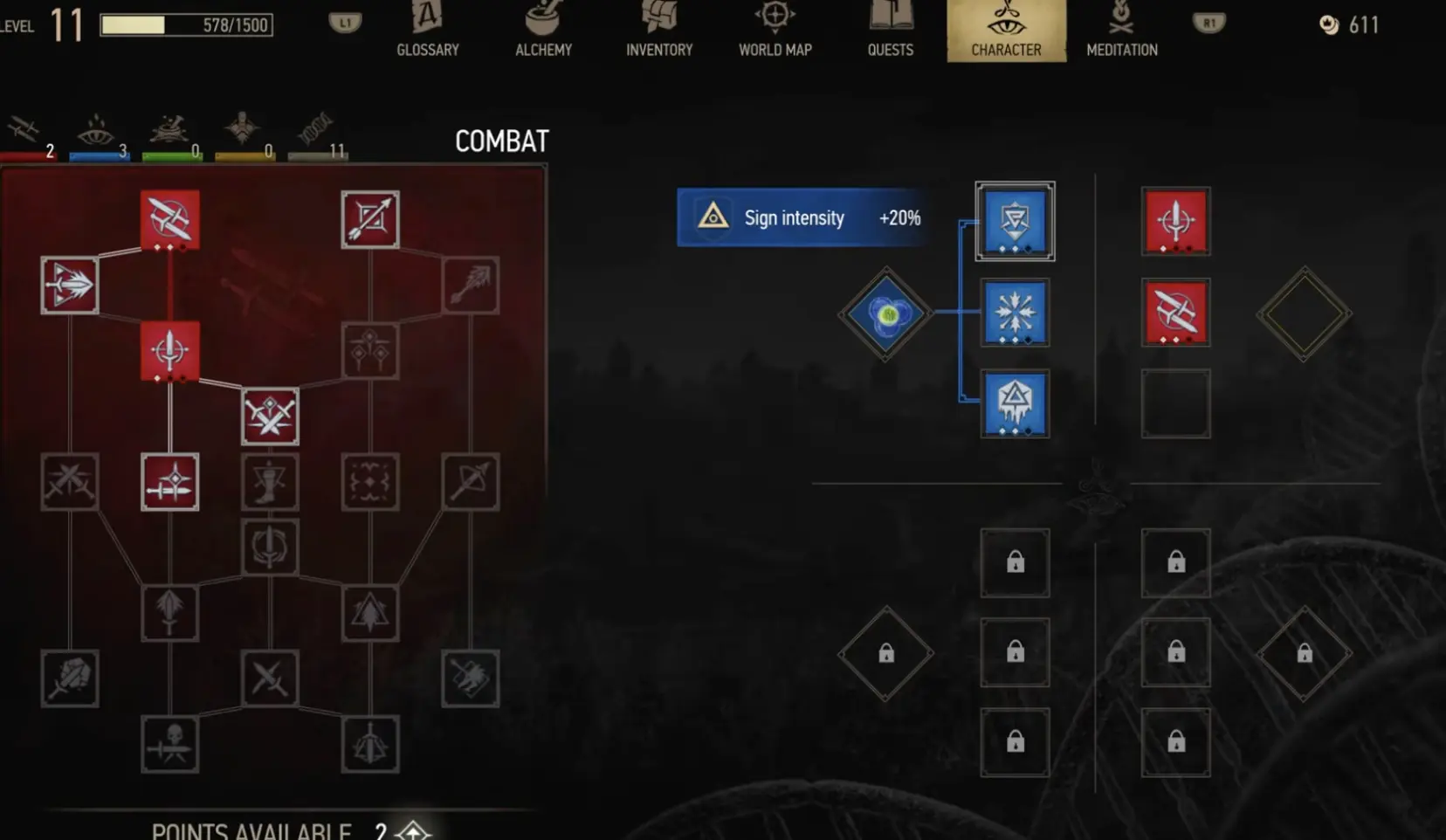
By level 13, the same progression had moved to 2 Combat and 5 Signs, with another point still available before the next purchase.
That is more useful to me than a rigid “spend every point at level X” route. Holding one or two points costs very little when the current skills already cover the fights in front of you. Spending those points on a weak upgrade because the icon is available can delay a prerequisite that changes the build much more.
I spend immediately when the upgrade fixes a current problem. I wait when the only reason to buy something is that the point counter is not zero.
Combat Is No Longer Five Simple Vertical Lanes
The older Combat tree was easy to divide into five categories:
Fast Attack → Strong Attack → Defense → Crossbow → Adrenaline
Those categories are still useful for understanding what a familiar skill is meant to do, but Remastered no longer keeps the entire route inside five neat columns. Skills have been moved and reconnected, so an old progression chart does not reliably tell you what must be bought first.
That makes combat style more important than color.
Before spending early red points, watch what Geralt actually does after an enemy misses:
- If you dodge and answer with several fast hits, bonuses tied to movement and fast attacks fit naturally.
- If you wait for a large opening and punish with a heavy strike, strong-attack interactions deserve more attention.
- If mistakes are ending the fight, Defense and Adrenaline survival tools can be worth more than another damage node.
- If you actively use the Crossbow instead of treating it as a situational gadget, several Remastered skills give that branch much more to work with.
Buying one skill from every Combat theme produces plenty of unlocked icons but very little that reinforces the same action sequence.
Muscle Memory Now Depends on How You Enter the Attack
Muscle Memory is a good example of why old skill reputation can mislead a returning player.
Its value is no longer simply a permanent fast-attack increase. The Remastered version rewards fast attacks after a successful dodge or roll, so the bonus fits a mobile sword style far better than a character who stands behind Quen and trades hits.
If dodging into a quick combo is already how you fight, the trigger happens naturally. If your openings mostly come from Signs or strong attacks, putting points into Muscle Memory because it used to be standard can produce much less value than expected.
Strong Attacks Gain More From Mixing Actions
The Remastered Combat tree also creates more reasons to alternate attacks.
Strength Training, for example, can reward a fast attack before the next strong attack. Other heavy-attack effects can then build on that stronger follow-up.
Instead of treating a strong-attack character as someone who only presses the heavy button, a practical sequence becomes:
avoid the hit → fast attack → strong punish
That does not mean every heavy build needs every mixed-attack skill. It means the new tree rewards looking at what triggers the next bonus, not only the attack category written on the node.
Undying Is Good When You Can Feed It Adrenaline
At level 13, one available Combat choice was Undying.
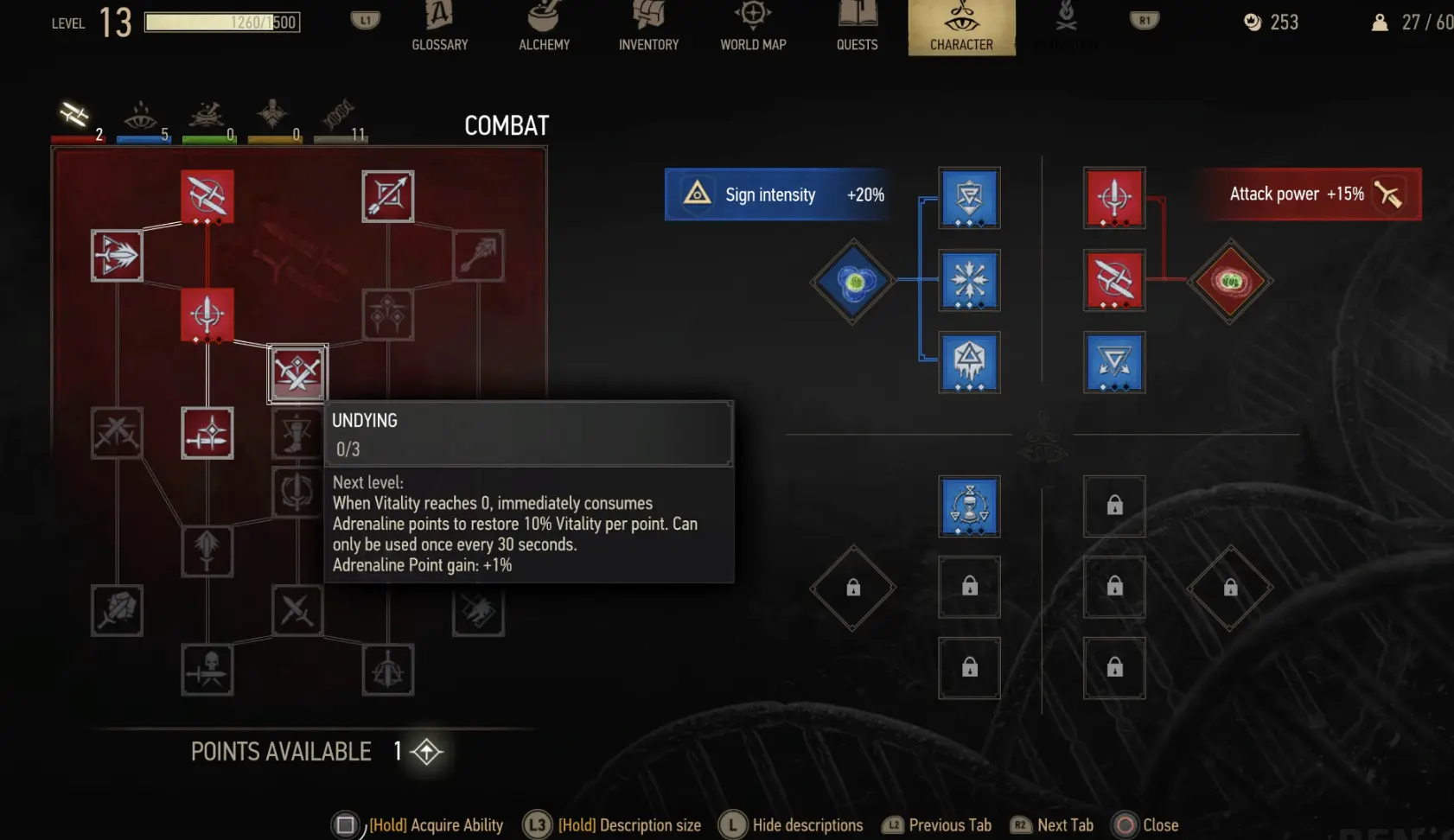
The first rank restores 10% Vitality per Adrenaline Point when Vitality reaches zero. It can activate only once every 30 seconds, and the rank also adds +1% Adrenaline Point gain.
That is useful insurance, but only when there is Adrenaline to consume.
If difficult fights are killing you after you have already spent or failed to build Adrenaline, Undying will not behave like a free extra life. A character that reliably generates the resource gets much more from it than one that rarely reaches even a single Adrenaline Point.
I would take it when deaths are the current blocker and the build is already feeding it. If damage is the real problem and Geralt rarely approaches zero Vitality, that point can usually work harder somewhere else.
Crossbow Skills Matter More Than They Used To
The Crossbow used to be easy to leave near the bottom of a normal sword build. Remastered gives it several interactions that make it worth checking again.
Anatomical Knowledge can scale Crossbow damage from current silver sword damage. Lightning Reflexes supports aimed shots and headshots. Counterattack can turn a successful defensive action into a much stronger follow-up.
The most interesting resource interaction is Cold Blood, which generates Adrenaline when a bolt reaches its target.
That gives the Crossbow another job: it can help prepare the resource used by the rest of the build. A player does not necessarily have to turn Geralt into a pure Crossbow character for those shots to matter.
I still would not spend several early points here if the Crossbow stays unused on my back. Once Adrenaline generation or ranged damage becomes part of the actual combat loop, the branch has much more reason to exist than it did in many older builds.
Signs Start Familiar, Then Become More Connected
The old Signs tree was extremely easy to read. Each column belonged to one Sign:
Aard, Igni, Yrden, Quen and Axii
The early rows generally improved the base Sign or opened its alternate mode. Remastered keeps enough of that structure that returning players will recognize the first part of each route, but deeper progression is no longer just five separate vertical columns.
Later Sign skills increasingly reward interactions between casts, buffs and other actions. That changes the way I plan a Sign-heavy character. Instead of asking only how high I can push one Sign’s intensity, I also look at what the next cast or attack receives from the skill I just used.
The practical effect shows up early even before those deeper synergies are available.
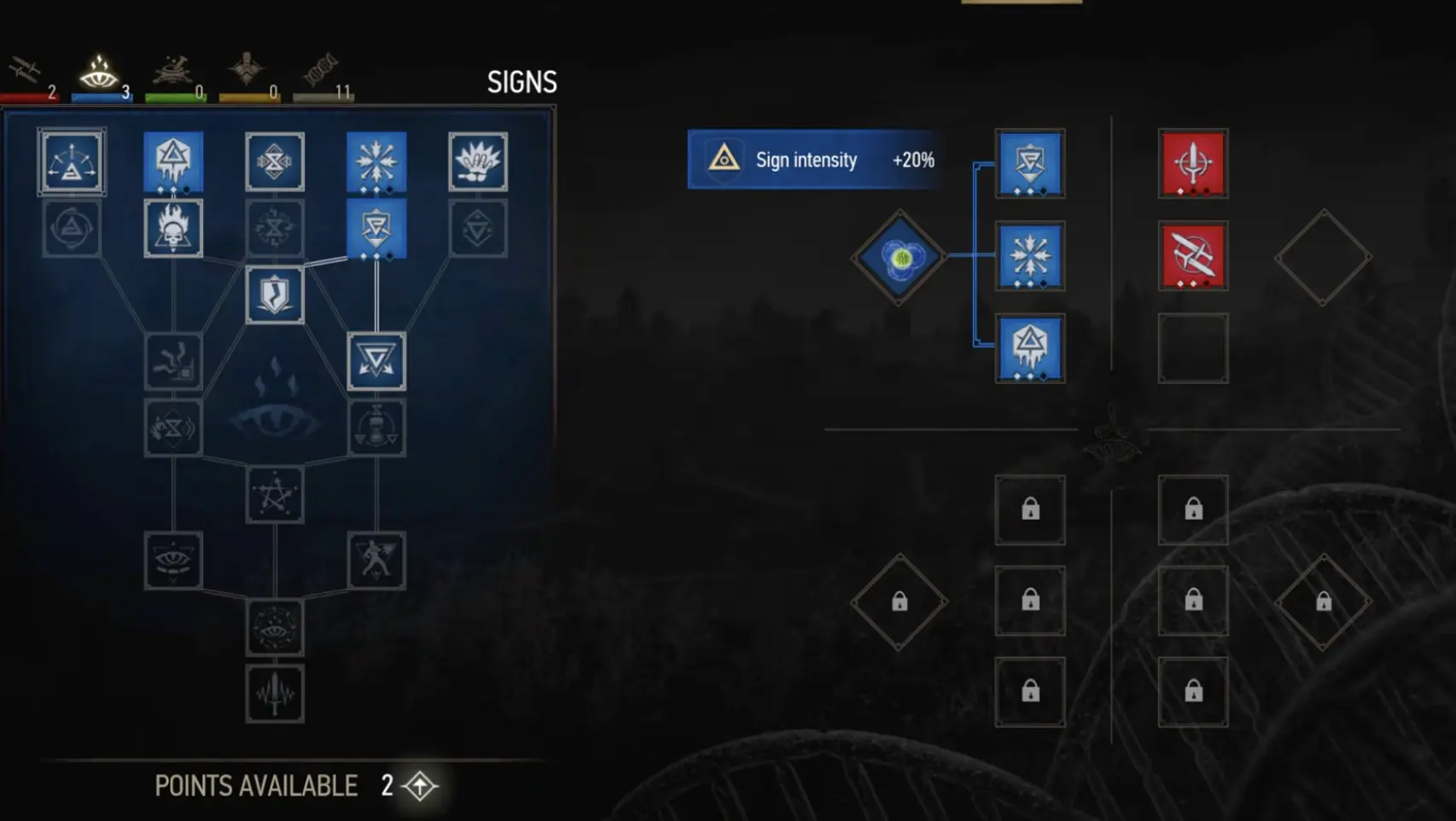
At level 13, this mixed setup had 5 points in Signs while still keeping a Combat path active. The equipped blue abilities also produced +20% Sign Intensity from the active mutagen connection.
That is enough for Signs to improve control and survival without requiring an early character to abandon sword damage entirely.
Active Shield Has a Much Better Third Rank Than Its Second
Active Shield shows why it is worth reading the next rank instead of automatically stopping once a skill already works.
At 2/3, maintaining the shield drains Stamina at 50% of the normal rate. Damage absorbed by the shield restores Vitality, and the skill provides +1/s Stamina regeneration in combat.
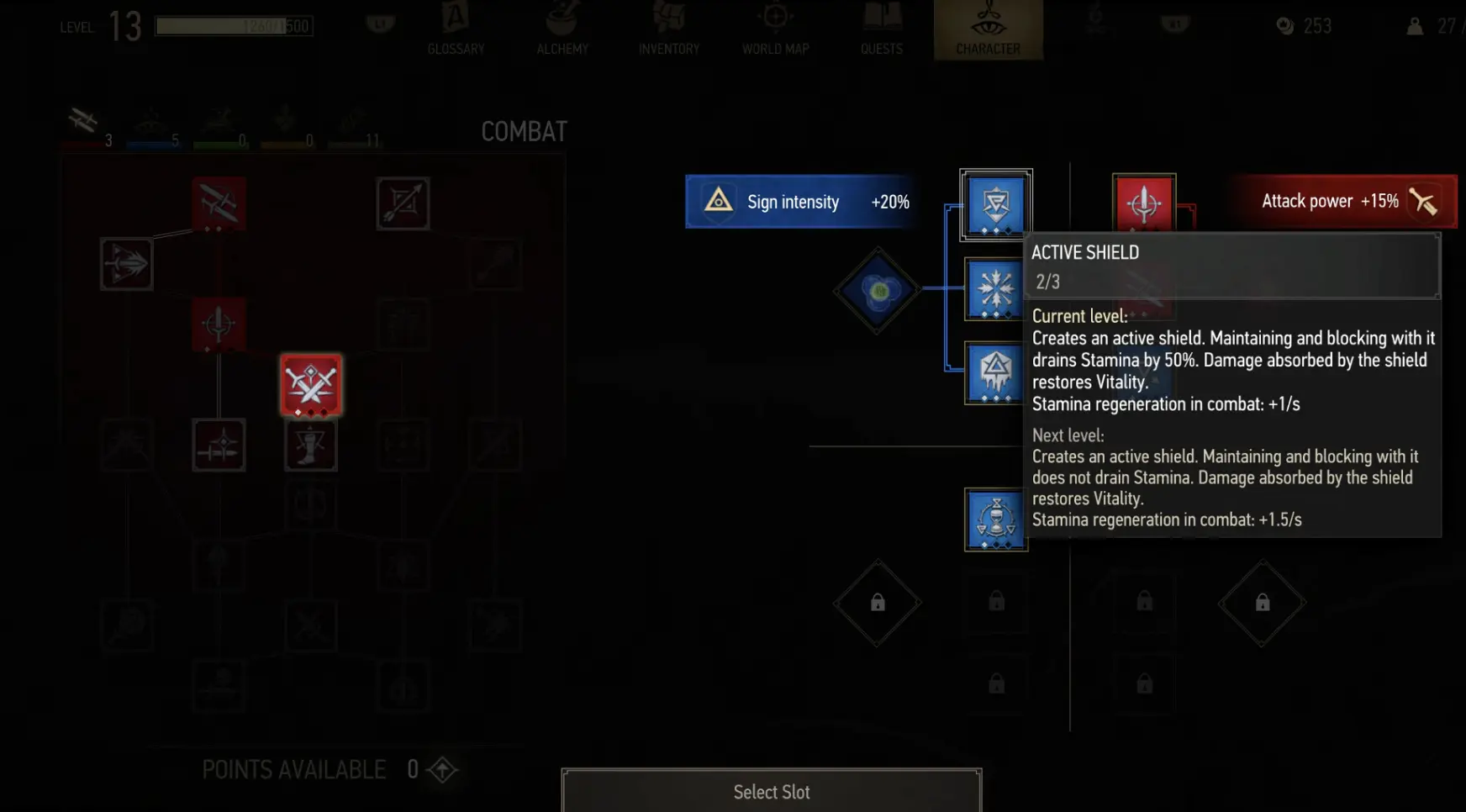
At 3/3, maintaining and blocking with Active Shield no longer drains Stamina, while absorbed damage continues restoring Vitality. Combat Stamina regeneration increases to +1.5/s.
That final point changes the way the skill can be used instead of simply adding a small percentage.
If Active Shield is already carrying difficult fights, finishing it makes sense. If you only tap normal Quen for a single-hit buffer and almost never hold Active Shield, the third rank can wait while another route develops.
Domination Is Useful for a Specific Kind of Fight
Domination solves a different problem.
At 1/3, Axii can affect two targets simultaneously, but the effect is 50% weaker. The rank also adds +0.5/s Stamina regeneration in combat.
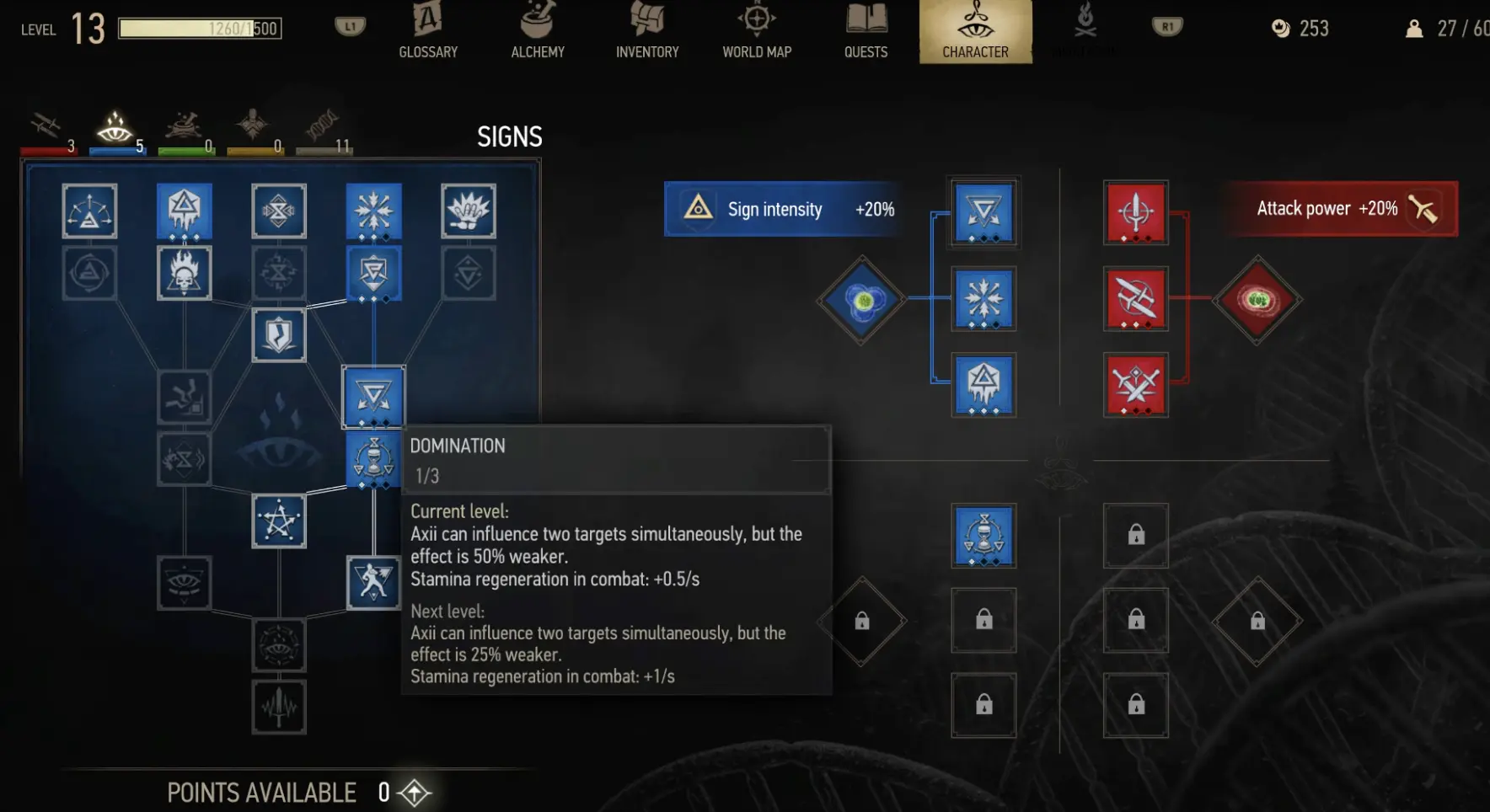
At the next rank, the penalty falls to 25% weaker and Stamina regeneration rises to +1/s.
That can be valuable for someone who regularly uses Axii against groups. It is a much less urgent purchase when most encounters are already handled through Quen, dodging and sword pressure.
This is the distinction I use throughout the new tree: a skill can be good without being the right next skill.
Alchemy Still Has Familiar Themes, but the Old Route Is Gone
The old Alchemy tree was divided into five very clean lanes:
Brewing, Oil Preparation, Bomb Creation, Mutation and Trial of the Grasses
Those themes are still useful for recognizing what kind of effect a green skill belongs to. They are no longer a reliable map for spending points, because the Remastered tree reconnects familiar Alchemy abilities into a different network.
The important consequence is not the shape of the menu. It is that an old Alchemy plan built around reaching row B, C or D after a fixed number of green points no longer tells you which prerequisite must be bought now.
This matters most when entering Alchemy as a secondary branch. Buying two unrelated green skills simply to “start Alchemy” can leave both of them too disconnected to change a fight.
I wait until preparation is already part of the playstyle:
- oils are being used against the correct enemy type;
- potions are being consumed regularly rather than saved forever;
- decoctions or Toxicity are becoming part of the build;
- bombs have a repeatable job instead of being occasional inventory clutter.
Once those systems are already contributing, a green point has a much clearer purpose.
A Safe Early Route Is About Functions, Not Colors
A fresh character does not need a finished endgame identity at level 10 or 13. I get more consistent results by solving one combat problem at a time.
A practical early order is:
- Choose the sword pattern you actually land. Start with the Combat path that supports those attacks rather than the one you expect to use later.
- Add one defensive answer. Quen investment is valuable when one mistake keeps ending otherwise manageable fights.
- Hold a point when the next prerequisite is more useful than the current rank.
- Take an Adrenaline survival skill only when the character already produces the resource it consumes.
- Add Alchemy once oils, potions or Toxicity are already part of normal preparation.
- Push deeper only after the build has enough equipment, slots and mutagen support to use the deeper interaction.
The level 11 and level 13 examples are useful because they show that an early hybrid does not need to spend everything immediately or commit every point to one color.
They are examples of a functioning progression, not a requirement that every character should reproduce the same numbers.
Reset Skill Points Should Be Rebuilt Around the New Triggers
Returning characters are more dangerous to rebuild than fresh ones because the old skill names create false confidence.
After the Remastered reset, start by asking what actually made the previous build work.
Was the damage coming from repeated fast attacks? Was Adrenaline feeding the important effect? Was Quen covering mistakes? Were oils and Toxicity carrying the difficult encounters?
Once that is clear, read those skills again before clicking through the old layout from memory.
Muscle Memory is the easiest example. If the old build treated it as a reliable passive fast-attack bonus, the Remastered trigger changes how often that bonus appears. The name survives, but the decision behind buying it has changed.
I rebuild only the foundation first, fight several normal encounters, and then spend the remaining points after seeing which part of the old rotation still works.
Reconnect Equipped Skills and Mutagens Before Judging the Build
Buying a skill does not automatically mean the character is receiving its full benefit.
The right side of the Character screen still matters because equipped abilities interact with mutagens. In the level 13 setup, the equipped blue skills produced +20% Sign Intensity, while the separate red group supported Attack Power.
That makes the rebuild order important:
buy the core abilities → equip the abilities you actually use → reconnect mutagen bonuses → fight several encounters → spend the remaining points
A build can look weak immediately after the reset simply because the purchased skills, active slots and mutagens have not been put back together yet.
Old Builds Still Work as Ideas, Not as Exact Shopping Lists
Fast-attack builds have not disappeared. Strong attacks still work. Signs can still become the center of a character, and Alchemy still supports highly optimized setups.
What changed is the path and the interaction between the pieces.
A familiar skill can now require a dodge, a different attack type, an Adrenaline state or another action before it reaches its full value. Signs can gain more from combining casts instead of stacking one isolated bonus, and Crossbow investment can contribute to resources used elsewhere in the build.
That is why I would not try to reproduce an old screenshot of a finished build point for point.
Get the current tree functioning first. Once the character has enough Skill Points, equipment, active slots and mutagens to support the intended interaction, then finish the deeper route.
For the other Remastered changes that affect returning saves, combat, graphics, Reforge and mods, continue with the The Witcher 3 Remastered guide.