Which Tape to Tape Squad Should You Pick?
Compare all 19 Tape to Tape squads, learn their unique rules and strategies, and find out which team suits your next campaign run.
Updated:
Quick Answer
Start with Vanilla Squad for your first campaign run, or choose Defense if you want to grow Team OVR through defenseman goals. On updated Steam versions, Vanilla, Defense, Oldschool, 16-Bit, Modern, and Violence are available immediately. To unlock another squad, open Campaign → New Run, select its locked icon, and check the displayed challenge before starting.
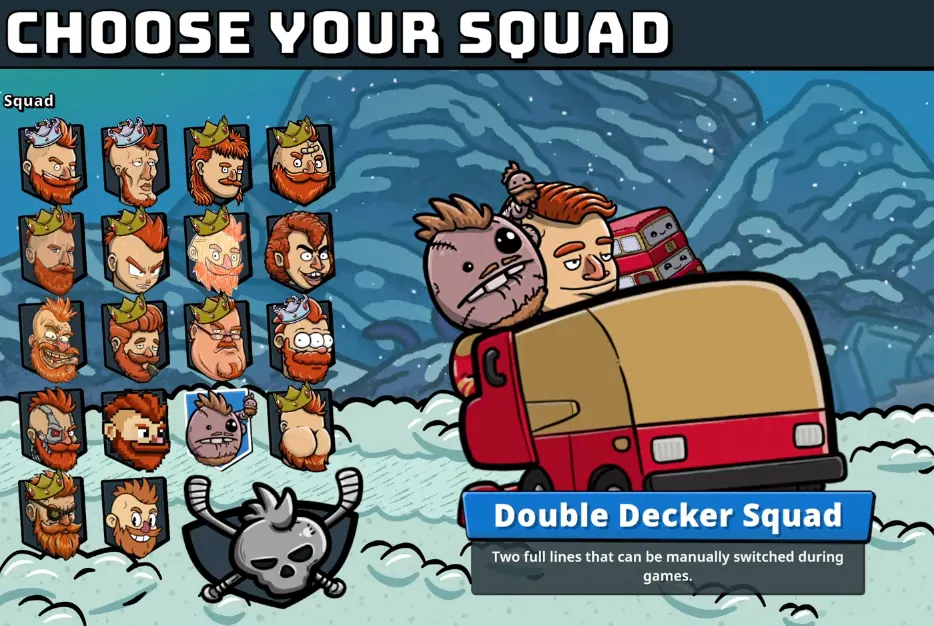
Tape to Tape has 19 playable squads, but choosing one changes much more than the face on your team selection screen. Defense rewards goals scored by defensemen, Oldschool removes injuries and the bench, Trio limits your lineup to three skaters, and Speedrun turns the first period into a deadline. Some squads even change the scoring rules or how you control your players.
That makes the first choice of a run surprisingly important. A lineup that works in Vanilla may need a different approach when another squad removes the Bench, limits your skaters, or changes how goals are scored. Before committing to a squad, check what its special rule changes and whether the opening roster can actually take advantage of it.
There is also an important distinction between unlocking a squad and completing a squad-related challenge. Tape to Tape 1.0 launched with three starting squads, but the October 24 Steam update opened three more by default and adjusted some remaining unlock requirements. A challenge that previously unlocked a squad may still appear in the achievement list without being necessary to select that squad on an updated Steam installation.
Which Tape to Tape Squad Should You Play First?
For a first campaign run, Vanilla is the straightforward choice. It introduces the regular lineup, Bench, Relic, and player progression systems without an extra restriction changing how the game behaves. Once you understand those systems, the more specialized squads make considerably more sense.
If you are still deciding which map rewards to take, when to recruit another player, or how to approach Elite games, start with the Tape to Tape campaign walkthrough before choosing a more restrictive squad.
The alternatives depend on what you want from your next run:
| Squad | Main gameplay change | Best reason to choose it |
|---|---|---|
| Vanilla | Balanced team without special restrictions | Learning the campaign and testing ordinary builds |
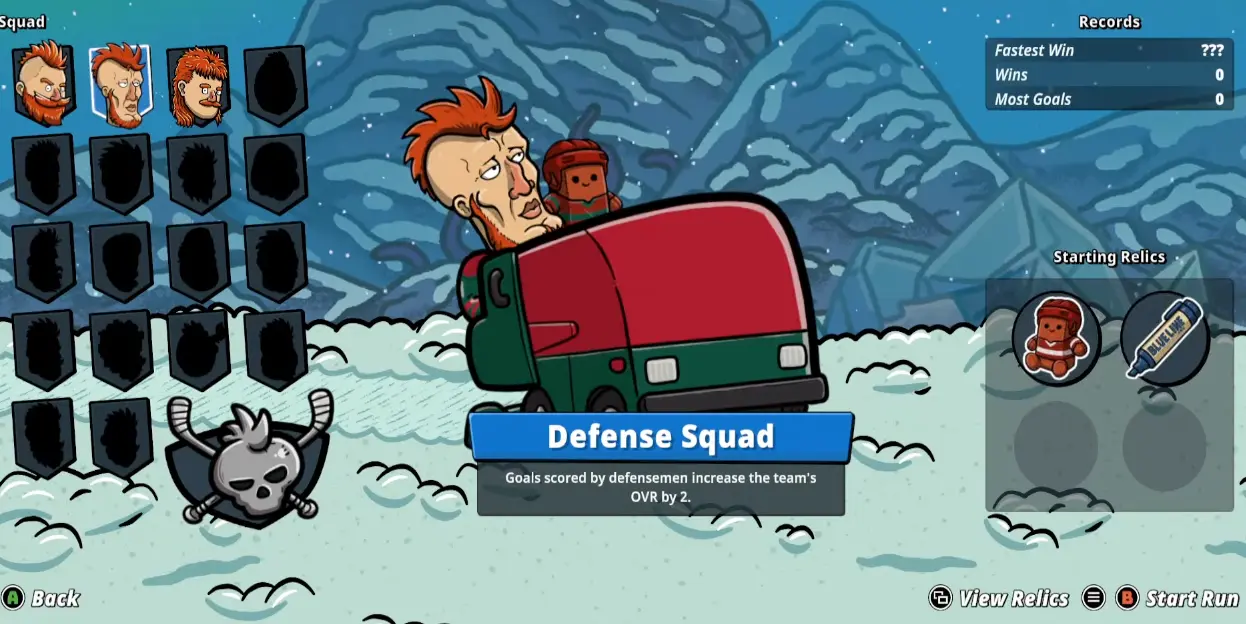
| Defense | Defenseman goals increase Team OVR by 2 | Building team-wide strength through offensive defensemen |
| Oldschool | No injuries and no bench | Playing without injury or reserve management |
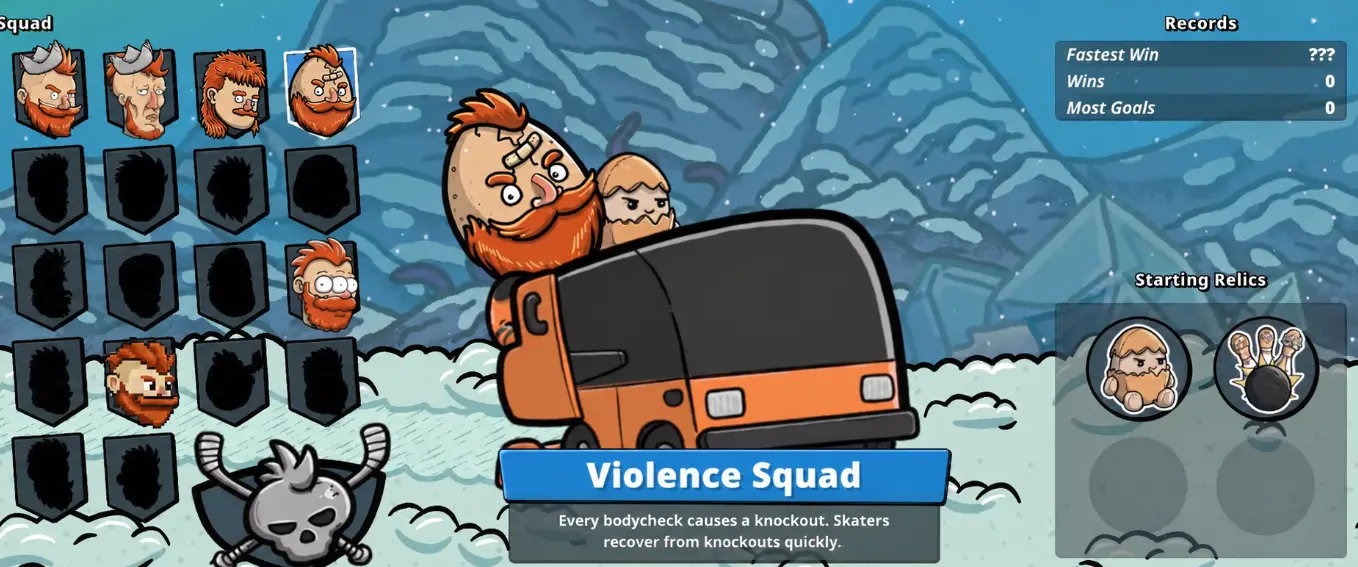
| Violence | Body checks cause knockouts; skaters recover quickly | Aggressive contact and repeated puck disruption |
| Modern | Offsides and manual pokechecks | A more simulation-style hockey experience |
| 16-Bit | Retro hockey with blue ice, speed bursts, and classic presentation | Fast-paced, retro-inspired hockey |
| Speedy | Extremely fast skaters that are easily knocked down | Speed-focused offense and quick attacks |
| Stats | Emphasizes attribute boosts | Experimenting with player-stat growth |
| Slapshot | Slapshots are effective; other shots are weak | Building around shot power and shooting lanes |
| Speedrun | Win before the first period ends or lose | Short, aggressive scoring challenges |
| Referee | Play 6-on-5 as a team of referees | An extra-skater advantage and unusual team composition |
| General Manager | Manage a changing roster of Free Agents | Roster-building and player-selection decisions |
| Trio | Only three skaters; goals assisted by both teammates increase Team OVR by 2 | Coordinated passing with a small lineup |
| Dominator | Four-on-four games with positive and negative Lucky Pucks | Unpredictable scoring swings and four-player formations |
| Double Decker | Two complete lines with manual line changes | Rotating players and managing stamina |
| Bum | Three elite skaters start at 0 OVR and gain special benefits from the bench | Building around bench-related advantages |
| Gauntlet | Face every team during one run | An extended endurance challenge |
| Solo | Player-locked to Angus throughout the run | Controlling one skater instead of switching normally |
| All Angus | Every skater is a different version of Angus | Playing with an entire lineup of Angus variants |
For players who prefer a traditional hockey feel, Oldschool is a sensible alternative to Vanilla. It removes two management systems rather than introducing a complicated scoring condition. Defense is a better next choice when you are comfortable getting your blue-line players involved in attacks.
Violence is much more forgiving of an aggressive checking style, although knocking down an opponent is not the same as maintaining possession or scoring. Modern requires a different kind of discipline because offsides and manual pokechecks change the decisions you make during every rush.
How to Unlock the Other 13 Squads
Tape to Tape has 19 squads, but only six are immediately selectable on an updated Steam installation. Vanilla, Defense, Oldschool, 16-Bit, Modern, and Violence require no additional squad unlock challenge.
The remaining squads are earned through campaign progression. Their requirements can involve winning runs, completing challenges with particular squads, unlocking additional players, or reaching cumulative progression goals.
The important step is to inspect the locked squad before choosing your next run. The requirement shown on your current squad selection screen tells you what still needs to be done.
Check the Current Unlock Condition
From the main menu, open Campaign → New Run and move to the squad you want to unlock.
- Highlight the locked squad.
- Read its displayed unlock requirement.
- Check whether the objective requires a specific squad, difficulty, or amount of accumulated progress.
- Complete the relevant challenge, then return to the squad selection screen to confirm that the squad is available.
Do this before committing to a long run. The October 24 Steam update changed squad progression, so some older unlock requirements no longer describe what a new player must complete.
Which Squads Became Available After the October 24 Update?
Three squads were added to the default Steam selection:
- 16-Bit Squad: Retro-inspired hockey with speed bursts and classic arcade presentation.
- Modern Squad: Hockey with offsides and manual pokechecks.
- Violence Squad: An aggressive squad built around body-check knockouts.
Previously, these squads were associated with specific progression challenges. On the updated Steam version, you can select them without first completing those older requirements.
Console updates follow separate patch schedules. If you play on Xbox, PlayStation, or Switch, check the squad selection screen on your installed version rather than assuming the Steam starting lineup applies.
Plan Your Next Unlock
The best next challenge depends on the requirement currently displayed.
For an objective involving wins with different squads, keep track of which squads have already completed a qualifying run. Repeating the same winner does not help when the objective specifically requires different squads.
For a challenge tied to a particular squad, make sure that squad is selectable before attempting the run. Winning with another team will not satisfy a condition that names one specific squad.
Collection-based and cumulative objectives should be approached differently. Check whether the required progress is tracked across runs or must be completed during one campaign attempt. That distinction can determine whether a failed run still contributes toward the goal.
When you are also working toward Steam’s complete achievement list, use the Tape to Tape achievements checklist to track those separate objectives. An achievement appearing in the list does not necessarily mean the corresponding squad is still locked behind it.
How to Play Defense Squad and Build Team OVR
Defense Squad rewards goals scored by defensemen with a 2-point increase to Team OVR. That gives you a way to strengthen the team through scoring rather than relying entirely on normal upgrade choices.
The catch is that the bonus depends on who finishes the scoring play. A goal from a forward may win the game, but it does not trigger the squad’s special defenseman-scoring benefit.
Before your first match, examine the position assignments in Edit Lineup. Identify which players are actually occupying the defensive positions, then check whether they have enough Shot Power and Accuracy to be worthwhile scoring options. A player with a powerful shot is less useful for this particular rule if you leave that player at forward throughout the run.
An effective starting pattern is to advance the puck with a forward, draw defenders toward the attacking skater, and look for a defenseman with an open shooting lane. That creates a chance to score without asking the defenseman to carry the puck through the entire opposition.
There is a trade-off. Sending both defensemen deep into an attack can leave your own zone exposed after a turnover. The squad’s OVR benefit is valuable, but not if the scoring attempt repeatedly gives the opponent an uncontested breakaway.
In a Defense run, one reasonable way to balance those demands is to give a capable defenseman more offensive responsibility while keeping another skater positioned to recover the puck. When you earn additional player upgrades, prioritize the attributes that make your actual defenseman-scoring plan more reliable.
Oldschool Squad: Why No Bench and No Injuries Matter
Oldschool Squad removes both injuries and the Bench, returning the campaign to a more straightforward lineup structure.
It is an attractive choice for a player who wants to concentrate on ordinary hockey, shooting, and Relic combinations without managing injured starters or developing reserve players. A complete Pro run with Oldschool is possible without using the regular bench-management loop.
The cost is the loss of that flexibility. In a normal lineup, resting a player can be part of a longer-term growth plan. Oldschool cannot use the Bench in that way, so the starting skaters and the improvements you obtain during the run carry greater importance.
Pay attention to your roster’s weak positions before the first Elite match. A team with one excellent scorer but poor support still needs enough passing, puck recovery, and defense to survive later encounters.
Oldschool is useful for learning consistent scoring habits. It is less appropriate when you specifically want to experiment with Benchwarmer growth or an upgrade combination that depends on bench participation.
Violence Squad: How to Make Body Checks Work
Violence Squad makes every successful body check cause a knockout, while affected skaters recover quickly. Knocked-out players can also collide with other skaters, creating additional disruption.
On updated Steam builds, this squad is available from the start. You do not need to complete the older 200-Knockout unlock objective simply to select it.
The immediate temptation is to body-check everyone continuously. That is fun, but an opponent getting back up quickly means the interruption may be brief. You still need to turn the contact into a scoring opportunity.
Use the first hit to interrupt the puck carrier or open space around a teammate with possession. If the knocked-down skater slides into another defender, take advantage of that opening before the opposing formation recovers. Strong positioning matters more than chasing an opponent who is already away from the puck.
Checking-focused player choices naturally fit this squad. Stronger, larger skaters can help you initiate contact, while faster teammates are useful for collecting loose pucks and converting the resulting disorder into shots.
There is also a difference between using Violence effectively and completing a knockout-count challenge. The squad’s normal playstyle is built around repeated contact, but the specific 200 Knockouts in One Run objective requires a deliberate accumulation strategy. The achievements checklist covers that objective separately.
16-Bit Squad: How to Play the Retro Hockey Mode
16-Bit Squad brings classic arcade-hockey presentation into the campaign, with blue ice, retro sound effects, and speed bursts.
Unlike Modern Squad, its defining appeal is the faster, arcade-style feel rather than additional hockey rules. Use the first few possessions to get comfortable with the movement and shot timing before attempting longer solo rushes.
Speed bursts can help you attack open space, but they do not remove the need to control the puck. Look for teammates moving into useful positions and release the pass before an approaching defender closes the lane.
On updated Steam versions, 16-Bit is available immediately. You can select it without first completing the older Pro-win challenge.
Modern Squad: How Offsides and Manual Pokechecks Work
Modern Squad adds offsides and manual pokechecks, changing both how you enter the offensive zone and how you defend against puck carriers.
Before passing into the attacking zone, check the positions of your teammates. Sending the puck forward while a teammate has entered the zone too early can stop an otherwise promising rush.
On defense, manual pokechecking places more responsibility on your timing and positioning. Approach the puck carrier at a useful angle, then attempt the pokecheck when the puck is within reach. Poor positioning can leave the opponent free to skate past.
These restrictions make Modern a better choice once you are comfortable with ordinary player switching, passing, and defensive positioning.
Modern is also immediately available on updated Steam builds. Its former unlock challenge is no longer required to select the squad.
Double Decker Squad: When to Switch Lines
Double Decker replaces the normal one-line setup with two complete lines that you can switch manually during games.
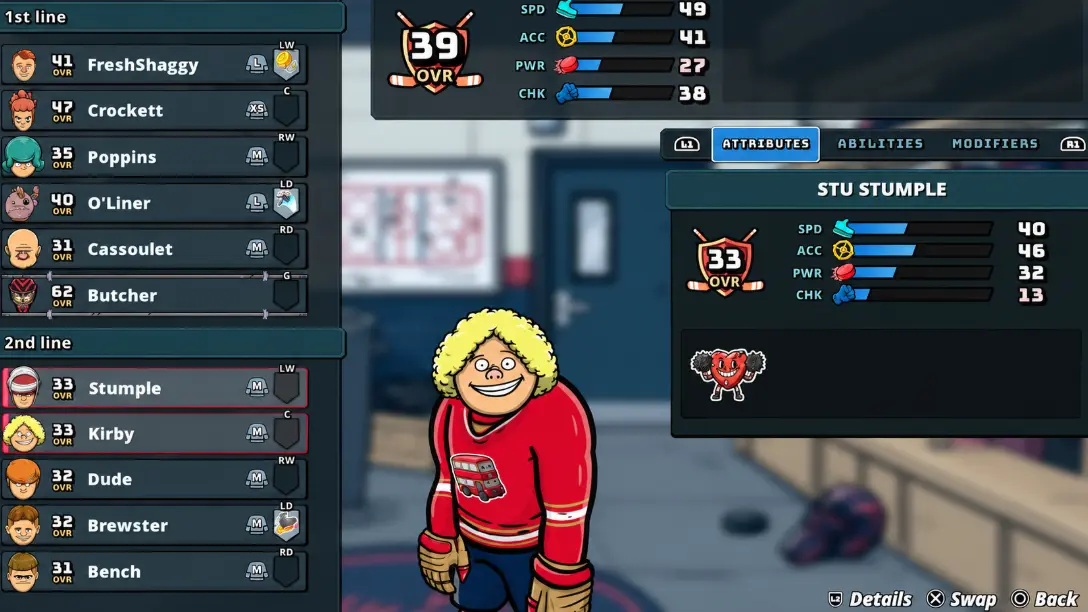
Each line needs a purpose. Filling the first with all your good scorers and leaving the second with players who cannot pass, recover the puck, or defend can make line changes dangerous rather than helpful.
A practical setup is:
- First line: Your stronger offensive players, reliable passers, and main scoring combination.
- Second line: Enough checking, mobility, and puck control to protect possession while the first line recovers.
These are roles, not mandatory fixed formations. You can distribute your strongest players differently when the roster provides a good reason.
The opening lineup screen is especially important because Double Decker begins with a larger pool of skaters. Move players between the two lines before the first game rather than assuming the initial arrangement is optimized.
Watch Stamina Before Your Offense Breaks Down
Double Decker displays separate L1 and L2 stamina bars during a match. Watch both indicators rather than leaving the same five skaters on the ice for the entire game.
When L1 has dropped into yellow while L2 is still green, the second line offers a fresher option. Look for a safe puck transition before switching so that the incoming players can take over without immediately facing an exposed defensive situation.
The on-screen controls identify the line-change inputs for your controller. Check those prompts before the opening faceoff, then use the stamina bars to decide when a change is worthwhile.
One Double Decker run demonstrated the cost of poor management clearly: the first line contained stronger attacking talent, but uneven changes and weak positioning left the team unable to generate enough shots. Later changes restored fresh skaters, yet the earlier lost opportunities still mattered.
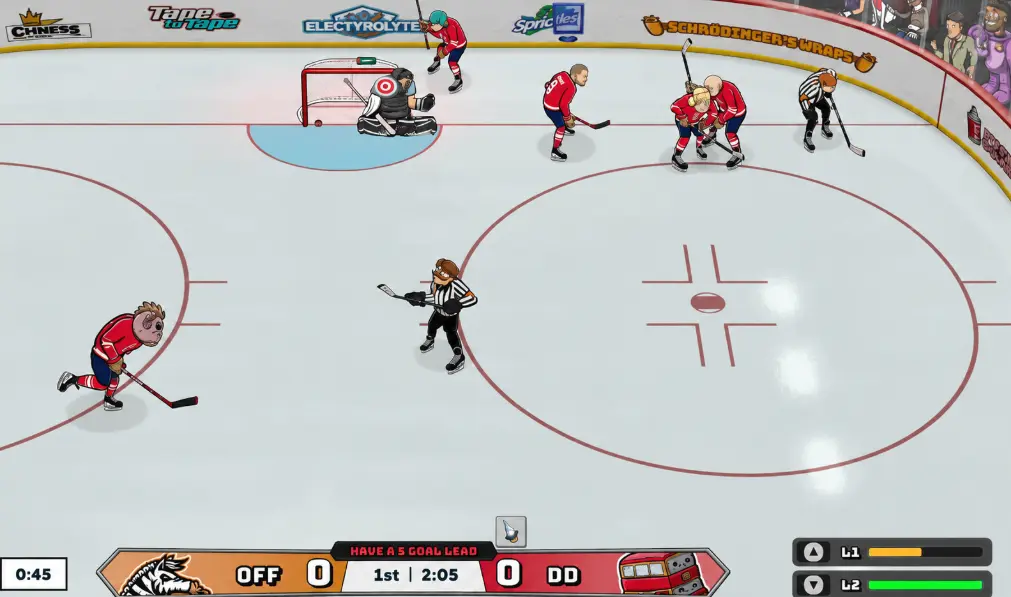
Double Decker suits players who enjoy active roster management. It is not the easiest choice when you are still learning the basic controls, because the additional lineup creates another decision during every match.
Dominator Squad: How Lucky Pucks Change the Score
Dominator Squad uses four-on-four hockey and introduces Lucky Pucks with positive and negative scoring effects.
The critical difference is that a goal may change the scoreboard by more than one point. A normal-looking scoring opportunity can have an unusually large effect on the match, while a negative Lucky Puck can create a result that would not happen in an ordinary game.
In a Veteran Dominator run, the game used Score mode rather than allowing a switch to Timer mode. An early Money Puck awarded +3, and another scoring event displayed a −2 effect. Later, a game that appeared comfortably under control at 4–0 became 4–3 after an opposing scoring sequence.
That changes how you should judge the score. A multi-goal lead is less reassuring when a special puck can swing the result sharply.
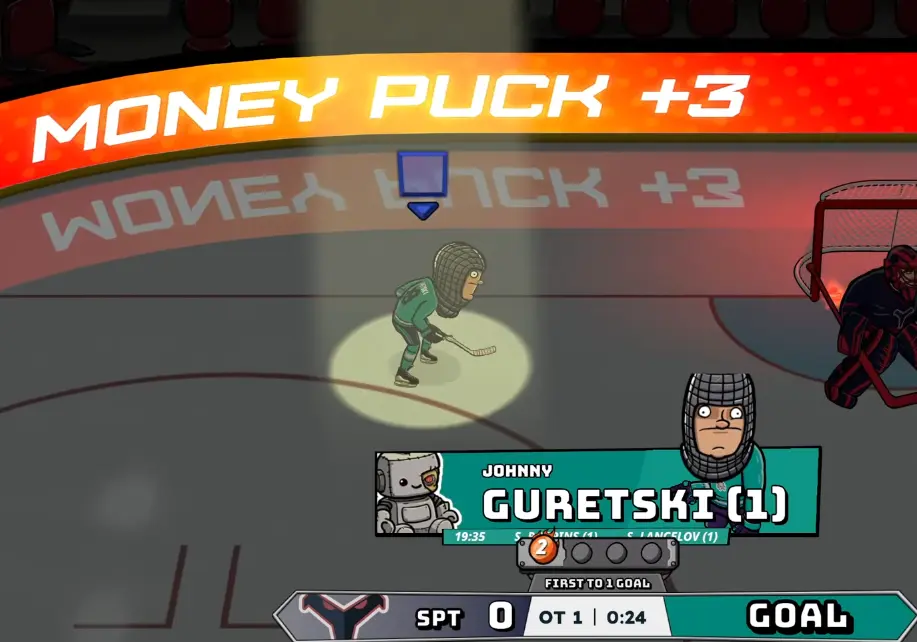
Four-on-four hockey also gives each player more responsibility for covering the rink. A skater removed from the play leaves a larger gap than in a standard five-skater formation.
Start with players who can contribute in more than one situation. A forward with strong scoring but no ability to recover the puck can become a liability when a Lucky Puck suddenly makes the next possession decisive.
Do not treat every bonus puck as a guaranteed benefit. Check the effect currently in play and consider whether attacking immediately is worth the possibility of a negative swing.
Trio Squad: Make Both Teammates Part of the Goal
Trio Squad has only three skaters. Its special growth condition rewards goals assisted by both teammates, increasing Team OVR by 2.
This is different from simply assigning one strong scorer and shooting whenever that player receives the puck. The squad has a reason to involve all three skaters in the same attacking sequence.
A sensible offensive pattern is to use one player to advance the puck, involve the second teammate in the passing move, and finish with the third skater. The play still has to produce the required assists, so check the post-goal details rather than assuming any sequence involving three players qualifies.
With only three skaters, possession mistakes are more expensive. A failed pass can leave very little defensive coverage, especially when the player who lost the puck is deep in the offensive zone.
Choose Trio when you are comfortable with passing and player selection. Its OVR mechanic can reward coordinated play, but a player who relies primarily on individual breakaways may find the restriction frustrating.
Trio is also associated with the Speedrun Squad progression challenge, making it a natural option to explore before tackling that shorter, higher-pressure mode.
Speedrun Squad: The First Period Is the Deadline
Speedrun Squad must win before the end of the first period. Failing to do so ends the game.
Ordinary campaign matches give you opportunities to recover from a slow opening, adjust your offense between periods, or wait for a better scoring chance later. Speedrun does not give you that flexibility.
Before choosing it, make sure you can create shots quickly with the skaters available. Speed, puck movement, and a reliable finisher are more useful for this restriction than a build that only becomes powerful after several periods.
The opening faceoff and first possession deserve more attention here. Losing time to unnecessary stickhandling or repeatedly attempting difficult shots can consume a substantial part of the only period available.
Its appeal is the compressed challenge. It is not a good squad for a player who expects to build a slow advantage and finish games in later periods.
Slapshot Squad: Build Around the Shot That Actually Works
Slapshot Squad makes slapshots your effective scoring method. Other shot types are weak.
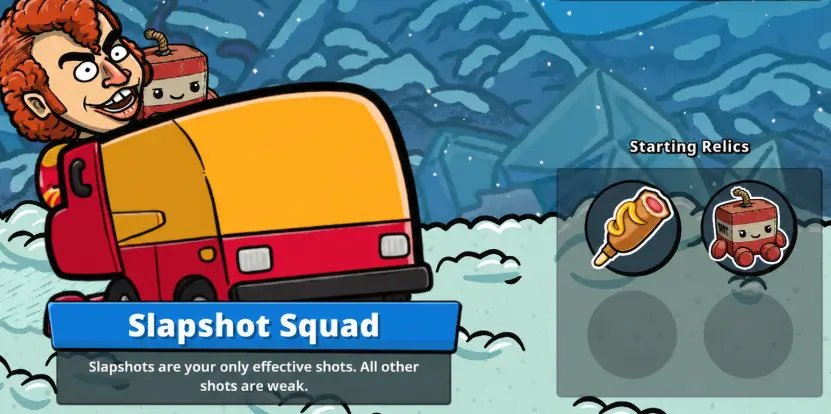
That means ordinary close-range shooting habits are much less reliable. You need time to wind up and an unobstructed path for the puck, or the squad’s main offensive strength will be difficult to use.
Prioritize situations where the shooter can receive a pass with enough room to complete the slapshot animation. A powerful shooter still loses the attempt when an opponent interrupts the windup.
The Wind Up Power-up is particularly relevant here. It pushes nearby skaters away while charging a slapshot, reducing the chance that an opponent interrupts the shooter. This gives Slapshot Squad a useful way to protect its strongest scoring option, although the shot still needs a clear path to the net.

You still need to watch the goaltender’s position and available shooting lane. Clearing nearby defenders creates a chance to shoot; it does not guarantee a goal.
Other Squads and Their Special Rules
Several squads have very distinctive rules but require a different approach from the teams discussed above.
Speedy Squad
Speedy skaters can move quickly into attacking space, but they are easier to knock down. Use that speed to create separation instead of skating directly into heavy defenders.
The extra mobility is most useful when the puck moves with the attack. Carrying it into repeated collisions wastes the squad’s main advantage.
Stats Squad
Stats Squad focuses on attribute boosts. Inspect its starting bonuses and your skaters’ current attributes before choosing Training rewards, then prioritize improvements that complement the players you intend to keep on the ice.
Referee Squad
Referee Squad puts a team of referees into six-on-five hockey.
The extra skater gives you more passing and coverage options, but still requires sensible positioning. Use the numerical advantage to maintain possession and create an open teammate rather than sending all available players after the puck.
General Manager Squad
General Manager revolves around a rotating roster of Free Agents.
Before committing to a lineup, inspect the players available and choose a balanced combination. The value here comes from roster flexibility; selecting players solely for one impressive attribute can leave important positions without suitable support.
Bum Squad
Bum Squad begins with three elite skaters at 0 OVR, using special bench-related advantages to change their effectiveness.
Their initial status makes ordinary early-game assumptions unreliable. Read the players’ specific bench bonuses and arrange the lineup around what those bonuses actually provide before entering the first meaningful match.
Solo Squad
Solo Squad locks player control to Angus for the whole run.
Automatic teammate behavior becomes more important because you cannot simply switch control to whichever skater is closest to the puck. Position Angus where he can contribute, and avoid chasing every loose puck when it pulls him away from his intended role.
Gauntlet Squad
Gauntlet requires you to face every team in a single run. A lineup that dominates one matchup may still struggle when forced through the full sequence.
Choose upgrades that remain useful across different opponents. Strong puck control, reliable shooting, and enough defensive coverage help prevent a successful early run from falling apart in a later game.
All Angus Squad
All Angus fills your lineup with different versions of Angus.
Before starting, inspect each skater’s attributes and available abilities. Assign positions according to what each version can actually do, rather than treating the entire roster as interchangeable.
Why Does a Squad Still Show as Locked?
A locked squad can have several explanations, and the correct fix depends on what the game currently displays.
The unlock requirement changed after the 1.0 launch. Steam’s October 24 update made 16-Bit, Modern, and Violence available immediately. On Steam, restart the game after installing the update and inspect the squad selection screen again. If one of these remains locked, check that your game is updated rather than immediately attempting the older challenge.
You completed an achievement objective but expected it to unlock a different squad. Some achievements record a challenge that was previously tied to an unlock. Current squad availability and achievement completion are not always the same thing after a progression update.
You are using a different platform version. The Steam changes were scheduled to reach console versions through separate platform patches. Check the installed update before assuming the starting squad list is identical across PC, Xbox, PlayStation, and Switch.
You won with the wrong difficulty or repeated the same winning squad. For objectives requiring wins with different squads on Pro, check both parts of the condition. A win on another difficulty or an additional win with a squad already counted may not advance the required total.
Your goal is cumulative rather than limited to one run. Training visits, slapshot goals, and Angus goals appear as across-run objectives in the 1.0 achievement list. By contrast, an objective explicitly requiring a certain number of knockouts in a single run must be completed within that run.
The safest progression habit is to check the exact locked-squad requirement before starting a challenge, then inspect the unlockables screen after the run ends. That separates normal campaign results from the specific squad or character you were trying to obtain.