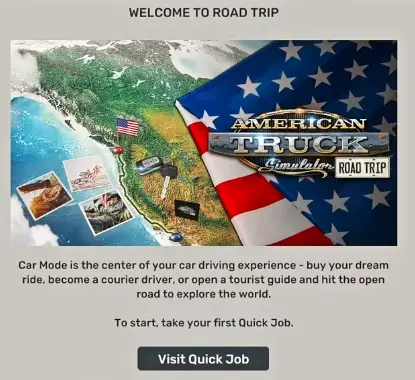
Switch from Truck Mode to Car Mode, then take a Quick Job before spending money on a car. Quick Jobs provide the vehicle, so they let you learn the courier system without buying anything first.
Finish deliveries cleanly, work toward the first five deliveries to unlock benefits, then buy your own Ford when you want to use the Dispatch Market or start exploring Road Trip more freely.
Road Trip does not begin by asking you to build another trucking company. The useful first move is much simpler: switch into Car Mode, accept a Quick Job, and learn how courier deliveries are scored before deciding where to spend your existing money.
That distinction matters because ATS can make a returning player look richer than a new Road Trip career really is. Your bank balance carries over, but Road Trip has its own progression. I found it much clearer to treat the first courier runs as a short introduction rather than immediately buying and configuring several cars.
Car Mode opens the Road Trip activities: courier work, personal vehicles, and Atlas exploration.
Start by Switching to Car Mode
Use the mode switch on the main desktop and enter Car Mode. You do not need a new ATS profile to begin.
The first Road Trip prompt directs you toward a Quick Job. This is the best place to start even if your trucking profile already has plenty of cash, because the job provides the car for you.
A first Quick Job can therefore answer several questions without any purchase:
how the cars feel with your current controls;
how courier navigation works;
what the game expects from the delivery;
whether your wheel and force-feedback settings need changing;
how the delivery result affects Road Trip progression.
Buying first does not make that learning phase disappear.
Quick Jobs Give You the Car
A Quick Job works much like the familiar entry-level trucking setup: choose an offer and the vehicle is supplied.
One early job, for example, provided a 1967 Ford Mustang Fastback for a 280-mile trip. The delivery screen also showed the customer priority before departure, so the important information is available before you start driving.
That makes Quick Jobs the low-risk choice when you have not decided which Ford you actually want to own.
Activity
Vehicle requirement
Best time to use it
Main result
Quick Job
Vehicle is provided
First Road Trip deliveries or when you do not want to buy yet
Builds courier progression without requiring your own car
Dispatch Market
Your own vehicle
After buying a car and wanting courier work in that vehicle
Opens professional courier offers for your owned car
Atlas
Road Trip exploration vehicle
When you want exploration rather than delivery work
Leads into Tourist Boards, POIs, Viewpoints, and postcard progress
The Road Trip interface starts with Delivery Streak 0 and tells you to:
Complete your first five deliveries to unlock benefits.
That is not the same as saying you must finish five deliveries before you are allowed to buy a car. The five-delivery target belongs to the courier progression and its benefits.
I would therefore keep the priorities separate:
Need to learn the mode? Run Quick Jobs.
Want the first progression benefits? Complete five deliveries.
Want to drive courier jobs in your own vehicle? Buy a car and move into the Dispatch Market.
Mixing those goals makes the opening feel more restrictive than it actually is.
Courier Jobs Grade More Than Whether You Reached the Destination
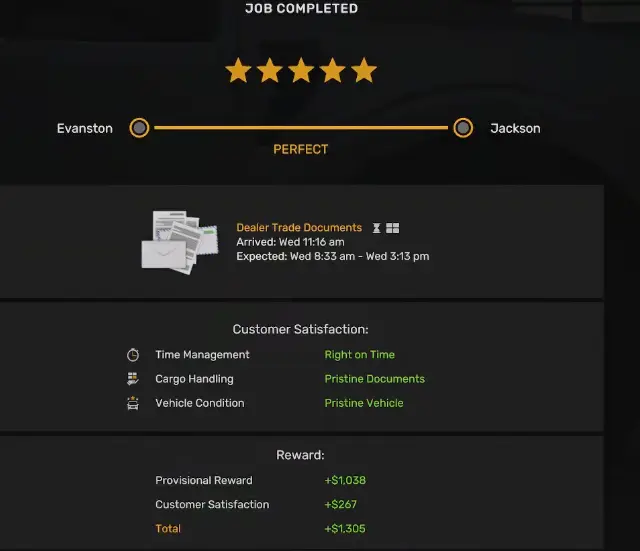
A completed delivery is scored across three visible categories:
Time Management
Cargo Handling
Vehicle Condition
Courier jobs grade how the delivery was completed, not just whether the car reached the destination.
This changes how aggressively it is worth driving.
A fast run stops being useful if the car arrives damaged or the cargo has been thrown around enough to hurt the result. On one run, simply hitting another car produced a large enough penalty that the job effectively made no money.
The safest early approach is to protect the three scoring categories rather than chase a few minutes of travel time. The Road Trip career replaces the normal leveling feel with Courier Rating, so repeated clean deliveries matter more than treating every job as a speed run.
Check Your Car Controls Before Committing to Longer Jobs
A car can expose truck-oriented control settings immediately.
With a wheel configured for heavy trucks, the cars can feel overly loose or produce force feedback that is far too strong for the lighter vehicle. Steering rotation can also feel wrong until it is adjusted.
This is another reason the first Quick Job is useful. A short supplied-car run gives you a safe place to catch bad settings before you buy a vehicle and start a longer exploration route.
The settings I would check first are:
steering rotation;
steering sensitivity;
force feedback;
seating position and field of view;
mirror position;
the gear mode you actually want to use.
If the car is shaking the wheel or forcing you to fight the steering on normal roads, fix that before worrying about Courier Rating.
When Should You Buy Your First Ford?
Buy once ownership gives you something you actually want to do.
Quick Jobs already provide a car, so there is little pressure to purchase immediately just to continue making deliveries. Ownership becomes more meaningful when you want to:
choose and keep your preferred Ford;
configure its paint, wheels, and available accessories;
use that vehicle for Dispatch Market jobs;
move freely between courier work and Road Trip exploration.
The Ford pack gives you four main vehicle choices:
Ford Mustang Fastback
Ford F-150
Ford Bronco
Ford Crown Victoria
The first purchase does not need to be a permanent optimization decision. Road Trip is not asking you to buy the one statistically correct vehicle before progression can continue.
I would choose the car whose driving position and handling I actually want to spend time with, especially because the mode contains long-distance exploration as well as courier work.
Do Not Buy Several Cars Before You Know How You Want to Play
A large trucking bank balance makes it easy to buy several Road Trip vehicles immediately, but there is little progression advantage in doing that at the start.
Run at least one courier delivery first. If you decide that the Mustang feels wrong with your setup but the F-150 is comfortable, you have learned that without purchasing both.
Customization is also more limited than a full truck build. There are paints, wheel choices, interior items, and vehicle-specific options, but buying another car only to discover that you expected a truck-sized customization system is an unnecessary expense.
Atlas progression can add additional interior items later, so there is also no need to finish every cosmetic decision the moment the car is purchased.
Buying a Car Opens the Dispatch Market
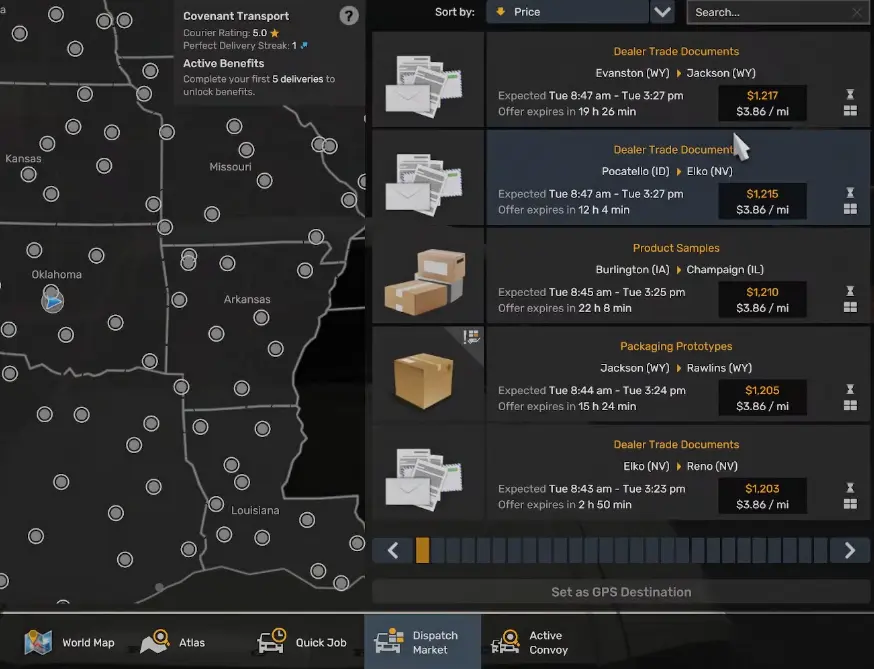
Once you own a Road Trip vehicle, the next major courier step is the Dispatch Market.
The unlock screen describes it as professional courier driving using your own vehicle.
The Dispatch Market moves courier work from supplied Quick Job cars to a vehicle you own.
The offers can include cargo such as:
dealer trade documents;
product samples;
packaging prototypes;
export customs declarations;
voter registration papers.
At this point the decision becomes straightforward. Quick Jobs remain useful when you want a supplied vehicle, while Dispatch Market work lets your purchased car become part of the courier progression.
If you have not decided what to buy yet, stay with Quick Jobs. Nothing is gained by forcing the purchase early.
Money Carries Over, Road Trip Progress Does Not Work Like Truck Levels
Your existing ATS economy carries into Road Trip. A long-running truck profile can therefore enter Car Mode with the same large bank balance it already had.
The career progression is different.
Road Trip uses its own courier progression rather than simply giving your existing truck driver level to the car career. That is why a wealthy established profile can still begin Road Trip with no courier history.
This creates an unusual early-game situation:
money may not be your blocker, but Road Trip progression still starts from the beginning.
Do not read a large bank balance as a reason to skip the introductory jobs. Those first deliveries establish the progression system that money cannot purchase directly.
What to Do After Your First Car
Once you have completed the introduction and bought a vehicle, the game opens into two different activities.
Courier work continues through the Dispatch Market, where your own car becomes the working vehicle.
Exploration moves into Atlas, where Tourist Boards lead you through regional POIs, Viewpoints, Photo Trophies, and completion rewards. If you are done with deliveries for a while, the ATS Road Trip Atlas guide covers how to activate a Tourist Board and turn its locations into a usable route.
You do not need to alternate between the two systems after every job. I found it cleaner to decide what I wanted from the session first: build courier progress for a while, or pick one exploration route and finish it.
A Practical Road Trip Opening
For a fresh Road Trip start, the sequence I would use is:
switch to Car Mode;
take a supplied Quick Job;
adjust car-specific steering and force feedback if needed;
finish the delivery without sacrificing cargo or vehicle condition for speed;
continue toward the first five completed deliveries if you want the early benefits;
buy the Ford you actually want to keep driving;
use Dispatch Market for owned-car courier work, or move into Atlas exploration.
The only reason I would change that order is if I already know exactly which car I want and have no interest in testing the others through Quick Jobs.
Road Trip becomes much easier to read once those first decisions are separated. Quick Jobs are for getting started without ownership, Courier Rating rewards clean delivery progression, an owned car opens the Dispatch Market, and Atlas becomes the route when the goal changes from delivery work to exploring the map.